
You've rewritten the title, swapped tags, and searched for your product again. It appears on your phone but seems to disappear on your laptop. Meanwhile, visits haven't changed enough to tell you whether the edits helped.
Learning how to improve keyword ranking on Etsy starts with separating a genuine improvement from a different set of search results. Record a baseline before editing anything, make the listing relevant to a specific buyer phrase, then improve the reasons shoppers click and buy. You can control those inputs. You can't control a universal position that every buyer sees.
The Ranking Signals to Work On First
Etsy ranking works in two stages: your listing must match the buyer's search, then compete against other matching listings through relevance, shopper engagement, and shop-quality signals. Treating both stages as a title-writing exercise leaves most of the work unfinished.
Etsy's search ranking disclosure describes matching through titles, tags, categories, and attributes, considers descriptions in ranking, and identifies clicks, views, favorites, and purchases as engagement inputs. The practical distinction is simple: keywords help Etsy understand your item, while shopper behavior helps Etsy assess how people respond to it.
Etsy ranking signals and how to check each one
Signal | Where it lives | Role in ranking | How to check |
|---|---|---|---|
Exact phrase match | Title, tags, category, attributes | Helps make the listing eligible for the phrase | Search the phrase and look for the listing; also audit its wording |
Description opening | First lines of the description | Adds relevance and explains the item quickly | Confirm the opening names the actual product |
Clicks | Search result thumbnail and title | Shows shoppers choose the listing from results | Compare impressions with clicks where reporting provides both |
Favorites and add-to-carts | Listing page | Indicates interest after the click | Record available counts for the same measurement window |
Purchases | Checkout | Demonstrates that shoppers complete an order | Track orders attributed to search where available |
Customer service | Shop metrics | Affects the shop's standing beyond individual keywords | Review rating, response rate, and case rate |
Don't confuse missing reporting with zero activity. Your dashboard may not connect every favorite, cart, or order to an exact search phrase. Keep listing-level counts separate from query-level figures rather than inventing attribution.
Find the weakest stage
Beautiful photos won't fix a listing Etsy can't connect to the buyer's phrase. Equally, a carefully written title won't cancel out incomplete information, unsuitable pricing, or weak service.
Practical rule: Fix the earliest broken stage before polishing a later one.
If you've never checked the listing against wording a buyer would type, start there. If it already receives relevant search visits, investigate what shoppers encounter after seeing it.
How to Track a Ranking Without Fooling Yourself
A single search position is an observation, not a permanent rank. Your browsing history, market, device, and filters can make separate checks unsuitable for comparison.
Define your measurement method before changing the listing. An Etsy rank checker can help organize observations, but the useful part is knowing exactly what each reported position represents.
Ranking log fields to record for every check
Log field | What to record | Why it matters |
|---|---|---|
Search phrase | The exact words typed, in full | Keeps checks comparable |
Marketplace and language | Etsy US, English, or your chosen market and language | Market context can change results |
Device | Phone or desktop, noted every time | Prevents unlike viewing conditions being compared |
Date and time | Timestamp, using a consistent time of day | Reduces confusion from checks taken under different conditions |
Filters | None, or every filter applied | Filters change the eligible listings |
Observed position | Position among the first 15 organic listings, excluding ads and modules | Defines a consistent observation range |
Impressions, clicks, favorites, carts, orders | Available counts for the same date window, labeled by reporting scope | Shows whether visibility brings useful activity |
Keep averages honest
Google Search Console's performance documentation defines average position using the topmost result across impressions. That's a Google-specific metric, not Etsy's reporting formula, but it illustrates why an average needs a clear definition.
Your spreadsheet average is the average of your comparable observations. Don't describe it as an impression-weighted Etsy average, and don't assign an invented position when the listing falls outside your observation range. Mark it outside tracked range.
Say a listing appears at position 6 on Monday and position 14 on Thursday. That hypothetical difference might reflect a changed filter or device rather than lost visibility. Don't compare those checks as if the conditions matched.
Repeat checks across several days under consistent conditions. Keep one spreadsheet row per check, then report the phrase, date window, average observed position, and any out-of-range observations together.
How to Match the Phrase Buyers Actually Type
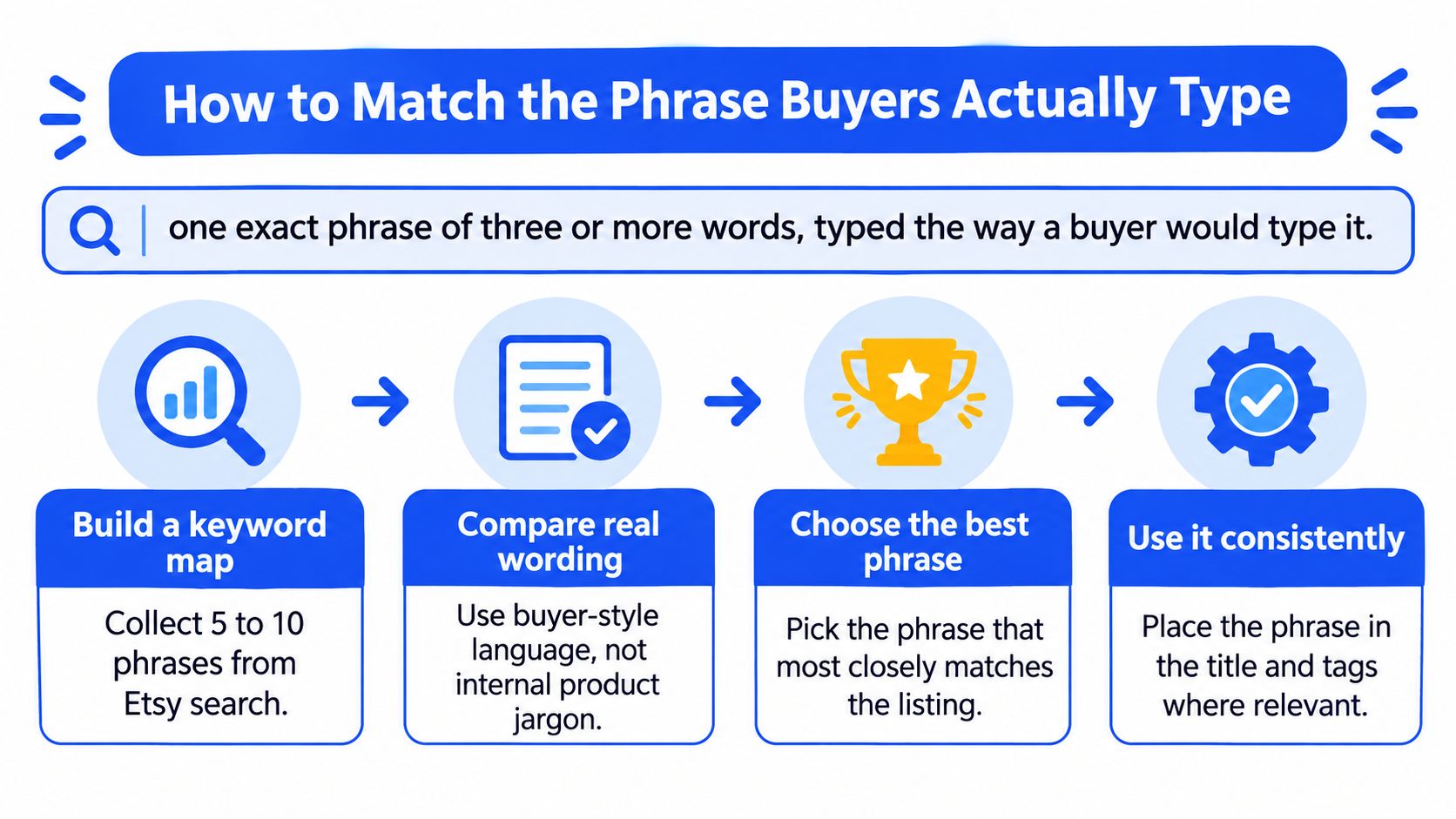
Choose one exact phrase of three or more words, written the way a buyer would type it. This is a useful targeting method, not a claim that Etsy requires that phrase length.
Etsy's explanation of search relevance says it first gathers relevant listings, then ranks them using relevance and other listing and shop signals. Exact matches may help relevance, but copying a phrase everywhere doesn't guarantee placement.
Build the wording around the actual product
Build a keyword map. Collect 5 to 10 candidate phrases from Etsy suggestions, competitor titles, and your own product vocabulary, then choose a primary phrase for the listing. Suggestions and competitors provide wording ideas, not proof of demand; the common slip is choosing a popular-sounding phrase that describes a different item.
Put the phrase near the front of a readable title. A linen table runner should sound like a linen table runner, not a string of unrelated gift occasions. Don't remove useful product details merely to repeat another keyword.
Fill the available tag slots with natural multi-word variants. For a suitable item, linen table runner and farmhouse linen runner describe related buying intentions. Repeating the same isolated word across tags wastes opportunities to describe material, style, and use.
A guide to Etsy long-tail keywords can help distinguish specific product wording from broad category terms. The best phrase is the one your listing can honestly satisfy, not the one that sounds most ambitious.
Complete the supporting fields
Choose the correct category and every applicable attribute. Material, color, occasion, and recipient should agree with the product and photos. Leaving relevant attributes blank removes useful matching information, but selecting inaccurate attributes is worse.
Use the target phrase naturally in the description's opening sentence. Explain what the buyer receives immediately, then add dimensions, options, or practical benefits. The common mistake is opening with shop history while leaving the product unclear.
Allow the updated listing to be processed before judging it. Search under your recorded conditions and enter the observation in the log. Don't assume Etsy has ignored an edit because an immediate manual check looks unchanged.
If the listing still doesn't appear after processing, inspect the title and category first. Confirm that the phrase describes the item precisely before expanding into more tags or rewriting the entire listing.
How to Lift Clicks and Favorites After Indexing
Once Etsy can match the listing, the next question is whether shoppers choose it. More keyword repetition won't make an unclear thumbnail easier to understand or make unexpected shipping costs less frustrating.
Use the available search and listing reports to locate the hesitation. Change one thing at a time, keeping a dated note of exactly what you replaced.

Compare exposure with visits. Where impressions and clicks are available for the same scope, rising exposure without more clicks points toward the search-result presentation. If your reports don't provide query-level impressions, don't calculate a supposedly exact click-through rate from unrelated totals.
Replace an unclear first image with a well-lit, square composition showing the product clearly, preferably in use. Avoid text overlays for this test, and check the crop at thumbnail size. A styled room photo is unhelpful if buyers can't identify what's for sale.
Read the first 40 characters of the title aloud. Use this as a practical readability check, not an Etsy ranking threshold. Put the product type early and remove awkward repetition.
Compare your price with comparable listings among the top 15 observed results. Match material, size, personalization, and quantity before judging the price band. A higher price needs visible justification; lowering it blindly can damage your margin without resolving buyer doubts.
Clarify processing time and shipping cost. Buyers should understand when you'll dispatch the item and what delivery adds to the total. Don't hide inconvenient information in a long description.
Rewrite the opening two lines to explain what the item is, who it suits, and what distinguishes it. Specific information beats claims such as perfect quality or ideal gift.
Give each test time
Use a two-to-four-week monitoring window as a working test plan, recording favorites, carts, and purchases at whatever reporting scope is available. Low activity may require more observation before you can draw a conclusion.
Don't replace the photo, cut the price, and rewrite the title together if you want to know which change helped.
Keep broader Etsy SEO improvements on a separate checklist rather than applying every idea during the same test.
Service Signals That Quietly Affect Your Position
Keywords aren't the only reason a well-presented listing can lose ground. Service performance belongs in your ranking review, even when the product page itself looks finished.
Etsy's customer-service guidance identifies average review rating, message response rate, and case rate over the previous three months, sets a 48-hour standard for responding to initial messages, and counts qualifying refund cases paid from the Payment account only when they're under $250.
Build a routine you can maintain
Check monthly. Review all service measures together instead of watching only your star rating.
Cover launch-week messages. Check messages at least twice daily as a practical routine when promoting a new item.
Prepare useful replies. Keep concise answers for sizing, customization, processing, and shipping questions.
Acknowledge unresolved questions. Tell the buyer you're checking rather than leaving the conversation unanswered.
Handle order problems early. Explain the next action clearly and resolve issues before they escalate into cases.
Consider a shop with excellent photos that takes three days to answer an initial question. Its response performance is weaker than a shop answering the same day, even if its listing looks better. That doesn't prove the precise cause of a ranking difference, but it identifies a controllable weakness.
Service decision: If a service measure is weak, address it before rewriting the title again.
Because the reporting window includes recent history, a better routine won't erase an earlier bad stretch immediately.
Why Your Listing Is Stuck and What to Change
Your listing appears on page two or three for the phrase you want, yet ranks well for a shorter phrase. That doesn't automatically mean you need more keywords. The longer phrase may describe a different buying intention, or your checks may not be comparable.
Etsy's guide to how search works explains Context Specific Ranking, which personalizes results using shoppers' browsing and purchasing habits. Etsy also considers relevance, engagement, service quality, recency, shop location, shipping price for US sellers, and applied filters.
Ranking symptoms, likely causes and the first check
Symptom | Likely cause | First check |
|---|---|---|
Shows on page two or three for the phrase | Weak phrase match or thin tags | Is the exact phrase represented naturally in the title and tags? |
Visible on one device or in one city only | Personalization or location | Did the check use the same phrase, filters, and device? |
Position jumps from day to day | Single observations and normal variation | How many comparable checks are averaged? |
Impressions rising, clicks flat | Weak first image or title | Does the thumbnail read clearly at small size? |
Clicks but no favorites or carts | Price, shipping, or description mismatch | Is the price comparable with genuinely similar top-ranking items? |
Position fell after slow replies | Possible customer-service weakness | What do the service measures show for the recent reporting window? |
Diagnose before changing
Treat these causes as testable explanations, not verdicts. A drop following slow replies doesn't establish that replies caused the drop. Likewise, clicks without orders might indicate unsuitable traffic rather than an overpriced product.
Start by checking the measurement log. Confirm the phrase, market, filters, device, and reporting window before deciding an edit failed. Then choose the smallest change that addresses the observed problem.
Appearing in results establishes visibility, not lasting preference. What shoppers do afterward, including whether visits lead to favorites, carts, or purchases, helps distinguish a merely relevant listing from one shoppers want.
A ranking gain is more convincing when repeated comparable observations improve and useful shopper activity follows. If the position improves without commercially useful visits, reconsider the target phrase rather than celebrating the rank alone.
Pick One Listing and Start This Week
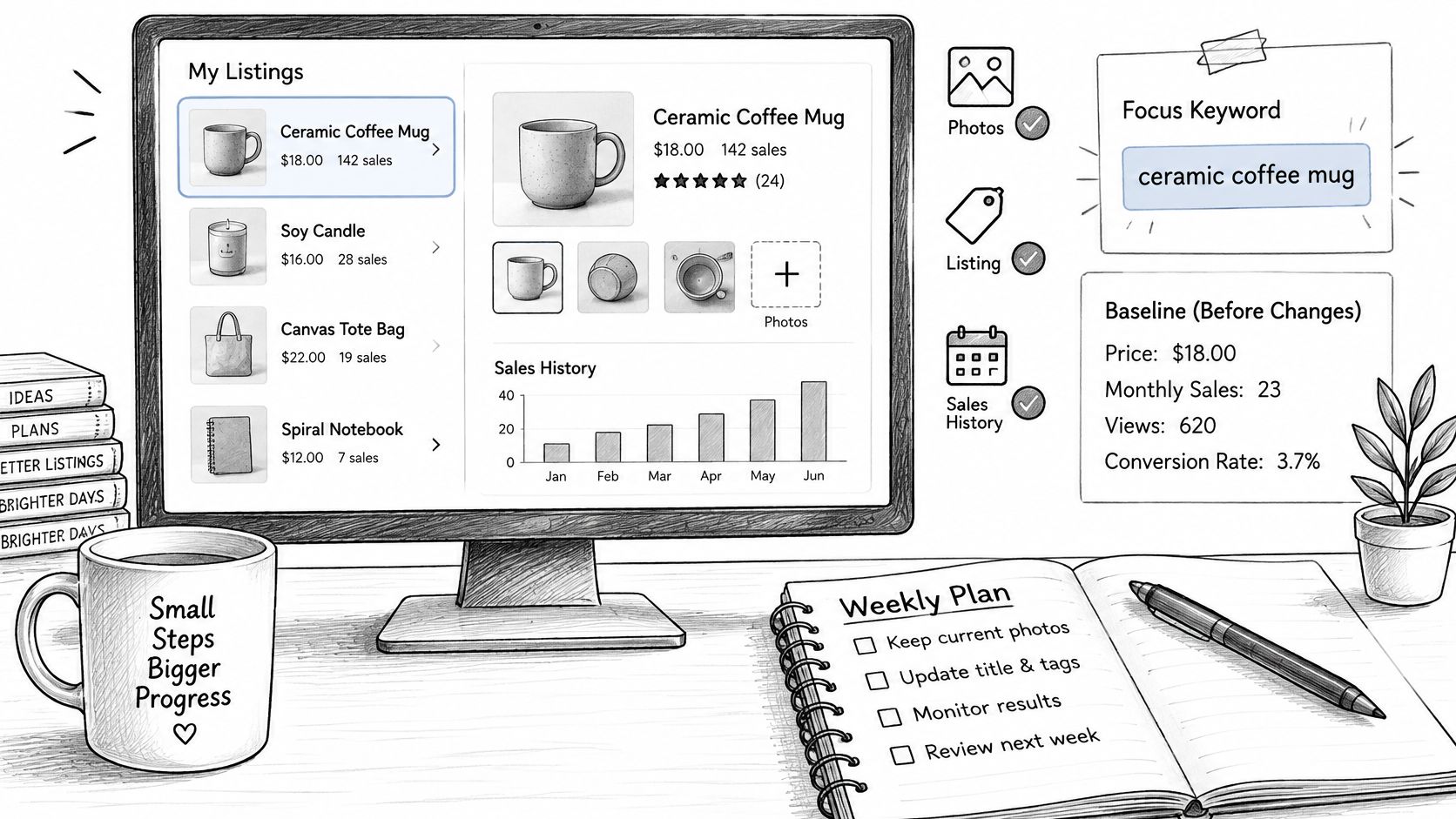
Choose a listing with usable photos and some sales history. That gives you an existing starting point rather than asking you to diagnose a new product, untested presentation, and unknown search demand simultaneously.
Select a phrase of three or more words that describes the item exactly, then record your baseline before making changes. Save the current title, tags, description opening, photo, price, and shipping details so you can reverse an unsuccessful edit accurately.
Make the next decision small
Fix matching first. Remove any mismatch between the buyer phrase and the actual item.
Test the presentation next. Choose the photo, price, or shipping issue most clearly supported by the observations.
Maintain service throughout. Don't postpone buyer replies while working on search visibility.
Keep, adjust, or revert. After your observation window, compare like-for-like averages and shopper activity rather than your best isolated position.
You can do this work yourself. The important commitment is to a repeatable test, not to constant editing.
If you prefer outside help, our Upglider campaigns focus on one chosen listing and the approved search phrase, targeting only the USA or UK market. We aim to reach Etsy's first 15 organic results within 9 to 21 days of confirmed payment, with money back if the agreed top-15 objective isn't reached, and maintain the ranking during the paid period. We're independent of Etsy and don't need access to your Etsy account.
Start this week by choosing the listing, writing down its target phrase, and creating the baseline log. If you'd rather use our campaign, submit that listing and phrase for assessment, and review the disclosed measurement method before payment.