You search your main keyword, scroll through the results, and still can't find your listing. Then you try again from another browser, check a second phrase, and wonder whether Etsy has hidden your product completely. A few minutes later, you may have several different answers and no clear idea which one reflects a real shopper's experience.
An Etsy rank checker can make that uncertainty easier to manage. It can show where a listing appears for a chosen search phrase and help you compare positions over time. But the number on the screen isn't the whole story. Etsy search changes by query, market, listing quality, buyer behavior, and timing, so the useful question isn't only “What position am I in?” It's “What does this position mean for the buyer I want to reach, and what happens after they see my listing?”
What an Etsy Rank Checker Actually Does
A seller named Maya notices that her handmade wall art has stopped receiving visits. She searches Etsy for “minimalist botanical wall art,” but her listing doesn't appear near the top. She refreshes the page, removes a word from the search, and checks again. The listing appears, then disappears deeper in the results.
Maya's first instinct is understandable. She assumes Etsy is giving her a fixed position and that the checker needs to reveal it. In reality, an Etsy rank checker is more like a digital rearview mirror. It gives you a view of where a listing appeared for a particular query at a particular time. It doesn't predict every future result, and it can't see every condition affecting a buyer's search.

What the tool measures
A checker generally asks a focused question: where does this listing appear when Etsy receives this search phrase? Depending on the service, you may enter a listing, a keyword, and sometimes a target market. The tool then returns a position, page placement, or an indication that it couldn't find the listing within the area it checked.
That output is useful because Etsy itself exposes search performance through Search Analytics. Etsy's seller documentation includes query-level data such as the search query, average position, impressions, visits, orders, conversion rate, revenue, and average order value, with date ranges that can cover specific days, months, or full years. Etsy's Search Analytics documentation also distinguishes impressions from position, where position means the average place a listing appears in search results.
A checker doesn't replace those business metrics. It helps you observe the position side of the picture more frequently or for selected phrases. If your listing moves from a low position toward the first page, that's a visibility change. It isn't proof of more sales until buyers click, save, and purchase.
Practical rule: Treat a rank result as a measurement of visibility, not a verdict on the value of your product.
Why one result can't answer everything
Suppose Maya sees her wall art in a strong position for one phrase. That result may reflect the exact wording she entered, the market selected, the time of the check, and the amount of search data the tool could inspect. A different long-tail phrase may produce a different result because Etsy evaluates relevance separately for each query.
The checker can tell Maya where to investigate. It can't tell her, by itself, whether the thumbnail attracts attention, whether the price fits the market, or whether the description answers the buyer's concerns. Those questions require Etsy analytics and a careful look at the listing itself.
Understanding Etsy Search Ranking Mechanics
Etsy search works in two broad stages. First, Etsy decides whether a listing qualifies for a buyer's query. Then it orders the qualifying listings using relevance, engagement, and quality signals. This distinction explains why a checker may find your listing while you still feel invisible.
Stage one qualifies the listing
Etsy looks at the relationship between the buyer's words and the listing's titles, tags, descriptions, categories, and attributes. A listing for a printable wedding invitation might match “editable wedding invitation,” but it may not qualify as strongly for a phrase describing a different format, style, or audience.
Exact-match keywords can improve relevance, according to Etsy's explanation of how search works. That doesn't mean sellers should force awkward phrases into every field. It means the listing should describe the product in the language buyers use, with closely aligned titles, tags, attributes, and categories.
A useful way to think about this stage is a door. Keyword relevance gets the listing through the door. Without that match, later performance signals may not matter because Etsy may not consider the listing a suitable answer to the query.
Stage two orders the qualified listings
After a listing qualifies, Etsy considers signals connected with shopper response and shop quality. These include clicks, favorites, purchases, review rating, response rate, and case rate. Etsy also explains that exact relevance, listing quality, customer and market experience, and shipping factors can affect search placement.
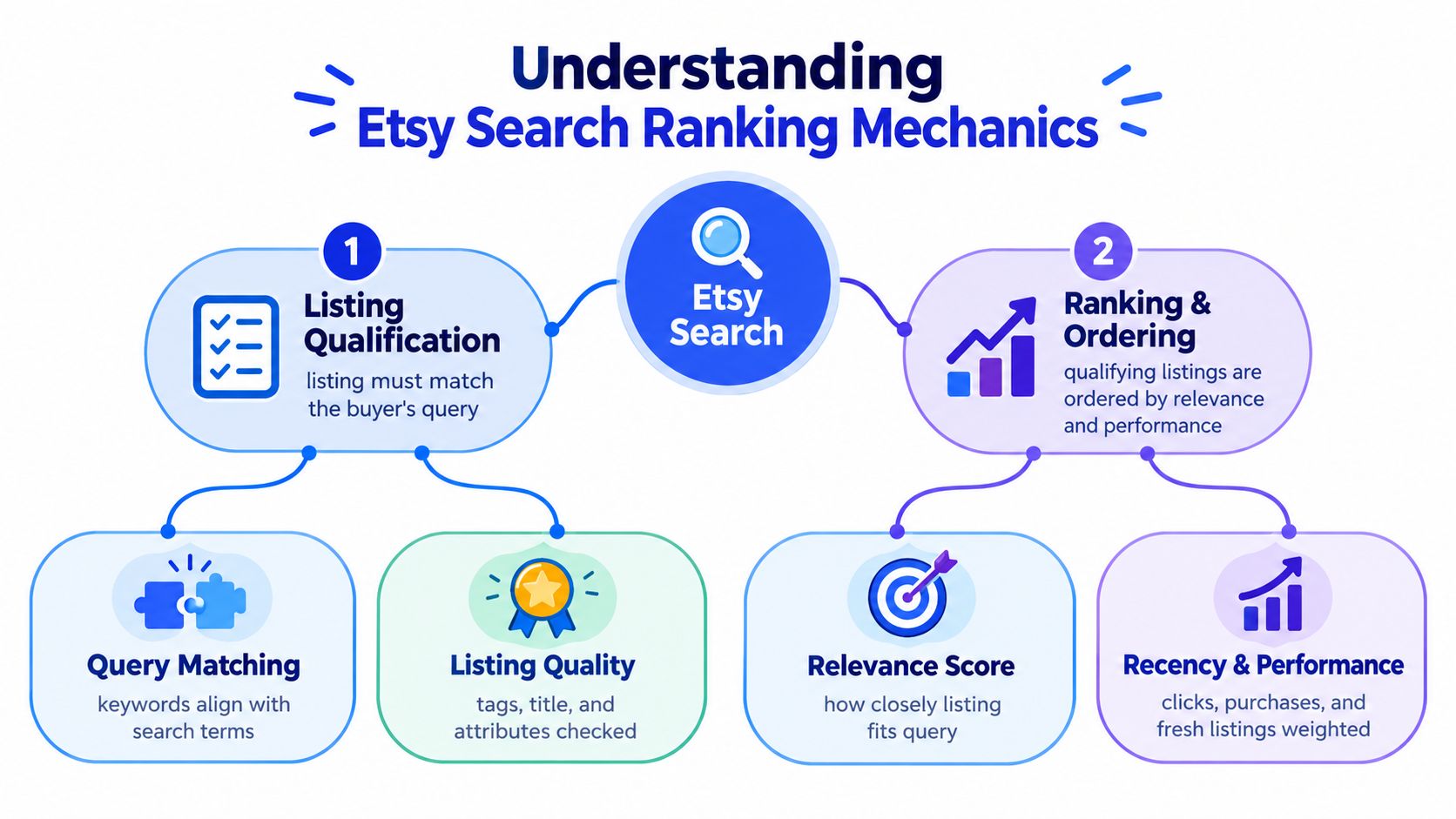
This creates a common diagnostic mistake. A checker may show that your listing is indexed for “custom pet portrait,” but the listing can remain buried because shoppers who see it don't click, save, or buy often enough. The keyword is doing its first job, but the listing isn't producing enough evidence that it satisfies the shopper.
That is why ranking isn't only a keyword-matching exercise. It resembles a two-part exam. The listing first answers, “Is this relevant to the search?” Then shopper behavior helps answer, “Is this a useful result?” Sellers who want a fuller explanation of the wider optimization process can use this guide to Etsy SEO.
What the checker can't diagnose
A position report won't normally explain whether weak performance comes from the main image, price, delivery promise, reviews, or product-market fit. It also won't automatically distinguish a listing that has never qualified from one that qualified but performed poorly after the click.
Use the result as a starting point:
Indexed but low: Review the listing's relevance and then its click and purchase signals.
Missing for a phrase: Check titles, tags, categories, and attributes before assuming a penalty.
Visible but not converting: Examine the product page, offer, images, shipping, and customer confidence.
Strong for one phrase only: Compare the phrase with the actual buyer language bringing visits.
Interpreting Your Rank Checker Results
A single position check is a snapshot. Sellers often turn that snapshot into a permanent conclusion, especially when a newly created or renewed listing appears unusually high. That can create a false sense of progress.
Etsy gives newly created and renewed listings a temporary visibility boost. Etsy's Seller Handbook describes that the boost can last from a few hours to a few days, depending on query demand. Etsy uses this period to learn how shoppers respond to the listing, so an early spike may fade if clicks and purchases don't support the listing's quality.
Read the result in context
Start by recording four details with every check:
The exact search phrase. “Gold necklace” and “personalized gold necklace” are different tests.
The listing checked. Shops with similar products can make it easy to inspect the wrong item.
The market or country. A result for one buyer location may not represent another.
The date and listing status. Note whether the listing was just created or renewed.
Then compare the early result with a later result after the temporary boost has passed. You don't need to panic when a new listing drops. The important question is whether it settles into a position that gradually improves as shoppers respond.
The first rank you see may be a test score, not your stable organic position.
Separate movement from meaning
A move upward can mean that Etsy is finding the listing more relevant or that shopper behavior has improved. A move downward can reflect stronger competing listings, a shift in demand, or the end of a recency test. The number alone doesn't identify the cause.
Connect the rank record to your Etsy analytics. If position improves while impressions and visits remain flat, the phrase may have limited demand or the listing may still be difficult to notice. If impressions rise but visits don't, inspect the main image, title opening, and offer. If visits rise but orders don't, study the product page and the buying experience.
This method prevents a common error: changing tags every time the position moves. Frequent edits make it harder to know which change affected the result. Choose a small group of relevant phrases, record the dates, and give each adjustment enough time to produce interpretable data.
Watch patterns instead of isolated highs
A useful rank log might show:
Stable visibility: The listing stays in a similar range across checks.
Temporary lift: The listing starts high and then settles lower after launch or renewal.
Gradual improvement: Position strengthens while visits, saves, or orders also become healthier.
Unstable visibility: Results move sharply across markets or phrases, suggesting that one position can't represent the whole opportunity.
The best result isn't always the highest number. It's a repeatable position connected to useful traffic and sales.
Manual Checking Versus Using a Tool
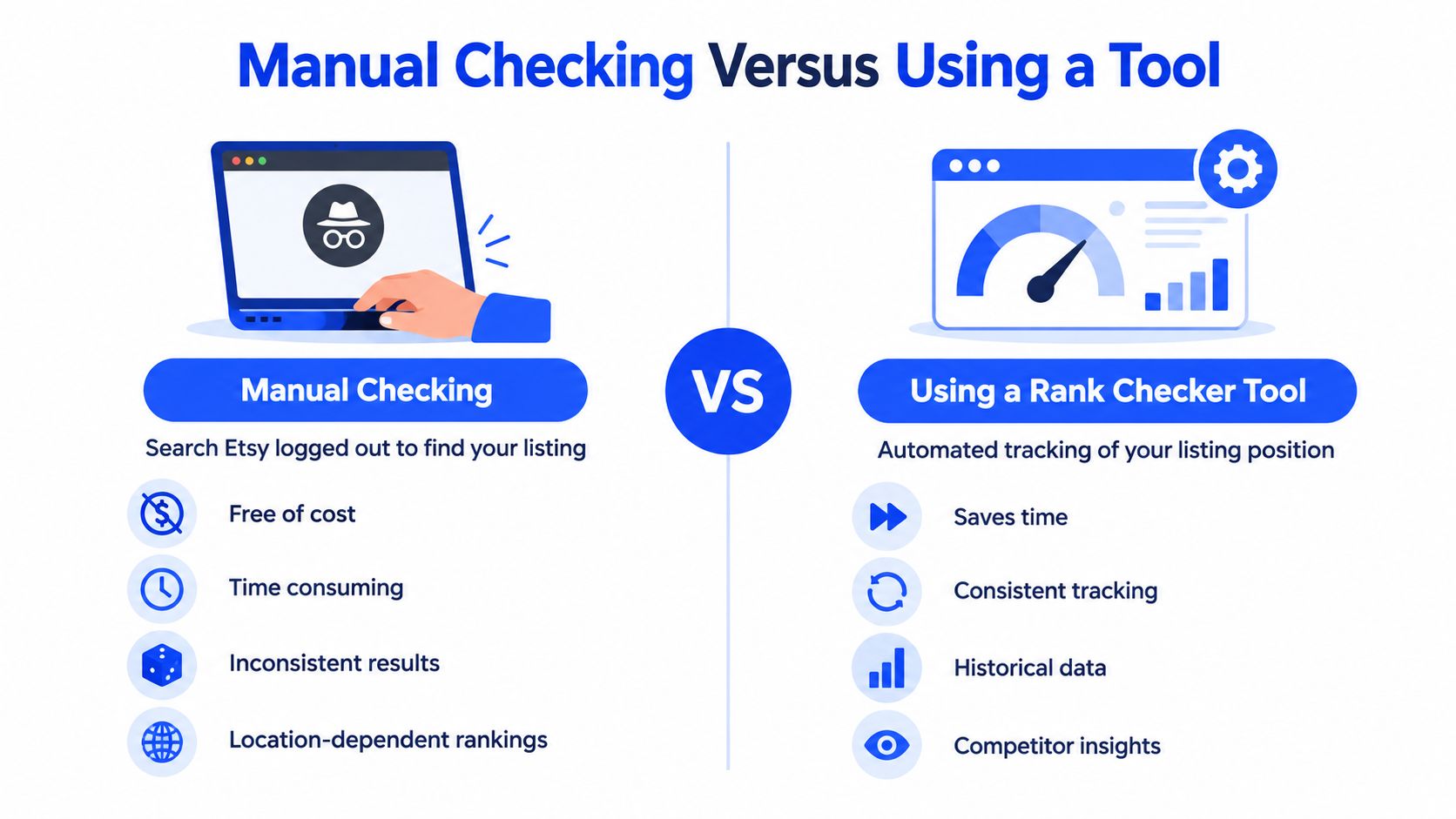
Manual checking costs nothing, and it can answer a simple question quickly: “Can I find this listing in Etsy search?” You search while logged out or in a private browsing window, enter the phrase, and inspect the results. That approach is useful for a quick visual review, especially when you want to see how competing thumbnails, prices, and titles look beside your listing.
Its weakness is consistency. A manual search can change when you alter the phrase, market, device, or browsing context. Etsy also says that search is influenced by factors including buyer location and shipping availability. Etsy's search optimization guidance makes clear that location and delivery conditions belong in the visibility conversation.
What manual checking does well
Manual inspection gives you context that a plain number may omit. You can see whether the first results use similar photography, whether competing listings offer free shipping, and whether your title communicates the product clearly at a glance.
It also helps you notice a practical issue: a listing may rank acceptably but look weak beside its competitors. A checker can't always show that difference. Human inspection remains valuable when the decision involves presentation, trust, or buyer expectations.
Where a tool earns its place
A rank checker creates a repeatable process. You can check the same listing and phrase using the same setup, save results, and compare movement instead of relying on memory. Some tools also support keyword monitoring or competitor observation, although their depth and method vary.
A tool is especially useful when you have several listings or when you want to compare changes over time. It turns “I think my listing moved” into a recorded observation. You can pair that record with Etsy's own search analytics and use an Etsy keyword tool when you need help choosing phrases to test.
Location changes the question
Imagine a seller in the United States checks a listing for a phrase and sees it near the top. A shopper in Germany may see a different position because Etsy considers market context and shipping availability. The listing may perform well in one country and struggle in another, particularly when delivery costs or eligibility differ.
That means “What is my Etsy rank?” is incomplete. Ask instead:
Which buyer country matters for this product?
Can the listing ship there under an attractive offer?
Does the checker let me select or compare markets?
Am I measuring one market or treating it as universal?
The result remains a proxy for a shopper's view, not a promise that every buyer sees the same order. A good tool should make its checking conditions clear. If it doesn't, treat the position as directional.
A useful checker doesn't remove uncertainty. It shows you where the uncertainty comes from.
Manual checking and automated tracking serve different purposes. Use manual inspection for visual context and market comparison. Use a tool for repeatability and history. Use Etsy analytics to decide whether the visibility produced meaningful visits, orders, revenue, and average order value.
Why Rank Alone Is Not a Win
A listing can reach page one and still fail to produce a healthy business result. A shopper may see the thumbnail, decide that the product isn't for them, and continue scrolling. The position was real, but the opportunity was lost after the impression.
Etsy's ranking system includes post-click and shop-quality signals, not just keyword matching. Etsy's Seller Handbook discusses factors such as click-through behavior, conversion, reviews, and listing quality. These signals help explain why a listing with excellent keyword coverage may stall while a less obvious competitor continues to gain visibility.
Think in a chain, not a single number
Search success follows a sequence:
Query match → impression → click → listing engagement → purchase → customer experience
A rank checker mainly observes the first part of that chain. Etsy analytics can help you inspect what happens afterward. If the chain breaks at a different point, changing the keyword may not solve the underlying problem.
For example, a ceramic mug may appear for “personalized teacher mug.” If impressions are healthy but visits are weak, the main photo might not communicate personalization. If visits are healthy but orders are weak, shoppers may need clearer information about size, delivery, customization, or returns. If orders arrive but reviews and repeat behavior suffer, the seller needs to improve fulfillment and customer care.

Use rank changes as diagnostic clues
A position change becomes useful when you connect it with a business signal:
Position rises, visits rise: The phrase may be reaching more relevant shoppers.
Position rises, visits stay weak: Improve the listing's visual hook and search-result message.
Visits rise, orders stay weak: Check price, photos, description, shipping, and buyer confidence.
Orders rise, position stays uneven: Keep measuring the phrase, but don't discard the listing because its rank isn't perfectly stable.
Position falls after an early lift: Consider whether a temporary new-listing or renewal boost ended.
This is why practical Etsy SEO tips should include conversion readiness, not just tags and titles. A keyword can bring attention, but the product page has to earn the click and support the purchase.
Improve what the number can't see
Rank tracking is valuable for choosing where to investigate. It doesn't replace strong listing fundamentals. Etsy identifies relevance across titles, tags, descriptions, categories, and attributes, while customer-service quality, reviews, shipping, and listing presentation can influence the shopper's decision.
A seller who moves from position 30 to position 10 but leaves a confusing first image may gain visibility without gaining enough sales. A seller who improves the image, clarifies the offer, and then monitors rank and visits has a better chance of turning visibility into demand.
Page one is an entrance, not a destination. The business outcome begins when a real buyer notices the listing and finds enough reasons to continue.
When to Use Upglider Instead
Some sellers want to diagnose and improve their own listings. Others have already optimized a strong product and need focused external help for a particular search phrase. The right choice depends on the problem.
Use an Etsy rank checker when you need to understand movement. It can help you compare phrases, observe a launch, identify market differences, and test whether a listing is gaining visibility. It makes sense to keep checking when you have time to improve images, copy, shipping, and customer experience alongside the search data.
An external ranking campaign addresses a narrower situation. You choose one listing and one agreed search phrase, then use a service that works outside your Etsy account rather than asking for your password. That may suit an established seller with a flagship product, a seasonal launch, or a listing that already converts but lacks exposure.
Choose based on the bottleneck
Ask yourself three questions:
Is the listing relevant to the phrase? If not, improve the title, tags, attributes, category, and description first.
Does the product page convert attention into action? If not, work on the images, offer, delivery details, reviews, and buying information.
Is the listing ready, but visibility remains the main obstacle? A focused external campaign may be worth evaluating.
Upglider is an independent Etsy SEO service that targets one listing for one approved search phrase of three or more words. Its publisher describes a top-15 ranking objective within 9 to 21 days, campaign periods of 30, 90, or 180 days, a pre-payment listing and keyword assessment, and work performed without Etsy account access. Upglider's service information also states that it isn't affiliated with or endorsed by Etsy.
That scope matters. This isn't a full-shop audit, listing rewrite, advertising program, or general marketing plan. It's a focused option for sellers who want external promotion tied to a specific listing and phrase. The service describes a money-back guarantee if the agreed listing doesn't reach the top 15 within 21 days, but sellers should review the final terms and measurement method before paying.
Campaign options
The publisher presents the campaign structure like this:
Duration | Best for | Cost model |
|---|---|---|
30 days | A short seasonal window or a focused visibility test | One-time campaign payment, with final terms shown before payment |
90 days | A listing that needs sustained visibility while performance is monitored | One-time campaign payment, no automatic renewal |
180 days | A longer selling period for an established or seasonal product | One-time campaign payment, no automatic renewal |
The campaign length shouldn't replace measurement. Continue watching the chosen phrase, market, impressions, visits, orders, and revenue. If the position improves but buyers don't respond, return to the listing itself rather than treating the ranking objective as the final business goal.
Whether you use manual checks, an Etsy rank checker, Etsy Search Analytics, or an external campaign, keep the same discipline: define the buyer market, record the exact phrase, compare results over time, and connect visibility to sales behavior. A rank number is useful only when it helps you make a better decision.
If you're unsure why a listing is fluctuating, start with one product and one buyer phrase. Record its position, market, impressions, visits, orders, and conversion behavior, then improve the weakest part of the journey before changing everything at once. That process will show whether you need better keyword alignment, a stronger product page, more reliable tracking, or focused external ranking support.