Most Etsy keyword advice starts with the wrong question. It asks, “What gets searched the most?” That's how sellers end up fighting impossible head terms like tote bag or silver ring while ignoring the phrases that fit their product and convert into sales.
The better question is simpler, and much harder to fake: Which exact query does this listing deserve to show up for? Etsy's search system matches listings through titles, tags, categories, and attributes, and it also weighs what happens after the click, including whether views lead to purchases and how the shop performs on customer signals like average review rating and message response rate (Etsy search documentation). That means keyword research for Etsy is really a relevance and market-fit exercise, not a vocabulary test.
Why Search Volume Is the Wrong Metric for Etsy
High search volume looks attractive until you test it against Etsy's ranking reality. A phrase can attract attention and still miss the product, which leads to weak clicks, poor conversion, and less useful ranking signals over time. Broad terms are usually harder to justify because they create more noise than sales.
Relevance beats reach on Etsy
Etsy's search documentation shows that search first matches a listing to the buyer's query, then ranks relevant results using signals tied to purchase behavior and shop quality. In practice, that means a keyword only works if the product can satisfy the intent behind it.
A generic “cute mug” tag can pull in shoppers looking for a joke gift, while your listing is a handmade ceramic anniversary mug. Those mismatched impressions lower click-through and conversion, which tells Etsy the listing is not a strong fit.
Practical rule: choose the keyword that matches the product first, then judge whether it is worth competing for. Etsy rewards fit before popularity.
That is why stuffing a listing with broad discovery terms usually fails. I would rather rank for one precise phrase that brings ready-to-buy traffic than chase ten loose terms that create visits without orders.
For a closer look at how Etsy search behaves, the Etsy search algorithm guide explains the ranking mechanics in more detail.
Building Your Initial Long-Tail Phrase List
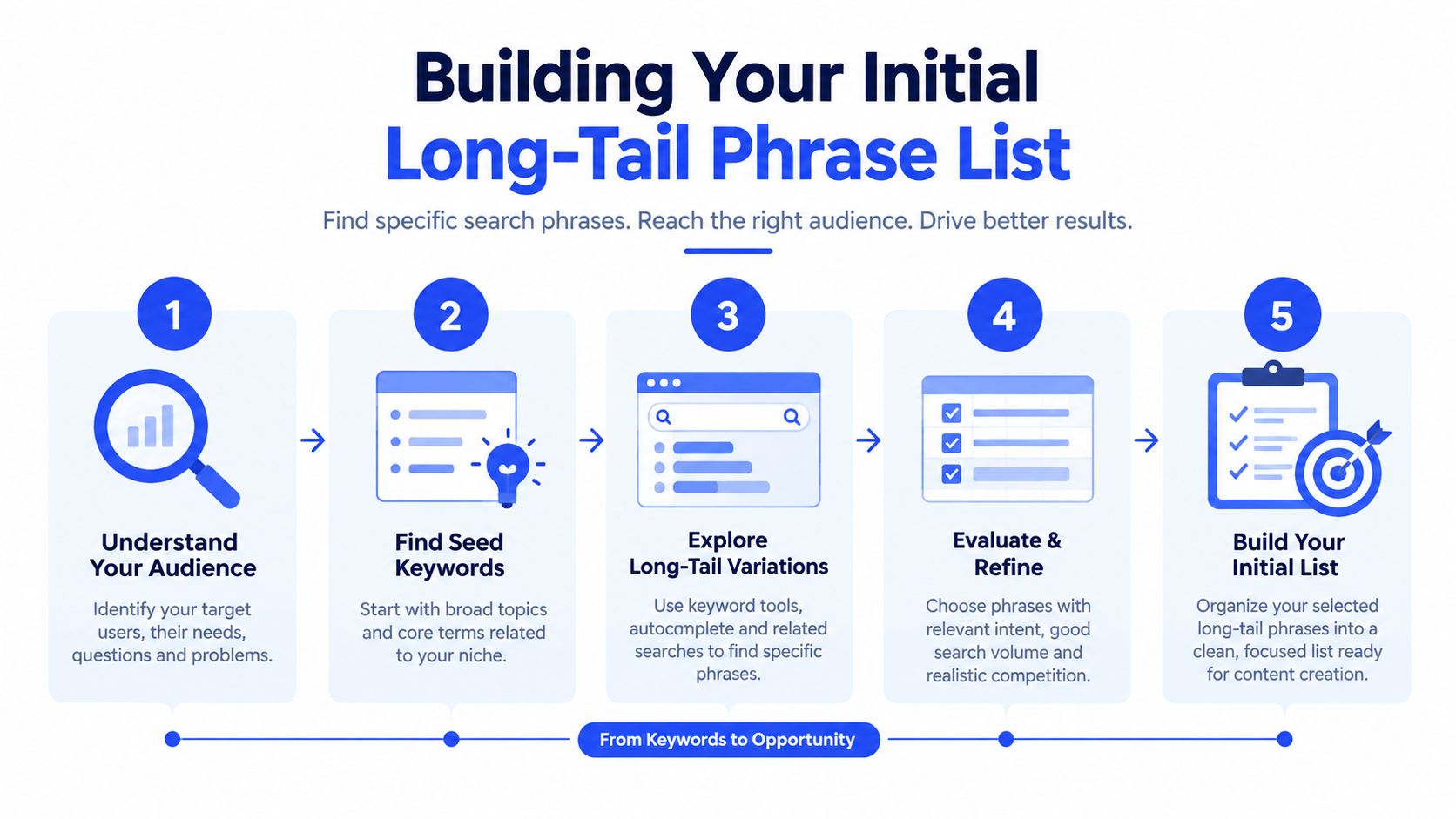
The first job is not research software, it's observing the product like a buyer would. Start with the core noun, then add the details that make the item distinct enough to be searched for by someone who already has clear intent.
Build phrases from the product itself
Etsy recommends starting with the product's core noun and adding differentiators such as material, recipient, style, use case, occasion, and size before turning those combinations into specific multi-word phrases (Etsy keyword research guidance). That gives you a list grounded in what the item really is, not what you hope people might search.
Use the item itself, customer questions, and common buying scenarios. For a mug, that could mean the drinkware type, who it's for, the theme, or the occasion. For jewelry, the same logic applies through material, stone, style, and gift intent. For printables, the differentiator might be format, event, or audience.
Keep the list buyer-shaped
A useful list usually contains a mix of broad category terms and sharper long-tail phrases, but they shouldn't be treated the same way. Broad terms tell you the category. Long-tail phrases tell you whether the listing is specific enough to deserve attention from a buyer who already knows what they want.
A good candidate phrase should describe the item so well that the wrong shopper would ignore it.
That's the standard I use. If a phrase feels too generic to predict who would buy it, it belongs lower on the list. If it points to a clear use case, material, recipient, or occasion, it's probably worth testing.
For sellers who want a structured way to capture those candidates, the long-tail keyword workflow in Upglider's long-tail keyword guide fits neatly with this approach.
Evaluating Query Eligibility and Ranking Feasibility
A phrase can be eligible and still be a bad bet. That distinction matters. Query eligibility asks whether the listing truly matches the search. Ranking feasibility asks whether the listing has a realistic chance of competing once Etsy shows it to shoppers.
A simple scoring matrix
Etsy reported 86.5 million active buyers and 5.6 million active sellers as of December 31, 2025, which shows how crowded the marketplace is and why broad phrases are so hard to win (Etsy investor filing). In a market that large, the goal isn't to find a phrase with the biggest audience. It's to find the phrase with the best combination of fit and attainable competition.
Evaluation Criteria | What to Look For | Pass/Fail Indicator |
|---|---|---|
Product fit | The phrase clearly describes the item | Pass if the listing feels exact, not approximate |
Shopper intent | The wording matches a buyer who is ready to buy | Pass if the intent is specific and commercial |
Result set quality | Competing listings look similar to yours | Pass if your item belongs in that group |
Differentiation | Your listing has a clear angle or feature | Pass if you can explain why yours belongs |
Conversion likelihood | Photos, price, and offer support the query | Pass if the listing can plausibly sell once clicked |
Judge the phrase against the shelf, not the spreadsheet
Your question is whether your item can hold its own among the listings already visible for that phrase. If the competing results all show stronger product alignment, better presentation, or clearer buyer intent, the phrase may be eligible but not feasible.
I also keep regional wording in mind. English-language research can still vary by geography, spelling, and shopping context, so a phrase that looks right in one market may be slightly off in another. That matters when the same product can be described more than one way without changing the actual item.
The cleanest outcome is usually one primary phrase for one listing. Not five half-committed targets, not a title full of near-duplicates, just one query the listing can legitimately own.
Mapping Keywords Across Titles and Tags
Once the phrase is chosen, placement matters. Etsy doesn't look at keywords in isolation. It uses multiple fields to match a listing, which means the same phrase should not be repeated carelessly across the title and tags.
Use the title for the primary phrase
Put the most important descriptive phrase near the start of the title so both shoppers and search can recognize the item quickly. Keep it readable. A title should feel like a real product name, not a stitched-together list of search terms.
Etsy gives each listing 13 tag fields and recommends using all of them with multi-word phrases written in natural language, rather than isolated words (Etsy tag guidance). That's a big clue. The platform wants descriptive phrases that reflect how people search.
Spread related phrases without wasting space
Tags should extend coverage, not repeat the same wording in slightly different form. If the title already says what the item is, use tags to capture adjacent buyer language, alternative uses, or closely related descriptors. Don't burn a tag slot on a duplicate phrase.
A few practical rules keep the mapping clean:
Use all 13 tags: Every tag is another route to discovery.
Write natural phrases: “dining room table” works better than chopping it into single words.
Skip plural duplicates: Etsy handles root words, so separate plural tags usually waste space.
Don't mirror categories blindly: If category or attribute fields already cover a term, use tags for a different angle.
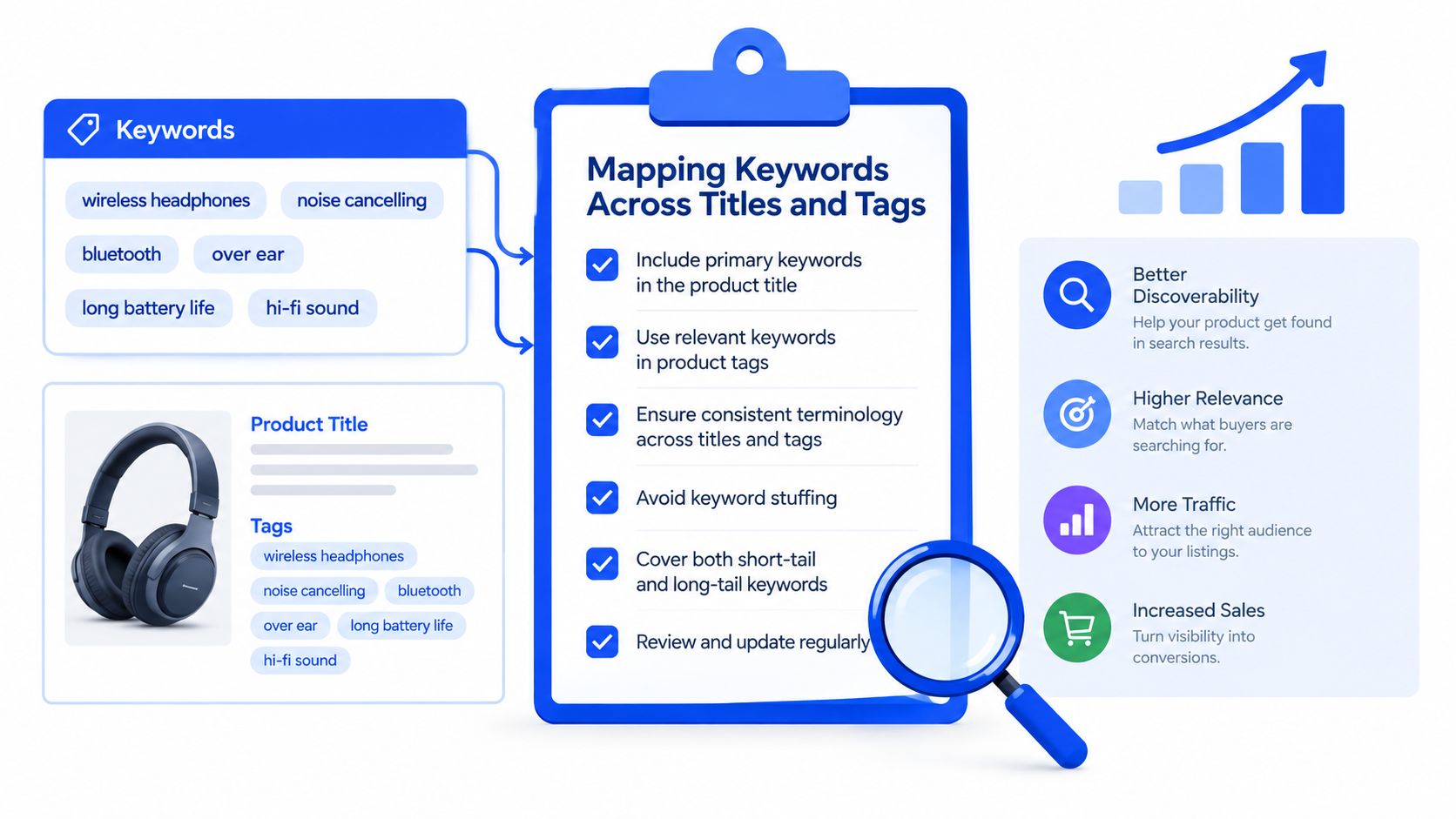
The best listings feel coordinated, not crowded. The title tells the story. The tags widen the reach. The category and attributes support the match.
Tracking Performance and Adapting to Seasonal Shifts
Keyword research doesn't end when the listing goes live. It becomes useful only when you watch how the phrase behaves after real shoppers see it. That means following the search funnel in order, not guessing at the problem from the final result alone.
Read the funnel in the right order
Etsy's guidance is blunt about what each stage means: no impressions suggests weak query matching, impressions without visits suggests weak title relevance, and visits without orders suggests a conversion problem rather than a keyword problem (Etsy performance guidance). That sequence saves a lot of bad edits.
Start by building a candidate sheet with the phrase, shopper intent, product fit, where it sits in the listing, and what the listing does after the click. Then watch which layer breaks first. If the phrase isn't getting impressions, the issue is usually relevance. If people see it but don't click, the presentation is weak. If they click but don't buy, the keyword may be fine and the offer may need work.
Keep seasonal phrases in a calendar
Seasonality changes what buyers type, and Etsy's own marketplace insights compare recent searches and sales against the same period in the prior year. That makes keyword timing part of the job, not an afterthought (Etsy Marketplace Insights guidance). A seasonal phrase shouldn't automatically replace an evergreen one. Sometimes the better move is to keep the base phrase and add a timed variation only when demand starts to rise.
For a focused review cycle, I like this rhythm:
Track one group at a time. Don't change every tag at once.
Document the exact phrase and context. Search results can vary by market and personalization.
Watch the trend window. If a phrase weakens before the seasonal window closes, switch sooner, not later.
Keep the winner. If a phrase earns clicks and orders, let it stay.
If you want a cleaner way to monitor positions over time, the rank-tracking walkthrough at Upglider's rank tracking guide pairs well with this process.
Accelerating Visibility with Targeted Ranking Campaigns
Even strong keyword research doesn't guarantee early visibility. A new listing can be relevant and still sit too low to get seen. That's where a focused ranking push can make sense, but only after the keyword work is tight.
Keep the campaign narrow
For a targeted campaign, the safest move is to choose one phrase of at least three words only after confirming the listing genuinely satisfies it (Etsy search guidance on focused campaigns). That protects the listing from being pushed toward traffic it can't convert. Broad exposure looks impressive until it lands on the wrong shoppers.
The same logic is why I prefer a single-listing focus over diffuse promotion. One listing, one phrase, one clear outcome. If the product is seasonal or newly launched, that narrow objective is often more useful than general shop visibility because it concentrates the signal on the exact query that matters.
Use external support without blurring control
Some sellers want help without handing over account access. That's reasonable. External ranking support can work without passwords when the campaign uses a public listing URL and a specific phrase, and when the objective is measured against a single query rather than a vague shopwide goal.
That's also where Upglider fits as one option among others, it runs external ranking campaigns for individual Etsy listings and focuses on a single agreed search phrase rather than broader marketing. For sellers who already have the listing optimized, that kind of narrow support can complement the keyword research process without replacing it.
The important part is alignment. If the listing isn't a real fit for the phrase, no campaign should force it. When the match is genuine, targeted support can help a strong listing get the visibility it already deserves.
If you're ready to turn keyword research into actual Etsy sales, audit one listing today, choose one precise long-tail phrase, and map it across the title, tags, category, and attributes before changing anything else. Then track the listing for a full cycle, keep the phrase that earns real clicks and orders, and if you want a focused push for a single listing, use a ranking campaign only after the query fit is solid.