The Etsy search algorithm works in two stages: it first checks whether your listing matches the buyer's words, then orders matching listings according to relevance, performance, and trust. Keywords help your product enter the search results, but buyer reactions and shop quality help determine where it appears.
You may have filled every tag, written a detailed title, and chosen what seems like the right category. Yet your listing still sits far below competing products. That experience is frustrating because it makes Etsy search feel like a keyword contest you can't win.
The clearer explanation is that Etsy isn't only asking, “Does this listing contain the right words?” It's also asking, “Do buyers find this listing useful, trustworthy, and worth choosing?” Think of the system as a helpful shop assistant. First, the assistant gathers products that fit the shopper's request. Then, from that group, the assistant gives more attention to products that appear relevant and create a positive shopping experience.
How Etsy Sorting Actually Works
A seller publishes a mug with a clear title and a full set of tags. The wording appears relevant, yet visits remain limited. The seller may conclude that Etsy ignored the keywords. A closer explanation is that the listing matched the query, while other products earned stronger responses from shoppers who saw them.
Etsy describes search as a two-stage process. First comes query matching. Etsy looks across the title, tags, description, categories, and attributes to determine whether a listing fits the buyer's request. It then orders the matching listings using relevance, listing quality, customer behavior, freshness, shipping conditions, and broader marketplace signals. Etsy's search guidance notes that exact matches in titles and tags can support relevance, while clicks, favorites, and purchases help indicate listing quality.

The shop assistant analogy
A shopper asking for a “personalized ceramic dog bowl” should see products that fit the request, not every item in the store. A helpful assistant would filter out unsuitable products, then present options that are clear, appealing, and dependable. Etsy's sorting process follows that progression.
Match the request. The listing must make its product type and purpose understandable to Etsy and the shopper.
Compare the candidates. Etsy considers how shoppers respond to matching listings, along with how consistently each shop serves customers.
Adjust the order. Freshness, shipping conditions, location, language, and marketplace experience can affect where a listing appears.
Keyword use therefore starts the process rather than finishing it. A crowded title may help a product enter the matching pool, but it does not give shoppers a reason to click, favorite, or purchase. Relevance earns consideration. A complete, trustworthy shopping experience helps the listing compete after that first filter.
Buyer satisfaction can show up through several connected details: an understandable offer, convincing presentation, reliable service, and a product that meets expectations. Search visibility works as both an invitation and an evaluation. Keywords bring the right shopper to the listing, while the listing and service give that shopper a reason to stay.
The First Stage Matching Your Listing
The first stage is Etsy's gate. If a product doesn't match the buyer's search, it generally won't reach the ranking stage for that query. Your job here is to make the listing easy to classify, not to repeat the same phrase until the title becomes awkward.
Think of your listing as a shop window. The category and attributes tell Etsy what kind of store it is. The title and tags place readable signs in the window. The description adds context for a person who has already stopped to look.
Etsy's help documentation on search identifies title and tag relevance, item attribute relevance, listing quality, and customer and market experience as important search inputs. In the matching phase, the first three areas matter most because they help Etsy decide whether the product belongs in the result set.
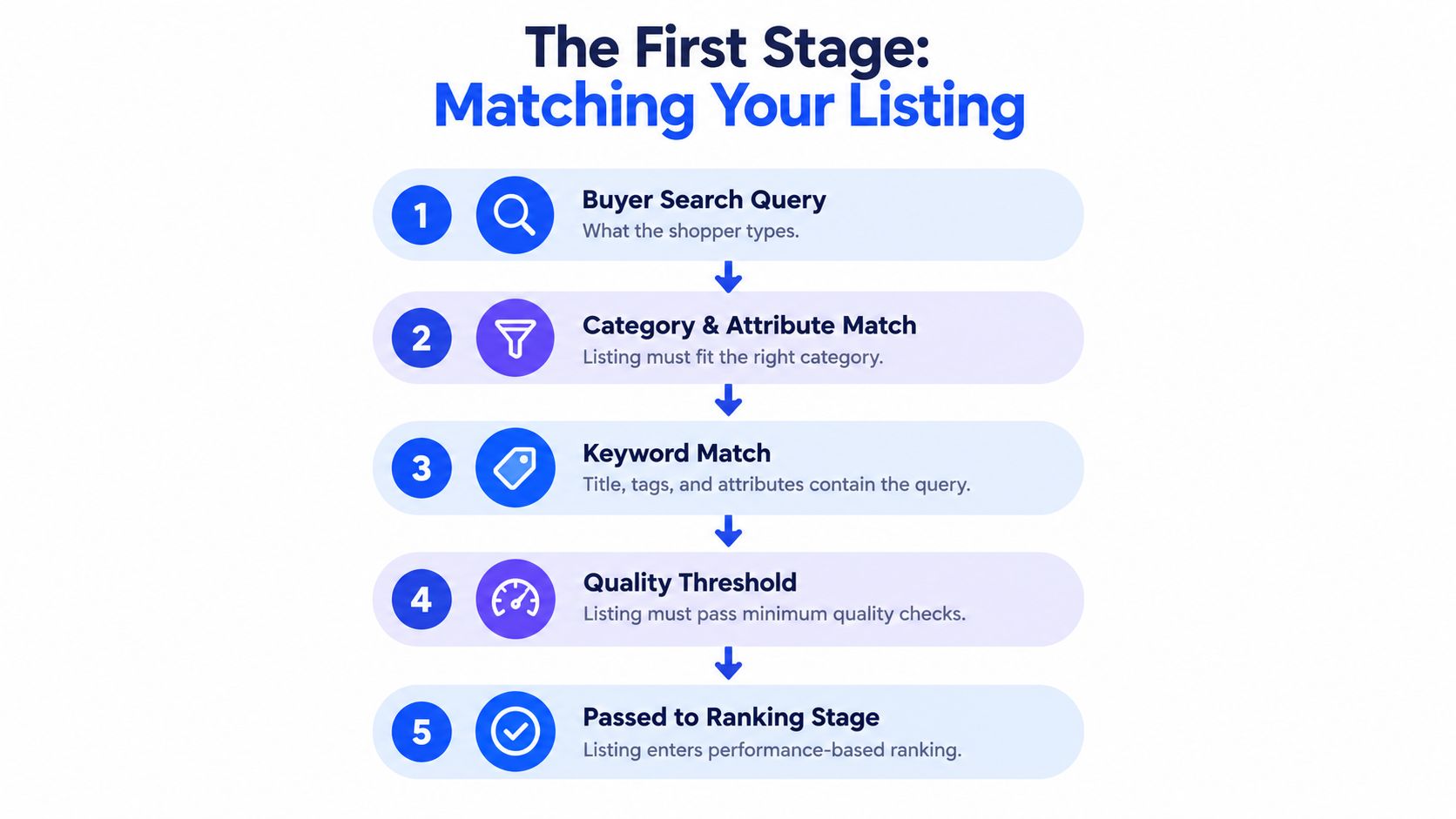
What Etsy uses to understand the listing
Title: Use language that identifies the actual item and its meaningful attributes. “Personalized ceramic dog bowl” tells the shopper and Etsy more than a string of loosely related phrases.
Tags: Add distinct expressions that reflect how buyers describe the product. Tags should expand the ways a relevant shopper might find the listing, not repeat one phrase in slightly different forms.
Categories: Choose the most accurate category available. A product placed in the wrong branch of Etsy's catalog may miss searches that depend on category context.
Attributes: Complete the relevant material, color, size, occasion, style, and other available fields. Attributes can support matching and help the product appear when a shopper uses a filter.
Description: Write for the buyer first. Etsy's verified help guidance emphasizes titles, tags, categories, and attributes for matching, so don't treat the description as a place to force every possible keyword.
Exact matching can be particularly useful. Etsy says that when titles and tags match the search term exactly, the listing may rank higher because Etsy sees it as more relevant. That doesn't mean every title should sound like a search query. It means the primary phrase should describe the product naturally and accurately.
A listing for a “blue linen table runner” shouldn't target “wedding gift,” “boho wall art,” and “kitchen decor” merely because those phrases attract broad attention. Those terms may bring the wrong audience, weaken clarity, and create disappointment after the click. A focused listing gives Etsy a clearer classification signal and gives the shopper a more honest promise.
If you're troubleshooting a product that doesn't appear in search, this guide to Etsy listings not showing in search can provide another diagnostic perspective. Start with the basic question: does the listing clearly match the exact intent behind the query?
Ranking Signals and Listing Quality
Two listings can match “handmade leather journal” equally well, yet Etsy may surface the one that earns clicks with a clear main image and an understandable offer. Keyword matching gets a product into consideration. Buyer behavior and post-click satisfaction help Etsy judge whether that product deserves stronger placement among relevant results.
Etsy identifies clicks, favorites, and purchases as signals that contribute to listing quality. These actions cannot confirm that every shopper was satisfied, but together they provide evidence about whether a listing attracts interest and meets buyer demand. Etsy's seller guidance describes these interactions as customer signals that help shape listing quality.

Why post-click behavior matters
A search result earns attention first, then has to keep its promise. One listing may receive clicks because its photo shows the item clearly and its offer is easy to understand. Another may receive similar exposure but little response because shoppers cannot tell what they will receive. The keyword match can be similar while buyer reactions give Etsy different evidence about each product.
Listing quality therefore reflects several buyer-facing decisions:
The image earns the click. Show the item, scale, finish, and likely use clearly enough for shoppers to understand it at a glance.
The listing confirms the promise. Explain materials, options, dimensions, personalization, and care in plain language.
The offer removes uncertainty. Make processing details, delivery information, variations, and shop policies easy to locate.
The product supports the expectation. A click is more likely to become a favorite or purchase when the item fits the searcher's intent.
Keyword stuffing cannot replace these signals. A long list of loosely related phrases may attract an impression, but it cannot make an unclear photo, confusing offer, or unsuitable product satisfy the shopper.
Etsy gives newly created listings a small temporary boost, while renewed listings receive a smaller boost. The purpose is to provide early exposure and gather engagement data, not to reward endless renewals. Etsy can then use those responses to refine the listing's quality and placement. Etsy's search and recommendation policy explains this temporary freshness effect.
Shipping can affect visibility as well. In major markets, Etsy considers shipping price. For shoppers in the United States, free shipping or lower shipping prices can improve placement, and the policy mentions free shipping, shipping under $6, and Delivered Duty Paid options in relevant situations. Sellers still need to protect a workable margin. Shipping friction clearly belongs in the search and shopping experience discussion.
A strong listing answers the shopper's question before the shopper has to ask it. Clear information supports both conversion and trust.
Improve the whole path instead of chasing one signal. Relevant keywords bring qualified shoppers, strong media and accurate details support the click, and dependable fulfillment gives Etsy better evidence that the listing deserves attention. For practical ways to connect these elements, explore these Etsy SEO tips.
Recent Algorithm Changes Explained
Many sellers still think of Etsy SEO as a fixed formula: find a phrase, place it in a title, repeat it in tags, and wait for higher visibility. That approach misses how Etsy search has developed. The platform has long combined textual relevance with marketplace signals, and its later guidance places more emphasis on shop and customer-service performance.
An older Etsy Seller Handbook article from 2010 listed relevance in titles and tags, listing quality, customer and marketplace experience, recency, shop location, and shop diversity among the main ranking criteria. Later Etsy guidance added average review rating, message response rate, and case rate from the past three months to search ranking. These details are documented in Etsy's explanation of how search works.
The shift from words to reliability
This change doesn't make keywords irrelevant. It changes what happens after keyword matching. A listing still needs to be relevant to the query, but Etsy also has reasons to favor shops that communicate well, fulfill orders reliably, and avoid customer problems.
That creates a practical distinction:
Older SEO assumption | Current search mindset |
|---|---|
More keywords create more visibility | Relevant keywords create qualified visibility |
The listing is the main object of optimization | The listing and shop experience work together |
Customer service happens after SEO | Customer service can affect search performance |
A temporary boost is a strategy | Freshness is a short-lived opportunity to collect data |
Ranking is mostly about phrase placement | Ranking blends relevance, behavior, trust, and context |
The daily implications are straightforward. Reply to buyer messages promptly. Keep policies accurate. Monitor whether reviews reflect the experience you intend to provide. Investigate recurring cases instead of treating them as unrelated events. A listing can be beautifully optimized and still struggle if the shop gives buyers reasons to hesitate.
Etsy also says shopper location and language can affect results, with local items receiving slightly more prominence in specific countries. Search isn't identical for every buyer, so a seller shouldn't treat one personal search view as a universal ranking report.
The broader lesson is that the Etsy search algorithm isn't something you optimize once and forget. It reflects an ongoing relationship between your listing, your customers, and the marketplace. Keyword work remains necessary, but it works best when your operations support the promise made in the search result.
Actionable Steps for Better Rankings
You don't need to rebuild every listing at once. Start with the products that already have a clear offer but underperform in search, then work through the following checklist.
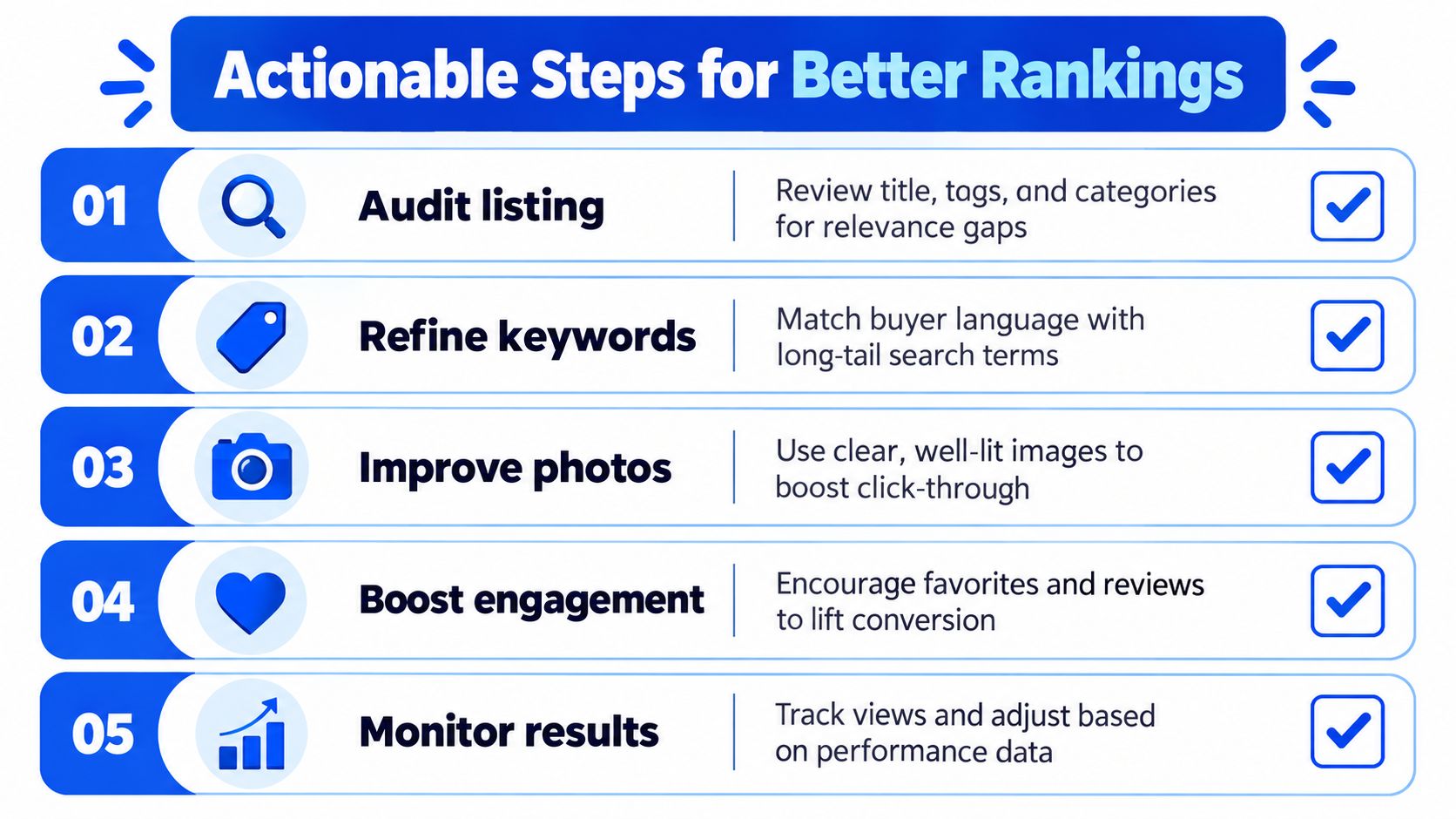
Audit the match
Open the listing as if you were a new shopper. Can you identify the product, audience, material, style, and main use from the title and first image? Compare those details with the search phrase you want to target.
Check these areas:
Title relevance: Put the clearest product description near the beginning, without turning the title into a list of disconnected terms.
Tag coverage: Look for relevant variations in buyer language. Remove tags that describe an audience or use the product doesn't serve.
Category accuracy: Confirm that the selected category reflects the item itself, not merely a nearby occasion or theme.
Attributes: Fill in every accurate attribute available to the listing. These fields can help Etsy understand and filter the product.
Description clarity: Explain what the buyer receives, how it works, and what choices are available. Natural language is more useful than repetition.
The Etsy long-tail keyword guide can help you think about specific search language. A phrase such as “personalized ceramic dog bowl” communicates more intent than a broad term such as “pet gift,” provided the product matches it.
Improve the reason to click
Search results give shoppers limited time to compare products. Your first image should show the item clearly, with enough context to understand its size and use. Additional photos can answer questions about texture, personalization, packaging, or variations.
Don't promise a performance improvement you can't measure, but do use a simple test: show the image to someone unfamiliar with the product and ask what they think it is, who it's for, and what they expect to receive. If their answers don't match your offer, revise the presentation.
Reduce purchase friction
Review the listing from the buyer's point of view. Is the price easy to understand? Are variations labeled clearly? Can the shopper tell what personalization information to provide? Are processing and delivery details consistent with what the shop can deliver?
Shipping deserves a deliberate decision rather than a default setting. Etsy says shipping price and method can affect ranking in relevant markets, including the potential benefit of free or low-cost shipping for US shoppers. Choose terms that reduce buyer hesitation while protecting your margins.
Protect customer signals
Treat every message, review, and case as feedback about the shopping system you built. A fast response won't fix an inaccurate product, but it can prevent avoidable confusion. A polished photo won't compensate for a late order that repeatedly surprises customers.
Focus on controllable habits:
Write predictable processing information. Avoid vague promises that create different expectations for different buyers.
Answer common questions in the listing. Buyers shouldn't need to message you for basic material, size, or customization details.
Inspect the finished product. Quality control protects the experience that search signals are meant to represent.
Resolve problems constructively. A difficult interaction can affect how a buyer evaluates the shop.
Review results without chasing noise
Give each change enough time to produce useful observations, then compare the listing's visibility and buyer response with its earlier performance. Don't rewrite the title, replace every image, change the category, and alter shipping simultaneously if you want to understand what made a difference.
Some sellers handle optimization themselves with Etsy analytics and a structured review schedule. Others use focused external support. Upglider, for example, offers campaigns centered on one listing and one agreed search phrase, with a stated objective of reaching and maintaining a position within Etsy's first fifteen results during the selected campaign period. It operates independently and doesn't request Etsy account passwords. Any external service should be evaluated against your own budget, risk tolerance, and understanding of Etsy's policies.
Real Examples of Optimization Wins
Consider a hypothetical listing for a personalized wooden wedding sign. The seller has packed the title with broad terms such as wedding decor, gift, rustic, home decor, bride, and event sign. The product technically relates to many of them, but the title doesn't quickly tell a shopper what makes the item distinct.
The seller changes the title to describe the product plainly, selects the most accurate category, completes the relevant attributes, and replaces vague tags with phrases that reflect the actual product. The photos then show the sign in context, close up, and with personalization examples. These are not tricks. They make the listing easier for both Etsy and the buyer to understand.
The seller also checks shipping information, responds consistently to questions, and reviews the finished product before dispatch. No single change guarantees a ranking result. The improvement comes from aligning the entry point, presentation, and service.
Keyword stuffing tries to impress the search box. Clear relevance tries to help the buyer.
That distinction matters. A listing can attract a search impression and still fail to create useful engagement if the promise is confusing. A focused title, accurate images, complete information, and dependable communication give the listing a stronger foundation than an overloaded set of tags.
Final Thoughts on Long-Term Growth
The Etsy search algorithm is easier to understand when you separate being found from being preferred. Titles, tags, categories, and attributes help Etsy identify relevant listings. Buyer behavior, shop quality, freshness, shipping conditions, and customer service help Etsy decide how those listings should compete.
Old SEO mindset | New SEO mindset |
|---|---|
Fill every available space with keywords | Describe the product in the buyer's language |
Optimize the listing in isolation | Improve the listing and the shop experience together |
Chase temporary visibility | Use freshness to gather feedback, then improve the offer |
Focus only on impressions | Care about clicks, favorites, purchases, and trust |
You don't beat the system by hiding the product behind clever wording. You build durable visibility by making the right product easy to find, easy to understand, and safe to buy.
Review one important listing today. Match its title and tags to a specific buyer query, complete its accurate attributes, clarify its images and shipping terms, then examine the customer experience that follows the click. Make the listing easier for Etsy to classify and easier for buyers to trust.