Adding more keywords doesn't automatically improve Etsy visibility. A crowded title can make a listing harder to understand, while a broad phrase can put a new product against established competitors before it has any useful buyer response.
A stronger process starts with one specific search phrase that matches what a buyer wants. Then you align the listing with that phrase, improve the reasons shoppers click and buy, and monitor movement before changing anything else. Etsy describes search as a two-stage system. It first matches listings to a query through relevance, then reorders those matches using signals such as listing quality, engagement, shop quality, customer service, shipping, language, and recency (Etsy's search and recommendation policy).
That approach matters in a marketplace with about 86.5 million active buyers and 5.6 million active sellers at the end of 2025 (Etsy company information). The following Etsy SEO tips are arranged as a listing workflow: choose a realistic phrase, build relevance, strengthen buyer response, and measure one meaningful change at a time.
1. Use Exact Multi-Word Search Phrases in Your Listing Title
Your title should tell Etsy and the buyer exactly what the product is. Start with the clearest phrase you're targeting, especially when it contains three or more words and describes a real purchase intent. Etsy's seller guidance recommends descriptive, multi-word long-tail keywords because they can match a shopper's specific need more closely than generic terms (Etsy's keywords guidance).
Suppose you sell a leather passport holder. “Leather Passport Holder with Monogram” gives Etsy a coherent product phrase and tells the buyer what makes the item relevant. A title assembled from disconnected terms, such as “Passport Holder, Leather, Handmade, Monogrammed,” may contain similar words, but it reads less naturally and gives the shopper less confidence.
Put the phrase near the beginning, then use the remaining space for useful modifiers. Include details such as material, audience, style, personalization, or occasion only when they describe the actual product.
Make the title readable before making it broad
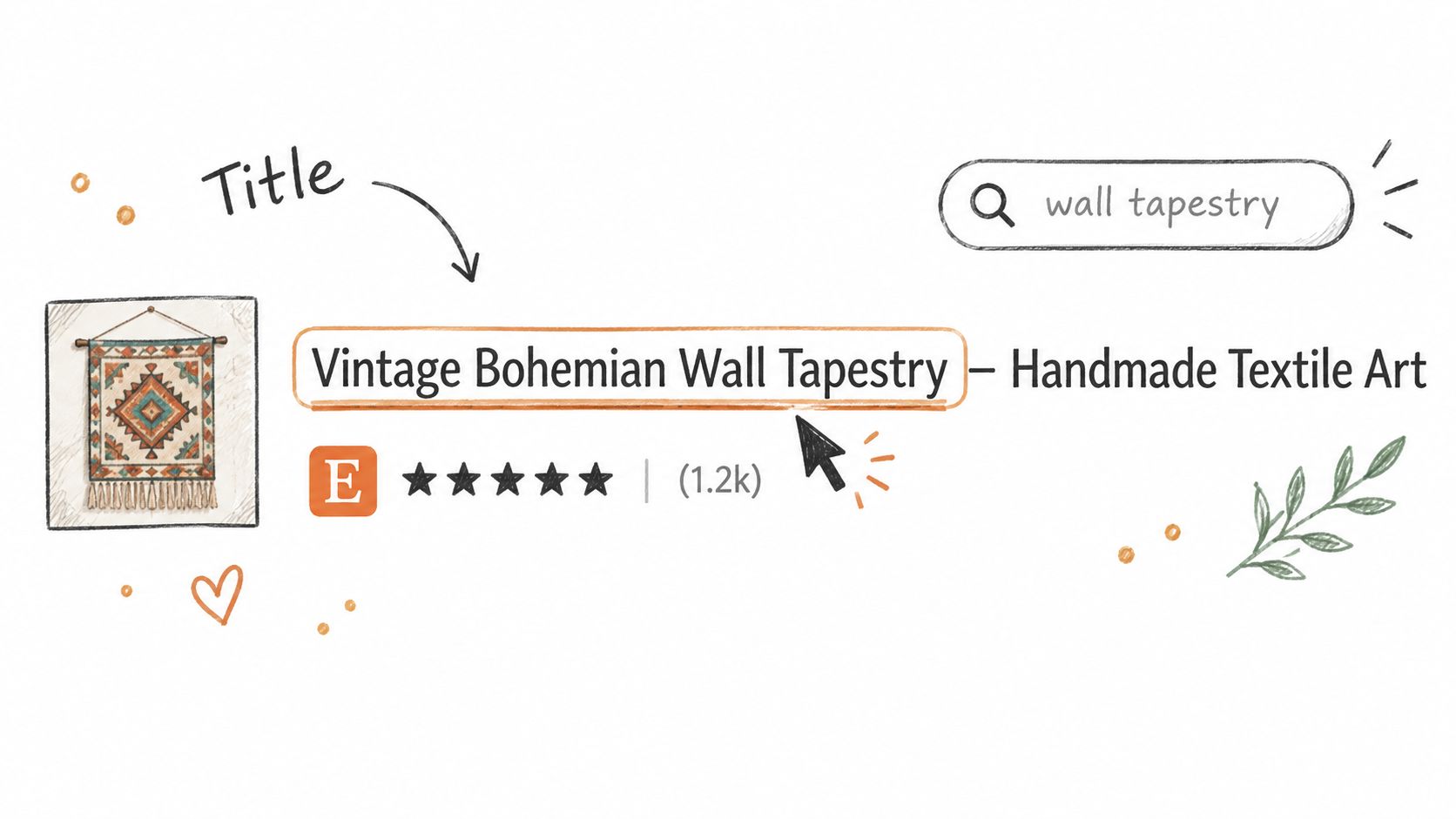
Keyword stuffing doesn't solve a relevance problem. If someone searches for “vintage bohemian wall tapestry,” a title that begins with that phrase and continues with “Handmade Textile Art” is clearer than a string of repeated terms. The same principle applies to “minimalist gold stud earrings”. Use the buyer's phrase naturally, then explain the product.
Avoid relying on vague descriptors such as “unique” or “beautiful.” They may sound positive, but they don't identify a search intent. Read the title aloud. If it sounds like a search query rather than a product someone would willingly click, revise it.
Practical rule: Choose one primary phrase, place it early, and make every remaining word help the buyer decide.
Don't rewrite the title every few days. Etsy gives new listings a small temporary boost so it can learn from buyer behavior, while renewed listings receive a smaller version of that boost (Etsy's search guidance). Let a meaningful title change gather enough response to evaluate before making another change.
2. Build Tags from Actual Buyer Search Behavior, Not Assumptions
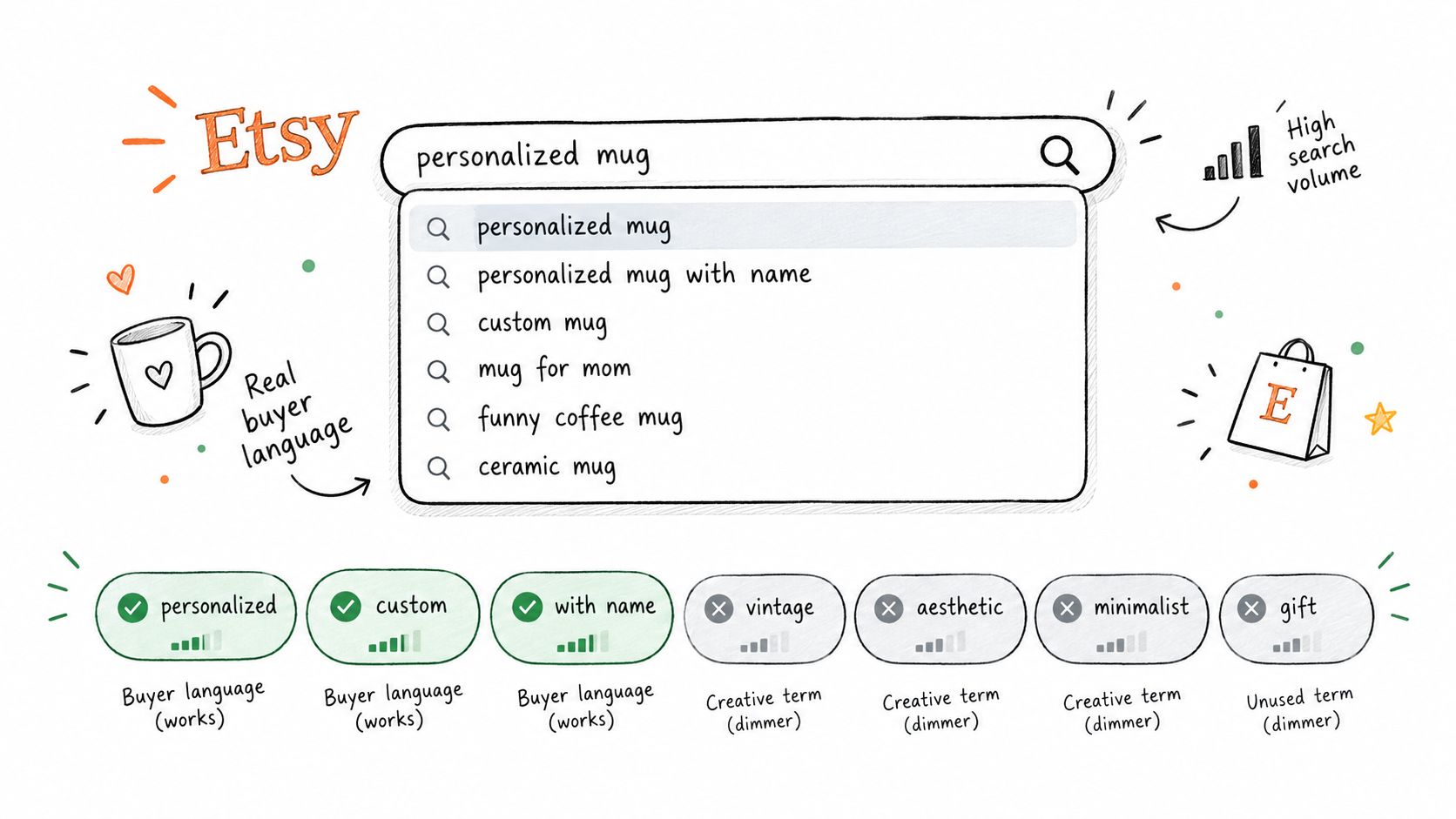
Tags should expand your listing's relevance, not repeat words because they sound appropriate. Start with the language shoppers use in Etsy's search bar. Autocomplete suggestions can reveal phrases people enter, while your shop statistics can show which queries produce impressions or visits.
Use the full tag space thoughtfully, but don't treat every available slot as permission to add vague terms. A printable wedding invitation might be described by the seller as a “DIY wedding invite template,” while buyers may search for “printable wedding invitation digital.” The second phrase is closer to a concrete product format and purchase intent.
A candle seller faces the same choice. “Candle” is broad and difficult to interpret. “Soy wax scented candle” tells Etsy more about the product and gives the buyer a clearer reason to click.
Spread related intent across the tags
Don't copy the exact title phrase into every tag. The title can establish the primary match, while tags cover adjacent language, use cases, audience, style, and occasion. For a personalized teacher mug, related tags might address the teacher audience, gift intent, mug type, and personalization, provided each describes the product accurately.
Use Etsy autocomplete first, then compare ideas with a specialist tool. The Etsy keyword tool guide can help organize phrase research without replacing judgment about the actual product.
A practical tag review looks like this:
Specific product language: Describe what the item is, not what you hope it becomes.
Buyer context: Add a relevant occasion, recipient, or use case when it matches the listing.
Synonyms and variations: Cover language that differs from your title without creating duplicates.
Evidence from performance: Review impressions and visits in your shop statistics, then retain phrases that attract relevant attention.
Avoided filler: Skip catch-alls such as “handmade” and “unique” when they don't distinguish the product.
Tags can create eligibility for more searches, but they can't rescue a listing whose product, photo, and offer don't match the query. Relevance gets the listing considered. Buyer response determines whether that visibility becomes useful.
3. Conduct Competitive Keyword Research to Avoid Over-Saturated Search Phrases
The largest keyword isn't automatically the best keyword. “Gold earrings” describes a broad category with many possible products, while “gold stud earrings for sensitive ears” expresses a narrower need. A new listing has a clearer opportunity when its phrase is specific enough to match a buyer while avoiding a search dominated by highly established listings.
Don't rely on unsupported search-volume targets or performance promises. Etsy's own guidance supports long-tail phrases because they describe what a shopper is looking for and can match intent more closely (Etsy's long-tail keyword advice). Use tools to compare phrases, but treat their estimates as directional rather than guaranteed demand.
Compare opportunity, relevance, and competition
Research several possible phrases before choosing one. For a brown leather crossbody bag, compare broad product language with phrases that include color, material, style, audience, or use. A phrase that sounds attractive but returns products unlike yours isn't a good target, even if a tool reports strong interest.
eRank and other Etsy seller tools can help you examine related keywords, competition patterns, and seasonal movement. Etsy's own search bar remains useful because it shows language connected to real marketplace searches.
Use this decision sequence:
Check the search results: Are the leading listings comparable to yours?
Inspect the intent: Does the phrase imply a product, gift, occasion, style, or problem your listing solves?
Assess your position: Can your product compete on quality, presentation, price, shipping, and trust?
Separate seasonal demand: A Christmas sweatshirt and a neutral everyday sweatshirt may need different launch timing and keyword choices.
Pick one phrase: Don't dilute the listing by pursuing several unrelated intents at once.
A realistic phrase isn't necessarily obscure. It's a phrase where the product clearly satisfies the query and your listing can earn the click. Start with the phrase that offers the strongest fit, then use tags and attributes to cover nearby language.
4. Optimize Your Shop's Attribute Tags Based on Your Product Category
Attributes are easy to overlook because they feel like form fields rather than SEO work. They help Etsy understand details such as material, color, size, style, and product type, and they can connect a listing with filtered searches. Etsy's search guidance identifies categories and attributes as part of the information used to match listings with buyer queries (Etsy's search guidance).
A jewelry listing for sterling silver minimalist earrings should select those attributes when they're available and accurate. A mug seller should distinguish ceramic from other materials and select relevant usage details when Etsy provides them. Missing information leaves the platform with less context, while inaccurate information can create the wrong expectation and lead to a poor buyer experience.
Complete the fields that describe the actual item
Review every available attribute for the listing's category. Prioritize details shoppers commonly filter by, such as color, size, material, style, and finish, but don't select an option merely because it might attract traffic.
Specificity helps when it remains truthful. If Etsy offers “sage green” and that matches the product, choose it rather than the broader “green.” If the item is a digital download, identify it clearly. If a product is handmade but doesn't have a particular material or style, don't add that attribute to chase a phrase.
Attributes and tags should work together rather than duplicate one another without purpose. Use attributes for structured product facts, then use tags for related buyer language, occasions, audiences, and use cases that aren't already covered.
Accurate attributes improve discoverability only when they also improve the buyer's understanding of the product.
Revisit the listing when Etsy adds new category options or when the product changes. A new material, size variation, or style detail may create a better match for a relevant filtered search. This is a confirmed optimization. Whether a particular attribute produces more traffic is an experiment, so measure impressions and clicks rather than assuming.
5. Write Listing Descriptions That Match Buyer Intent, Not Just Keywords
A description has two jobs. It gives Etsy additional context, and it helps a shopper decide whether the item fits. Etsy's help guidance includes the title, description, images, video, and policies among the elements that support listing SEO (Etsy's SEO help page).
Write for the question behind the search phrase. A buyer searching for a minimalist leather wallet may want to know whether it has a slim profile, how many cards it holds, what material it uses, and whether it will withstand regular use. A paragraph filled with repeated versions of “leather wallet” won't answer those concerns.
Start with a direct explanation of what the product is and who it suits. Then make the practical details easy to scan.
Product identity: Say whether it's handmade, vintage, personalized, digital, or physical.
Specifications: Include dimensions, materials, capacity, colors, and available options.
Usage details: Explain care, printing, compatibility, or fit where relevant.
Fulfillment expectations: State processing and shipping information accurately.
Buyer reassurance: Clarify customization, returns, exchanges, and common questions.
Match the opening to the search intent
For a digital planner, “Digital download, print at home” immediately answers a format question. For hand-knit baby booties, the opening should make size, material, and intended age easy to find. A buyer shouldn't have to read through brand language before learning what they're purchasing.
Use one or two natural variations of the target phrase, but don't repeat the same wording until the copy feels mechanical. Short paragraphs and bullet points work well on mobile. Formatting can emphasize measurements or materials, but clarity matters more than decoration.
Descriptions don't guarantee higher rankings. They can, however, reduce uncertainty after a searcher reaches the listing. That can improve buyer response, which Etsy considers alongside relevance and shop quality.

6. Ensure Listing Photos Clearly Show the Product Matching Your Target Keyword
Your first photo is a search result asset, not just a product gallery image. It has to make the listing understandable at a glance and give the buyer a reason to open it. Etsy's guidance identifies images and video as part of listing SEO, while the platform's ranking system also uses engagement and quality signals (Etsy's search and recommendation policy).
If the target phrase is “vintage brass pendant necklace,” the first image should clearly show the complete necklace. A clasp close-up may demonstrate craftsmanship, but it doesn't communicate the whole product quickly. A lifestyle image can show scale and context, but it shouldn't replace a clear product view when the object is difficult to identify.
Build the image sequence around buyer questions
Use the gallery to remove uncertainty in a logical order:
Complete product view: Show what the buyer is purchasing without confusing cropping.
Material detail: Let the shopper inspect texture, finish, stitching, or print quality.
Scale and fit: Use a model, room setting, or measurement reference where helpful.
Multiple angles: Show the back, closure, interior, or other functional details.
Use context: Demonstrate how the product looks in its intended setting.
Accuracy: Avoid filters and angles that make the color, size, or shape misleading.
A handmade home decor listing may benefit from a room scene because the buyer wants to understand placement. A necklace may perform better when one image shows it worn, as long as the product remains easy to identify. These are tests, not universal rules.
Don't change the lead image and title simultaneously if you want to learn what caused a movement in clicks. Test the image first, record the response, then adjust the next variable. Strong photography can't fix a phrase that attracts the wrong audience, but it can help a relevant listing earn the click it needs.
7. Establish a Review Velocity Strategy to Signal Freshness and Quality
Reviews are not a shortcut for weak fulfillment. They reflect the buyer experience, and Etsy includes recent shop review rating, message response rate, and case rate in search ranking considerations (Etsy's seller handbook on search). That makes customer service part of Etsy SEO, not a separate administrative task.
Focus on actions you control. Ship within the processing time you promised, answer questions clearly, package the product carefully, and make the listing accurate enough that the buyer isn't surprised. You can invite honest feedback through Etsy's normal review process, but you shouldn't pressure customers to leave a positive review or offer a reward for one.
Protect the operational signals behind visibility
Etsy says shop-level performance includes the past three months of review rating, message response rate, and case rate. Shipping price is also an overall consideration for US sellers (Etsy's search factors guidance). Those factors are measurable, so improve the underlying service rather than trying to manipulate the outcome.
Use a simple service routine:
Answer promptly: Respond to questions before uncertainty turns into abandonment.
Set honest expectations: State processing, delivery, personalization, and digital access details clearly.
Resolve problems directly: A fast, respectful response can prevent an issue from becoming a case.
Request feedback appropriately: Let Etsy's review process do the requesting.
Track patterns: Note whether complaints involve sizing, color, shipping, or product instructions.
New listings receive a temporary search boost so Etsy can observe buyer behavior, and that window makes accurate presentation especially important (Etsy's search guidance). A listing that attracts attention but creates disappointed buyers won't build durable visibility.
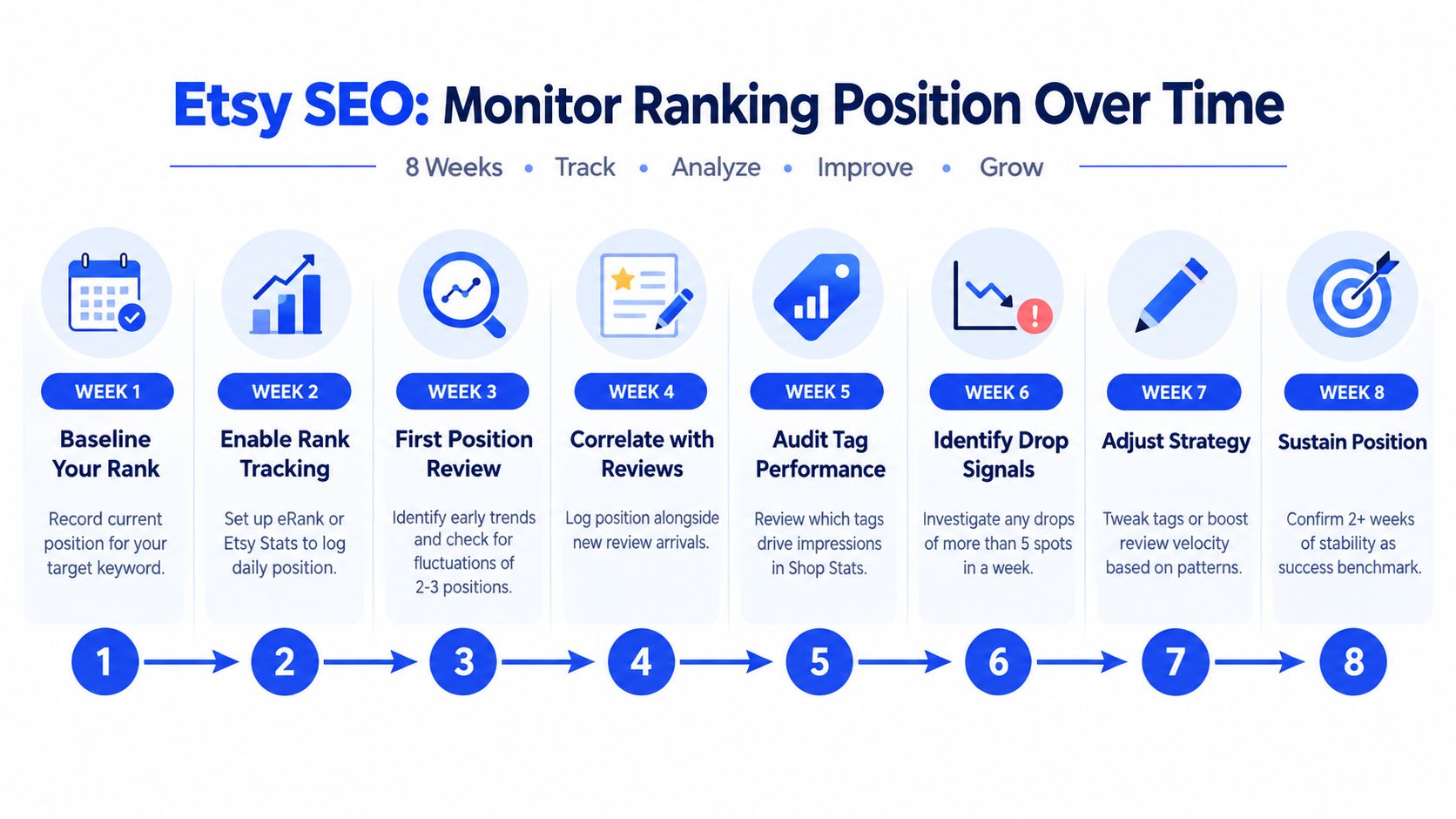
8. Monitor Ranking Position Over Time and Adjust Strategy Based on Movement Patterns
Ranking changes because demand, competition, buyer behavior, and shop performance change. A position is a snapshot, not a permanent guarantee. Etsy says search results are personalized and reordered using multiple signals, so a single check can't explain the full performance of a listing (Etsy's search and recommendation policy).
Track the target phrase consistently, but don't confuse every small movement with a problem. Compare ranking with impressions, visits, favorites, orders, review activity, listing edits, and seasonal demand. If impressions rise but visits don't, inspect the first image and title. If visits arrive but buyers don't proceed, inspect price, description, personalization instructions, shipping, and trust signals.
Change the variable that matches the evidence
Use a basic log with the date, phrase, position, impressions, visits, favorites, orders, and notable events. Then apply a controlled response:
Lower impressions: Recheck phrase relevance, category, attributes, and tags.
Impressions without clicks: Test the first photo, title readability, and product clarity.
Clicks without orders: Review buyer intent, offer details, shipping, price, and description.
Ranking decline after stronger competition: Compare the competing listing's product presentation and phrase alignment.
Stable visibility with weak response: Improve conversion elements before changing the keyword.
Avoid changing the title, tags, photos, price, and description together. You may see movement, but you won't know why. Etsy's temporary boost for new and renewed listings can also create short-term variation, so interpret early results carefully rather than treating a brief rise as proof of a permanent win.
The strongest workflow is simple: measure, form a specific hypothesis, make one meaningful change, and observe again.
8-Point Etsy SEO Comparison
Strategy | 🔄 Implementation complexity | Resources ⚡ (time / tools) | 📊 Expected outcomes | Ideal use cases | ⭐ Key advantages / 💡 Quick tip |
|---|---|---|---|---|---|
Use Exact Multi-Word Search Phrases in Your Listing Title | Low, simple edits and phrasing skill | Low, time to rewrite titles; no tools required | Faster relevance boost and improved CTR within days–weeks | Any listing aiming for a specific buyer phrase | High control and quick impact, Lead with the exact phrase; keep natural wording |
Build Tags from Actual Buyer Search Behavior, Not Assumptions | Medium, requires research and selection | Moderate, time + optional tools (eRank, Marmalead) | Better discoverability for real search queries; niche traction | Listings where buyer language differs from seller jargon | Data-driven tag choices reduce guesswork, use autocomplete and tool data |
Conduct Competitive Keyword Research to Avoid Over‑Saturated Phrases | Medium–High, analysis and filtering required | Moderate–High, paid tools and time for analysis | More realistic ranking timelines; higher conversion for targeted phrases | New shops or focused ranking campaigns | Identifies attainable keywords, target 500–2,000 searches & <5k listings |
Optimize Your Shop's Attribute Tags Based on Product Category | Low, selection within Etsy's options | Low, minutes per listing | Improved filtered search visibility and fewer irrelevant impressions | Categories with many filters (jewelry, home decor, clothing) | Underused leverage with little effort, complete attributes accurately |
Write Listing Descriptions That Match Buyer Intent, Not Just Keywords | Medium, good writing and structure needed | Low–Moderate, time to rewrite; formatting effort | Higher conversion and fewer returns; richer indexing context | Products with buyer questions (materials, sizing, use cases) | Boosts conversion more than raw ranking, answer buyer questions first |
Ensure Listing Photos Clearly Show the Product Matching Your Target Keyword | Low–Medium, photography skill and selection | Low–Moderate, time, basic equipment or smartphone | Better image matching, higher impressions and CTR | Visual products (jewelry, decor, apparel) | Improves ranking + conversion simultaneously, primary photo should show full product |
Establish a Review Velocity Strategy to Signal Freshness and Quality | Medium, process and consistency required | Moderate, fast shipping, follow-up messages, packaging | Strong freshness signal that can lift rankings quickly for active listings | New shops, relaunches, seasonal items | Compounding ranking effect via steady reviews, aim for regular weekly reviews |
Monitor Ranking Position Over Time and Adjust Strategy Based on Movement Patterns | Medium, ongoing tracking and analysis | Moderate, time and rank-tracking tools (eRank, Etsy Stats) | Data-driven adjustments; early detection of drops or opportunities | Active sellers running campaigns or multiple listings | Reveals which levers move rank, check 2–3×/week and log events for correlation |
Turn Eight Tactics Into One Repeatable Listing Routine
Etsy SEO works better as a sequence than as a pile of isolated tricks. Begin with one listing and one realistic multi-word phrase. Check the search results, confirm that the phrase describes the product and buyer intent, then build the title around it. Use tags to cover related language, complete accurate attributes, and write a description that answers the questions a buyer is likely to have.
Next, inspect the visual experience. The first photo should make the product immediately recognizable, while the remaining images should explain scale, materials, function, and use. A strong listing doesn't force the shopper to guess whether the product matches the search. It confirms the match quickly.
Customer service belongs in the same workflow. Etsy considers recent review rating, message response rate, and case rate in search ranking, so fulfillment, communication, and accurate expectations can support visibility alongside title and tag relevance (Etsy's customer service search guidance). A keyword change can't compensate for unresolved buyer problems.
Track impressions, visits, favorites, orders, reviews, and ranking movement. If the listing receives impressions but few clicks, test the title or first image. If it receives clicks but weak buyer response, improve the offer and description. If it isn't matching the intended phrase, return to the category, attributes, tags, and query choice. Make one substantial change at a time so the result teaches you something.
Don't treat a ranking position as a guarantee. Etsy search changes with query demand, competition, personalization, listing quality, and shop performance. Your goal is a repeatable process that helps one listing become more relevant and more persuasive, not a permanent promise attached to a single number.
For sellers who want focused help without sharing account access, Upglider is an independent Etsy SEO option. It assesses the listing and phrase before payment, targets one agreed search phrase, provides dashboard updates, and offers 30-, 90-, or 180-day campaigns with a stated top-15 objective. Its terms include a money-back guarantee if the listing doesn't reach the top 15 within 21 days. Upglider is independent and isn't affiliated with Etsy.
Choose one listing today, write down the phrase you want to win, and record its current performance before editing. Then improve the title, tags, attributes, buyer-facing content, and first image in that order, giving each change enough time to produce evidence.