You've improved your product photos, rewritten the title, and checked your shop again. The listing still isn't getting the attention you hoped for. An Etsy listing service might help, but the offers can be hard to compare. Some sell better listing text. Others promise search placement without explaining how they'll measure it.
The safest way to choose is to ask what the provider can prove and what access it needs. A ranking claim needs a fixed search phrase, a date, and a repeatable checking method. Your password shouldn't be part of the deal.
What an Etsy Listing Service Is
An Etsy listing service is an independent outside provider that works on one listing, or a small set of listings, to improve how it appears in Etsy search for specific phrases. It doesn't run your shop, act for Etsy, or buy ads on Etsy's behalf as part of that narrow service.
Think of Etsy as a mall holding more than 100 million items: a listing service tries to guide shoppers to one door rather than rebuild the building. As of December 31, 2025, Etsy's annual filing reported 86.5 million active buyers, 5.6 million active sellers, and more than 100 million items available for purchase.
What the provider actually changes
Providers tend to offer work in these areas:
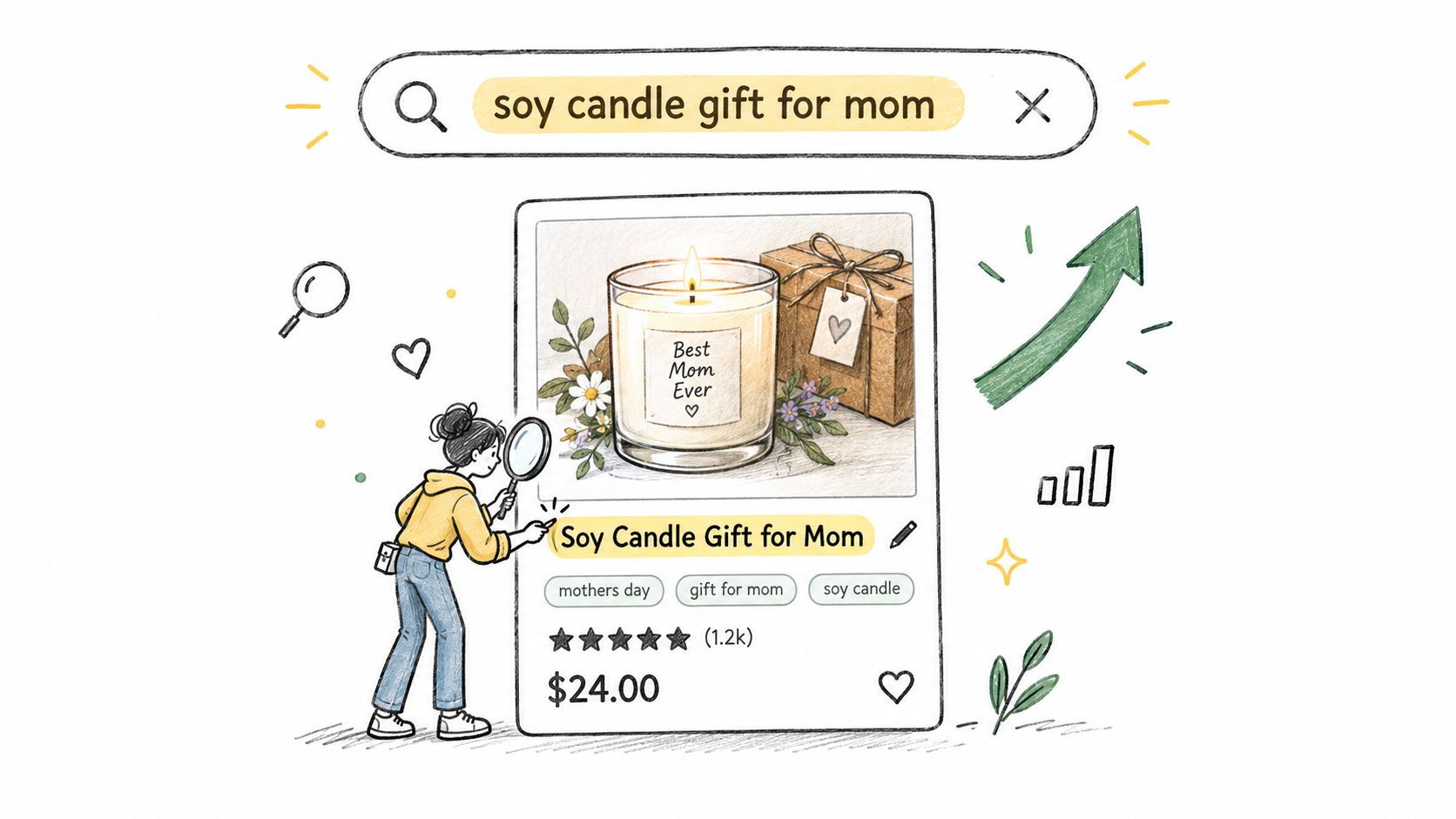
Search relevance: Titles, tags, attributes, and categories that describe the product in language a shopper might use.
Presentation: Photo improvements and clearer copy that help shoppers understand what they're buying.
Focused promotion: Work aimed at improving a listing's position for an agreed search phrase.
Those aren't interchangeable jobs. A polished description is a deliverable you can read and approve. A ranking campaign aims for an outcome within a search system the provider doesn't own.
The service should also distinguish relevant visibility from general attention. A candle maker doesn't need every possible visitor. She needs shoppers looking for the kind of candle she sells, at a price and delivery date she can offer.
Define the job before discussing packages
One listing and one phrase form a practical unit of measurement. You can identify the product, record its starting position, and check the same query later. A promise of more exposure leaves too much unanswered: exposure to whom, for what search, and by when?
Before contacting a provider, decide which listing, which phrase, and which deadline matter. Those choices make it easier to reject a broad package that doesn't solve your immediate problem.
Services You Will See and What Each Covers
The most useful comparison starts with what you'll receive, not the package name. These common Etsy listing service types range from a self-contained research task to ongoing campaign work.
Service | What It Includes | Question to Ask Before Buying |
|---|---|---|
Keyword research | Finds search phrases buyers type for your product | Which exact phrases, and why does each fit this listing? |
Listing SEO rewrite | Title, tags, attributes, and category updates | Will you show before-and-after text, and will it avoid keyword stuffing? |
Product photo editing | Cleanup, consistent backgrounds, lifestyle shots | Do I receive the original files, and what usage rights do I get? |
Listing copy | Description, FAQ, and policy text | What claims will be made, and can I edit the wording? |
Single-listing ranking campaign | Works to lift one listing for one agreed phrase | What is the exact phrase, how long is the campaign, and how is position measured? |
Shop audit | Review of reviews, policies, shipping, and response times | Will findings come in writing, ranked by priority? |
Buying a deliverable versus buying campaign work
Text and photo work change what a shopper sees. You can inspect the proposed title, compare edited photos, and correct inaccurate product details before publishing anything.
Say you sell a personalized necklace. A copywriter might clarify the chain material, engraving choices, and packaging. A photo editor might improve lighting and crop the main image so the engraving is visible. Neither task should turn an ordinary product into something you can't truthfully supply.
A ranking campaign has a different purpose. It targets search position for a phrase rather than handing over a finished piece of copy. The provider needs to explain the work, the checking method, and the limits of the outcome.
Buying rule: Pay for the missing capability, not the longest list of deliverables.
Keep publishing decisions in your hands
For rewrites and photo edits, ask for files or proposed changes that you review and publish yourself. Check measurements, materials, care instructions, delivery promises, and personalization limits. Don't let a writer invent policies that conflict with how you operate.
Ask photographers and editors to distinguish actual product images from staged or digitally created scenes. A lifestyle image shouldn't imply that accessories are included when they aren't.
A ranking campaign is worth considering only once the text and photos match the intended search. Promoting a minimalist candle for a phrase about elaborate gift baskets creates a mismatch that more attention won't fix.
Most sellers need only two or three of these services at a time. If your photography is already clear, don't pay for another image package just because it's bundled with keyword research. Ask for a narrower quote and written deliverables.
How to Vet a Provider Without Sharing Your Login
No honest provider can promise a fixed search position for every shopper. Etsy's explanation of search says titles, tags, descriptions, categories, and attributes help determine whether a listing matches a query, while ranking also considers listing quality, shop quality, customer-service quality, recency, shipping, and personalized context.
That distinction matters. Matching a phrase can make a listing eligible to appear. It doesn't give an outside provider control over the order of results.
Compare the evidence before the sales pitch
Use these provider vetting criteria to separate a defined service from an unverifiable promise.
Criterion | Good Sign | Red Flag |
|---|---|---|
Scope | Names one listing and one agreed phrase | Promises top rankings across a whole shop |
Measurement | Gives the query, device or location, date, and proof format | Offers only screenshots without context or asks for blind trust |
Audit | Checks title, tags, photos, policies, and shipping before accepting | Accepts every listing without questions |
Access | Asks only for the public listing URL and keywords | Asks for a password, login code, or edit rights |
Guarantee | Written terms with a defined window and exclusions | Terms exist only in chat messages |
Payment | Full total, tax, and renewal terms shown before payment | Pressure to pay quickly or unusual payment methods only |
Identity | Named business, location, and verifiable history | Anonymous contact with no company details |
Promises | Describes uncertainty and says Etsy customizes results | Guarantees page one for every buyer |
A screenshot can support a report, but it can't replace a measurement protocol. For example, a claim of position nine means little if you don't know the query, location, or whether the provider counted advertisements.
The questions in an Etsy SEO expert evaluation guide are useful when comparing a specialist's scope with your actual needs. Apply the same checks to freelancers, agencies, and dedicated ranking services.
Run these checks before paying
Get the scope in writing. Identify the listing, agreed phrase, and campaign duration. Ask whether extra phrases or replacement listings cost more.
Confirm the access boundary. Supply the public listing URL and proposed keywords. Decline requests for your password, login code, or edit rights for this focused service. You can publish any recommended changes yourself.
Agree on rank measurement. Record the exact query, device or location, observation date, and proof format. Ask whether the method counts organic results separately from ads and whether later checks will use the same setup. Personalized results mean different shoppers may see different orders.
Read the refund terms. Find the claim window, exclusions, required evidence, and refund process. Save the version you accepted rather than relying on a conversation you might not be able to retrieve.
Check the full payment total. Confirm tax, optional extras, cancellation terms, and renewal rules before authorizing payment. A bank transfer or crypto option isn't proof of misconduct, but you should understand your recourse before using it.
Record your own starting point. Etsy's Search Visibility guidance explains that the page is available in Shop Manager and the Etsy Seller app, with insights covering shop quality, listing quality, and customer-service quality. Note its recommendations and save your listing's views and sales for the comparison period.
Compare results yourself afterward. Review the Search Visibility page, your listing statistics, and the provider's dated rank checks. Note any price changes, promotions, or stock shortages that could affect the comparison.
The provider must answer the commercial and measurement questions. Your account-level checks remain yours to perform, without outside access.
A provider who won't name the phrase, date, and check method is asking you to trust a screenshot.
Pricing Models and the Fees Still Owed to Etsy
The provider's fee is only part of what you pay. Use this comparison of listing service pricing models to identify the commitment before comparing headline prices.
Pricing Model | How You Pay | Best For | Term to Check |
|---|---|---|---|
Fixed campaign | One payment for a defined campaign period | One listing with a clear goal | What happens when the period ends |
Monthly retainer | Recurring monthly fee | Shops needing ongoing management | Auto-renewal and cancellation rules |
Hourly rate | Paid per hour of work | Small custom tasks such as photo edits | Whether hours are capped |
Per-deliverable | Price per keyword set, photo set, or rewrite | Specific one-off needs | Add-ons that raise the final total |
Performance-based | Fee tied to an agreed result | Sellers who want risk shared | Who defines and measures the result |
Compare fixed campaigns over the same duration. For example, a hypothetical short campaign shouldn't be judged against a season-long package on price alone. Check whether monitoring, maintenance, and reporting continue throughout the paid period.
A managed SEO service comparison can help you distinguish an ongoing management arrangement from a defined task. Don't take on recurring work when you only need a rewrite.
Work out the margin, not just the fee
Etsy's Fees and Payments Policy sets a $0.20 USD fee when a listing is created or renewed, with no fee for editing an existing listing, and a 6.5% transaction fee on the displayed price plus shipping and gift wrapping for sales through Etsy.com.
For a hypothetical $30 item with $5 shipping, applying those fees produces about $2.28 in transaction fees, plus the $0.20 listing fee when applicable. That isn't a complete profit calculation. You still need to account for materials, packaging, actual postage, your work, and any other applicable charges.
Calculate contribution per order: Subtract the costs that arise when you make and fulfill the sale.
Add the service cost: Use the full provider total, not its advertised starting price.
Estimate the payback requirement: Divide the campaign cost by contribution per additional order.
Don't use total revenue as the measure of success. A campaign can generate orders without leaving enough margin to repay its cost.
A very low quote may cover only a brief audit, with no implementation or meaningful measurement. Ask what you'll receive before deciding it's a bargain.
What Guarantees Cover and What They Leave Out
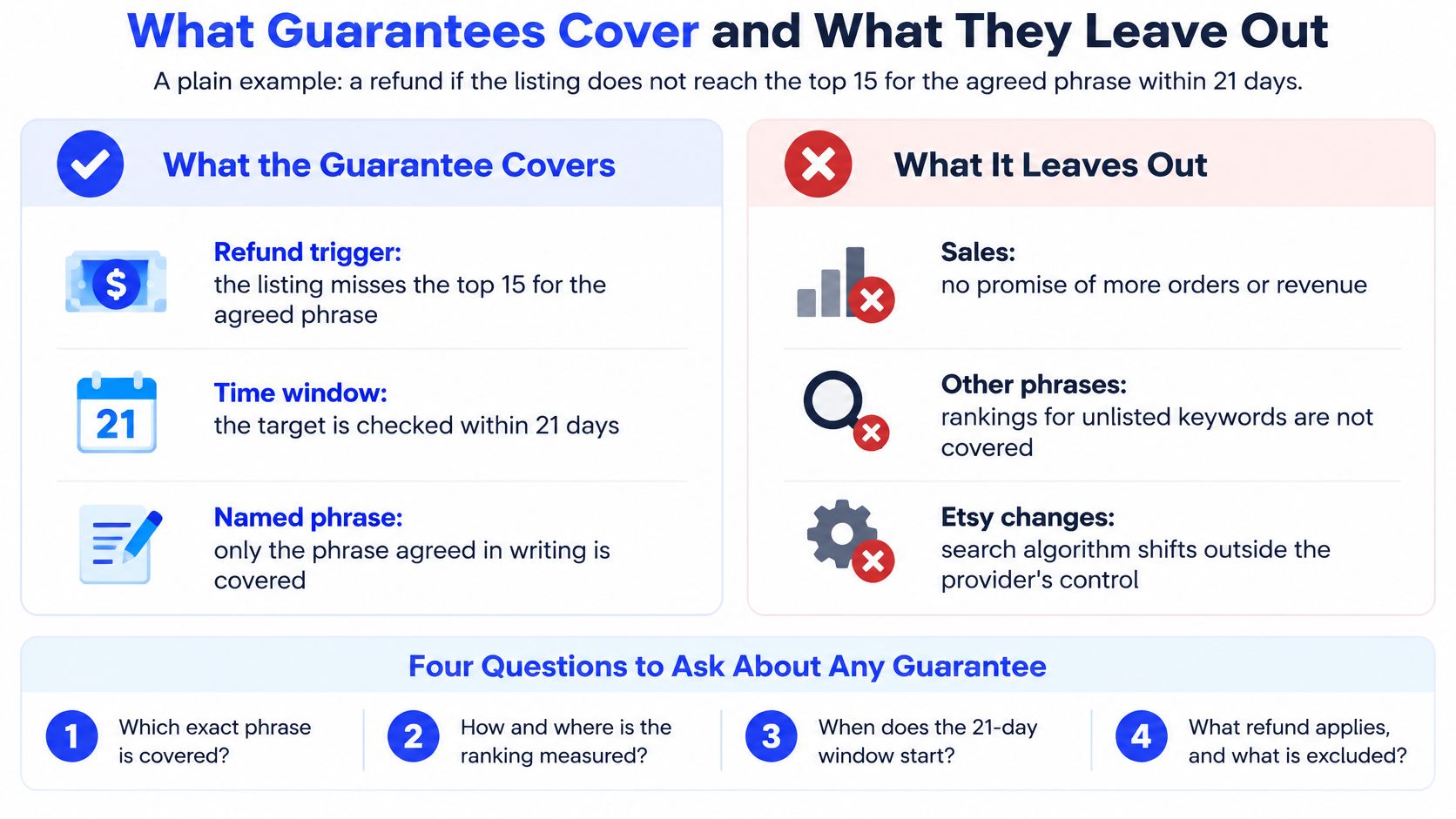
A plain hypothetical example is a refund if the listing doesn't reach the top 15 for the agreed phrase within 21 days. That sounds reassuring, but it's a refund condition, not a promise that your shop will become profitable.
The important details sit beneath the headline: the qualifying phrase, the measurement procedure, the deadline, and the exclusions.
Separate financial protection from business results
What a clear guarantee can cover | What it doesn't automatically cover |
|---|---|
A refund when a written condition isn't met | More orders, revenue, or profit |
A deadline for checking the agreed target | Rankings after the paid campaign ends |
A named phrase and measurement setting | Every other phrase or shopper's results |
A remedy defined in the contract | Changes Etsy makes to search |
Ask these questions before treating a guarantee as useful protection:
Which phrase is covered? Make sure spelling and wording are recorded exactly.
How is position measured? The contract should identify the search setting and acceptable evidence.
When does the window begin? Payment confirmation, acceptance, and campaign launch aren't necessarily the same event.
What is excluded? Ask whether changing the title, price, availability, or shipping during the campaign affects eligibility.
Read the exclusions as carefully as the promise
A narrow guarantee can still be useful if its terms are understandable and the provider follows them. A broad headline with unclear exclusions is harder to rely on.
Check what happens if the target is reached briefly and then lost. Does that satisfy the promise? Is maintenance part of the paid service, and what remedy applies if it stops?
Don't accept fake reviews, fake buyers, or fabricated purchases as a shortcut. Require a plain explanation of the methods and reject any proposal to manipulate customer activity.
Price, product fit, photographs, and buyer confidence still affect whether visitors purchase. A guarantee protects your money under stated conditions. It doesn't protect your sales.
A Worked Example From Payment to Results
Say a candle maker's gift listing slows down before Mother's Day. She wants shoppers searching for soy candle gift for mom to find it. She doesn't need a shop redesign or someone to manage her entire catalog.
Upglider is one independent option offering this type of focused campaign: it accepts phrases of three or more words, rejects single-word keywords, and offers 30-, 90-, or 180-day campaigns, with a top-15 objective within 9–21 days and maintenance during the paid period.
In this illustrative case, she chooses the middle campaign length to cover her selling window. She shares her public listing URL and target phrase, never her password.
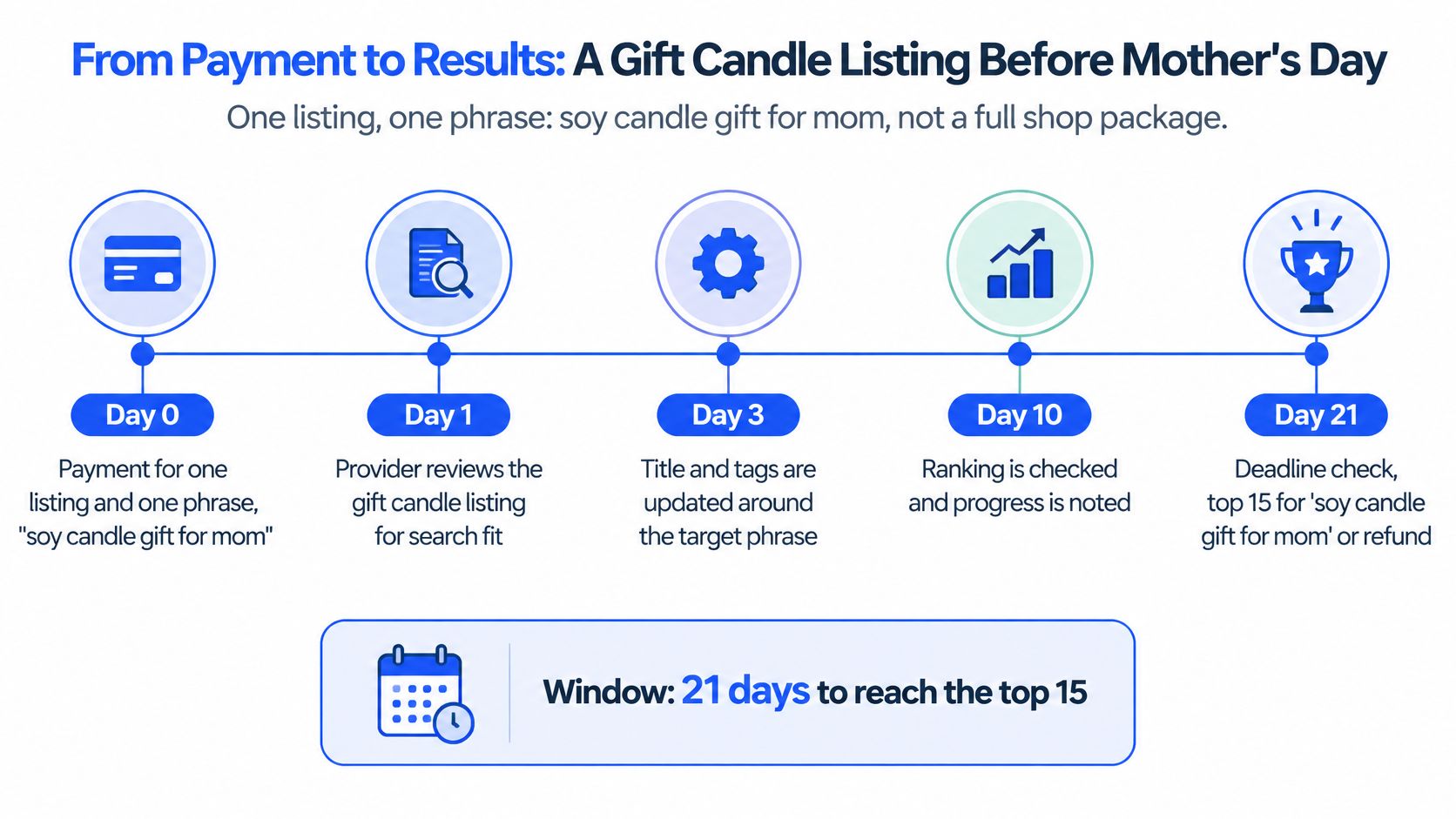
What happens during the campaign
The timeline shows a hypothetical sequence, not a guaranteed daily schedule:
Day 0: Payment is confirmed, and the listing, phrase, measurement method, and deadline are recorded.
Day 1: The provider reviews whether the gift candle fits the intended search.
Day 3: The seller publishes any needed title and tag changes herself. The provider doesn't edit her account.
Day 10: A status update records the latest rank check and any relevant observations.
Day 21: The provider checks the target against the written refund terms.
Through day 90: Position maintenance continues under the campaign agreement, then the campaign ends without automatic renewal.
The distinction about edits matters. External promotion doesn't require account access. Any preparation the seller needs to complete should be agreed before work starts, not introduced unexpectedly after payment.
What counts as a useful result
Her dashboard updates should explain what stage the campaign has reached, when the phrase was checked, and what the observation showed. A vague progress bar isn't a substitute for dated information.
She compares her own Etsy views and sales with the starting period. She also notes changes in price, stock, and seasonal demand so she doesn't attribute every order to the campaign.
The outcome might be stronger placement without a matching increase in purchases. That would prompt a closer look at the offer, not an automatic purchase of more promotion. The campaign is one part of her selling plan, alongside product quality, fulfillment, and a gift buyers actually want.
Decide Whether a Listing Service Fits Your Shop
Go ahead only if the specific listing is ready for relevant visitors. If a shopper can't understand the product, trust the delivery promise, or see what's included, fix those problems before paying to attract attention.
Etsy's customer-experience guidance identifies review ratings, message responsiveness, case rate, shipping, tracking, policies, and shop quality as search considerations; it also says new shops without reviews can improve their standing by completing their About page and shop policies.
Run a practical readiness check
Credible photos: Show the actual product, important details, scale, and included items.
Clear delivery expectations: State realistic processing and shipping information, especially for gifts.
Complete policies: Explain returns, personalization limits, and how you handle problems.
Competitive shipping: Check the buyer's total cost against comparable products, not just your item price.
Capacity to respond: Make sure you can answer messages promptly and fulfill extra orders reliably.
A new shop isn't automatically unsuitable. However, its newest listing isn't automatically the strongest candidate either. A flagship product with clear demand, dependable fulfillment, and room in the margin may justify focused support more readily.
Make the decision around the selling window
If the shop and listing pass the checks, shortlist providers and choose a duration that covers when customers are likely to buy. Use an Etsy SEO service comparison to compare scope and terms, not just ranking promises.
If the checks reveal weak photos, missing policies, or delivery problems, postpone the campaign. Those fixes remain useful whether you later hire help or manage the listing yourself.
This week, choose one promising listing and request a pre-payment case assessment from a provider that reviews product fit, keyword choice, and difficulty. Ask for the phrase, deadline, checking method, total price, and refund terms in writing. Compare the answer with the checklist, and keep your login to yourself.