Most advice about a managed SEO service starts with the wrong question. It asks whether you should hire an agency, then compares packages filled with audits, blog posts, backlinks, and monthly reports. The better question is simpler: what visibility outcome are you buying, who carries the risk, and can you verify the result?
For an e-commerce owner, a vague retainer can become an expensive habit. You may receive polished ranking charts while your flagship product, category page, or marketplace listing still fails to attract qualified buyers. Outsourcing makes sense when a provider owns a measurable growth problem. It doesn't make sense when you're paying for activity without a clear route to sales.
Evaluation area | DIY optimization | Managed SEO service |
|---|---|---|
Cost structure | Internal time and software costs | Retainer, project, or performance-linked fee |
Technical depth | Depends on your team's skills | Access to specialists and operating systems |
Execution | Competes with daily shop operations | Provider handles agreed work |
Accountability | You own every decision | Must be defined in the contract |
Best fit | Narrow, manageable improvements | Complex, ongoing, or high-value visibility goals |
How Managed SEO Services Operate Today
Managed SEO is now an outsourced growth function, not a monthly title-tag edit. The work can include technical SEO, content, analytics, authority building, and visibility in AI-generated answers. Google.com was registered in September 1997, and SEO expanded as businesses became more dependent on search discovery. Backlinko's SEO services statistics captures that dependence, reporting that 68% of online experiences begin with a search engine and Google holds about 91.38% of the global search engine market.
That concentration creates demand for specialists, but it also creates room for weak contracts. Search systems change, indexing failures appear, competitors publish new pages, and commercial visibility depends on more than one keyword adjustment. A capable provider should connect strategy, implementation, measurement, technical oversight, and clear decisions about where limited effort will produce business value.
The market is large enough to support agencies, consultants, freelancers, and recurring service arrangements. Recent estimates place the global SEO services market at USD 83.98 billion in 2026, up from USD 74.9 billion in 2025, with a projection of USD 148.86 billion by 2031 and a 12.12% CAGR from 2026 to 2031, according to the SEO history market overview.
Two different buying decisions
A managed program should match the visibility problem, not an agency's standard package. A large retailer may need technical governance, content planning, internal linking, analytics, and coordination across teams. A shop owner with one stagnant product may need a tightly bounded ranking campaign with a defined target and review point.
That narrower model deserves attention because broad retainers can keep businesses paying for activity without proving commercial progress. Retainers and subscriptions represented 61.95% of SEO services revenue in 2025, while outcome-based contracts are projected to be the fastest-growing model, with an 18.40% CAGR through 2031, according to Mordor Intelligence's SEO market research.
Practical rule: Buy the smallest service that can solve the visibility problem you can name.
Before signing, define the outcome in business terms. It could be revenue from a category, qualified leads from a service page, or visibility for a specific marketplace query. The contract should identify the target, responsibilities, reporting method, and decision points. If the provider cannot state what success means before work starts, the monthly report will likely measure completed tasks instead of meaningful change.
Managed SEO Services vs DIY Optimization
DIY SEO is viable when the problem is narrow and you can execute consistently. You can improve product titles, clarify category structure, repair internal links, update weak descriptions, and monitor search performance without hiring an agency. The limitation isn't intelligence. It's operational capacity.
Search optimization requires repeated attention to technical health, content quality, indexing, user behavior, and platform-specific rules. A shop owner who spends evenings learning every change in search behavior is also taking time away from merchandising, customer service, fulfillment, and product development. That opportunity cost is often the true price of doing everything internally.
Evaluation Criteria | DIY Optimization | Managed SEO Service |
|---|---|---|
Time commitment | You research, prioritize, implement, and review the work | The provider manages the agreed workflow |
Technical depth | Limited by your own knowledge and available tools | Specialists can investigate crawl, indexation, architecture, and performance issues |
Platform knowledge | You must learn the rules of each search platform | The provider should demonstrate platform-specific expertise |
Governance | Decisions may live in scattered documents or personal notes | A mature program can include change control, audit trails, and role-based access |
Reporting | Often focused on rankings or visits | Should connect visibility with engagement and business goals |
Flexibility | Easy to change direction, but easy to lose consistency | More structure, with less direct control over daily execution |
Best use | Small fixes and learning | Ongoing programs or problems requiring specialist execution |
Where DIY works
DIY makes sense when you have a small catalog, clear product-market fit, and someone who can protect time for the work. It also suits sellers who want to understand their platform before outsourcing. Start with the pages or listings closest to a purchase, not a broad redesign.
For Etsy, the platform says search first gathers listings related to a buyer's query and then ranks those matches using weighted factors. Its stated visibility factors include relevancy, listing engagement rate, recency, listing and shop quality, and shipping. Etsy's search policy also makes clear that organic ranking isn't purchased through a fee or compensation.
That gives a DIY seller a practical starting point. Improve query relevance, present a stronger finished product, watch engagement, and resolve shop-quality issues. You don't need a full agency for every adjustment.
Where outsourcing earns its fee
A managed provider becomes more useful when several systems interact. The team may need to diagnose indexation, coordinate content and technical work, protect changes from being overwritten, and report on whether visitors complete valuable actions. Neutral guidance on measuring SEO effectiveness recommends looking beyond rankings to search impressions, Core Web Vitals, organic CTR, time on page, scroll depth, return rate, and downstream completions such as demos, downloads, and signups.
Operational discipline matters just as much as expertise. Comparison guidance for managed SEO services highlights governance quality, reporting granularity, change control, audit trails, RBAC, and automation or API access as important evaluation criteria. Ask to see how the provider records changes and assigns responsibility. If the answer is a collection of informal messages and screenshots, you aren't buying a controlled growth process.
Pricing Models and Contract Risks
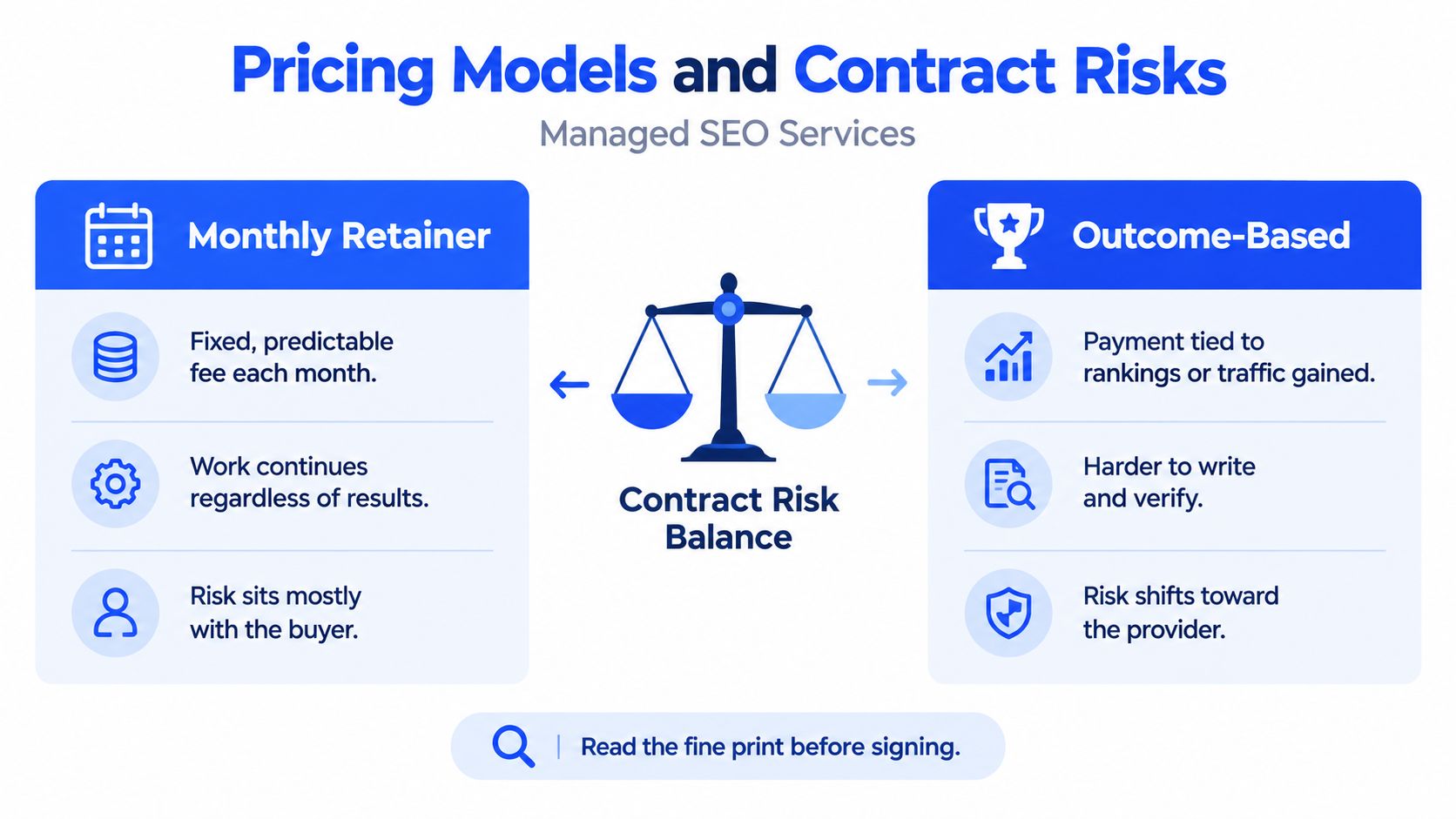
A monthly retainer buys capacity, not accountability. You pay a fixed amount, the agency chooses a changing mix of tasks, and results may arrive later or remain difficult to connect to revenue. Predictable billing helps with budgeting, but it does not prove that the work will increase qualified sales.
A survey of 439 providers reported average monthly retainers of USD 3,209 for SEO agencies and USD 3,250 for consultants, with 78.2% of providers billing monthly. The SEO services market overview offers a useful reference point, not a reason to accept any quote. A higher fee can make sense when the provider handles difficult implementation. A lower fee is still wasteful if nobody owns the commercial result.
What the contract should settle
Specify the work, decision rights, reporting method, access requirements, and review points. The agreement should also explain what happens when your team delays approvals, withholds assets, or fails to implement technical recommendations. Without those terms, an agency can blame execution gaps on your shop while continuing to invoice.
Outcome-based pricing shifts more risk toward the provider, but verification becomes harder. Define the search location, device, query, measurement tool, baseline, qualifying period, volatility rules, exclusions, and remedy. “More visibility” is not an outcome. “Top placement for a defined query under an agreed measurement method” is closer, but the contract still needs protection against temporary or commercially useless rankings.
Review the provider's pricing information after you understand those conditions. The fee matters less than the evidence required to earn it.
Retainer or performance-linked campaign
Choose a retainer when your domain needs ongoing work across technical SEO, content, authority, and conversion paths. Choose a fixed-term campaign when one page, product, or query has clear commercial value and you want a bounded test before expanding the relationship.
Performance pricing is not automatically safer. A provider can target easy phrases, manipulate the reporting window, or celebrate rankings that produce no buyers. Require qualified queries, transparent tracking, access to the data, and a remedy tied to missed obligations. That structure makes accountability contractually visible instead of leaving it to agency promises.
Broad Agency Retainers vs Niche Ranking Campaigns
A large retainer is often the wrong purchase for a shop with one visibility problem. Broad agencies and niche ranking campaigns solve different problems, so match the contract to the outcome you need rather than accepting a long feature list.
Consider an Etsy shop with a seasonal listing that fails to appear for a specific buyer phrase. A full-service agency may review the entire shop, product taxonomy, content, promotion, analytics, and brand presence. That scope makes sense when several structural problems need attention and the owner wants an ongoing marketing partner. It is excessive when one listing is the commercial priority.

A niche campaign begins with one listing and one agreed search phrase. It concentrates work on the factors tied to that placement objective. Etsy says relevancy depends on how closely tags, titles, descriptions, and attributes match the query. Engagement includes clicks, views, favorites, and purchases. New listings receive a temporary boost, while renewed listings receive a smaller one. Etsy's explanation of how search works gives sellers a practical framework for assessing that process.
The trade-off is focus versus coverage
Choose broad coverage when your shop needs coordinated work across content, technical fixes, internal linking, local visibility, or several conversion paths. The risk is diluted accountability. Your highest-value listing can become one task among many, while the retainer continues regardless of its commercial progress.
A niche provider fits a launch, seasonal product, or flagship listing with a defined query objective. Set a fixed scope, a clear end date, and independent measurement. Do not treat this format as a substitute for shop-wide merchandising, product quality, or customer service.
Etsy's Shop Manager includes a search-visibility view covering shop quality, listing quality, and customer service quality. Sellers can filter listings for search-improvement issues through that view, as described in Etsy's seller checklist. Run that diagnostic before hiring anyone. It can show whether the listing needs focused ranking work or whether broader shop problems come first.
Account security also matters. Require a precise explanation of needed access and any external promotion. Upglider is one example of a focused Etsy service targeting one listing for one agreed phrase, with campaign terms covering a 30, 90, or 180-day period, a stated top-15 objective, and no automatic renewal. Judge those terms as a contract, not a sales promise. For a broader comparison, review these ecommerce SEO service options before choosing between a retainer and a focused campaign.
Evaluating Guarantees and Accountability
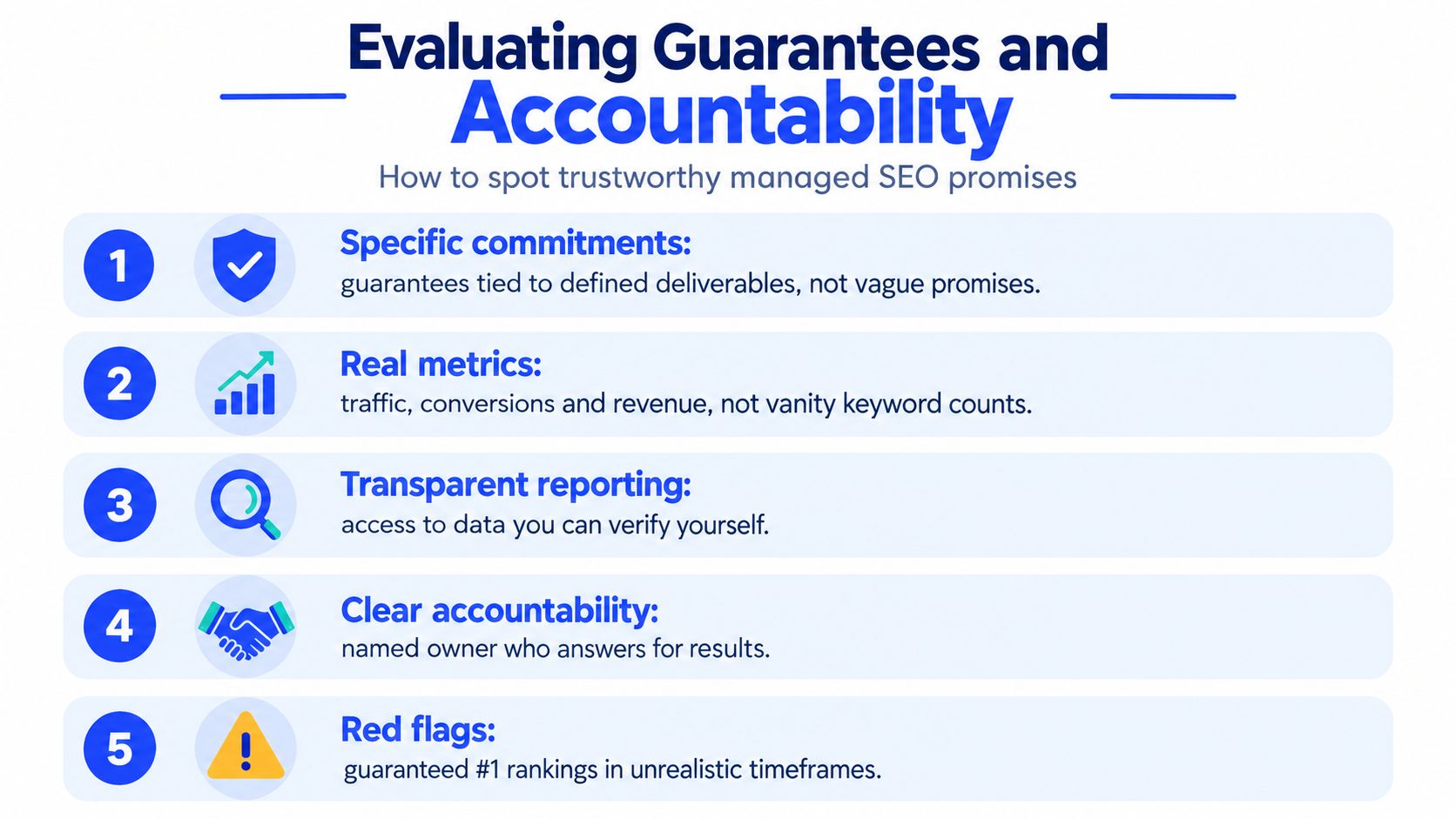
A guarantee has value only when the contract defines the target, measurement, and remedy. The word “guaranteed” proves nothing by itself. Treat every promise as a testable commercial obligation, especially when a provider sells a narrow ranking campaign instead of ongoing shop-wide work.
Start with the exact commitment. A first-page guarantee needs a named query, location, device, timeframe, and measurement method. Without those details, the provider can redefine success after the campaign begins. A ranking screenshot is weak evidence if you cannot reproduce the search or inspect the underlying data.
Five tests for a serious promise
Demand specific commitments. The agreement should list the deliverables and visibility objective. “Optimize your presence” is too vague to enforce.
Measure business value. Rankings matter, but sales and qualified actions matter more. Ask how the provider tracks organic CTR, leads, purchases, or revenue when the setup supports that measurement.
Verify the data yourself. Require access to the reporting source or a reproducible method. You should not rely on a private dashboard to confirm whether the provider met its claim.
Name the accountable owner. One person must own decisions, explanations, and missed commitments. A generic support inbox is not accountability.
Reject impossible timelines. A promised top ranking within an unrealistic timeframe signals risk, particularly if the provider will not explain query difficulty or platform constraints.
Compare those tests against a published guarantee page with defined targets and remedies. It should name the target, measurement method, and consequence if the provider misses the commitment.
The strongest guarantee is narrow enough to test and clear enough to enforce.
Search visibility now includes AI-generated answers, zero-click results, structured information, authoritative content, brand mentions, entity relationships, and traditional keyword positions. Analysts at Coherent Market Insights identify voice and visual search SEO as a segment projected to grow at a 20.10% CAGR through 2031 in Coherent Market Insights' SEO services market analysis.
Do not accept vague AI visibility promises. Ask which surfaces the provider monitors, what evidence it records, and how answer-engine representation connects to commercial goals. A report limited to legacy keywords misses important discovery through answers, images, voice, and marketplaces.
Vetting Questions to Ask Before Hiring
Use the sales call to test operational depth, not personality. A polished presentation can hide a weak process, while precise answers reveal whether the provider has thought through execution and measurement.
Ask these questions before you discuss a long-term commitment:
What business outcome are you targeting? Make the provider connect the work to product sales, qualified leads, signups, or another defined result.
Which pages or listings come first? A credible roadmap prioritizes commercial value and feasibility instead of promising to improve everything at once.
What will you change directly? Get a clear answer about technical fixes, content, internal links, listing edits, promotion, and approvals.
How do you report Core Web Vitals and organic CTR? The provider should explain the source, reporting period, and interpretation rather than send unexplained charts.
How do you track downstream completions? Ask whether demo requests, downloads, signups, purchases, or calls can be connected to organic visits.
Who performs the work? Find out whether the strategist, writer, technical specialist, and account contact are the same people or separate layers.
What governance do you use? Ask how the team records changes, handles approvals, preserves an audit trail, and limits access through role-based controls.
What happens if results stall? The answer should cover diagnosis, strategy changes, pause rights, or a contractual remedy.
What do you need from my shop? If a provider asks for broad access, understand why. For a marketplace campaign, ask whether a public listing URL and search phrase are sufficient.
Can you define the target for one page or listing? A provider that can't scope a focused test will struggle to give a credible full-site plan.
Look for evidence, not volume
A monthly deliverables list can be useful, but activity isn't proof of value. Ten published articles may be less useful than one properly improved category page if that page serves a high-intent query and converts visitors.
Ask for a sample report with sensitive information removed. Look for baseline comparisons, explanations of changes, organic CTR, impressions, Core Web Vitals, engagement, goal completions, and a record of work completed. If all you see is ranking movement, ask why the provider hasn't connected visibility with customer behavior.
If the provider can't explain what changed, why it changed, and what you should do next, the report is decoration.
Choosing the Right Path for Your Business
Choose based on the problem, not the label. “Managed SEO” can describe a full outsourced department, a consultant-led retainer, or a focused campaign for one commercial query. Your contract should match the size and shape of the visibility gap.
A new e-commerce shop usually needs foundations first. Fix product structure, search relevance, customer-facing quality, analytics, and the pages closest to purchase. DIY can work while the catalog is small and the owner has time. Outsource when technical work, content production, or competitive research begins to delay shop operations.
A stagnant flagship product calls for a narrower test before a broad retainer. Define the query, confirm the listing or page is worth promoting, agree on measurement, and set an end date. If the test produces useful evidence, expand. If it doesn't, you've limited the financial exposure and learned where the bottleneck sits.
An enterprise content hub is a different purchase. Multiple teams, technical dependencies, international pages, structured data, governance, and conversion paths require ongoing coordination. A long-term managed program is more appropriate, but only with clear owners, change control, reporting access, and business-level measurement.
A practical decision rule
Choose DIY when the work is narrow, your team can execute it, and you can measure the effect.
Choose a niche campaign when one listing, product, page, or query has a defined commercial objective.
Choose a broad retainer when your domain needs continuous technical, content, authority, and conversion work across many assets.
Avoid any model that charges indefinitely while defining success only through activity or vague ranking movement.
Don't sign a subscription because an agency says SEO takes time. Sign when the provider can show what it will do, how you'll verify it, who owns the result, and when the agreement will be reviewed. Get a written scope, a measurable baseline, access to the reporting data, and a cancellation or remedy clause before work begins. If your immediate need is one Etsy listing or one search phrase, request a pre-payment assessment and a fixed-term proposal first. That discipline will tell you more about the provider than another package comparison ever will.
Ask for a managed SEO proposal that names your target pages or listings, defines the measurement method, and states exactly what happens if the agreed objective isn't reached. Start with a bounded campaign when your need is narrow, or request a full operational roadmap when your site requires continuous growth work.