You've finished a listing, the photos are ready, and a seasonal selling window is approaching. But you're still staring at a keyword box, wondering whether shoppers would search for the material, the occasion, or the person receiving it. An Etsy free keyword tool can help you choose a descriptive phrase to investigate. It can't tell you that pasting that phrase into your listing will earn a prominent position.
Why an Etsy Free Keyword Tool Comes First
Suppose you're preparing to sell a handmade linen table runner. Your starting list might include table decor, linen runner, wedding table decoration, and farmhouse dining room. All sound plausible, but they describe different shopping needs.
The useful question isn't which phrase sounds most impressive. It's which phrase describes the item the shopper expects to find. Someone decorating a wedding venue may need something different from someone replacing an everyday dining-table runner.
Free keyword research helps you separate those possibilities before you rewrite the listing or spend money promoting it. Treat the tool as a place to discover and organize shopper language, not as a full marketing plan.
Start with the audience you can serve
Etsy reported 86.5 million active buyers and 5.6 million active sellers in its full-year 2025 results, with active buyers down 3.4% and active sellers down 1.5% year over year, according to Etsy's full-year marketplace results.
Those totals describe the marketplace's scale. They don't measure demand for linen runners, searches in a particular country, or interest during a wedding season.
For your listing, the practical lesson is narrower: you don't need to address everyone shopping on Etsy. You need wording that helps the right shoppers recognize what you sell.
Product language: Describe what someone can buy, such as a linen table runner.
Use language: Consider where it belongs, such as a dining table or wedding reception.
Style language: Add a relevant visual distinction, such as rustic or minimalist, only when the item supports it.
Research before rewriting
Before opening a tool, write down what makes the product different. Then use research to compare phrases built from those details.
For the hypothetical runner, natural linen table runner and rustic wedding table runner deserve separate consideration. They express different reasons to buy, whereas repeatedly rearranging linen and runner may add little to your understanding.
Practical rule: Leave your research session with a manageable set of accurate phrases, not a large collection of words you feel obliged to use.
The immediate result is a clearer direction for the listing. You're deciding whom it should speak to before deciding how much visibility to pursue.
How Etsy Search Uses a Phrase
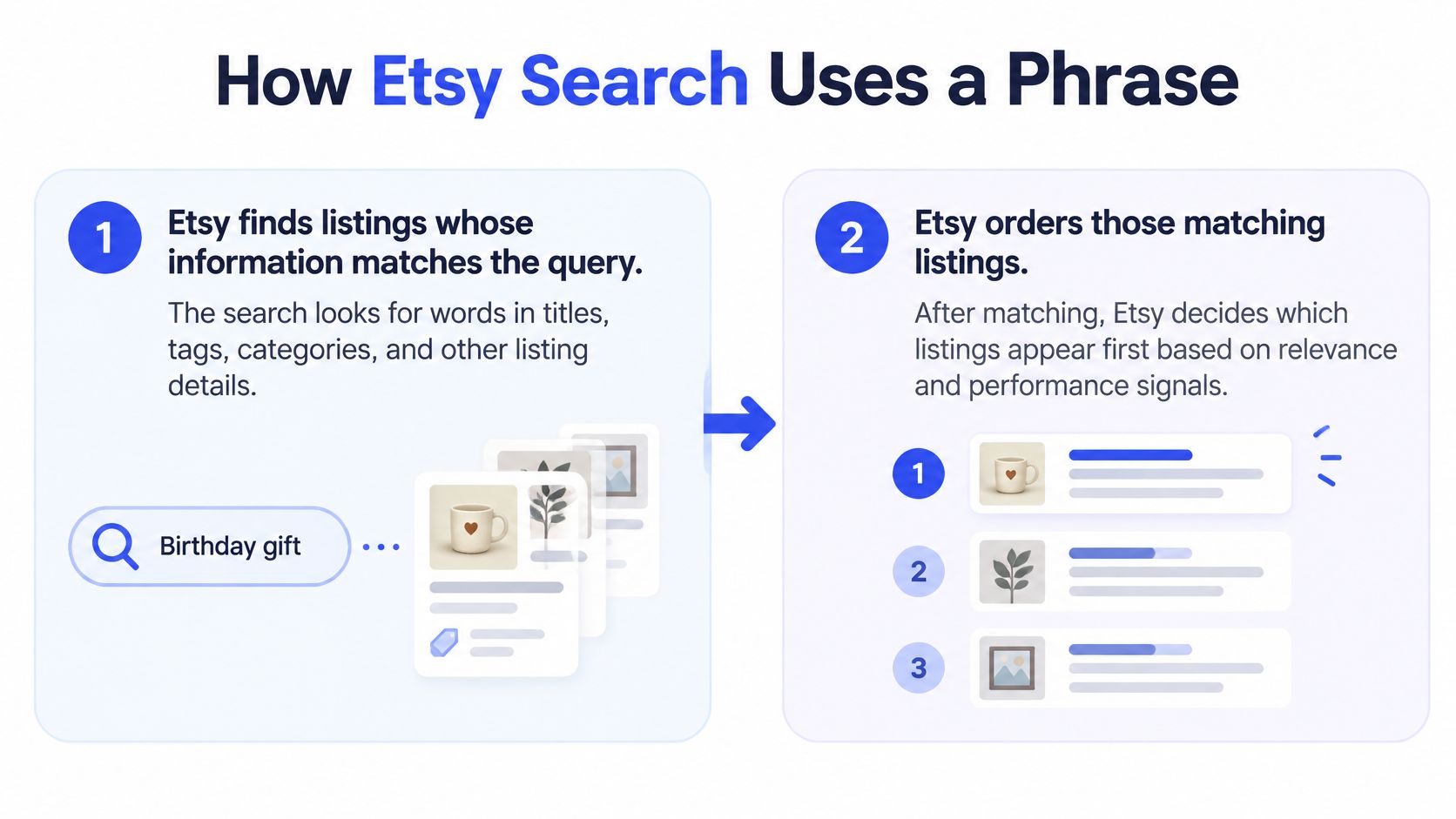
Etsy search works like a selection desk followed by an ordering desk. The selection desk finds listings that match the shopper's request. The ordering desk decides which of those matches should appear ahead of others.
That distinction matters because matching creates an opportunity to appear, not a reserved position. Etsy describes these broad stages in its explanation of how Etsy search works.
Give each listing field a job
A phrase doesn't have to do all its work in a tag. Etsy considers information across the listing, so think about where each detail belongs.
Title: Identify the product clearly and include wording that a shopper can understand without decoding a keyword list.
Tags: Supply relevant search phrases and complementary descriptions.
Category and attributes: State what the item is and record applicable characteristics, such as material or color.
Description: Explain the product naturally, including useful wording within sentences that answer buying questions.
Consider tote bag versus embroidered canvas tote bag. The longer phrase tells the shopper more about the product and gives you a clearer standard for deciding whether it belongs in the listing. A recipient or occasion can add further meaning, but only if it fits.
Translate suggestions instead of pasting blindly
Etsy limits tags to 20 characters and recommends specific, multi-word phrases, while advising sellers to write naturally rather than repeat titles or fill descriptions with keyword lists in its shop and listing SEO guidance.
A useful suggestion may therefore be too long for a tag. That doesn't make it a bad research phrase. It means you need to decide whether the full wording belongs in the title and whether shorter, meaningful components belong elsewhere.
Don't shorten it into an awkward string just to make it fit. Likewise, don't force a material or occasion into the description if it changes what the product appears to be.
The placement map is straightforward: use the title to identify, tags to describe additional relevant searches, structured fields to specify, and the description to explain. Accuracy comes before repetition. A listing should still read like something written for a person who might buy it.
What Free Keyword Data Can Show
The most useful demand information comes from the marketplace where you want to sell. Before trusting an Etsy free keyword tool, ask whether its numbers describe Etsy searches, estimates from an outside database, or something else.
Etsy's Marketplace Insights uses real Etsy search data to show how often buyers search terms and how many items are available for those searches. Etsy also describes Search Analytics information covering visibility-generating queries, matched tags, search conversion, and average search position in its guidance on search data and keyword research.
What a Free Etsy Keyword Signal Means
Signal | What it tells you | What it does not prove |
|---|---|---|
Search demand | How frequently a term was searched within the reported scope | That those shoppers want your particular item |
Available listings | How many items are available for that search | That every competing item is equally relevant or strong |
Related phrases | Other wording worth investigating | That every suggestion accurately describes your product |
Average search position | A way to observe placement in the reported data | A permanent position for every shopper |
Search conversion | Whether search visits led to purchases | That the keyword alone caused the outcome |
Demand and available listings support an opportunity check, not a ranking forecast. A phrase with meaningful demand and fewer competing listings may deserve attention, but you still need to inspect what buyers appear to mean by it.
Open the live results and compare the products, not just the wording. If a search for a table runner mainly shows products unlike yours, a favorable-looking metric won't resolve that mismatch.
Turn output into a research record
Record candidate phrases in a simple document or spreadsheet. Keep the tool's reported scope beside the data so you don't later mistake a recent observation for a lasting pattern.
Combine duplicates: Group minor spelling or wording variants so they don't distract from different buyer needs.
Label the intent: Mark whether each phrase describes product type, material, recipient, occasion, or style.
Record uncertainty: Note anything you still need to check, such as whether shoppers expect personalization.
Longer, more specific phrases can help you investigate clearer buying intent. They aren't automatically better because they're longer.
A useful keyword is a plausible route to a suitable shopper, not merely a phrase with an attractive number beside it.
After implementation, use your own search performance to reassess the choice. The tool proposes candidates; shopper behavior helps you decide which candidates deserve to stay.
Turn Suggestions into Listing Phrases
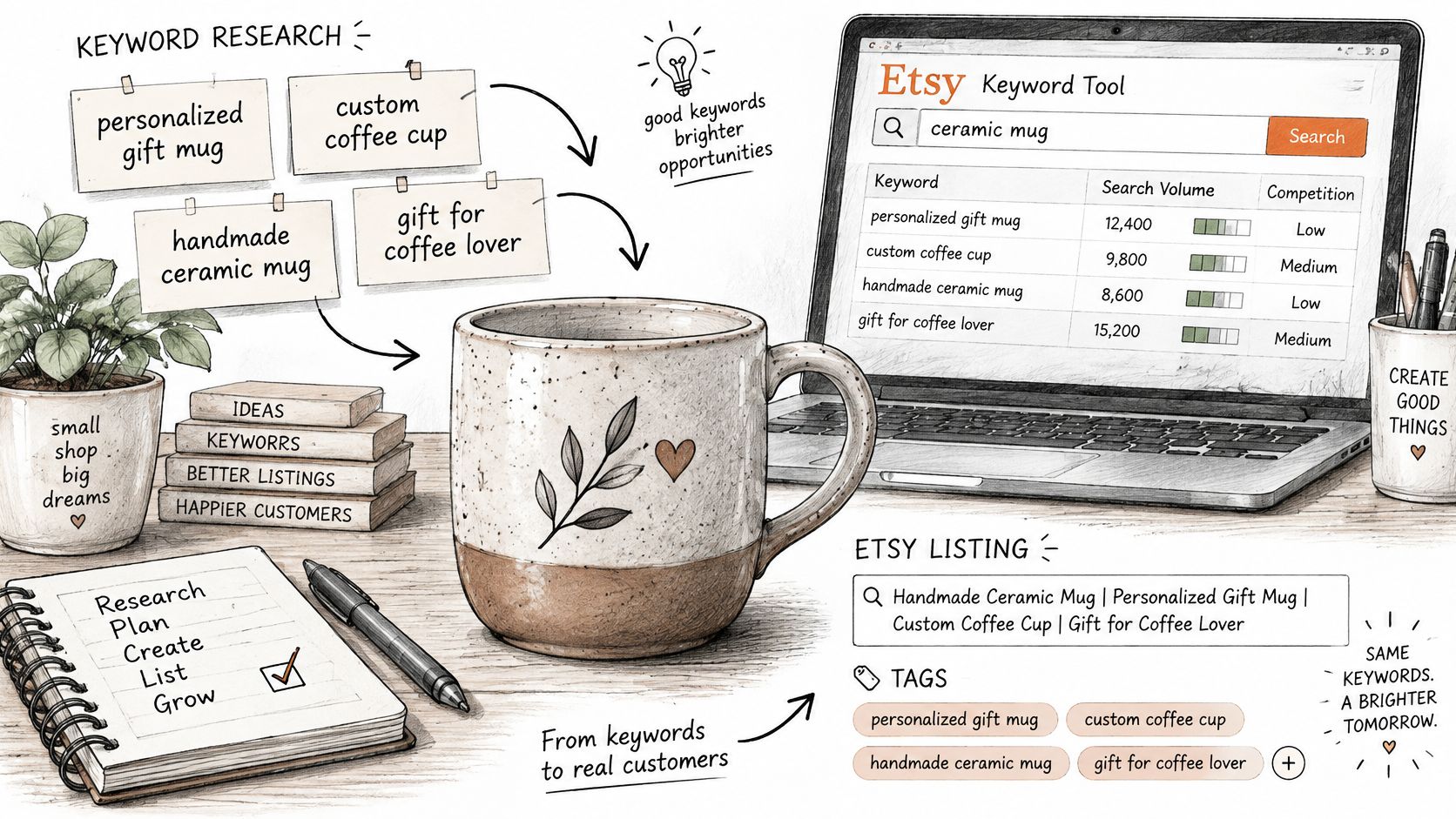
Consider a hypothetical handmade blue ceramic mug with no personalization option. Its possible phrases might include blue ceramic coffee mug, handmade pottery gift, personalized teacher mug, and ceramic mug for tea.
These aren't equally suitable. The personalization phrase promises an option the seller doesn't offer, so it should be removed before comparing demand.
Keep different reasons to buy
The surviving phrases express useful distinctions. Blue ceramic coffee mug describes appearance, material, and use. Handmade pottery gift describes a buying purpose. Ceramic mug for tea describes another use the product may support.
Keep those distinctions visible in your notes rather than treating every phrase containing mug as interchangeable. The Etsy keyword research guide provides a broader starting point for organizing product language and candidate searches.
For this example, a natural title could be Blue Ceramic Coffee Mug, Handmade Pottery. That's illustrative listing copy, not a claim that the phrase has verified demand.
Place the wording where it fits
Title wording: Keep the main product identity easy to read. Don't append every surviving phrase just because the tool suggested it.
Tag wording: Blue ceramic mug and pottery gift are possible components that fit the tag constraint discussed earlier.
Category and attributes: Select the category that accurately describes the mug and fill applicable material and color details.
Description wording: A sentence such as “This handmade blue ceramic mug is made for your everyday coffee or tea” explains the item without copying the title mechanically.
The phrase handmade pottery gift still needs judgment. It may describe a reasonable use, but it shouldn't crowd out concrete product information or imply gift packaging that isn't included.
The practical score isn't the length of the keyword export. It's the range of distinct, accurate shopping needs the listing addresses.
Check relevance before promotion
Use this editorial checklist before committing to a campaign:
Specific enough: Choose a phrase of at least three words rather than a broad product label.
Visible evidence: Confirm that the photos, materials, and attributes support the wording.
Comparable results: Check that similar items already appear for the phrase.
No hidden promise: Remove wording that implies an unavailable feature, format, quantity, or customization.
If the phrase fails that check, revise the target before paying to bring more shoppers to the listing.
Why a Busy Phrase Can Be the Wrong Target
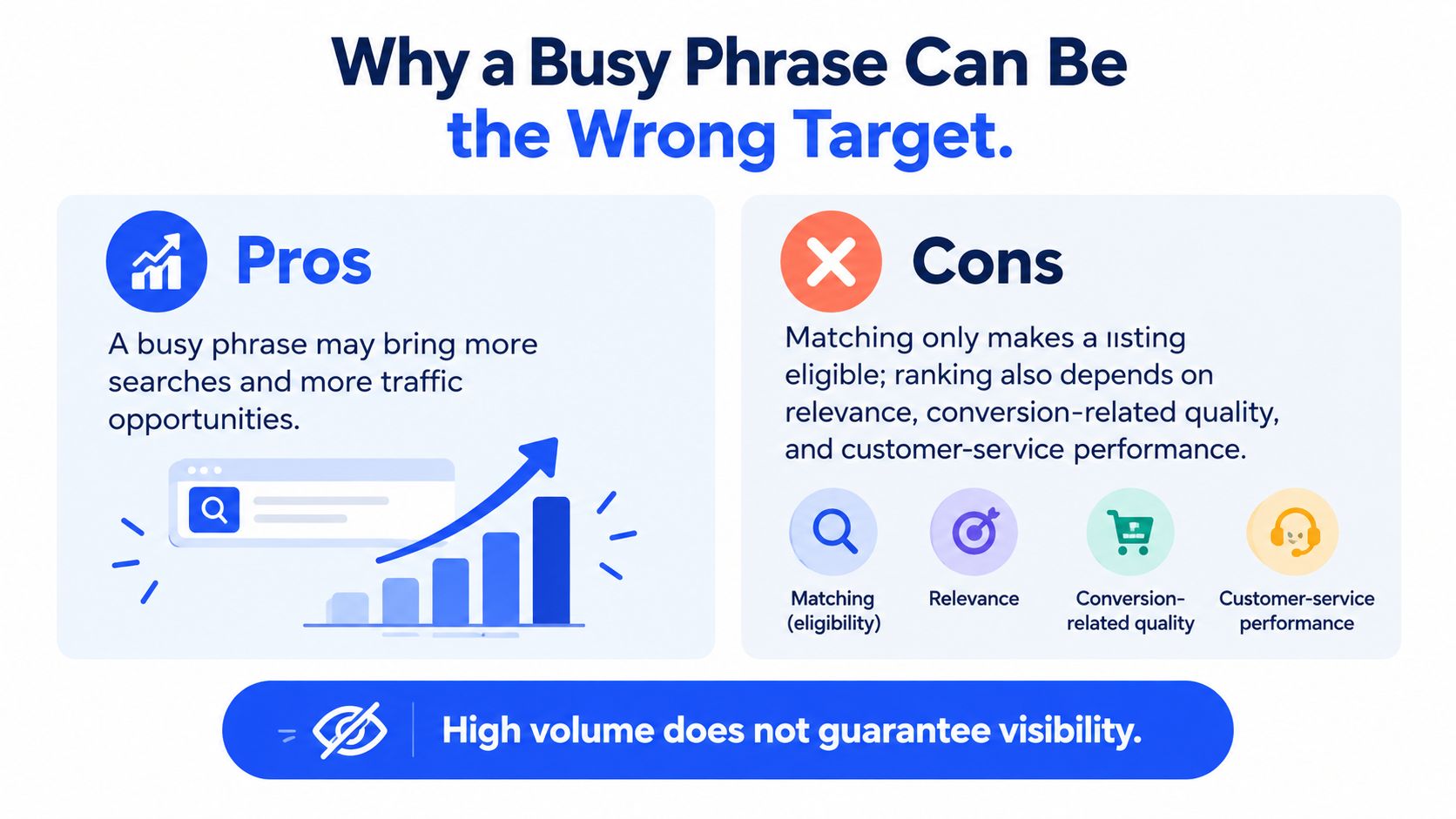
A popular phrase can be a poor choice for a particular item. If shoppers expect a personalized gift and you sell a ready-made product, greater search activity doesn't make the mismatch less important.
Etsy considers more than keyword relevance when ordering results, including conversion-related quality and customer-service performance, as described in its search-ranking guidance. Etsy also identifies engagement signals such as clicks, views, favorites, and purchases in its explanation of listing relevance and engagement.
Spend limited searches on different questions
Marketplace Insights reports searches and listings from the previous 30 days, while free access allows up to 15 keyword searches per week, according to Growtsy's explanation of Etsy keyword research limits.
That recent window helps prioritize ideas. It doesn't establish stable annual demand or give you unlimited room to investigate products, languages, and seasonal variations.
Use each search to answer a different question. Compare a material-led phrase with an occasion-led phrase, for example, rather than repeatedly checking slight rearrangements of the same words.
Check the calendar: Ask whether the observed interest could reflect a short seasonal window.
Inspect the first page: Compare how directly the visible products answer the search.
Consider the destination: Check whether your wording, shipping offer, and product details suit the audience you intend to reach.
Reject popularity when fit is weak
For a seasonal item, a recent rise may be useful if you can serve that buying window. It's less useful if your production and delivery arrangements don't match the occasion.
Regional interpretation deserves similar care. Don't assume that apparent demand translates cleanly across countries or languages. Treat audience fit as something to verify, not something the volume figure settles.
Decision filter: Pass on a busy phrase when you can't meet the shopper's likely expectations or the visible results offer substantially closer matches.
A more specific alternative may be worth investigating. Use the guide to Etsy long-tail keywords to develop alternatives without assuming that narrower wording guarantees easier rankings.
Choose Research or a Ranking Campaign
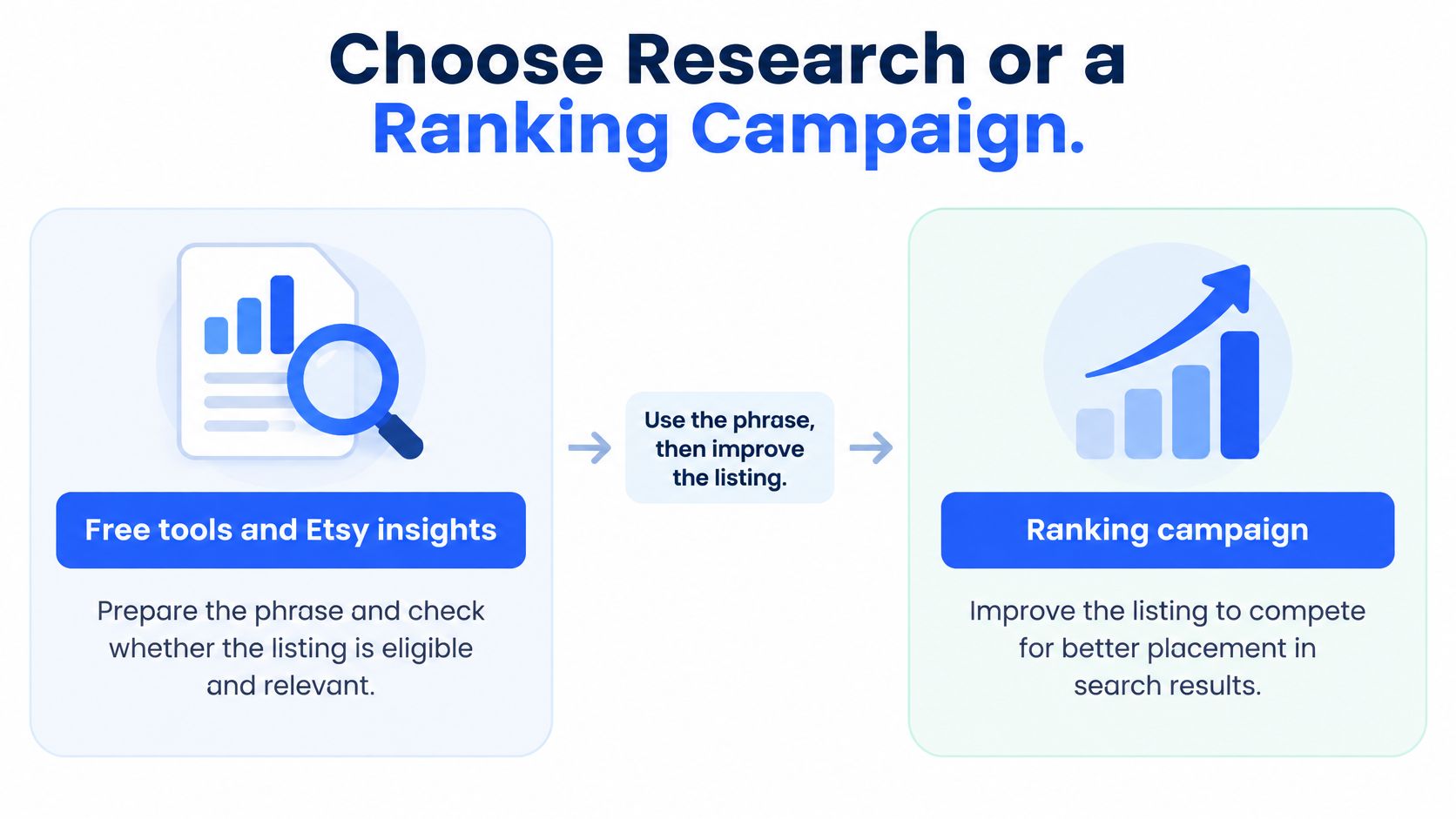
Free research, do-it-yourself optimization, and a focused ranking campaign solve different problems. The right choice depends on whether you're still selecting the phrase, improving the listing, or seeking help pursuing a defined placement objective.
A free tool supplies research evidence. It doesn't take responsibility for your listing copy, evaluate every competing product, or maintain a search position.
Match the approach to the job
Approach | What you use it for | What remains your responsibility |
|---|---|---|
Free research | Discover and compare plausible phrases | Decide whether the evidence supports your product |
Do-it-yourself optimization | Edit listing information and assess performance | Monitor results, diagnose weak matches, and revise |
Focused ranking campaign | Pursue an agreed placement objective for a selected listing | Review terms and keep the product offer accurate |
With the do-it-yourself route, you retain direct control over edits and testing. You also take on the learning: watching impressions, clicks, conversions, and average position, then deciding whether the problem is the phrase, the presentation, or the offer.
That work can be worthwhile if you want to understand search yourself. If you'd rather delegate a narrow ranking task, evaluate a provider against a clearly defined scope.
Understand the campaign boundary
Upglider offers one listing per campaign for an agreed phrase of three or more words, with a top-15 objective within 9–21 days after confirmed payment, placement maintenance during a one-time 30-, 90-, or 180-day campaign without automatic renewal, and a money-back guarantee if the agreed top 15 isn't reached within 21 days.
The service assesses the listing and proposed keyword before payment and provides status updates through a dashboard. It works through external promotion using the public listing URL, without requesting Etsy passwords or editing the shop.
It's an independent provider, not affiliated with or endorsed by Etsy. Its scope doesn't include shop redesign or ads management, and a ranking objective shouldn't be read as a sales guarantee.
Review the Etsy ranking service explanation alongside the actual terms before deciding. Pay particular attention to how position is measured, what maintenance covers, and how the guarantee operates.
The distinction is practical: research helps you choose a target; optimization improves your listing; a focused campaign pursues an agreed ranking outcome. None removes your responsibility to sell an accurately described product.
Prepare One Phrase Before You Pay
Create a short decision record for the listing you want to promote. Include its public URL, the proposed phrase, the relevant product details, and your reasons for believing the phrase fits.
This isn't extra paperwork for its own sake. It stops you from drifting between unrelated targets or choosing a different phrase every time another metric looks appealing.
Record evidence and uncertainty separately
Keep observations separate from conclusions. A tool's demand count is an observation. Your belief that the listing can compete is a judgment that needs support from the product and the live results.
Product evidence: Note which photo, material detail, or attribute supports the target wording.
Demand evidence: Record the demand and competing-listing information you can access, including its reporting window.
Results-page evidence: Describe whether the visible products resemble yours and what expectations they establish.
Open questions: Flag seasonal dependence, regional wording, delivery suitability, or features you haven't verified.
Don't invent a minimum acceptable volume or a universal competition cutoff. The available evidence doesn't establish either. Your decision should reflect the relationship between demand, product fit, and the competing offers you can inspect.
Choose the next action deliberately
Return to research if the phrase is too broad, depends on a selling window you can't serve, or implies something your item doesn't provide. Paying for promotion won't fix an unsuitable promise.
Continue independently if the phrase fits and you want to learn through direct observation. Place the wording naturally, keep a record of your edits, and assess query-level conversion and average position where those reports are available.
Request a pre-payment assessment if you prefer external help with the defined ranking task. Read the measurement method, campaign length, maintenance terms, and guarantee before making a commitment, and preserve control of your seller account.
The useful endpoint isn't a perfect tool score. It's a phrase you can defend with product evidence and a clear decision about what to do next.
Choose a listing today, write down a specific phrase that its photos and attributes support, and compare it with the live search results. If the fit remains uncertain, keep researching for free. If it holds up, either implement it yourself or submit the public listing URL and proposed phrase for an assessment before paying for a time-bound campaign.