You've launched a product you're proud of. The photos are sharp, the description is clear, and the item still sits deep in Etsy search where few buyers will find it. At that point, an Etsy ranking service can sound attractive, but the wrong provider can put your shop security, budget, and reputation at risk.
A ranking campaign should be treated as a narrow visibility project, not a magic sales button. The provider should target one listing, one realistic search phrase, and one measurable objective, while leaving your Etsy credentials under your control. The safest decision comes from understanding exactly how the work is performed and what the provider can prove.
Understanding the Etsy Ranking Service Model
An Etsy ranking service promotes one listing for a selected search phrase. Its job is narrower than shop administration, content management, social scheduling, or broad marketing across email, advertising, and branding. That narrow scope is useful because you can judge the work against a defined listing, keyword, timeframe, and ranking objective.
Etsy search is crowded. The marketplace reported 5.6 million active sellers, 86.5 million active buyers, and $10.4607 billion in marketplace gross merchandise sales in 2025 in its full-year results. Strong products can still receive limited exposure when competing listings fill the same buyer search.
What the service changes
A focused provider should help you make three decisions:
Which listing deserves support? Select a product with clear buyer intent, strong photography, viable pricing, and enough margin to justify promotion.
Which phrase should attract buyers? Choose a specific multi-word query that matches the listing instead of chasing a broad, highly competitive term.
What result counts as success? Set the ranking position, measurement method, campaign length, and refund conditions before payment.
Security belongs in the operating model. The provider should work from a public listing URL and agreed search phrase, not your Etsy password or two-factor authentication code. Do not grant shop access merely because a seller promises faster results. Ask how visits are generated, what reporting you receive, and whether the provider can separate rankings from clicks, favorites, orders, and revenue.
External promotion may improve a listing's opportunity to be seen, but Etsy controls the result. Its search, ads, and recommendation policy identifies factors such as relevance, listing quality, customer experience, recency, shipping, language, and shopper personalization.
A campaign cannot repair weak photos, slow fulfillment, poor reviews, or an unclear offer. Treat ranking as a visibility test, not a sales guarantee.
For wider context, compare a focused campaign with an ecommerce SEO service. Choose broader support when your catalog needs work. Choose a ranking campaign when one flagship, seasonal, or stagnant listing needs a controlled visibility push.
How Focused Ranking Campaigns Operate
A professional campaign should be easy to describe in one sentence. It targets one Etsy listing for one agreed search phrase, then tracks whether that listing reaches and maintains the intended position.
The Upglider operating model provides a useful benchmark for what a focused package can look like. Its stated scope is one listing and one phrase of three or more words, with a top-15 ranking objective within 9 to 21 days, followed by position maintenance during a selected 30, 90, or 180-day campaign. Those are provider-specific terms, not a universal Etsy standard, so you should compare any offer against its written agreement.
The normal campaign sequence
A credible process should include these stages:
Case assessment: Before payment, the provider reviews the listing, phrase, and competitive difficulty. If the phrase is unrealistic, the provider should say so.
Scope confirmation: You approve the exact listing URL, target phrase, campaign duration, ranking definition, and refund conditions.
External execution: The provider works without your Etsy password. A public listing URL and agreed keywords should be sufficient for a campaign that doesn't require account edits.
Progress reporting: A dashboard or written status update should show what has happened, what remains, and how ranking is being measured.
Final accountability: The provider reports the outcome against the agreed target, rather than replacing a missed ranking objective with vague exposure metrics.
This structure is far safer than handing over shop access and hoping the provider knows what it's doing. Account access also creates operational risk. A provider could change titles, tags, prices, images, policies, or customer-facing settings without your timely approval.
Security rule: If a provider needs your Etsy password to “boost rankings,” stop the conversation and ask why the campaign can't be performed externally.
The guide to getting an Etsy listing on the first page can help you understand the difference between a ranking objective and a general visibility promise. The important point is control. You should know what is being promoted, how success is checked, and when the work ends.
No automatic renewal is another useful safeguard. A fixed campaign lets you review ranking stability, clicks, orders, and profit before deciding whether another campaign makes commercial sense.
Comparing Ranking Services to DIY SEO and Etsy Ads
A seller with one seasonal product has three workable paths: improve Etsy SEO independently, buy Etsy Ads, or hire an external ranking service for a defined listing and phrase. The choice should follow the business problem. DIY work suits shop-wide improvement, Ads provide immediate paid exposure, and an external campaign offers a controlled test for one product.
DIY SEO requires time instead of a provider fee. You research buyer language, improve titles and tags, write useful descriptions, choose accurate categories and attributes, then monitor listing quality. Etsy's keyword guidance recommends multi-word phrases, long-tail keywords, and tags of up to 20 characters. The work builds your team's operating skill and can improve several listings, but it does not give you a fast answer when you need to test one product quickly.
Etsy Ads buy native placement within Etsy. They suit sellers who want immediate testing across selected listings and can monitor a daily budget. The trade-off is direct: paid placement ends when payment stops. Ads can show which products and phrases attract attention, but they do not automatically create lasting organic placement.
An external ranking campaign serves a narrower purpose. It seeks stronger organic visibility for an agreed listing and phrase during a defined period. That fits a flagship product, new release, or seasonal item with a clear sales window. It does not repair weak listing fundamentals, poor conversion, or wider shop problems.
Visibility strategies compared
Strategy | Primary Focus | Cost Structure | Best Use Case |
|---|---|---|---|
DIY SEO | Listing and shop optimization | Your time and learning effort | Long-term shop health and repeatable skills |
Etsy Ads | Paid Etsy visibility and testing | Ongoing budget while ads run | Immediate exposure and broad product testing |
Ranking service | One listing and one target phrase | Fixed campaign fee, if terms are clear | A targeted, time-bound organic visibility push |
Use DIY SEO when listings need basic work. Use Etsy Ads when you need fast market feedback and can watch spending closely. Choose an external service only after you can state the exact listing, phrase, commercial reason, measurement window, and success condition. Keep the campaign separate from your Etsy credentials, and treat a dashboard full of impressions as weak evidence unless it also shows the target phrase and observed position.
Ranking is not revenue. Etsy reported $668 million in Q2 2026 revenue, $2.6 billion in marketplace GMS, and 87 million active buyers in its stand-alone marketplace. GMS per active buyer reached $124 in the same period, according to Etsy's Q2 2026 earnings call transcript. Those figures show the value of qualified traffic, while the product page still has to convert that attention into sales.
Evaluating Providers and Spotting Red Flags
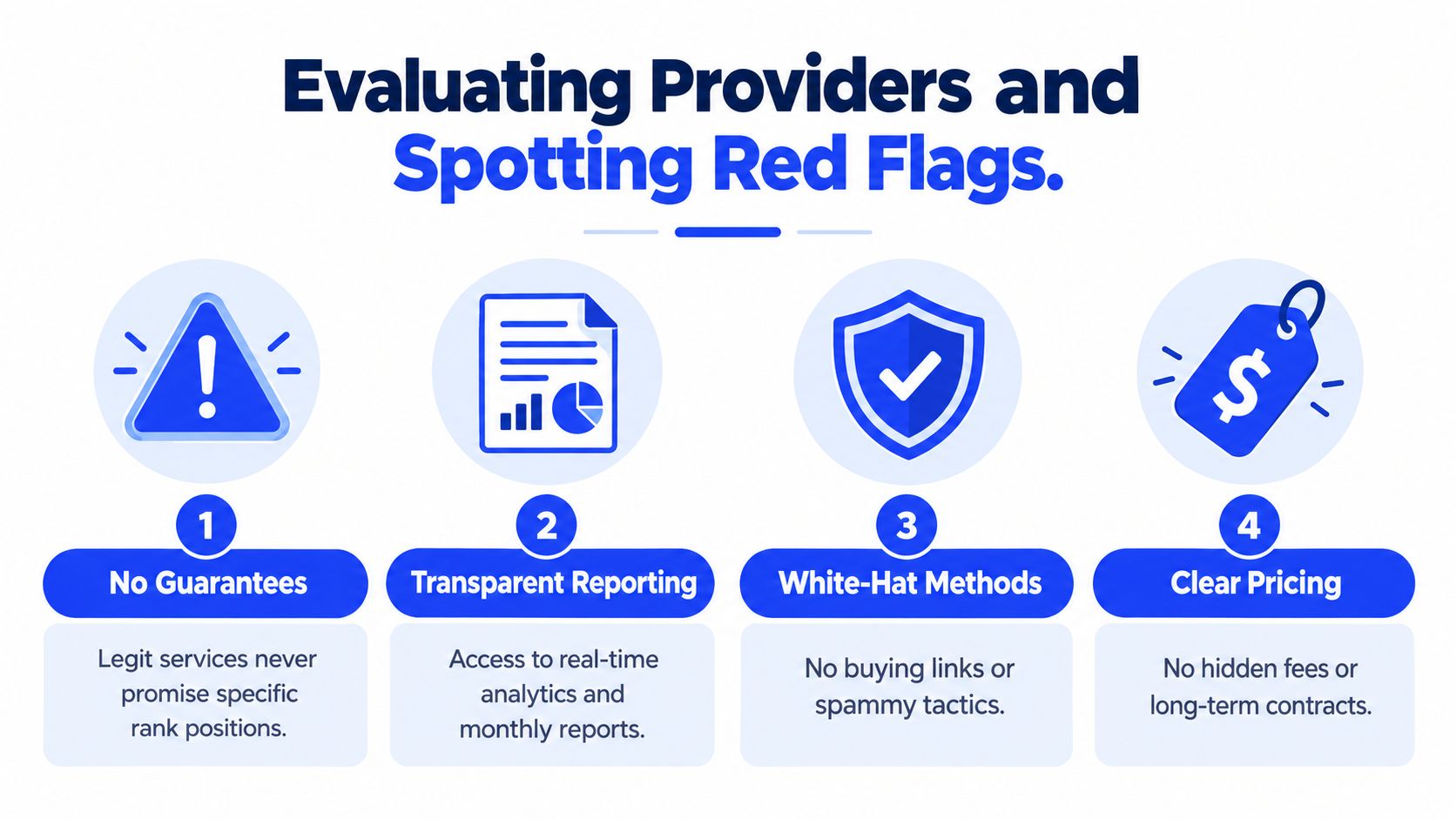
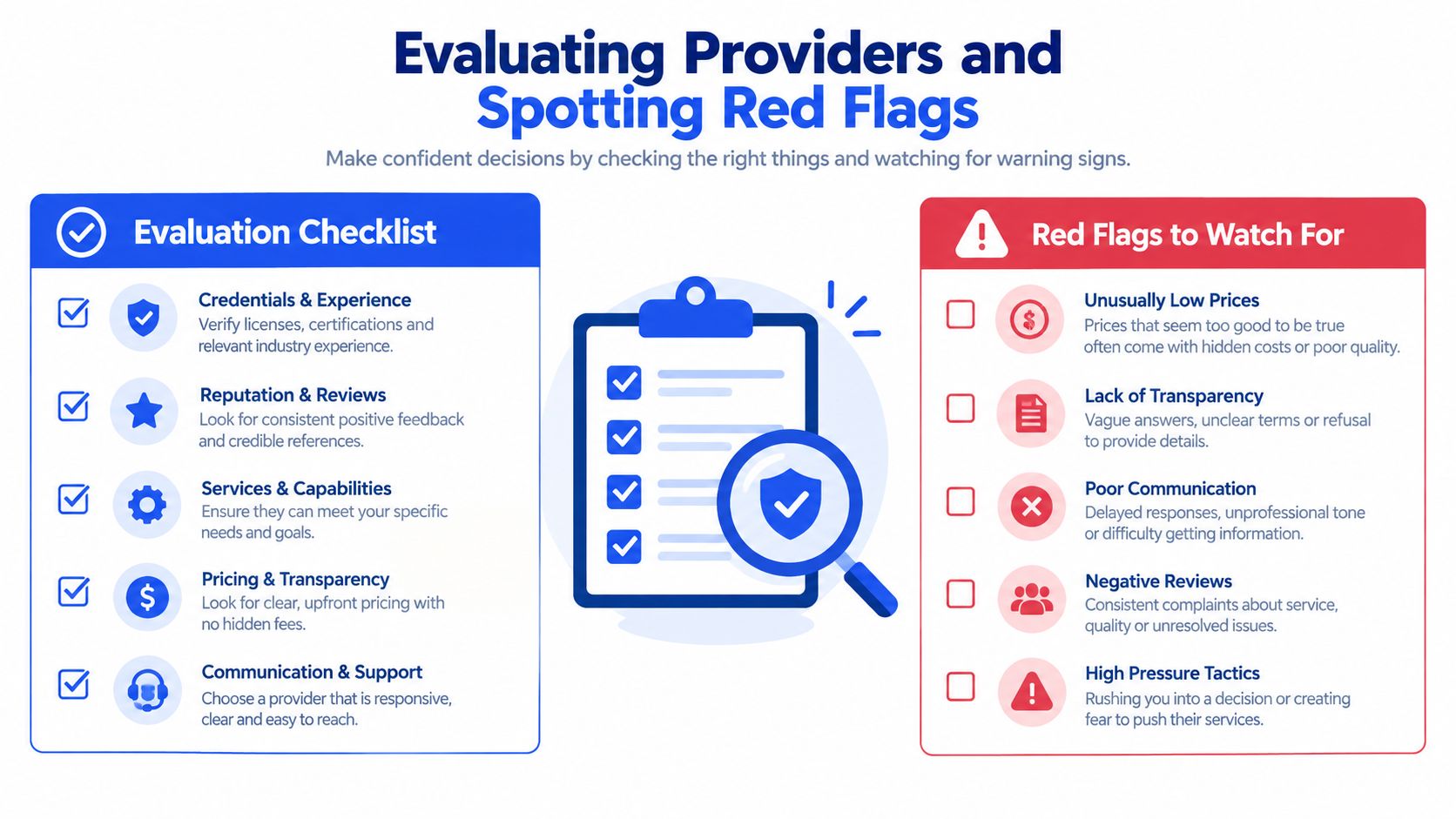
The first question isn't “How fast can you rank me?” It's “What access do you need?” A legitimate external campaign should not require your Etsy password or shop manager access. If a provider asks for credentials, you can't properly separate its work from changes made inside your account.
You also need to challenge the measurement method. “More impressions” is not the same as a higher organic position. Impressions can rise while your listing remains commercially invisible, and a dashboard that doesn't show the target phrase, search context, date, and observed position gives you little to verify.
Questions to ask before payment
Access: Can the provider work with only a public listing URL and keywords?
Target: Is the campaign tied to one exact phrase and one exact listing?
Timing: What is the agreed measurement window, and when does it start?
Reporting: Where will you see ranking checks and campaign updates?
Guarantee: What happens if the listing misses the stated ranking target?
Billing: Is payment fixed and one-time, or does the service renew automatically?
Methods: Will the provider explain its promotional approach in plain language?
A money-back promise can improve accountability, but read the conditions carefully. Check whether the guarantee applies to the exact phrase you selected, whether the target is measured within an agreed timeframe, and whether the provider defines what “top” or “first page” means. A guarantee without a measurement method is marketing language, not protection.
Practical rule: Never accept impressions, clicks, or vague “visibility” as a substitute for a ranking position when ranking is the product you purchased.
Review professional Etsy SEO service criteria before comparing offers. Look for clear final terms, tax treatment, accepted payment methods, refund rules, campaign length, and renewal policy. Bank transfer and crypto may be available with some providers, but the payment method doesn't prove quality. Written scope and verifiable reporting matter more.
Avoid providers that promise permanent placement, guaranteed sales, instant dominance for broad single-word terms, or secret methods that can't be explained. Etsy personalizes results, so your own search view may differ from another buyer's. A responsible provider should discuss that limitation instead of pretending rankings are perfectly fixed.
Aligning External Promotion with Etsy Search Signals
External promotion cannot bypass Etsy's search system. Etsy first checks whether a listing matches a shopper's query through its title, tags, description, categories, and attributes. It then orders eligible listings using factors such as listing quality, customer experience, recency, shipping price, language, and personalization, as described in its official search and recommendation policy.
The listing must support the campaign. A target phrase that does not accurately describe the product attracts the wrong audience. A page that fails to persuade visitors wastes the traffic and gives the campaign provider a misleading success story.
Relevance comes before promotion
Etsy considers shop, customer service, and listing quality alongside the information used to match queries. Matching titles, tags, descriptions, categories, and attributes can help a listing appear for a relevant search. Etsy also explains that an exact keyword match may rank higher because it can appear more relevant, as outlined in How Etsy search works.
Use a specific phrase with clear buyer intent. “Personalized ceramic dog mug” gives a provider a more useful campaign target than “mug,” provided the product genuinely matches the phrase. A provider should be able to show the exact phrase, landing listing, campaign dates, and reporting method before receiving access to any account or shop information.
Keep credentials out of the process. External promotion should not require your Etsy password, recovery codes, or unrestricted shop access. Use provider reports, tagged links where appropriate, and Etsy's own shop data to verify visits and commercial results. A rise in a tracking dashboard means little if the campaign produces irrelevant clicks, weak engagement, or no orders.
Clicks still need to become decisions
Visitors assess the main image, supporting photos, price, shipping cost, delivery expectations, personalization instructions, reviews, and description. A campaign can create attention, but the listing must convert that attention into a confident purchase decision. If it attracts curiosity without satisfying buyers, visibility may not last.
Audit the page before promotion:
Does the first image explain the product immediately?
Do the photos answer questions about size, material, color, and use?
Is the shipping offer competitive for your market?
Does the description remove purchase doubts?
Can buyers personalize the item without confusion?
A ranking service should amplify a credible offer, not conceal a weak one. Fix photography, product information, or fulfillment details first. Greater exposure brings more scrutiny, so promote only after the listing can handle qualified traffic.
Structuring Campaigns for Seasonal and Flagship Items
Don't try to promote your entire shop with one vague request for “more traffic.” Choose one product that can carry the campaign commercially. A flagship listing gives you a clear offer to refine, a clear phrase to track, and a clear profit calculation.
Seasonal products need a different decision. Their value depends on timing, inventory, production capacity, and delivery reliability. A campaign that starts after the buying window has passed may produce a ranking result without producing useful sales.
Match duration to the product cycle
A fixed campaign length gives you a practical planning framework:
30 days: Use this as a short test for a new product concept or a limited selling window. Confirm that the phrase attracts the right kind of buyer before committing more resources.
90 days: Use a longer push when you need sustained visibility around a seasonal collection, launch period, or important inventory cycle.
180 days: Reserve this for a durable flagship item with enough margin and fulfillment capacity to justify extended promotion.
These durations describe available campaign structures, not guaranteed business outcomes. A top position can increase discovery, but your product still needs demand, competitive pricing, strong service, and reliable delivery.
Buy a defined outcome, not an open-ended retainer
Fixed, one-time pricing is easier to manage than a subscription that automatically renews. You can calculate the campaign cost against contribution margin, review performance at the end, and decide whether another push is justified. Automatic renewals make that decision less deliberate.
Write the brief before contacting a provider. Include:
The listing URL.
One target phrase of at least three words.
The reason for the campaign, such as a seasonal launch or flagship product.
The desired ranking position.
The campaign duration.
The reporting method.
The refund or remedy if the target isn't reached.
The exact end date and renewal policy.
Commercial test: If you can't explain how the listing could repay the campaign fee through profitable orders, don't buy the campaign yet.
Don't use a ranking service to validate a product with no clear buyer intent. Test the offer, improve the page, and then use targeted promotion when the listing is ready to convert attention.
Preparing Your Listing for a Ranking Campaign
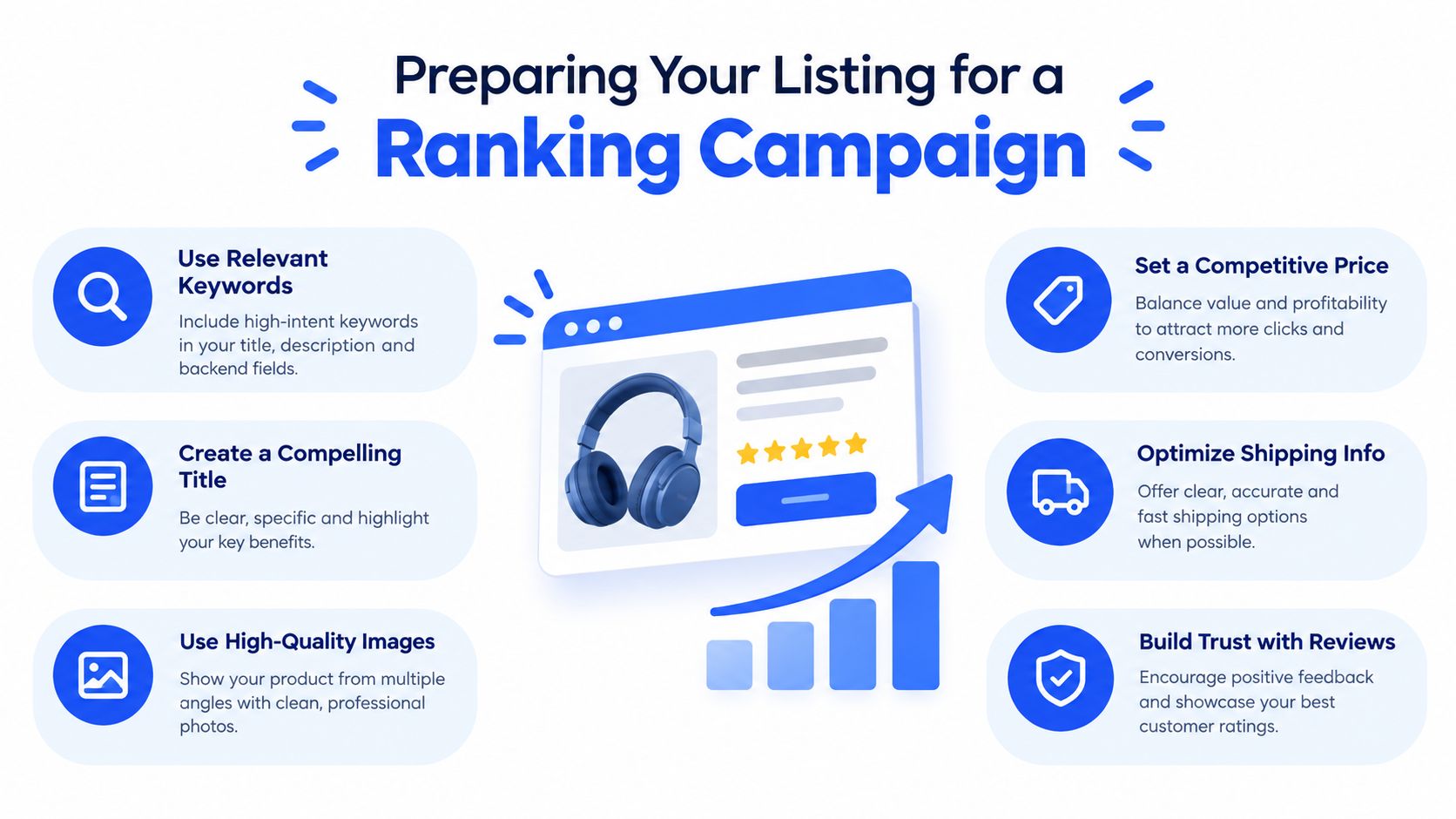
Preparation determines whether increased visibility becomes useful traffic or wasted attention. Start with the product page, not the provider. A ranking campaign can't compensate for unclear photos, weak fulfillment economics, or a phrase that real buyers don't use.
Complete the listing audit
Check the essentials in this order:
Photos: Use a strong first image and supporting images that answer practical questions about scale, materials, customization, and use.
Shipping: Review the total delivery offer, not just the item price. Etsy's system considers shipping price as part of ranking, and buyers notice unexpected delivery costs.
Keywords: Build the title, tags, description, categories, and attributes around a specific phrase that accurately describes the item.
Buyer intent: Ask whether someone searching the phrase is ready to buy this product, not merely browsing an adjacent category.
Conversion readiness: Make personalization steps, variations, processing expectations, and care instructions easy to understand.
Capacity: Confirm that you can fulfill the extra demand without late dispatches or avoidable service problems.
Don't target a phrase solely because it sounds popular. Broad keywords attract mixed intent and tougher competition. A longer phrase that accurately describes the product gives the provider a cleaner target and gives buyers a clearer reason to click.
Check the provider's paperwork
Before sending money or a URL, read the final terms. Confirm the campaign scope, ranking definition, start date, duration, reporting access, refund conditions, tax treatment, and accepted payment method. If the provider accepts bank transfer or crypto, verify the payment instructions through its official sales process and keep a copy of the agreement.
You should also confirm that the provider is independent and isn't affiliated with or endorsed by Etsy. That distinction protects your expectations. An external service can promote a listing, but it can't speak for Etsy or guarantee how Etsy will personalize results.
A safe campaign leaves your account untouched. Give the provider only the public listing URL and agreed phrase when that is all the work requires. Keep your password private, retain control of edits, and record the listing's baseline position and commercial performance before the campaign begins.
If the provider can't explain its method, measurement, security boundaries, and refund terms in plain English, walk away. Choose a service only when the objective is specific, the payment is controlled, and the listing is ready to turn search visibility into a satisfying buyer experience.
An Etsy ranking service is worth considering when one strong listing needs a focused, measurable push. Start with a realistic long-tail phrase, protect your account credentials, demand transparent ranking evidence, and choose a fixed campaign with clear end conditions. Before you pay, audit your listing and request a written assessment of the URL, keyword, timeline, reporting method, and guarantee. That process will eliminate most risky providers and leave you with a campaign you can evaluate on business results, not vanity metrics.