Your listing can be beautiful, the photos can be sharp, and the tags can be packed with keywords, yet the search bar still acts like you're invisible. That's the frustrating part most Etsy sellers run into, especially when the listing feels ready but the views stay flat. How to get Etsy listing on first page comes down to more than writing a clever title, it's about matching one exact phrase, making the listing easy for Etsy to trust, and keeping the shop signals clean enough to compete.
Understanding Why Your Listing Isn't Visible
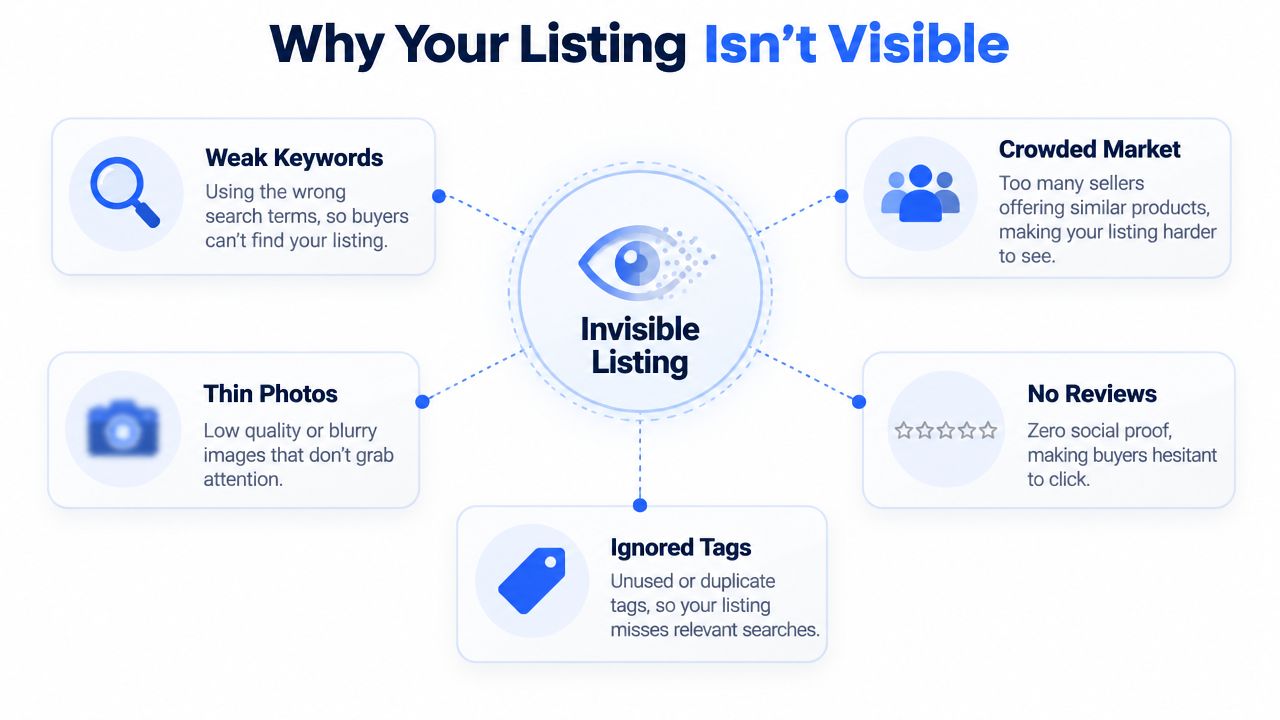
You've published the listing, refreshed the page, and still nothing happens. That usually means the listing is competing on the wrong terms, or it's not strong enough on the signals Etsy uses to sort search results. Etsy says search ranking is a mix of relevance, listing quality, customer and marketplace experience, recency, shop location, and shop diversity, and those factors are not equally weighted. Etsy's search guidance makes one thing clear, a listing doesn't earn page one just by being newly posted.
Broad keywords are usually the wrong fight
A broad term like “gift” or “wall art” puts you into a crowded race where a lot of listings look vaguely relevant. A focused long-tail phrase gives Etsy a cleaner match to work with, which is why sellers who chase page one usually do better when they pick one exact buying phrase and build the listing around it. Etsy also says that if the same word or phrase appears in both the title and tags, the listing is treated as more relevant than if it appears in only one place, and words near the beginning of the title matter more than words at the end.
Practical rule: one listing should be built around one search intent, not five different hopes.
Why a strong product can still disappear
Etsy's search is also shaped by shop performance. The platform includes a shop's average review rating, message response rate, and case rate from the past three months in ranking signals, so a good product with weak service signals can still struggle. That's why page-one placement is really a competition between keyword match and seller quality, not a vote for the prettiest listing.
The search result itself is also dynamic. Etsy says translations, shopper language, location, and shipping price can affect what appears, and it may limit how often the same listing or shop shows up at the top for one user or keyword. That means a listing can't be judged by a single universal position and expected to hold there forever without the right query, shop health, and market fit.
The Real Ranking Factors That Matter
Etsy's ranking system rewards more than text matching, and that's where a lot of sellers waste time. If you only rewrite titles and ignore the shop experience, you're working with half the picture. In a marketplace with about 86.6 million active buyers in late 2025 and early 2026, alongside independent estimates of roughly 8.1 million active sellers and about 8.76 million sellers overall in 2025, the contest for visibility is naturally intense. Printful's Etsy statistics summary shows why page one is so valuable, there are a lot of people fighting for the same attention.
Shipping, photos, and trust signals shape the fight
Etsy's own visibility guidance says active listings need a few concrete quality signals to have a real shot at priority placement, including at least one image, a high-resolution primary photo of 2000 pixels or more, a clear and well-lit singular product photo, a specific category, and a return policy. Etsy also says listings with shipping prices lower than $6 are prioritized in search, with exceptions, and that shipping price and method are ranking factors. Etsy's search visibility page is a reminder that visibility starts before the click.
Search is local, not universal
A listing doesn't show the same way to everyone. Etsy says translations, shopper language, location, and shipping can change which listings appear, and its search may apply frequency capping so the same shop doesn't dominate the top spots for every user. That's why page-one tracking should be tied to a specific market-language query, not a loose idea of “ranking somewhere on Etsy.”
First-page placement is less like a fixed leaderboard and more like a live matching system that keeps recalculating.
The practical takeaway is simple. A listing that ranks well usually combines tight keyword alignment, clean shipping competitiveness, and strong shop performance, because Etsy's own documentation treats those as part of the same ranking problem. If one piece is weak, the others have to carry more weight, and that rarely lasts.
What Etsy SEO actually means in practice
Single Listing Campaign vs Broad SEO Strategy
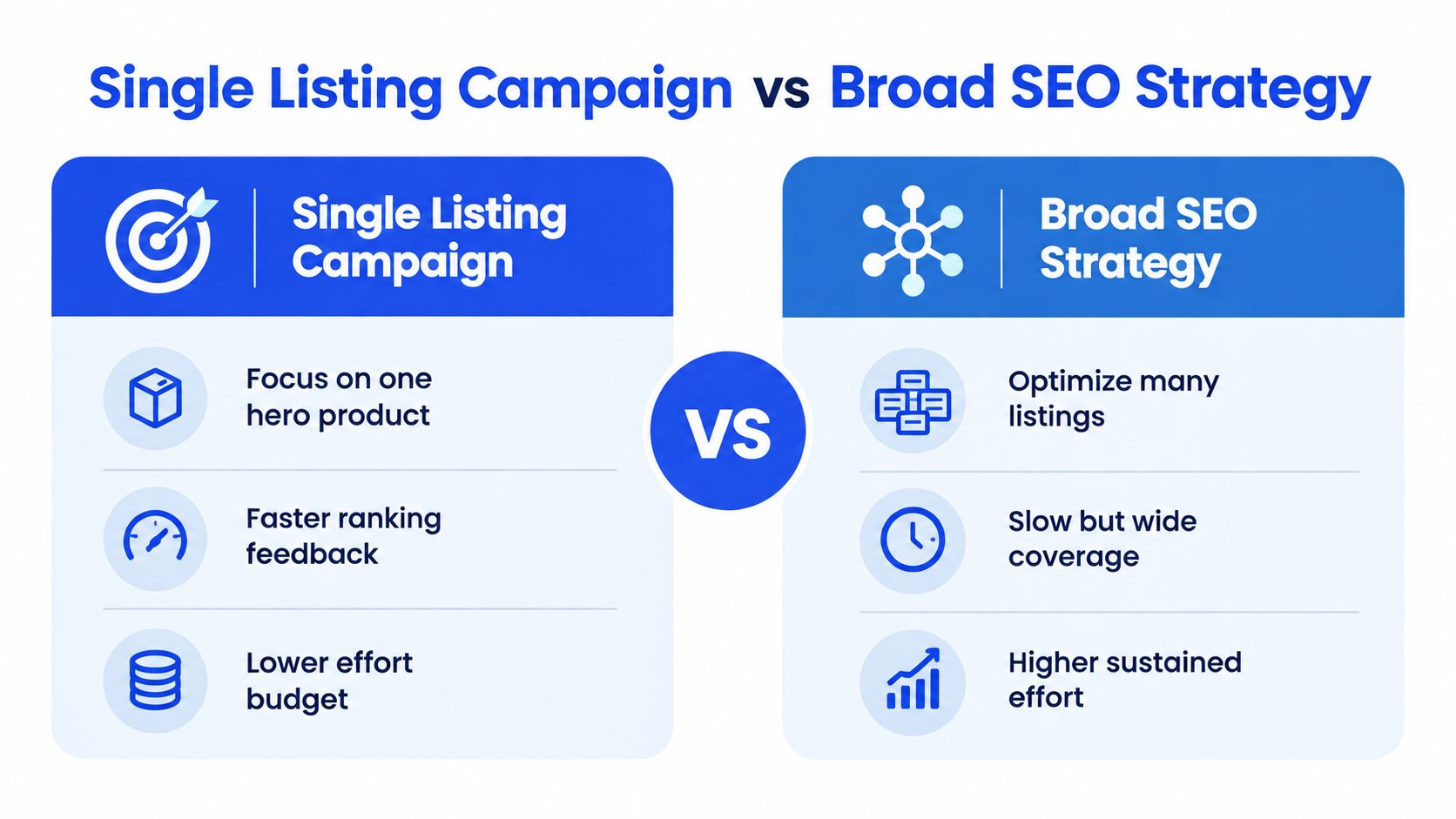
Most sellers try to fix everything at once. They rewrite every title, shuffle tags across the shop, and hope the whole account starts moving. That usually spreads effort too thin, especially when the goal is one specific first-page result for one product.
Focus wins when the goal is one ranking slot
A single listing campaign puts all the effort behind one hero product and one agreed search phrase. That makes the feedback easier to read, because you're not wondering whether a result came from ten different tweaks across the shop. It also fits Etsy's search behavior better, since the platform can limit how often the same listing appears at the top for one user or keyword, which means you want a sharp match and a clean measurement target rather than a vague shop-wide push.
A broad SEO strategy still has value, but it's slower. It makes sense when the goal is coverage across many products, not a quick attempt to move one listing into the first page for a specific phrase. If you're launching a seasonal item or trying to lift a single proven bestseller, the focused route is usually the better trade-off.
What focused work looks like in practice
A practical single-listing campaign usually starts with one question, is this listing worth pushing hard right now? If the answer is yes, the next step is to pick the exact phrase, tighten the title, check the photos and shipping setup, and watch how the result changes in the defined market. That's where a service like Upglider fits, it runs focused ranking campaigns for one Etsy listing and one agreed search phrase, rather than trying to manage the whole shop.
Broad optimization can still help the rest of the shop later. But if the actual goal is page one for a specific product, the win usually comes from concentrated effort, not scattered edits across twenty listings. The seller who wants one clear ranking result needs one clear target.
Campaign Journey from Assessment to Ranking
A real ranking campaign doesn't begin with edits. It begins with a blunt check on whether the listing has a chance at all. The strongest campaigns I've seen start with a simple question, is the listing specific enough, credible enough, and commercially competitive enough to deserve attention for one phrase?
From review to live movement
The first pass is usually an assessment of the listing against the target phrase. That means checking whether the phrase is tightly represented, whether the category is specific enough, and whether the product itself matches the intent behind the search. Etsy keyword research basics matter here because the wrong phrase can make even a solid listing look weak.
After that, the work turns into monitoring. A focused campaign watches how the listing behaves after the target is set, then compares the result against the agreed ranking window. If the listing moves up, the job is to keep the signal clean. If it drops, the question becomes whether the phrase was too broad, the listing too loose, or the shop signals too soft.
The decisions that separate progress from noise
The hardest part is not getting an early bump. It's deciding whether a ranking shift is real or just noise from Etsy's dynamic search. A seller has to keep looking at the same target phrase, the same market context, and the same listing version instead of constantly changing variables midstream.
A ranking campaign only works when the target stays stable long enough to measure it.
That's why dashboards and status updates matter. They turn a vague hope into a sequence of checks, adjustments, and confirmations. The goal isn't to “do SEO” in the abstract. The goal is to move one listing into a known position range for one exact search phrase, then verify that the result holds.
Listing Preparation Checklist for Rankings
A listing that isn't structurally ready will waste a ranking push. Before the campaign starts, the listing needs to look complete to both Etsy and the buyer. Etsy's own visibility guidance gives the clearest starting point, and the basics are more concrete than most sellers expect. Etsy seller tools and workflow ideas can help with process, but the listing itself still has to be built properly.
The essentials that should already be in place
Keyword-Rich Title: Put the main phrase near the front, because Etsy says the beginning of the title matters more.
All Tags Used Well: Fill the available tag space with unique, relevant terms instead of repeating the same idea in different forms.
High-Resolution Photos: Etsy says the primary image should be 2000 pixels or more, and the first image needs to look clear and singular.
Specific Category Choice: Choose the narrowest category that truly fits the product, not a broad bucket that makes the item harder to classify.
Return Policy in Place: Etsy includes return policy as part of the visibility signals, so incomplete shop settings work against trust.
Shipping That Makes Sense: Etsy says shipping price and method affect ranking, and lower domestic shipping prices are prioritized in search with exceptions.
Why each item matters
Photos do more than decorate the page. They tell Etsy the listing is serious, and they tell buyers the item is real, readable, and ready to buy. A weak primary image can sink clicks before the title ever gets a fair shot.
Shipping setup matters for the same reason. If the shipping price makes the listing look expensive next to similar results, the ranking effort has to work harder just to earn the click. Etsy's guidance makes clear that pricing and shipping aren't separate from visibility, they're part of it.
Your category choice also matters more than many sellers think. A specific category helps Etsy understand the item faster, which makes the title and tags easier to interpret. The better the match, the less the algorithm has to guess.
Building Your Sustainable Ranking Plan
Getting onto the first page is useful only if the listing can stay there long enough to matter. That means the work doesn't stop when a position improves. It continues through shop maintenance, seasonal keyword checks, and careful monitoring of whether the target phrase still deserves the effort.
Keep the shop healthy, not just the listing
Etsy's ranking system includes shop performance signals, so response rate, review quality, and case rate can't be ignored after the launch push. A seller who lets service slip can undo a good search position faster than they expect. The fix is boring but real, answer messages quickly, resolve issues cleanly, and keep the shop record steady.
Seasonality matters too. Search demand shifts quickly, and phrases that made sense one month may be too crowded or too narrow later on. That's why a sustainable plan isn't built on one-time keyword work, it's built on periodic reassessment of the single phrase you're targeting.
Measure the right thing
Don't get trapped by vanity checks like casual browsing or one-off searches from your own account. Track the agreed phrase in the right market context, then compare that against shop performance and listing quality. If the phrase is stable and the listing is holding position, keep it steady. If the phrase is losing relevance, change the target rather than forcing the same listing to fight the wrong battle.
The most reliable path is still the simplest one, choose one strong long-tail phrase, prepare the listing properly, and keep the shop trustworthy enough for Etsy to keep showing it. That's the practical version of how to get Etsy listing on first page, and it's also how you keep it there.
If you want help turning one Etsy listing into a focused ranking campaign, choose the product you want to push, lock in one specific long-tail phrase, and review the listing against Etsy's visibility signals before making another edit. A disciplined first-page plan starts with one listing, one query, and one clear standard for success.