One seller is staring at a listing that barely shows up in search. Another has ideas for new products but no clear way to tell which one has real demand. A larger shop has strong sales already, but updating titles, prices, photos, and variations across a big catalog is eating hours every week.
Those sellers don't need the same tool.
The best Etsy seller tools aren't interchangeable. Some help you find keywords. Some help you decide what to make next. Some are built for listing cleanup, bulk edits, or promotion outside Etsy. Etsy's own tools have also grown into a more complete shop control center. Its Seller App and Shop Manager now combine listings, orders, analytics, messaging, and finances, with stats like views, visits, orders, revenue, conversion rate, and traffic sources available in the workflow sellers already use (Etsy Seller App and Shop Manager overview).
That matters because you should pick tools based on the bottleneck you have right now, not based on who has the longest feature list. If your problem is visibility for one listing, broad analytics won't fix it. If your problem is bulk maintenance, a keyword tool won't save your week.
One more expectation check before the list. Marketplace research tools often rely on modeled estimates, so treat them as directional. They help you compare options and spot patterns. They don't replace your own shop data. And ranking visibility is not the same as sales. Better placement can increase the chance of clicks. It doesn't guarantee conversions.
1. Upglider
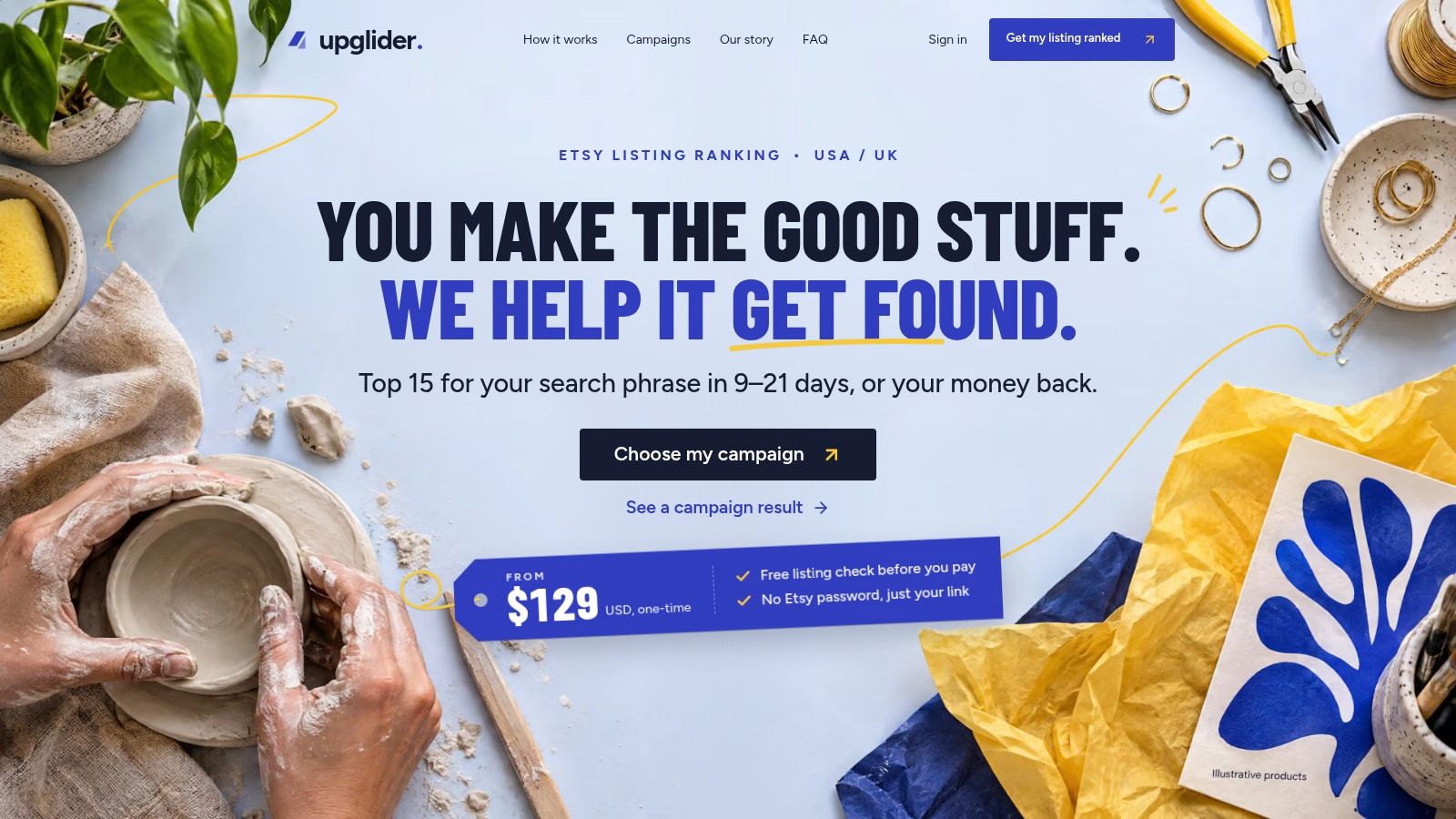
Upglider is the most focused tool on this list. It isn't trying to be your keyword database, your analytics suite, or your social scheduler. It does one job. It targets one Etsy listing for one approved search phrase and works to move that listing into Etsy's top 15 organic results.
If your main problem is "I know which listing matters, and I know which phrase I want, but I need visibility fast," this is the sharpest option here. It's especially useful for a flagship product, a seasonal launch, or a listing that already converts when it gets traffic.
Where Upglider fits
Upglider runs as a pay-once campaign, not a subscription. You choose a 30, 90, or 180 day campaign. Pricing starts at $129 for 30 days, $349 for 90 days, and $649 for 180 days. It works toward top-15 placement for the agreed phrase within 9 to 21 days in the USA or UK, then maintains that position during the paid period. If that ranking target isn't reached within 21 days, the service offers a full refund.
You don't hand over your Etsy password, and you don't need to give shop access. Upglider only needs a public listing link and the keyword you want assessed. It also does a free pre-payment case review, which is useful because not every listing and phrase pair is equally realistic.
Practical rule: Use Upglider when you've already decided which listing deserves concentrated effort. Don't use it when you're still guessing what product or keyword matters most.
Upglider also gives you an owner dashboard with step-by-step updates. Payment options include card payments through Whop, Apple Pay, Google Pay, bank transfer, and crypto.
Where it does not fit
This is not a broad Etsy operations tool. It won't manage Etsy Ads, rewrite your entire catalog, redesign your shop, or guarantee sales after visits arrive. It guarantees ranking placement for the approved phrase, not revenue.
That limitation is important because Etsy search performance depends on more than keywords alone. Etsy's own guidance says search placement also reflects signals such as average review rating, message response rate, and case rate over the last three months (how Etsy search works). So if a shop has weak service signals or a listing has poor conversion once clicked, ranking support alone won't solve the full problem.
A few reasons to pick it:
Best for one listing: It suits sellers who want to push a single SKU, not tune an entire store.
Best for privacy-sensitive sellers: No account access required.
Best for clear outcomes: The promise is narrow and easy to judge.
Website: Upglider
2. eRank
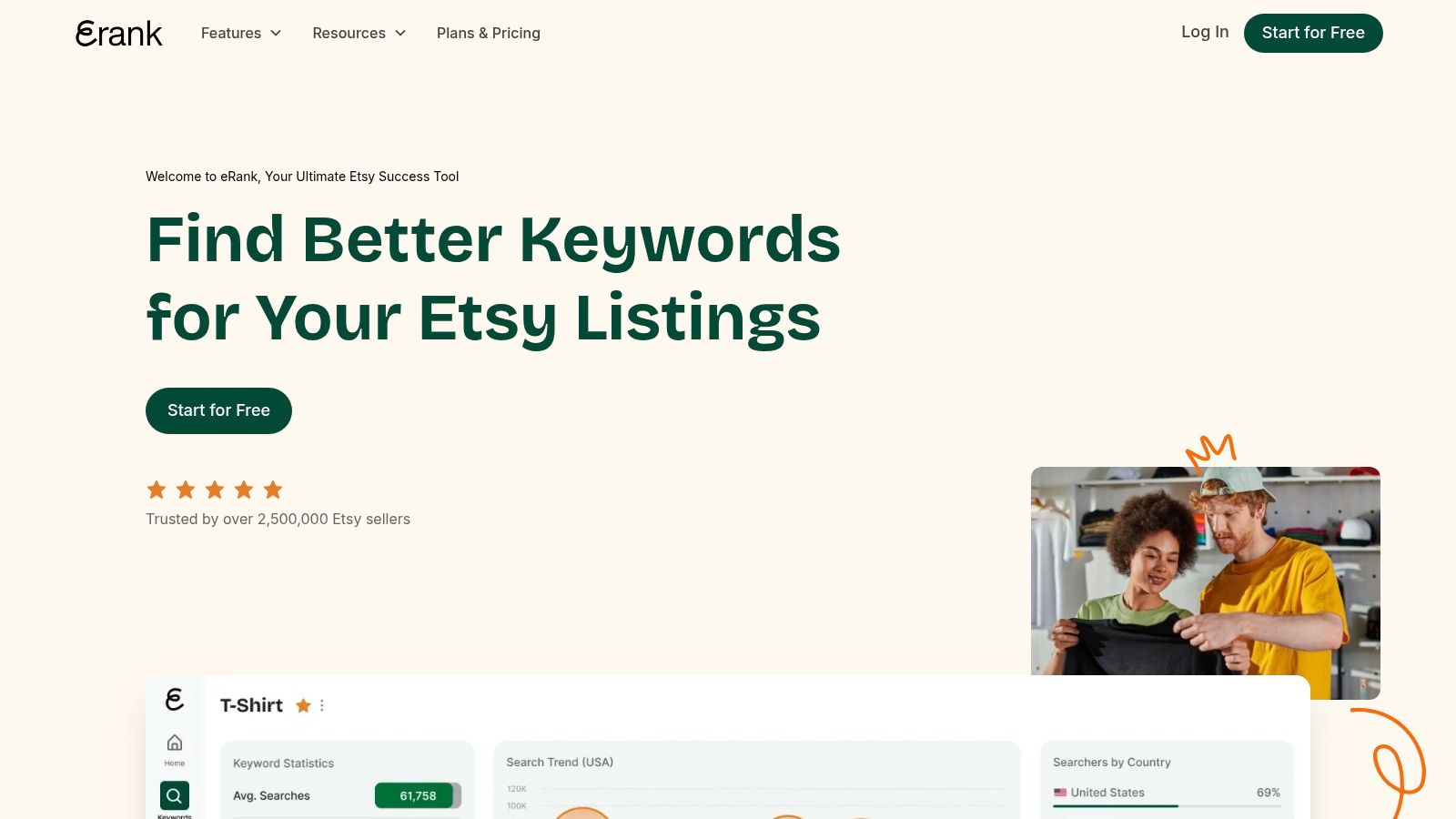
eRank is the tool I'd recommend first to sellers who need to improve discoverability across multiple listings and want a lot of research depth without jumping straight into an expensive software stack. It covers keyword discovery, listing audits, rank monitoring, and competitor tracking in one place.
Its strongest use case is iterative SEO work. You research phrases, tighten titles and tags, audit weak listings, then watch whether visibility improves over time.
Best use for eRank
eRank works well before and during listing optimization. Etsy has expanded seller-side guidance too, including updates highlighted in April 2025 such as a dashboard that flags listings needing updates for better search visibility, access to all listing categories and subcategories in the app, and a beta tool that gives real-time feedback on listing quality before publishing (coverage of Etsy seller tool updates). eRank complements that by giving you a larger SEO workspace outside Etsy's native interface.
If you like to compare many phrase variations, inspect competitors, and track incremental movement, eRank is a strong fit. It also pairs well with a focused service when you want strategy help around the broader context. Sellers trying to decide whether they need software alone or outside support can also compare approaches through this Ecommerce SEO service guide.
Watch-outs
eRank can feel busy at first. That's the cost of getting many tools in one dashboard. New sellers sometimes open it and try to use everything on day one. Don't.
Start with keyword research, listing audits, and rank checks. Ignore the rest until you need it.
Its sales and revenue-style outputs should be treated as directional, not exact. That's true for most marketplace research tools. Use eRank to compare options and identify weak listings, not to pretend estimated metrics are your accounting system.
Website: eRank
3. Marmalead
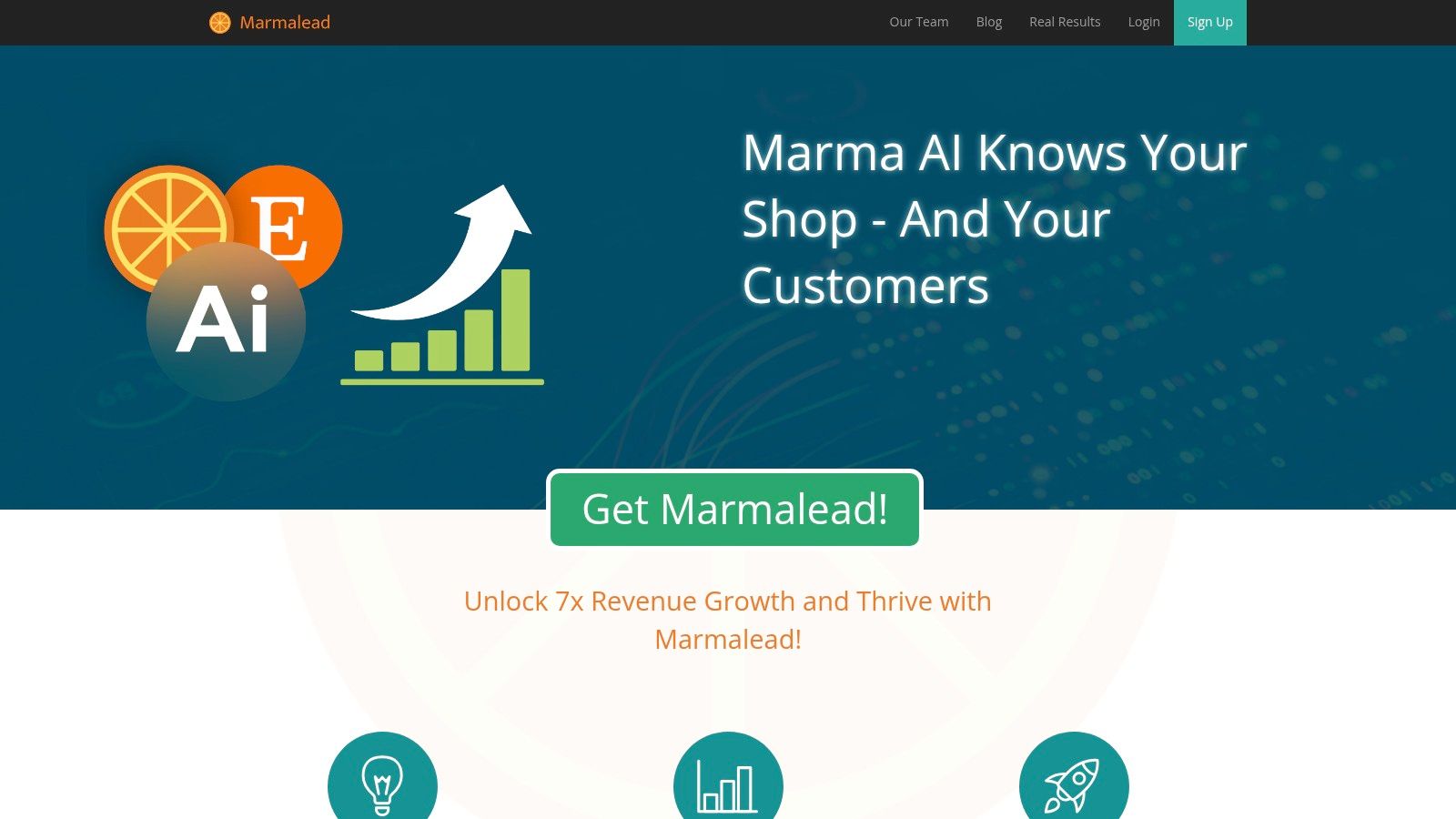
Marmalead is for sellers who don't want to swim in a huge interface. Its appeal is focus. You research shopper language, assess listing SEO, and rewrite faster with guidance that stays close to the listing itself.
If eRank feels like a toolbox, Marmalead feels more like a guided workbench.
Why sellers pick Marmalead
Marmalead's strength is turning keyword research into cleaner titles and tags quickly. The built-in SEO scoring and coaching are useful if you already know your product but need help expressing it in search-friendly wording. Sellers who rewrite listings often, especially handmade and gift-oriented listings, tend to benefit from this tighter workflow.
Its pricing guidance is another reason people choose it. Not because software can tell you the perfect price, but because it can help you see the range you're stepping into before you publish or relaunch a listing.
Where it falls short
Marmalead isn't the best pick if your main need is broad competitor surveillance or a large mix of operational extras. It leans harder into optimization than into full-spectrum shop management.
Etsy search also isn't only about stuffing better terms into titles. Relevancy and recency both matter. Etsy says relevancy reflects how closely keywords in titles, tags, descriptions, and attributes match the shopper's search, and recency gives new listings a small temporary boost, with renewed listings getting a similar smaller boost (Etsy SEO guide citing Etsy ranking factors).
That makes Marmalead useful for wording and on-page alignment. It doesn't remove the need to monitor conversion, reviews, and overall listing quality once the traffic arrives.
Website: Marmalead
4. Alura
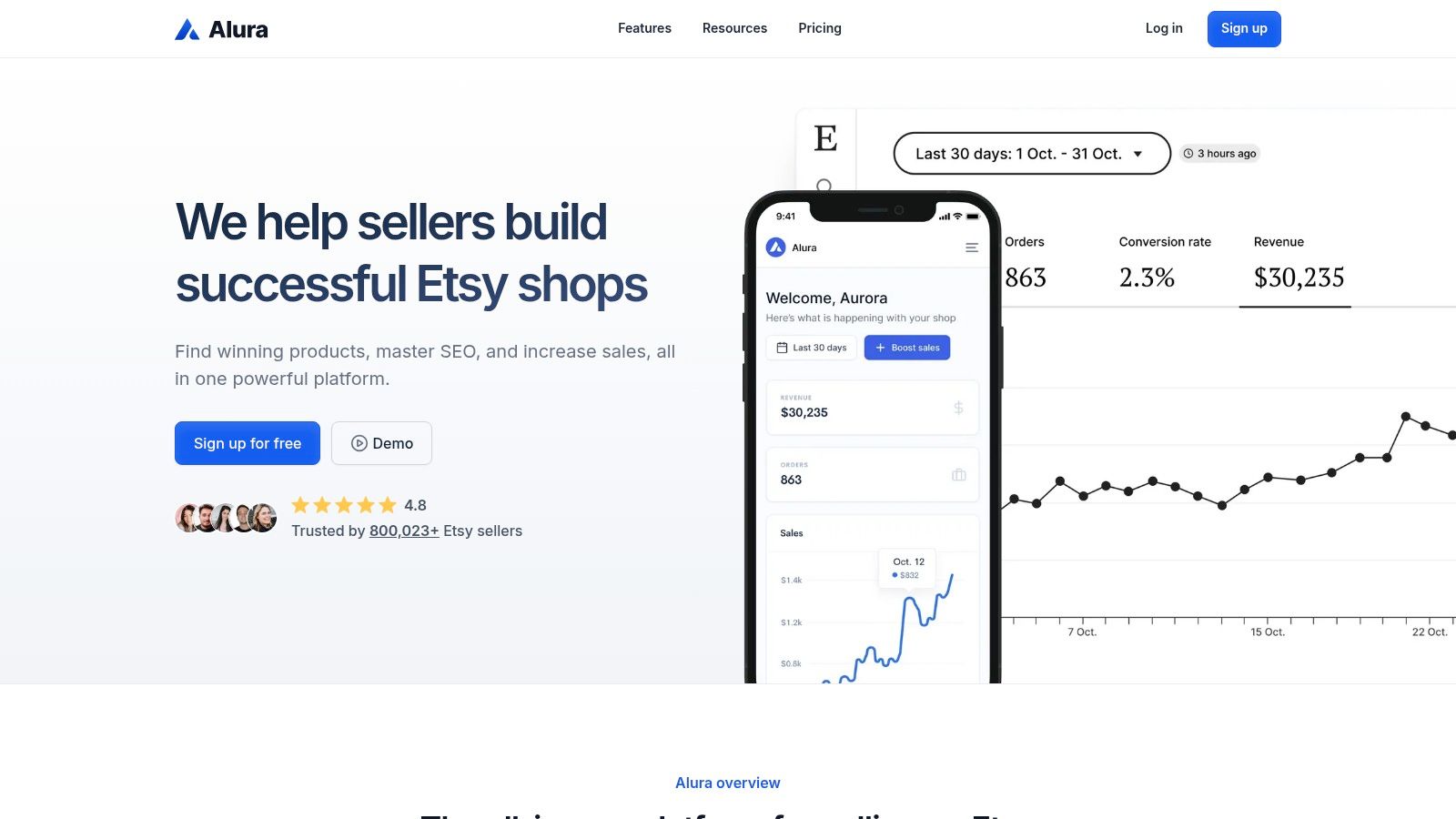
Alura suits the seller who wants one login for a lot of everyday jobs. It mixes product research, keyword research, listing optimization, AI writing help, customer follow-ups, and simple shop insights.
That combination makes it a good middle-ground choice. It won't be the deepest specialist in every category, but it can replace several lighter tools for a solo seller.
Where Alura works best
Use Alura when your workflow crosses research and communication every day. If you're checking product ideas, cleaning listing copy, and sending follow-ups without wanting separate apps for each, Alura is efficient.
Its fee and profit calculator is also practical. Etsy sellers often focus too heavily on search and forget margin. A tool that keeps research and profit awareness in the same environment is helpful when you're deciding whether a product idea is worth pursuing at all.
Why it isn't for everyone
Alura is broader than a pure keyword tool, which is both its advantage and its compromise. Some modules will feel "good enough" rather than best-in-class if you're already very advanced in one area.
A lot of Etsy seller tool buying goes wrong here. Sellers pay for broad suites before they know their real bottleneck. Independent analysis of the category points to a simple price-and-capability ladder: native Etsy stats are free for every shop, low-cost keyword tools sit around $5.99 per month for early-stage sellers, and broader analytics suites often land around $19 to $20 per month for growing shops (2026 Etsy seller analytics analysis).
If you don't need the whole bundle yet, don't buy the whole bundle yet.
Website: Alura
5. EverBee
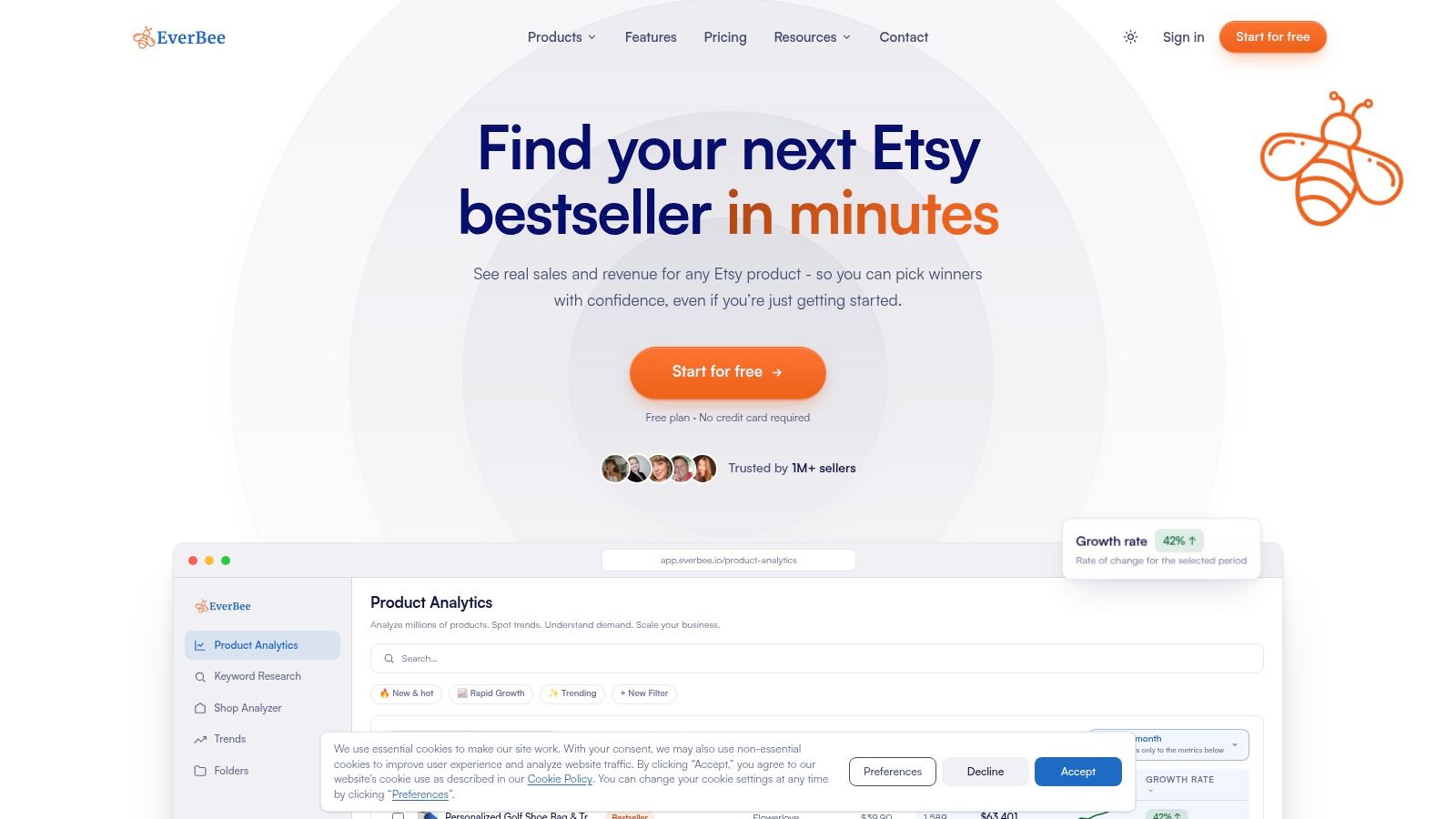
EverBee is the fastest tool on this list for product validation on live Etsy pages. That's why many sellers like it. You search Etsy, turn on the overlay, and start comparing listings and niches without leaving the marketplace view.
If your biggest question is "What should I list next?" EverBee is easier to justify than a heavy SEO suite.
Best for idea selection
EverBee shines at niche scanning. Its overlays put estimated sales, revenue, conversion, keyword, and trend views right where you're already browsing. That makes it good for deciding whether a product concept looks crowded, underdeveloped, or worth testing.
It also helps when you're choosing between adjacent niches. If you sell home decor, printables, or jewelry with many close variations, the visual workflow speeds up first-pass filtering.
Use EverBee early in the decision process. Then use a dedicated listing optimization tool after you've chosen the product direction.
Keep the estimates in their place
EverBee is built around modeled estimates. That's useful, but it can trick sellers into overconfidence. Etsy's own Shop Manager only exposes your shop's actual first-party performance data. Practical benchmarking usually requires a second layer of market-context tools that compare public listings, keyword competition, and estimated demand across the marketplace. The most useful workflow is to pair first-party stats like conversion rate and traffic sources with public-market analysis, because per-listing inspection beats shop-level averages when you're optimizing a single SKU (benchmarking Etsy performance with marketplace context).
That means EverBee is strongest when you use it for relative judgment. Compare one niche to another. Compare one listing style to another. Don't mistake estimates for proof.
Website: EverBee
6. Sale Samurai
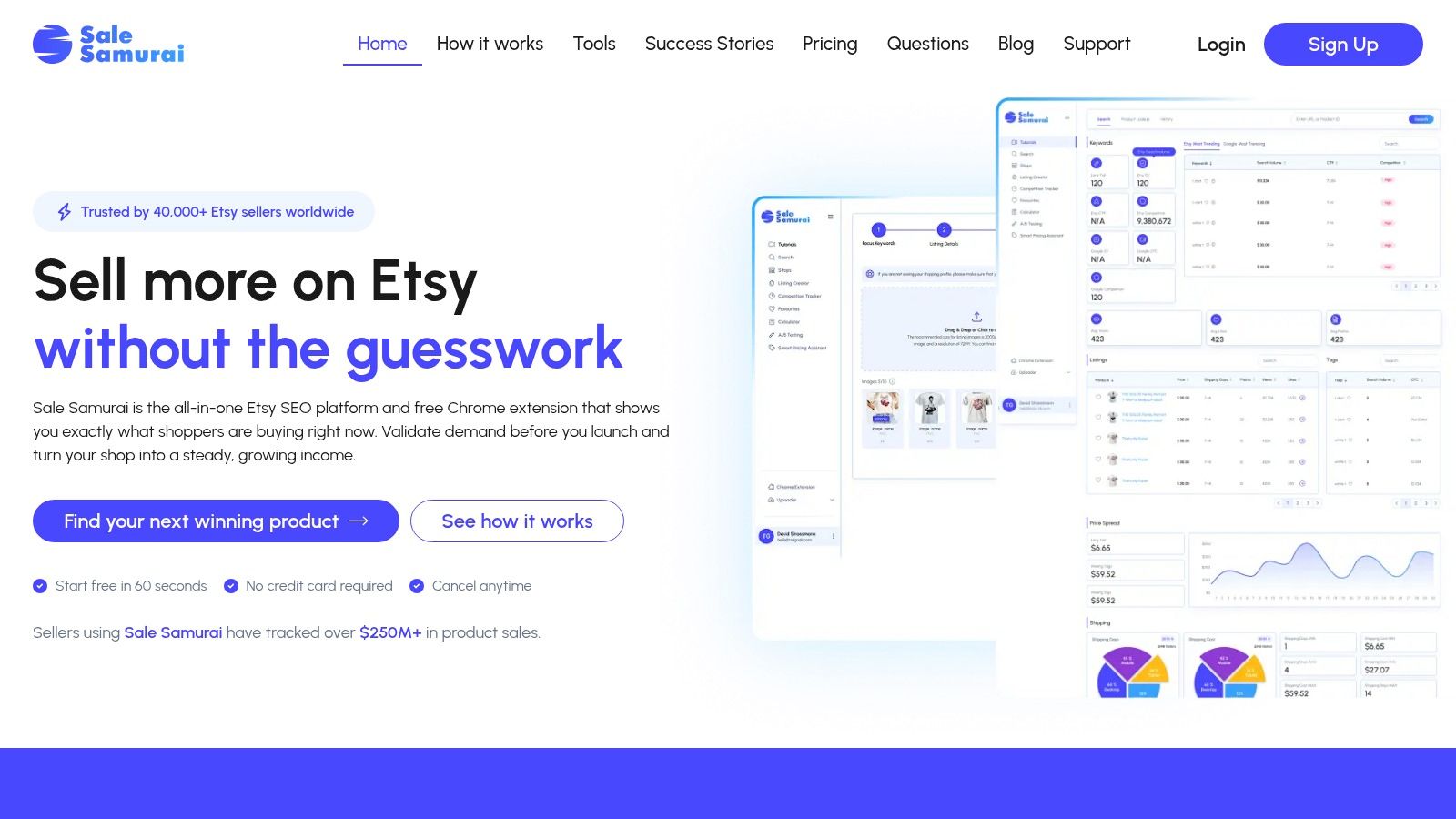
Sale Samurai is the tool for sellers who want Etsy SEO help without a bloated learning curve. It covers keyword research, listing analysis, competition checks, and seasonality planning in a cleaner package than many all-in-one platforms.
It's a good fit for sellers who want answers quickly and don't enjoy exploring a maze of tabs.
Why choose Sale Samurai
Some tools are powerful but tiring. Sale Samurai's advantage is that you can learn the core workflow fast. Search a niche, evaluate competition, inspect related terms, and improve a listing without feeling like you need a training course first.
Its holiday and seasonality planning is also useful for gift sellers and event-driven shops. If your catalog changes around Mother's Day, wedding season, Christmas, or back-to-school demand, a lean research interface is often enough.
Where it lags
You won't get the same depth of analytics or automation that broader suites offer. If you want shop-wide operational coverage, customer messaging support, or a large reporting layer, Sale Samurai won't replace those systems.
That isn't a flaw. It's a product choice. Many sellers only need one research tool plus one SEO tool, and current advice around the Etsy tool ecosystem increasingly warns against piling up overlapping subscriptions as the market shifts and some tools change or disappear (roundup on Etsy tools in 2026).
Sale Samurai makes the most sense when you want a lighter stack and a shorter path from keyword idea to listing edit.
Website: Sale Samurai
7. Koalanda
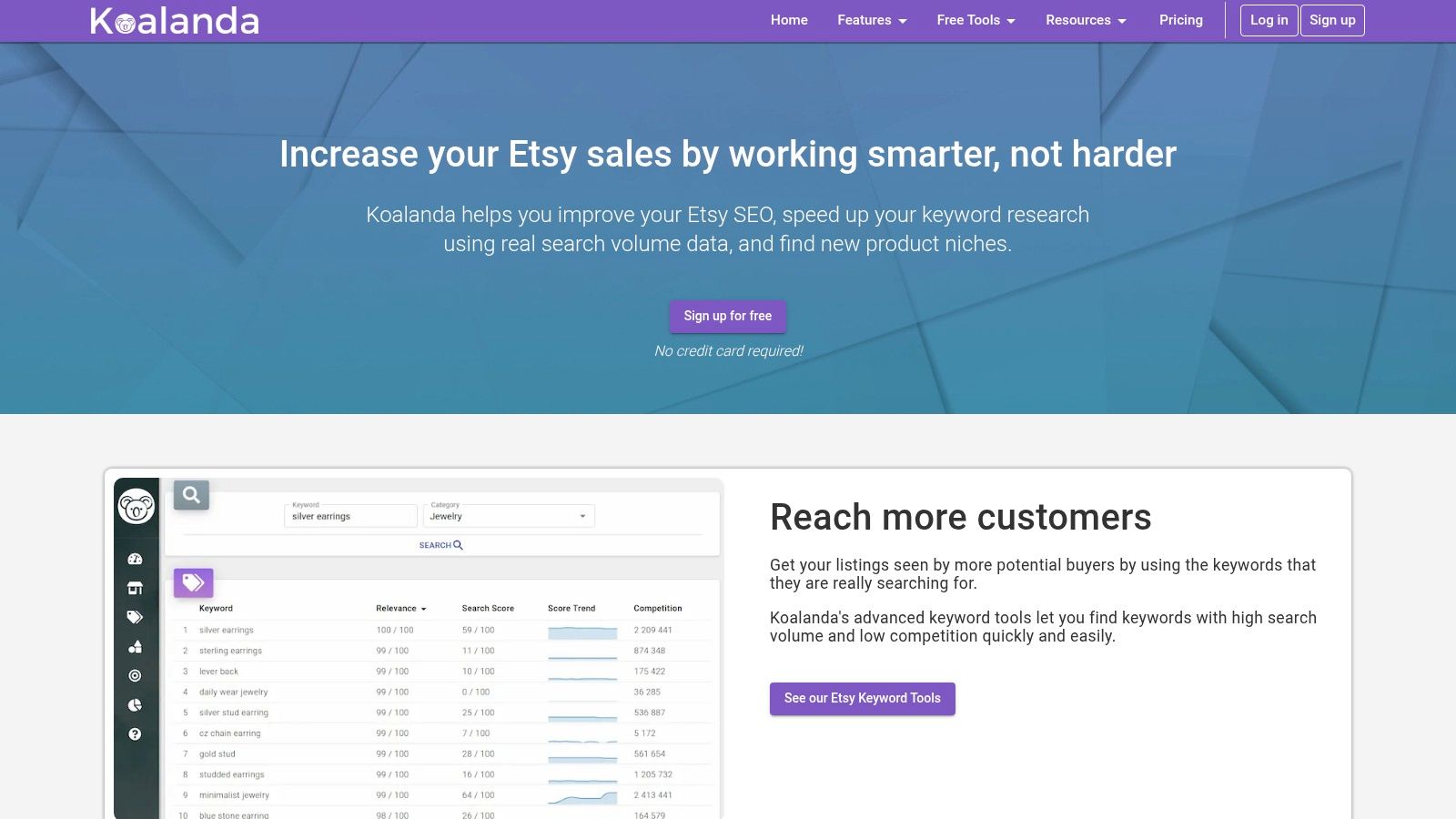
Koalanda is the budget pick for sellers who still want serious utility. Its biggest appeal is simple pricing with broad access, especially if you run more than one shop or do a lot of repeated keyword work.
It doesn't have the biggest brand presence, but that can work in your favor if you care more about access than polish.
Good fit for budget-conscious operators
Paid plans include unlimited keyword searches, which matters if you brainstorm at volume. Sellers with multiple niche shops, or sellers who test many phrase variants before settling on titles and tags, can get a lot of value from that structure.
Koalanda also supports multi-shop analytics and listing help, so it works best for owners who don't need the biggest ecosystem around them and prefer a flat, low-cost setup.
Why some sellers skip it
The interface and documentation are more practical than slick. If you like large communities, lots of tutorials, or a very polished app experience, you'll probably feel more comfortable with one of the category leaders.
Still, low price matters less than useful outputs. For advanced sellers, the tools worth paying for are usually the ones that support exportable listing-level data, keyword opportunity scoring, and workflows tied to meaningful KPIs such as visits, conversion rate, average order value, repeat purchase rate, listing click-through rate from search, ad CPC or ROAS, and contribution margin per order. That same analysis also notes that trust in data accuracy and workflow fit often matters more than feature breadth alone (analytics priorities for Etsy tool selection).
If Koalanda fits your way of working, its lower-profile brand won't matter.
Website: Koalanda
8. Vela
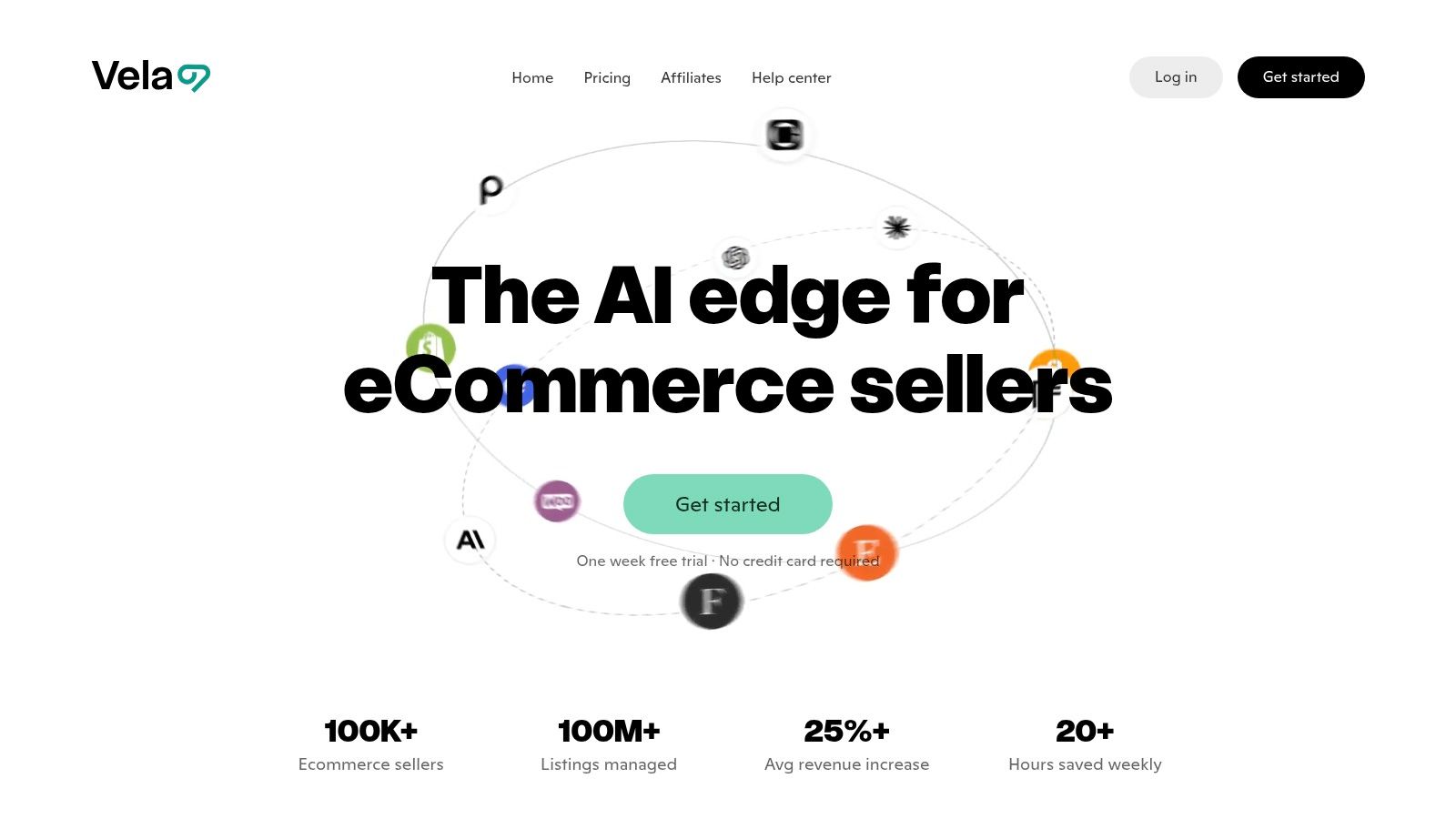
Vela is not a discovery tool. It is a speed tool.
If you manage a large catalog and keep making the same edits across many listings, Vela can save more time than any SEO platform on this page. It handles bulk changes to titles, tags, descriptions, pricing, photos, and more, with templates, scheduling, and import-export support.
Best for mature catalogs
Vela fits shops that already know what they want to sell and need to move faster. Seasonal shops, print-on-demand shops, and any seller with lots of variants will feel the value immediately.
Its AI listing optimization and photo tools also help reduce repetitive media cleanup. When you're standardizing backgrounds or making broad title updates across many listings, bulk tooling matters more than deep research.
Bulk editing doesn't improve a weak offer. It does make a strong catalog far easier to maintain.
Don't use Vela as your first paid tool
For a small shop with a handful of listings, Vela is overkill. You need enough catalog complexity to justify it. Some listing settings also still need to be adjusted inside Etsy because of API limits, so this isn't a total replacement for native shop management.
That said, Etsy itself keeps moving toward more unified control inside its own tools. By 2025, Etsy added "new stats for your business" spanning multiple selling channels on the platform, reflecting broader performance monitoring across Etsy, Pattern, and related storefronts (Etsy seller mobile platform details). Vela sits on top of that reality. Etsy gives you the native operating layer. Vela helps when native editing becomes too slow.
Website: Vela
9. Outfy
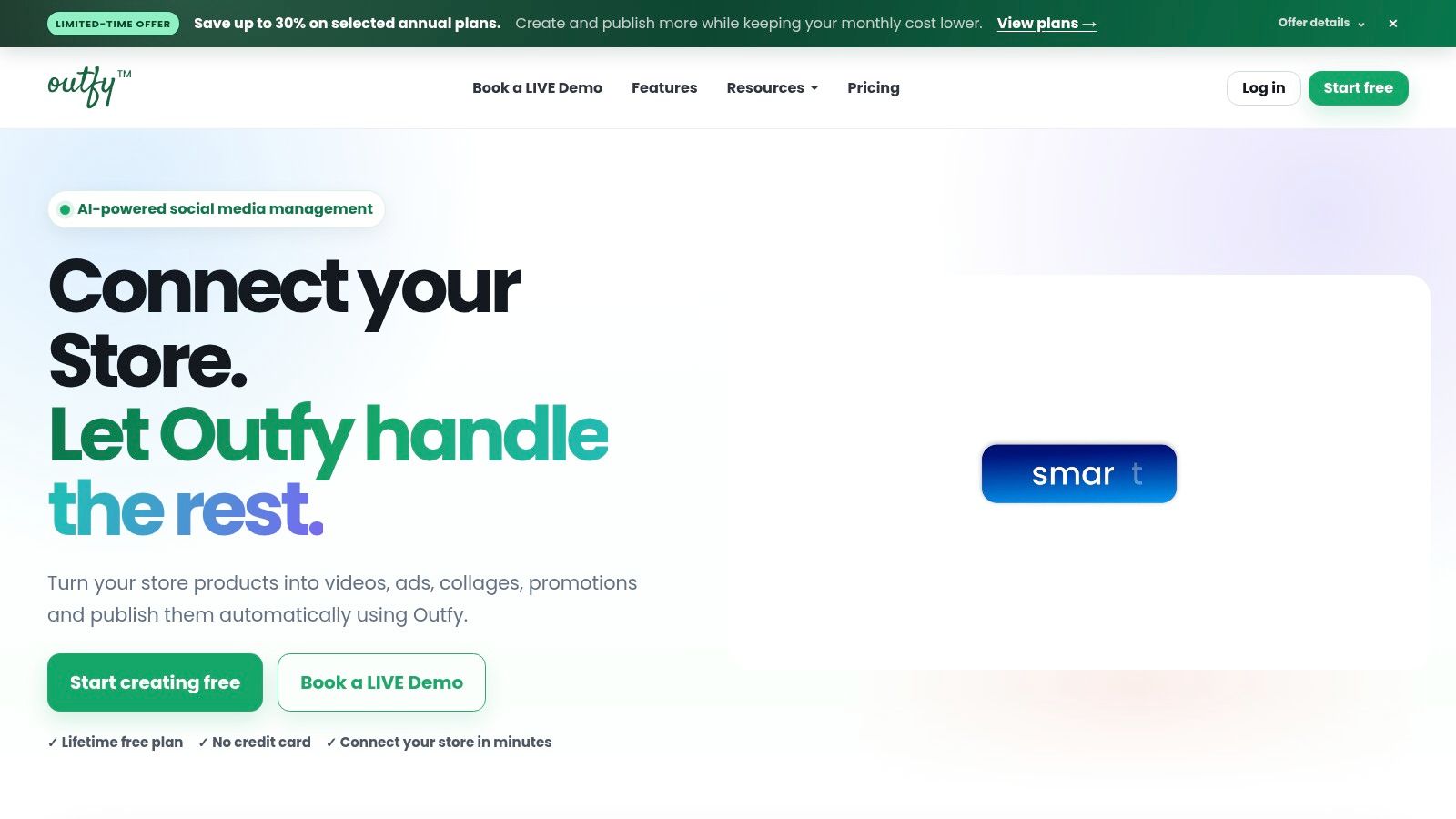
Outfy is for the seller who knows they should post more on social media and doesn't want to spend every evening making collages and short promo videos by hand.
It automates product promotion across channels like Instagram, Facebook, Pinterest, TikTok, Threads, and YouTube. That's useful if you're trying to create steady off-Etsy visibility without building a custom content engine from scratch.
Where Outfy helps most
Outfy works best when your listings are already presentable and your shop can handle more attention. It can auto-create product videos and graphics, use templates and a brand kit, and help you keep a consistent posting rhythm across multiple networks.
That's especially practical for shops with visual products such as jewelry, home decor, art, printables, and gifts. You can keep products circulating without manually rebuilding every promo post.
For sellers planning a broader awareness push around Etsy traffic and external channels, this Etsy shop marketing guide is a useful companion read.
Where sellers overestimate it
Social posting doesn't repair poor product-market fit, weak photos, or confusing offers. It can multiply attention. It can't create demand out of thin air.
And if you also use Etsy Ads, remember those placements run on their own logic. Etsy says ad placement is influenced by search relevance, listing quality, the bid amount or budget set for bids, and in some cases the likelihood of views or sales. Etsy also states that it enters bids on the seller's behalf based on the daily budget the seller sets (summary of Etsy Ads ranking factors).
Outfy is promotion support, not a replacement for listing quality or ad strategy.
Website: Outfy
10. Keyword Tool Dominator, Etsy Keyword Tool
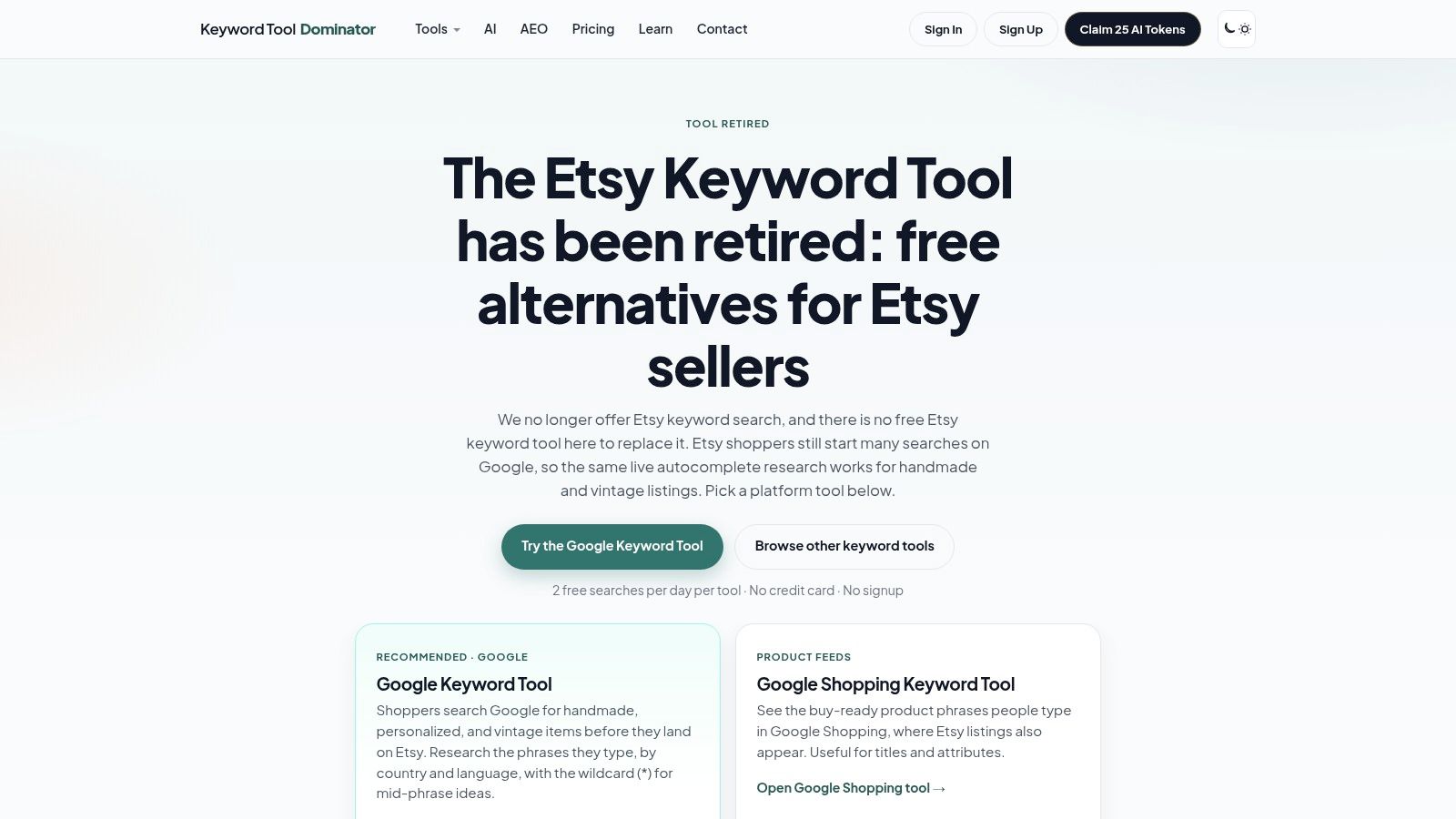
Keyword Tool Dominator's Etsy Keyword Tool is the simplest option on this list. That's the reason to buy it.
It pulls Etsy autocomplete suggestions fast, which makes it useful for long-tail phrase discovery when you want to validate wording variations without committing to a full SEO suite.
Best as a low-cost add-on
This tool is most valuable when you're filling title and tag gaps. It helps you surface phrasing buyers type, especially useful if you already know your niche but want more wording options for search-aligned copy.
It's also handy if you sell across platforms. The broader tool family covers other channels too, so some sellers use it to compare phrase patterns beyond Etsy.
A good companion concept here is the role of Etsy SEO itself. If you want a plain-language primer before buying tools, this what Etsy SEO means for sellers explainer is worth reading.
Why it shouldn't be your only serious tool
This tool doesn't audit listings, track rank, or estimate marketplace performance. It is not a decision engine. It is a phrase miner.
That makes it good for quick discovery and weak as a standalone operating system for your shop. If you're optimizing at any serious level, pair it with either a stronger SEO tool or your own first-party Etsy data.
One final practical note if you also run ads. Etsy's Ads FAQ says your daily budget is the maximum Etsy can spend in a day, you're charged only when a buyer clicks, impressions alone don't use the budget, Etsy won't exceed the daily budget, and ads stop showing once that budget is fully used (Etsy Ads FAQ summary). Keyword idea tools help ad planning, but they don't replace budget control or listing quality.
Website: Keyword Tool Dominator Etsy Keyword Tool
Top 10 Etsy Seller Tools: Feature Comparison
Product | Core focus & key features | UX & Quality (★) | Value & Price (💰) | Target & USP (👥 / ✨) |
|---|---|---|---|---|
🏆 Upglider | Single‑listing ranking campaigns (30/90/180d); top‑15 guarantee; dashboard; no Etsy access | ★★★★☆ | 💰 $129/30d • $349/90d • $649/180d (one‑time) | 👥 Sellers needing quick, measurable rank boosts; ✨ Guaranteed top‑15 placement, refund, pre‑check |
eRank | Keyword research, listing audits, rank monitoring, AI helper | ★★★★☆ | 💰 Free tier → low‑cost paid plans | 👥 Data‑driven sellers and researchers; ✨ Deep keyword + monitoring tools |
Marmalead | Real‑shopper keyword discovery, pricing guidance, AI coach | ★★★★☆ | 💰 Mid‑range subscription | 👥 Sellers wanting guided listing optimization; ✨ Pricing insight + Marma AI coach |
Alura | All‑in‑one: keyword research, AI copy, CRM, ads insights | ★★★★☆ | 💰 Freemium → Pro monthly tiers | 👥 Sellers who want ops + optimization in one login; ✨ CRM + AI listing writer |
EverBee | Chrome overlays with sales/revenue estimates, keyword discovery | ★★★★☆ | 💰 Low monthly (Chrome‑first) | 👥 Product researchers & validators; ✨ Live Etsy overlays for fast validation |
Sale Samurai | Lean keyword research, listing analyzer, seasonal planning | ★★★★☆ | 💰 Low, simple pricing; short trial | 👥 Sellers who prefer a clean, fast SEO tool; ✨ Simple UI + seasonal aids |
Koalanda | Unlimited searches (paid), multi‑shop analytics, listing helper | ★★★★☆ | 💰 Very low flat pricing (paid plans) | 👥 Multi‑shop owners on a budget; ✨ Unlimited keyword searches (paid) |
Vela | Bulk listing editor, AI photo tools, scheduling & templates | ★★★★☆ | 💰 Per‑shop pricing that scales with listings | 👥 High‑SKU shops & seasonal sellers; ✨ Massive time saver for bulk edits |
Outfy | Social media automation, AI studio, auto‑post creatives | ★★★☆☆ | 💰 Mid plans; creative credits system | 👥 Sellers needing hands‑off social posting; ✨ Multi‑network auto‑post + AI creatives |
Keyword Tool Dominator, Etsy | Etsy autocomplete mining, exportable long‑tail lists | ★★★☆☆ | 💰 One‑time or low‑cost add‑on | 👥 Sellers needing quick long‑tail ideas; ✨ Real Etsy autocomplete keyword pulls |
Build a Tool Stack Around One Next Step
Most Etsy sellers don't need more tools. They need a tighter sequence.
Start with demand validation. If you don't know what to sell next, use a research-first tool like EverBee, Sale Samurai, or Keyword Tool Dominator to test phrasing, niche shape, and product direction. That's the right move when your bottleneck is uncertainty, not execution.
Then improve the listing itself. eRank and Marmalead are the strongest fits when the problem is weak search visibility across titles, tags, and on-page SEO. Alura makes sense if you want that optimization layer bundled with research and simple customer follow-up in one place. If you're using Etsy's built-in tools too, that pairing works even better. Etsy has been expanding seller-side guidance toward listing quality and search visibility, not just shop administration, which makes native data more useful when combined with outside research.
Next, watch your own shop data instead of guessing. Etsy's first-party stats are the truth for your shop. Marketplace tools provide context. Use both. If views rise but orders don't, your problem probably isn't ranking anymore. If one listing improves while the shop average stays flat, that's still a win if that SKU matters most.
For large catalogs, don't keep paying with your time. Vela is the right purchase when bulk edits, photo consistency, and launch speed have become the bottleneck. That's not a beginner need. It's an operations need. The moment you're delaying updates because the work is too tedious, a bulk editor starts paying for itself in saved effort.
Use Outfy only after your listings are ready for wider exposure. External promotion helps when your products already look good and your shop can convert visits. If not, more social posting just sends more people to an underperforming listing.
A focused service like Upglider fits a narrower but very real situation. You already know the listing. You already know the phrase. You want concentrated ranking help for that one target without sharing account access or buying another monthly software stack. In that case, a ranking campaign can make sense, especially for a seasonal or high-potential SKU. But keep the promise straight. Ranking support can improve placement. It cannot guarantee sales, revenue, or long-term results after the campaign if the listing itself doesn't hold up.
Choose the smallest stack that solves your current bottleneck. One research tool, one optimization path, and your own Etsy data is enough for most shops. Review results, then decide if you need another subscription.