You've published a product you're proud of, checked the photos, and added tags. Then you open your shop stats and find almost no views. You search for it yourself, spot it briefly, and wonder why that visibility hasn't turned into sales.
Learning how to improve Etsy SEO starts with separating a search appearance from lasting visibility. Choose a precise buyer search, make the whole listing deliver on it, and measure results under consistent conditions. Changing keywords without that discipline makes it hard to tell what helped.
Why Most Etsy Listings Stay Invisible
A stalled listing doesn't necessarily need more keywords. It may describe the wrong buying intent, present an unclear offer, or look relevant to you without answering the shopper's actual question.
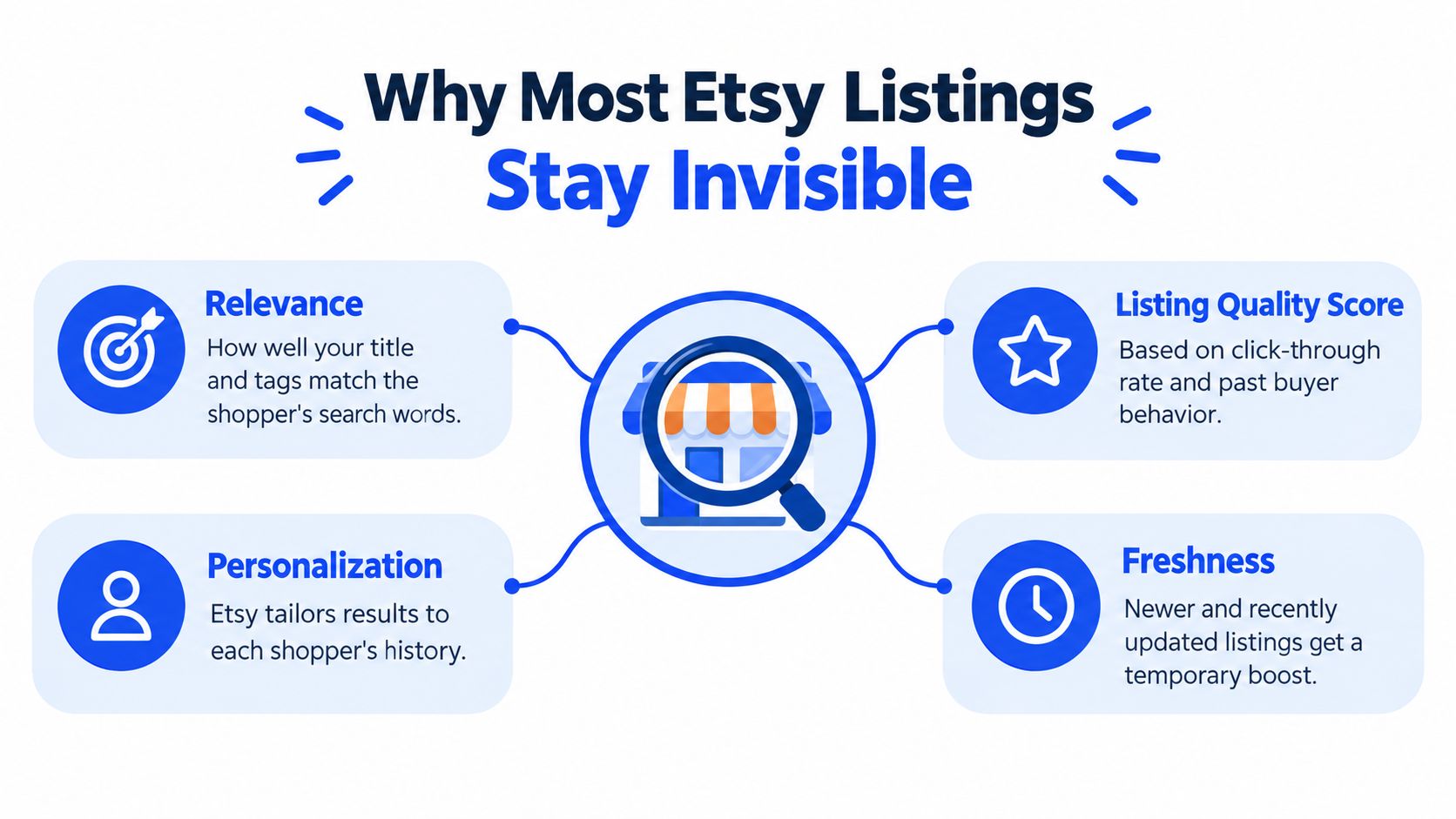
Etsy describes search as a matching process followed by ranking. Titles, tags, categories, and attributes help determine which listings match; listing quality, customer-service quality, and personalized search insights help determine their order, according to Etsy's guide to search. That distinction explains why adding tags alone isn't a complete fix.
Separate matching from buyer response
Think about a shopper looking for a personalized ceramic ring dish. A listing called Beautiful Handmade Gift makes that shopper do unnecessary work. A clearer product phrase establishes what's being sold before the shopper opens the listing.
But matching that search isn't the same as persuading someone to buy. If the photograph hides the personalization, or the description doesn't explain how to submit a name, the listing still leaves important questions unanswered.
Practical rule: Make the listing answer the same shopper question from the search result through to checkout.
The competitive setting matters too. Etsy reported 89.6 million active buyers on its marketplace as of December 31, 2024, alongside 8.1 million active sellers across its broader marketplaces, in its 2024 Integrated Annual Report. Those populations have different scopes, so don't treat them as a direct buyer-to-seller ratio. They still illustrate why a broad word such as gift is an ambitious starting point.
Diagnose the mismatch before editing
Check whether your listing makes a consistent promise:
Search wording: Does the phrase identify the actual product rather than a vague category?
Offer clarity: Can shoppers distinguish a physical item from a digital file or customization option?
Visual agreement: Does the main photograph show what the title promises?
Buyer confidence: Can someone understand what they'll receive without sending a message?
Use this explanation of the Etsy search algorithm to frame your audit, not to hunt for a hidden shortcut. Your next edit should solve an identifiable problem, not just make the listing look more optimized.
Pick One Search Phrase Before You Touch Anything
Start with a sentence describing the buyer's task: Someone wants a downloadable, understated print for a bedroom and already knows the style they like. That gives you a more useful starting point than a loose collection of popular words.
For this hypothetical product, wall art could become minimalist bedroom wall art print. The longer phrase identifies the style, room, and product. It's a working target, not a claim that the phrase has proven demand.
Check the phrase against the product
Type the candidate into Etsy's search bar and inspect any autocomplete suggestions. Treat suggestions as wording to investigate, not as verified search-volume figures.
Then inspect the results. Are shoppers seeing physical prints, downloadable files, framed pieces, or mixed products? If your offer differs from what the phrase appears to describe, refine your wording rather than forcing the listing into that search.
Candidate phrase | What to check before choosing it |
|---|---|
Minimalist bedroom wall art print | Does the artwork clearly fit that style and setting? |
Neutral botanical printable | Is it downloadable, botanical, and genuinely neutral? |
Personalized wedding keepsake | Can buyers customize it, and is its wedding use obvious? |
Competitor listings can help you notice product distinctions you've overlooked. Don't copy their wording or assume a prominent result proves every keyword in its title works.
Choose a target you can measure
Record your selected phrase before making changes. Keep closely related alternatives in a separate research sheet so you don't switch targets whenever a different suggestion looks appealing.
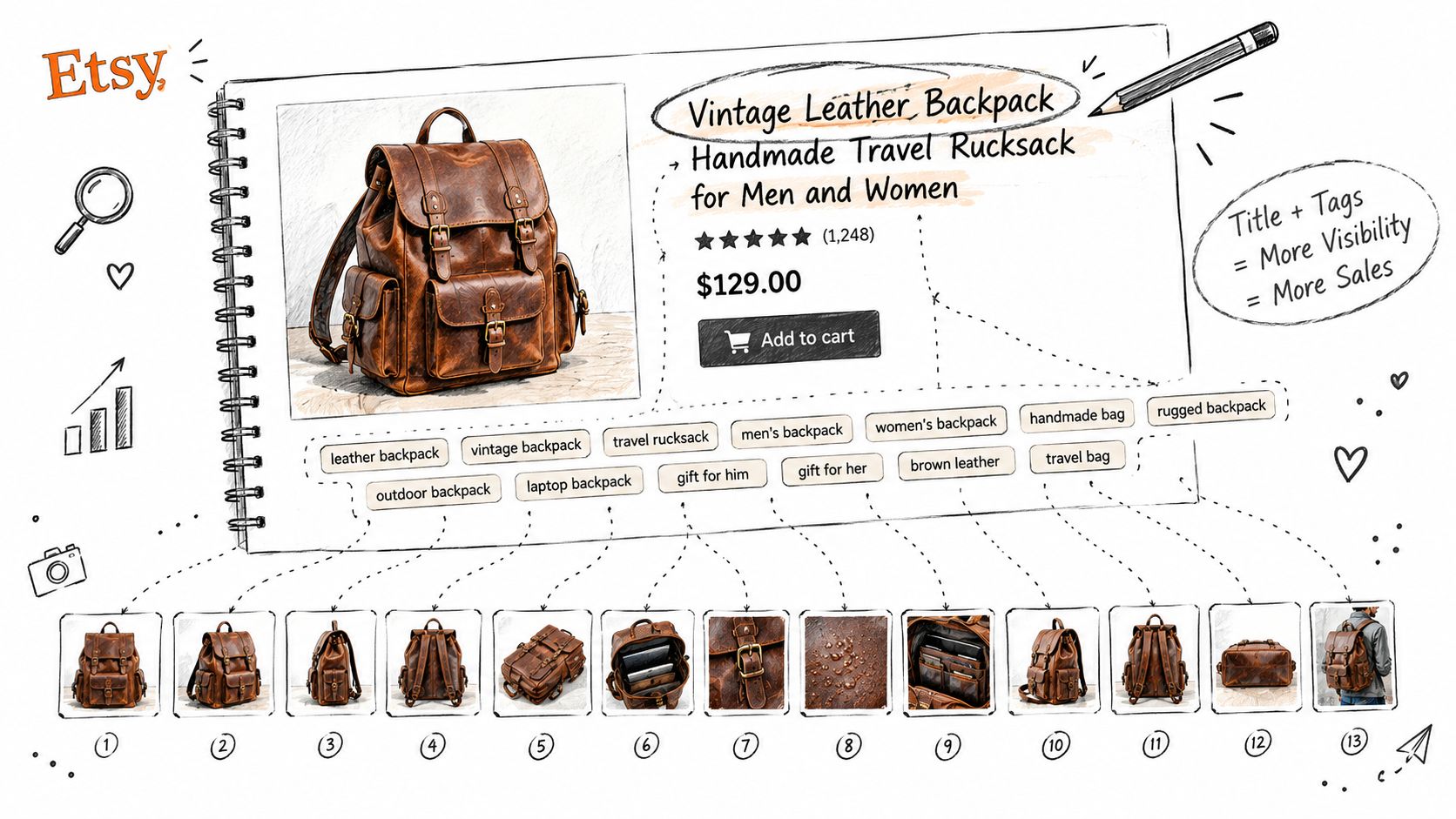
Etsy recommends using all 13 available tags, explaining that unused fields are missed matching opportunities in its guidance on keywords and tags. That doesn't mean your listing needs unrelated search targets. Use the available coverage to describe relevant aspects of the same product.
A useful target phrase describes the item you actually sell, not the audience you wish it could attract.
For a fuller research process, use this guide to Etsy keyword research. Keep the decision simple: identify the buyer, name the product precisely, and choose wording you can hold steady while evaluating changes.
A focus phrase isn't a restriction on every possible search match. It's a reference point that keeps your edits and measurements connected.
Build the Title and All 13 Tags as One System
For a hypothetical downloadable line drawing, the title and tags should describe the same offer without becoming a string of near-duplicates. Start with the product phrase, then add details that help a buyer distinguish it.
Etsy advises putting important keywords early in the title for shopper clarity. It also explains that conversion contributes to listing quality and that new listings receive a small, temporary boost, generally lasting a few hours to a few days, with a smaller boost for renewals, in its explanation of how search works. Better wording should therefore support a buying decision, not just a brief appearance.
Write the title as a product label
Target phrase: Minimalist bedroom wall art print
Example title: Minimalist Bedroom Wall Art Print, Neutral Botanical Line Drawing, Digital Download
The opening identifies the product. The remaining wording clarifies its appearance and delivery format. There's no need to use every available character if the result becomes difficult to read.
Compare that with Bedroom Print Wall Art Minimalist Art Print Bedroom Decor Gift. The repeated terms add little useful information. A shopper still needs to know what the artwork depicts and whether anything arrives in the mail.
Give each tag a useful job
Building on Etsy's tag guidance above, use natural phrases that cover different relevant aspects of the offer. For the hypothetical print, the complete tag set could be:
Search angle | Example tags |
|---|---|
Core product | minimalist print, bedroom wall art, botanical drawing |
Appearance | neutral decor, beige illustration, single line flower |
Format | digital download, printable artwork |
Setting and style | apartment styling, scandi interior, gallery wall piece |
Relevant use | housewarming gift, calm room accent |
These are illustrative phrases, not researched winners. Only use them if they accurately describe your artwork and its intended use.
Some shared words are unavoidable. Don't twist natural language merely to eliminate every repeated root word. The useful distinction is between repeating an entire idea and adding a meaningful angle.
Keep specific descriptors: Subject, style, material, and format can help distinguish the offer.
Reject unrelated occasions: Don't add wedding wording to an item with no credible wedding use.
Avoid empty gift language: Identify why the product suits the recipient rather than collecting broad gift phrases.
Save the previous title and tags before publishing. If you later see a change in search traffic, you'll have an actual version to compare instead of relying on memory.
Strengthen Categories Attributes Description and the First Photo
Open the listing editor and inspect the fields beneath the title. A polished keyword block can't compensate for a category that describes the wrong product or a description that leaves the purchase unclear.
Etsy says it evaluates listings holistically, including titles, tags, attributes, descriptions, first photographs, reviews, and other listing information. It also highlights high-quality photographs and a return policy as information buyers use when deciding whether to purchase in its listing-quality and search guidance.
Make the structured fields accurate
Choose the most specific category that fits the item. Don't select a category because its wording resembles an attractive keyword if it misrepresents what you sell.
Complete relevant attributes when they're available. Check material, color, occasion, room, or holiday against the actual item, not against a wish list of searches.
Material: Identify what the buyer receives, not a material shown only in staging.
Color: Describe the product itself rather than a background prop.
Occasion: Select an occasion only when the connection is credible.
Format: Keep physical and digital offers unmistakably distinct throughout the listing.
For the example printable, a frame visible in the photograph is a particular risk. If the purchase includes only files, explain that clearly rather than expecting shoppers to infer it.
Write the description around purchase questions
Open with what the item is, who it suits, and what's included. Use the target phrase naturally where it helps, then answer practical questions.
For a downloadable print, explain the supplied files, how the buyer accesses them, and what they'll need to arrange separately. For a personalized dish, explain the customization process, appearance, care, and fulfillment expectations.
Buyer-confidence check: Could someone explain exactly what they're buying after reading the opening and looking through the photos?
Publish a return policy that accurately reflects your offer. Keep fulfillment promises realistic, answer questions clearly, and use reviews as feedback about where buyers' expectations and the delivered product diverge. Don't invent a separate ranking benefit for returning customers when you can't substantiate it.
Judge the main photo at search-result size
Shrink the image before approving it. Check whether the product remains recognizable, whether personalization is visible, and whether props compete with the item.
Use supporting photographs to explain scale, texture, packaging, or customization. The first photograph should establish the offer quickly; the rest should help buyers evaluate it.
Treat these edits as buyer-experience work with search implications, not as isolated technical tricks. Record image changes alongside copy changes so you can interpret later results sensibly.
Measure Ranking Honestly Instead of Guessing
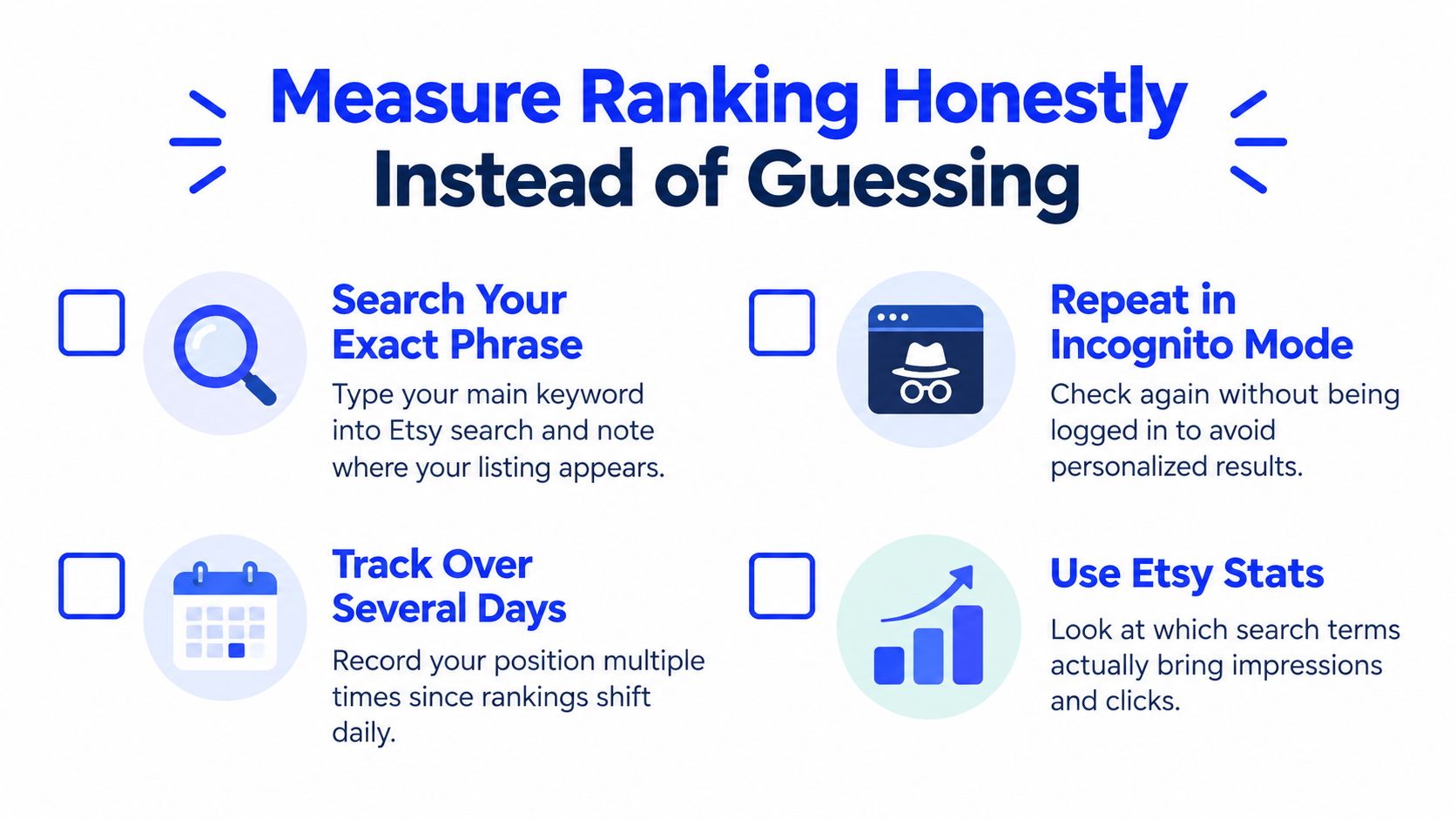
Your observed position isn't a universal Etsy ranking. As Etsy's search guidance above explains, matched listings are ordered partly through personalized search insights. Your own search is therefore an observation from a particular context, not proof of what every shopper sees.
Distinguish eligibility from position. Eligibility means a listing can match a query. Position describes where you observe it within a particular set of results, and not finding it within your checking range doesn't prove it's ineligible.
Fix the checking conditions
Use a signed-out private browser window to reduce account-history effects. Don't treat private browsing as a way to eliminate every contextual influence or reveal a single objective ranking.
Keep your phrase, device type, target market, language, and search settings consistent. Separate advertising placements from the organic results you're tracking.
A simple spreadsheet can capture the essentials:
Field | What to record |
|---|---|
Search context | Exact phrase, market, language, device, and filters |
Observation | Date, checking method, and observed organic position |
Listing version | Title, tag, attribute, description, or image changes |
Business results | Available search traffic and order information |
Interpretation | Whether the observation is repeated or isolated |
If you don't find the item, record not found within checked results. That's more honest than assigning a position you haven't observed.
Look for repetition and useful traffic
Choose a checking schedule you can maintain and review the pattern across weeks. Use longer review windows for slower-moving listings rather than declaring success or failure after an isolated search.
Compare those observations with the listing-performance information available in Etsy's analytics. A better observed position without relevant visits or purchases needs investigation, not celebration.
Record what you saw, where you saw it, and how you checked. Don't turn an observation into a guarantee.
A consistent Etsy rank-checking method is especially important when evaluating outside help. Ask providers to disclose their checking conditions before comparing their reports with your own.
Keep the measurement method unchanged while evaluating an edit. Otherwise, an apparent improvement may reflect a different checking setup rather than better visibility.
Promote Smartly Then Decide What to Do Next
Once the listing is clear and complete, choose promotion that reaches people who might want the product. For botanical artwork, consider showing the print in a relevant room-setting post or sharing useful styling content with an interested audience.
Treat external promotion as a separate activity to evaluate. Don't assume every visit improves organic ranking, and don't buy meaningless traffic to make a dashboard look busier.
Use analytics to choose the next edit
Review the search terms and listing-performance information available in Etsy Stats. Ask whether the visitors arriving are looking for the product you sell.
If shoppers arrive through mismatched wording, revisit relevance. If the traffic appears appropriate but purchases remain weak, inspect the offer: product clarity, photos, price, delivery expectations, and unanswered questions.
Relevant visits but hesitation: Improve the information buyers need to make a decision.
Unexpected search terms: Check whether your wording attracts the wrong intent.
Little usable evidence: Keep observing before repeatedly replacing the target phrase.
Recent renewal or launch: Separate temporary exposure from a sustained pattern.
The freshness effect described earlier is why repeated renewing isn't a durable optimization strategy. It can also muddy your interpretation if you renew while changing the title, photos, and promotion at the same time.
Evaluate help against a defined problem
Your options include continued self-testing, a listing audit, targeted promotion, or a narrowly scoped ranking campaign. Upglider is an independent option for campaigns focused on an individual listing and an agreed search phrase, with pre-payment assessment and no Etsy account access required.
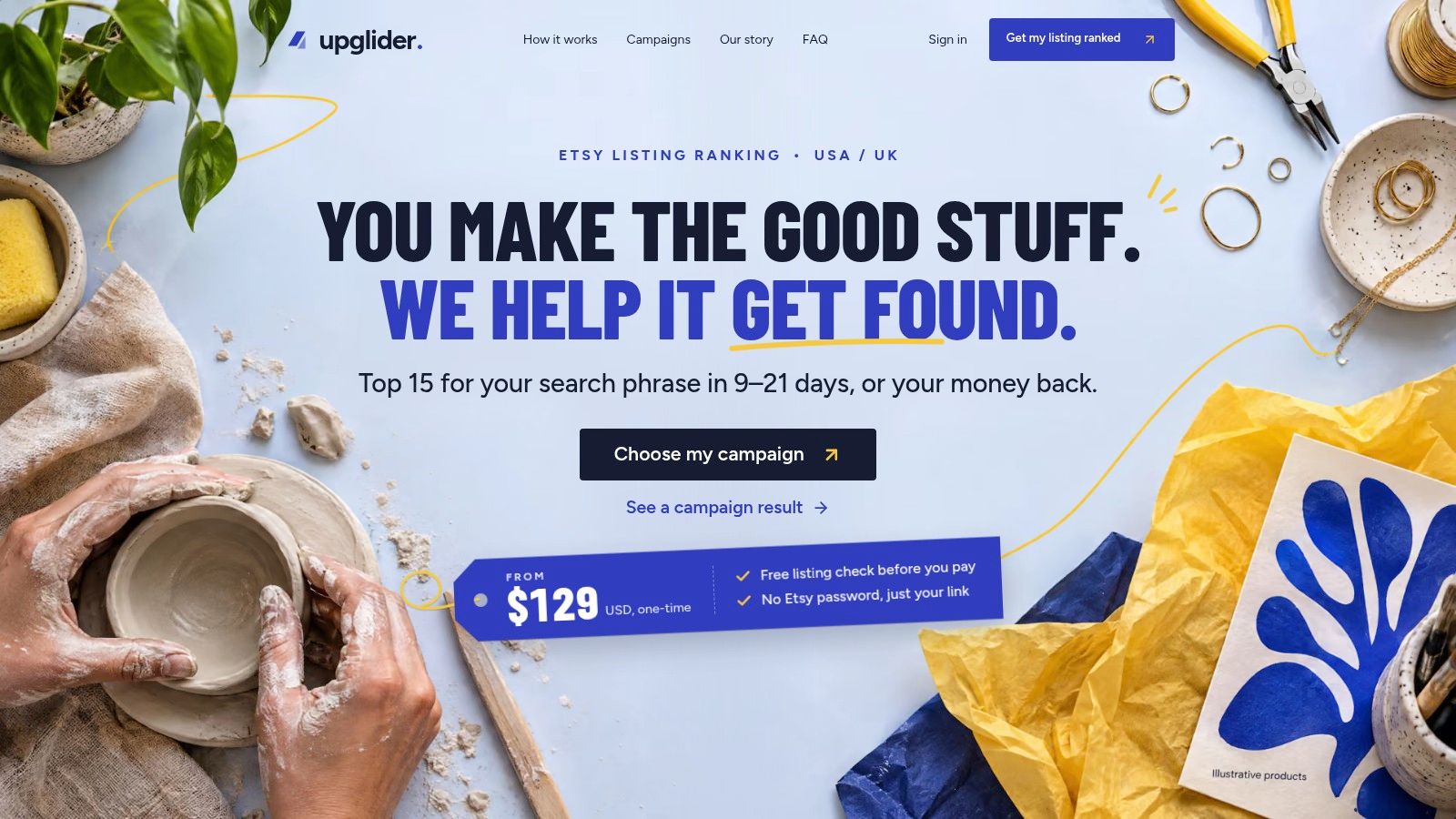
Before considering a service, check your readiness:
Listing fit: The product matches the proposed phrase.
Purchase clarity: Photos, description, options, and policies explain the offer.
Measurement agreement: You understand the market, checking method, and reporting conditions.
Commercial boundaries: Deliverables, duration, refund terms, and seller responsibilities are clear.
Outside help can address a defined visibility task; it can't make an unclear product offer persuasive. Keep responsibility for product quality and the customer experience in your shop.
Choose a promising listing today, save its current version, and write down its target phrase and checking conditions. Complete the listing audit, observe results consistently, and use that record to decide whether your next investment should be better presentation, different wording, targeted promotion, or specialist help.