Etsy SEO is optimizing titles, tags, attributes, and shop signals so a listing matches buyer search phrases and ranks higher in Etsy search. On a marketplace with 8.5 million active sellers and 93.2 million active buyers as of September 30, 2025, being findable can decide whether a beautiful product gets noticed or remains hidden. (Etsy marketplace filing)
You may recognize the frustrating pattern. You make a thoughtful handmade product, photograph it carefully, write a description, and publish the listing. Then the views barely move. The problem might not be the product. Buyers may be using different words from the ones you chose.
Introduction
A new seller might call a product “Handcrafted Walnut Shelf,” because that describes how it was made. A buyer, however, may search for “floating wood shelf for kitchen.” If the listing doesn't give Etsy enough clues to connect those phrases, the product can struggle to appear, even when the craftsmanship is excellent.
That connection is the heart of what Etsy SEO means. You adjust the words and details in a listing so Etsy can understand what you're selling and match it with the phrases shoppers type into the search bar. You also improve the listing and shop experience so shoppers are more likely to click, trust, and buy.
Etsy was founded in Brooklyn in 2005 and launched publicly on June 18, 2005. Search discovery has been part of the marketplace's development from its early years, including tag-based categorization introduced during the 2005 to 2007 period. (Etsy history and search development)
This guide treats Etsy SEO as a matchmaking system, not a pile of keywords. You'll see how Etsy checks relevance, how shopper behavior affects listing quality, why customer service can influence visibility, and which changes deserve your attention first. For broader promotion ideas beyond search, you can also explore Etsy shop marketing strategies.
The useful mindset is simple: speak the buyer's language, give Etsy complete information, and make the post-click experience strong.
What Etsy SEO Really Means for Sellers
A buyer may search for “personalized wedding mug,” while a seller describes the same product as a “custom ceramic keepsake.” Etsy SEO helps connect those two ways of speaking. It gives Etsy clear clues about the item, then helps the marketplace match it with shoppers who may want it.
Etsy has its own catalog, search box, filters, categories, and ranking system. A polished brand name cannot replace clear product information if Etsy cannot tell what the listing offers.
Etsy works like a market guide. Buyers describe what they need, and the guide checks the information attached to each stall and product. Titles, tags, descriptions, and attributes help it identify possible matches.
The match must also lead somewhere useful. Photos, reviews, service, and shopper response give Etsy signals about whether the listing can provide a satisfying experience. Keywords help a product enter the conversation, while the full listing and shop experience support buyer confidence.
Etsy reported 21.2 million new marketplace buyers during 2025, showing why search visibility can help sellers reach new demand as well as returning shoppers. (Etsy marketplace filing)
Core definition: Etsy SEO matches your listing's language and signals with the way buyers search, then supports that match with a useful, trustworthy shopping experience.
The practical goal is straightforward: use language buyers recognize, provide complete details, and make the path from click to purchase clear.
How Etsy Search Decides What Ranks Higher
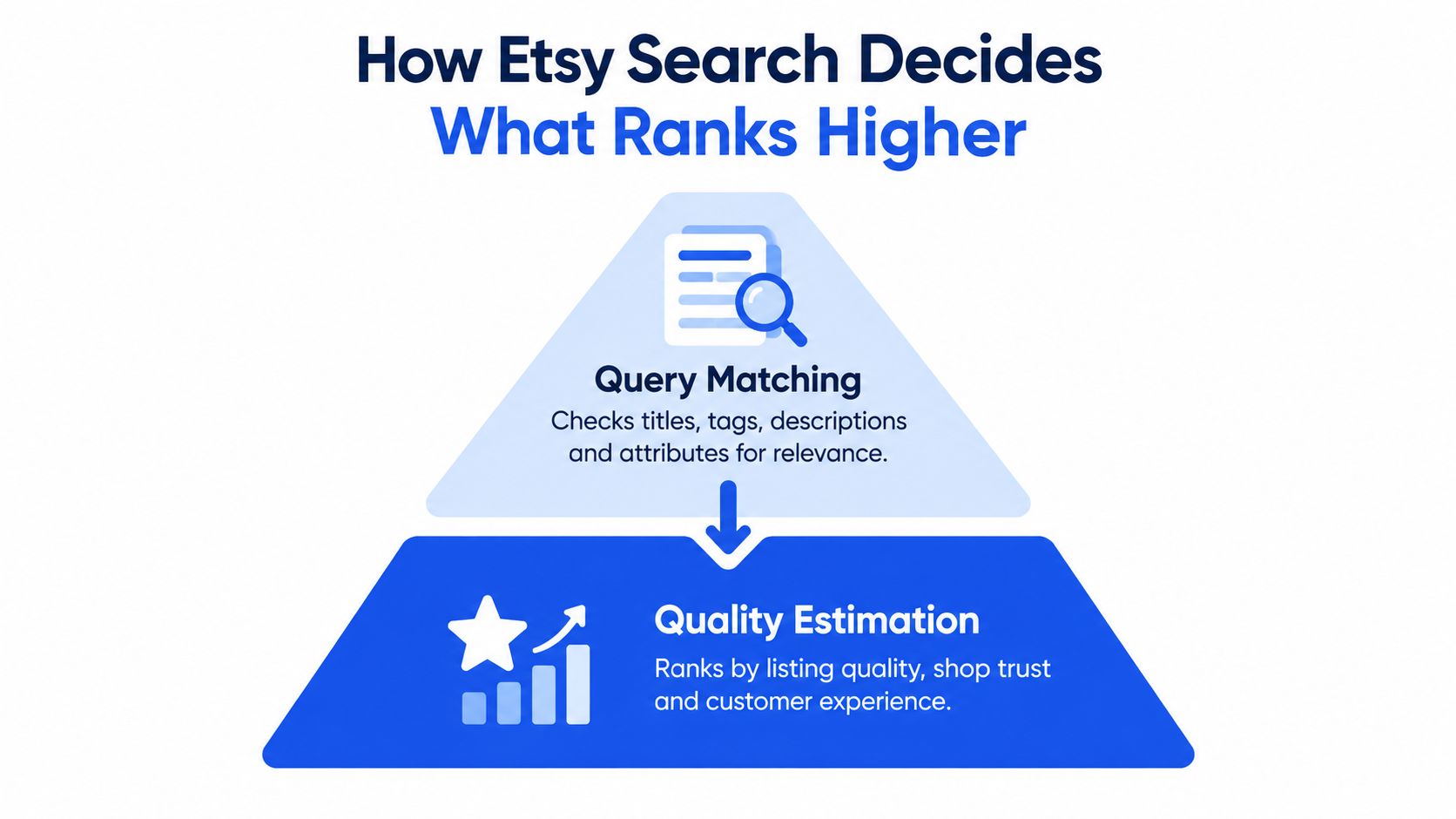
Etsy search works like a matchmaking system. A shopper describes a need, and Etsy compares that language with the signals attached to each listing. Relevance gets an item into the possible matches. Quality and shop trust help determine which matches deserve more visibility. (Etsy search and recommendation policy)
Layer one is query matching
Etsy checks the listing's title, tags, description, and attributes to understand whether it fits a search. For a customizable ceramic mug, a buyer might type “personalized coffee mug.” Clear product wording, tags about personalization and use, and accurate attributes give Etsy several connected clues.
Your private product language may be meaningful to you but unclear to shoppers. “Morning vessel, speckled series” sounds distinctive, yet it does not plainly identify the item or its audience. Buyer-centered wording gives Etsy a clearer bridge between the query and your listing.
Layer two is quality estimation
Once a listing appears relevant, Etsy considers engagement signals such as clicks, views, favorites, and purchases. These actions show how shoppers respond after encountering the listing. A relevant item that gains attention and sales provides stronger quality evidence than one that receives views but little further activity.
Keywords help a listing enter the search conversation. They do not promise lasting visibility. The main photo, price, description, shipping details, and product experience influence whether a shopper stays, engages, and buys.
New or relisted items receive a small temporary recency boost, according to Etsy. This gives Etsy an opportunity to observe shopper response. The effect is temporary, so repeated relisting without improving relevance or customer experience is unlikely to create durable visibility.
Key Ranking Signals You Can Control
A shopper searches for “personalized wedding mug.” Etsy compares those words with the signals in each listing, much like matching a question with the clearest answer. Your job is to make that answer easy to recognize.
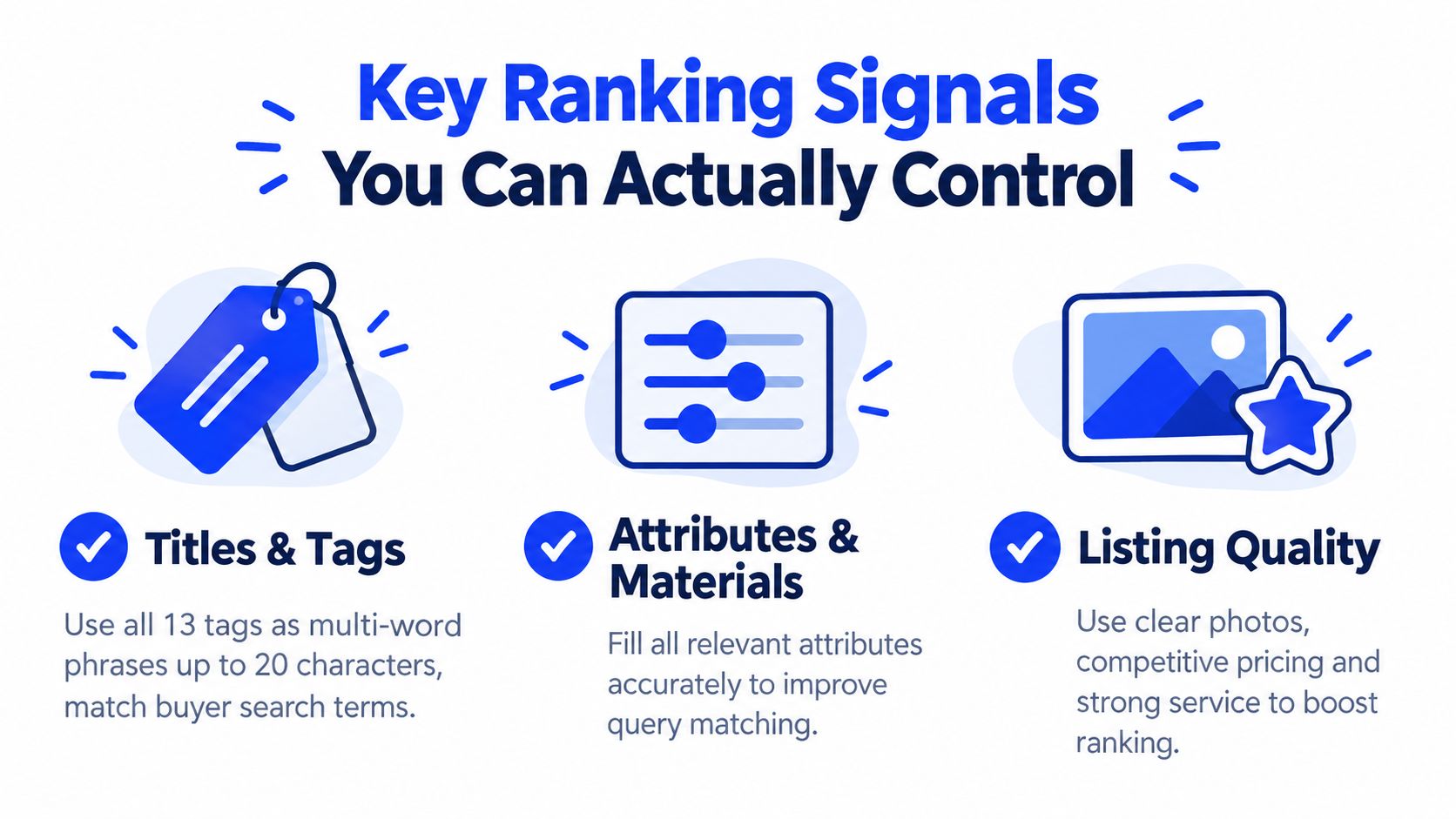
Start with the listing fields you can edit. Etsy recommends using all 13 tags, because each tag gives your item another opportunity to match a shopper's search. Tags should be multi-word phrases and can be up to 20 characters long. (Etsy tag guidance)
For a personalized wedding mug, tag ideas can describe the product, audience, use, or occasion. Each phrase should reflect a genuine way a buyer might search. Unrelated terms weaken the match between the shopper's words and your item.
Your title should identify the product before trying to sound clever. Etsy recommends placing important traits near the beginning, keeping the title easy to scan, and considering fewer than 15 words when those words cover the item's key characteristics. Use your shop's language for titles and tags instead of repeating the same terms in multiple languages. (Etsy title guidance)
A practical title might be:
Less clear: “Handcrafted Custom Walnut Shelf”
More buyer-focused: “Floating Wood Shelf for Kitchen, Custom Size”
The second title names the product and likely use right away. The description can provide dimensions, materials, care instructions, and customization details without becoming a string of keywords.
Complete the listing itself
Select the most specific category available and complete every relevant attribute accurately. These details give Etsy more context for matching queries, while shoppers use them to narrow their choices.
Your primary photo affects both visibility and the click that follows. Etsy's Search Visibility page says active listings need at least one image, with a primary photo that is high-resolution, singular, clear, and well-lit. It also lists a return policy among the requirements for having a chance at priority placement. (Etsy Search Visibility requirements)
Review this Etsy listings resource to see how titles, images, descriptions, and customer-facing details support one another.
Why Shop Trust and Service Affect Your Visibility
A listing doesn't exist in isolation. Etsy also evaluates signals connected to the shop behind it, so SEO includes operational habits as well as written metadata.
Etsy says ranking includes the shop's average review rating, message response rate, and case rate from the past three months. It also considers broader customer-service quality and shop completeness, including high-quality images and policies. (Etsy search guidance for sellers)
That creates a practical connection between service and search. Replying promptly helps a buyer feel supported before purchase. Clear policies reduce uncertainty. Accurate descriptions and reliable fulfillment reduce the chance that a customer feels misled. Those actions support conversion and also contribute to the trust signals Etsy uses.
Shipping can matter too. Etsy says shipping price and method may affect ranking, while translations, location, and language settings help match listings to buyers in different markets. For US listings, Etsy states that domestic shipping prices lower than $6 will be prioritized in search. (Etsy Search Visibility requirements)
That doesn't mean you should choose shipping terms that hurt your business. It means you should understand how the buyer's total experience, including delivery expectations, fits into visibility.

A strong Etsy SEO routine asks two questions: “Can Etsy understand this listing?” and “Will the buyer feel confident after clicking?”
Review your shop as a customer would. Check whether the main photo is easy to read, whether policies answer obvious concerns, whether messages receive timely replies, and whether shipping information matches what you can deliver.
Common Misunderstandings That Hurt Etsy SEO
Keyword stuffing isn't the same as relevance. A title such as “Rustic Shelf, Floating Shelf, Wood Shelf, Kitchen Shelf” includes related phrases, but it feels repetitive and is harder to scan. “Floating Wood Shelf for Kitchen, Custom Size” gives shoppers a clearer picture of the product and its use.
The same idea applies to tags. Repeating one phrase with minor changes wastes opportunities to describe genuine variations, audiences, occasions, or uses. Each tag should help Etsy connect the listing with a different way a buyer might search for the item.
Multiple languages aren't automatically better. Etsy recommends using your shop language for titles and tags and warns against adding tags in multiple languages. Its translation system can help match listings with buyers in other languages, so foreign-language terms in your own metadata may make the listing less clear. (Etsy title guidance)
A new-listing boost won't carry a weak listing. The temporary recency boost gives Etsy a chance to observe shopper response. It does not provide lasting exposure. If clicks, favorites, and purchases do not follow, repeatedly refreshing the listing leaves the main problem unchanged.
Search demand also shifts, especially for seasonal or trend-led products. Etsy's Spring and Summer 2026 trend report describes changing interest in items such as embroidered straw bags, embroidered bags among Gen Z shoppers, and handmade jumpers. (Etsy Spring and Summer 2026 trend report) Treat titles and tags as working language. Review them when buyer interests change, rather than assuming one optimization pass will remain useful forever.
What to Prioritize to Improve Your Etsy Visibility
A shopper searches for a phrase, and Etsy compares it with your listing. Improve that match one listing at a time instead of rebuilding the whole shop.
Start with buyer language. Describe what the product is, where it is used, who might buy it, and whether it suits a gift or occasion. Choose words shoppers use, not private maker terminology.
Connect the title and tags. Place the clearest product phrase near the title's beginning, then add meaningful traits. Use all 13 tags as relevant multi-word phrases, staying within Etsy's 20-character tag limit.
Complete the listing details. Select the most specific category, fill in relevant attributes, strengthen the primary image, and add a return policy where appropriate. These details give Etsy more signals for matching the item with a search.
Remove trust obstacles. Review response habits, shop policies, shipping setup, and customer experience. Relevance may bring a shopper to the listing, while dependable service helps support confidence and engagement.
Make changes deliberately, then allow time for useful shopper feedback. The goal is a clearer match between buyer language and listing signals, supported by quality and shop trust.
For paid visibility, Etsy ads guidance explains how promoted placement differs from organic optimization. Upglider also offers external campaigns focused on one listing and one agreed search phrase, without Etsy account access.
Start with one listing today. Rewrite its title, complete relevant tags and attributes, then review the main photo and policies from a customer's perspective. Small improvements give Etsy clearer information and shoppers a stronger reason to click.