What if the problem is not your whole Etsy shop, but one listing that never gets enough search traction to prove itself? That is where a focused Etsy SEO service earns its keep. It gives you a single target, a single phrase, and a cleaner path to visibility instead of spreading effort across every listing and hoping something sticks.
Etsy is a crowded place. By the end of 2025, Etsy had 5.6 million active sellers and 86.5 million active buyers, and in Q2 2026 it reported 5.706 million active sellers and 86.969 million active buyers alongside about $2.6 billion in gross merchandise sales and $668 million in revenue, which is exactly why small ranking gains can matter so much for one listing (market context and Etsy metrics). If you're trying to earn attention in that environment, broad “do everything” advice often wastes time.
Approach | Best for | Main trade-off |
|---|---|---|
Single-listing SEO | One product, one phrase, one clear ranking goal | Narrower scope, less shop-wide coverage |
Full-shop optimization | Shops building a broader catalog presence | Slower, more work, harder to measure one win |
Etsy Ads | Sellers who already convert and want paid reach | Ongoing spend, weaker if the listing itself is not ready |
A focused campaign makes sense when you've got a flagship listing, a seasonal launch, or a product you want to push hard without turning your week into a keyword research project. It also makes sense when you care less about “brand building” and more about whether one listing can hold a search position for one specific phrase. That's a different job from general marketing.
If you want a deeper breakdown of listing-level help, this guide to Etsy listing help is a useful companion. The question is simple, which listing deserves the first serious push, and what would it mean if that one page finally started earning consistent clicks?
Why Focus on One Listing Instead of Everything at Once
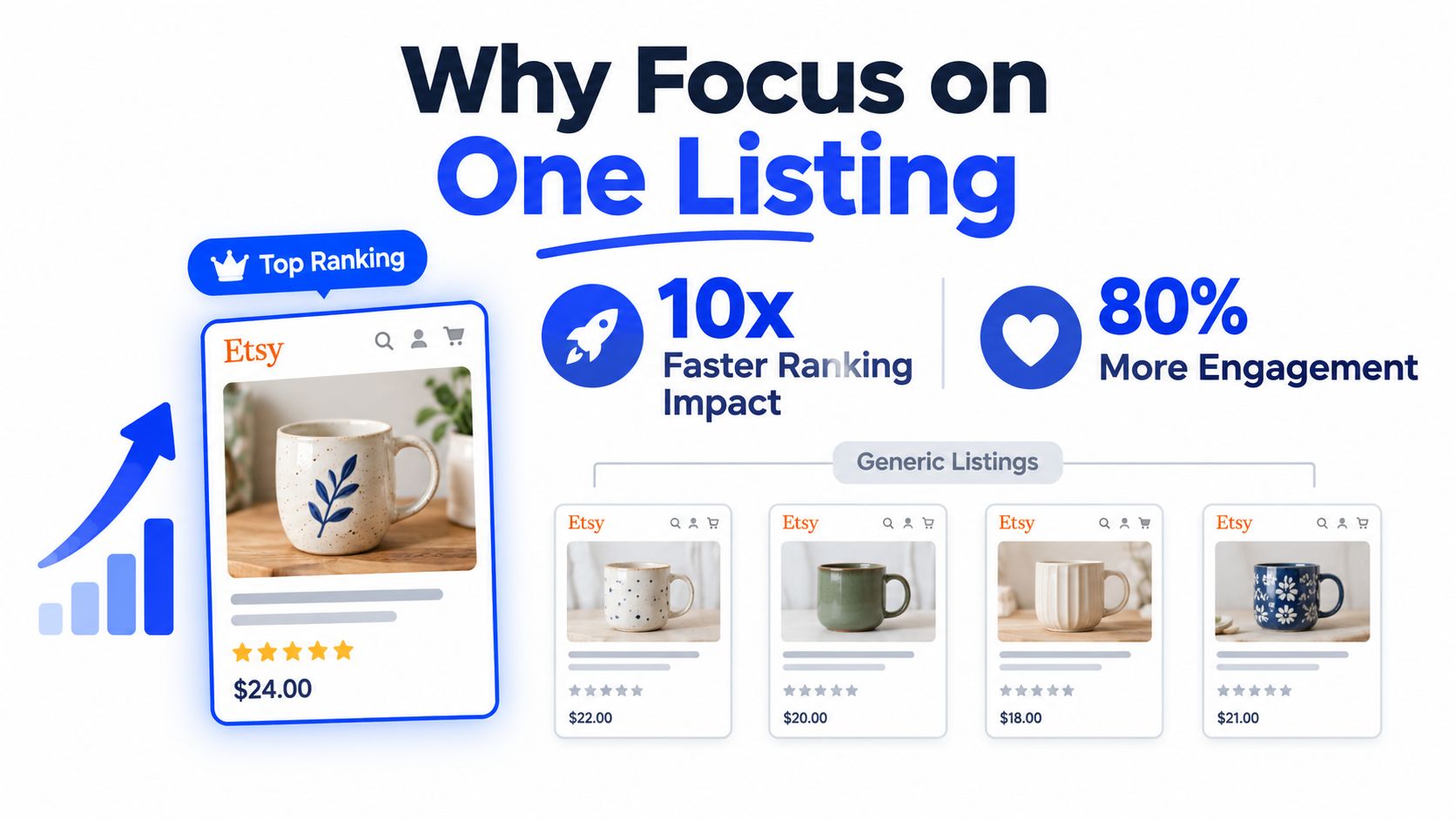
Trying to fix an entire shop usually feels productive until you check the results and nothing has moved. A single-listing campaign avoids that trap. You pick one product, one phrase, and one ranking target, instead of hoping a wide batch of changes somehow creates momentum everywhere.
The narrow win is often the decisive win
For a new shop, the first useful result is usually not broader branding. It is one listing appearing where buyers can find it. That matters even more for sellers with limited time, because broad optimization demands more research, more rewriting, and more patience than expected.
A targeted Etsy SEO service is a decision to put effort where the commercial upside is clearest. If one product already has strong photos, a sensible price, and a believable offer, ranking that listing can do more for sales than polishing five weaker pages.
Practical rule: start with the listing that already has the best chance to convert, not the one that is easiest to edit.
Seasonal products and launch windows fit this approach too. If your window is short, you do not need a theory about the whole shop. You need one listing to earn attention while demand is still there.
Pick the listing that can carry the shop
Choose the product with the cleanest search intent behind it. If the phrase is vague, the traffic will be vague too. If the product is a strong match for a specific buyer need, the ranking work has a much better chance of paying off.
The single-listing help path is built around that idea, and it matches how serious sellers work. They stop asking, “How do I optimize everything?” and start asking, “Which page is most worth the push right now?”
That shift changes the economics. A narrow campaign is easier to judge, easier to manage, and easier to connect to real sales behavior. Once that listing proves itself, you can expand. If it does not, you learned something without burning time on the whole catalog.
If you want a deeper breakdown of listing-level help, this guide to Etsy listing help is a useful companion.
How Etsy Search Actually Ranks Listings
How does Etsy decide which listings get shown first? It starts with query matching across titles, tags, categories, and attributes, then weighs signals like review rating, message response rate, case rate, shipping price, and buyer behavior, according to Etsy's search guidance. For a focused campaign, that puts phrase-level relevance at the center of the work.
Relevance comes first, then performance signals
If the listing misses the query, the rest barely matters. Sellers waste time when they chase broad keyword lists and hope a page will rank for everything because the title is longer. It has to match the search phrase a buyer typed.
Etsy also says search term visits appear in traffic details, so keyword work is not abstract. You are trying to win clicks from a real query, and the listing has to fit that query cleanly.
Independent Etsy SEO guides also frame ranking around relevance, listing quality, customer and market experience, recency, shop location, and postage price, which reinforces the same point from another angle. A useful overview of what Etsy SEO is is https://upglider.com/blog/what-is-etsy-seo, and it makes the same basic point from a different angle. Good SEO on Etsy is alignment between the buyer's phrase and the page's offer.
Recency gives you a short window
Etsy's public policy says newly created or renewed listings get a temporary boost so search can learn buyer interactions. That boost is small and temporary, not permanent, according to Etsy's search and recommendation policy. That makes the first stretch of a campaign a real test.
A listing has to earn its place quickly. Early clicks, favorites, views, and purchases feed the ranking loop.
Etsy also says listing engagement rate is based on clicks, views, favorites, and purchases, and higher engagement can improve visibility. So the early work is not about adding more copy for its own sake. It is about making the listing strong enough to win those first interactions and keep them coming.
That is the standard a credible Etsy SEO service should meet. A weak keyword match stalls the campaign. A listing that gets attention but fails to convert loses momentum fast. The work has to support both sides of the system, not just the title.
Single-Listing SEO Services Compared with Broader Etsy Marketing
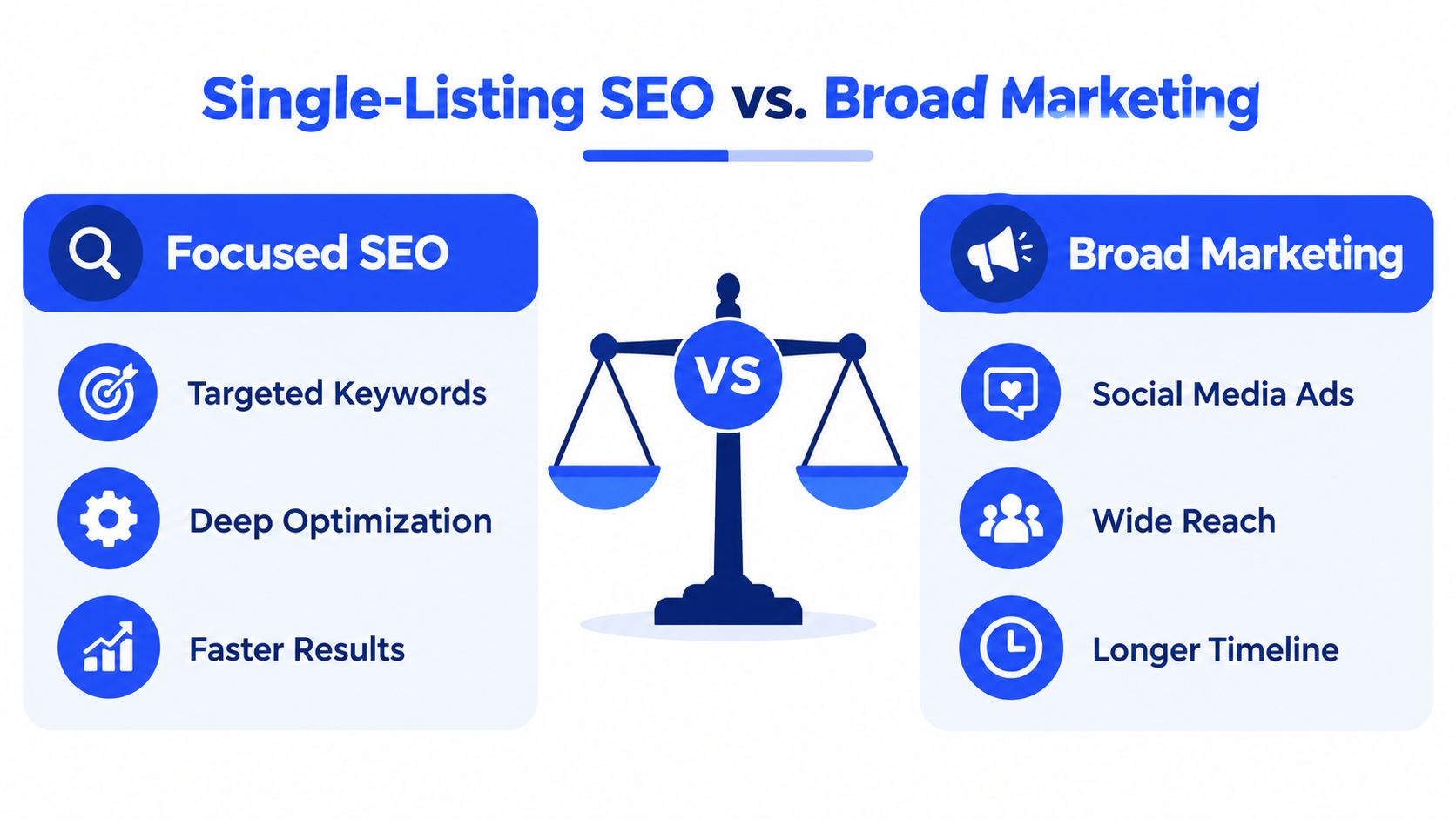
A single-listing campaign and broader marketing are not rivals. They solve different problems. If you want predictable placement for one phrase, you need a different playbook than if you're trying to grow the whole shop, keep content moving, and build a long-term brand presence.
Option | Main strength | Main weakness |
|---|---|---|
Single-listing SEO | Clear ranking target for one product | Doesn't improve every listing |
Full-shop optimization | Wider foundation for future growth | More moving parts, slower to measure |
Etsy Ads | Paid visibility right away | Costs keep running, even if the listing is weak |
A lot of sellers jump to ads too early. That's backwards when the listing itself isn't ready. Ads can buy exposure, but they don't fix poor phrase matching, weak descriptions, or a listing that never converts once shoppers land on it. If the organic listing is underprepared, paid traffic just reveals the same problem faster.
A focused Etsy SEO service is better for sellers who want a specific listing to earn search visibility without turning marketing into a full-time job. It's also better when you care about a time-bound outcome, like a launch or a seasonal sales window. You're not trying to build every channel at once. You're trying to get one page into the game.
Broad marketing makes more sense when the shop has several products with real potential and enough time to support them. In that case, content work, on-site optimization, and external promotion can complement each other. But if the main problem is that one listing can't break through, broad effort can dilute the budget fast.
If one product is already the obvious candidate, ranking that page usually beats spreading the same energy across five weaker ones.
The one-time, fixed-scope model can also suit sellers who hate subscription drift. One example is Upglider, which runs focused campaigns on a single listing for an agreed phrase and keeps the work tied to a defined term rather than open-ended account management. That setup is useful when you want ranking work, not a bundle of unrelated marketing tasks.
There's no universal winner here. There's only the right tool for the current job. A single-listing service is for getting one listing seen. Broader marketing is for building the shop around that win.
What Happens During a Focused Etsy SEO Campaign
A real campaign starts before any visible ranking change. The first step is a case assessment. That means looking at the listing, the phrase, and the likely difficulty instead of pretending every product deserves the same treatment.
The listing gets checked before money changes hands
A proper provider should vet whether the listing is worth pushing. If the photos are weak, the phrase is mismatched, or the product can't credibly serve the query, ranking work is the wrong first move. That saves both sides from pretending a bad fit can be brute-forced into success.
The campaign then centers on a single agreed phrase, usually a phrase of three or more words, because specificity makes the target measurable. You're not paying for general exposure. You're paying to move one listing for one search intent.
The work should stay visible to you
You should know what's being changed, what's being monitored, and how the position is tracked. A status dashboard with step-by-step updates and notes is far more useful than vague “we're working on it” messages. It gives you proof that the campaign is active without handing over your entire account.
The campaign cost guide is worth reading if you want to know what a lean, fixed-term campaign usually covers. That's the level of clarity I'd want before paying anyone.
Don't expect account access to be required
A legitimate external campaign does not need your password. No Etsy account access is a feature, not a flaw, because it preserves control and reduces security risk. The work can be done from outside the account using the public listing and the agreed search target.
Best practice: if the provider can't explain the tracking method in plain language, keep walking.
Optional keyword expansion can make sense later, but only after the first phrase has done its job. A focused campaign should prove one thing at a time. If it tries to do everything on day one, it's usually hiding the fact that it can't promise much of anything clearly.
Guarantees, Tracking, and Account Security Realities
The only guarantee that matters is one tied to a measurable ranking result. If a provider won't say what position they're tracking, what phrase they're targeting, and what happens if the listing misses the target, the offer is too fuzzy to trust.
Track the outcome, not the hype
Dashboards are useful only if they show the same thing every time. You want the search phrase, the current position, and the campaign status. Anything beyond that is secondary. Fancy reporting means nothing if you can't tell whether the listing moved.
A money-back guarantee can be reasonable when it's attached to a clear ranking target and a clear time frame. What matters is whether the terms are simple enough to verify. If the ranking method is hidden, the guarantee is just decoration.
Security should reduce friction, not add it
Etsy's own security guidance recommends two-factor authentication, meaning sign-in requires a password and a code sent to a phone or tablet, and it advises refreshing passwords every six months (Etsy account security guidance). Etsy also says a security code email can function as a one-time password and expires if not used within five minutes. That's the right mindset for any external service touching your shop workflow.
A provider that works without asking for your password is often the safer choice. It keeps control in your hands and lowers the chance of unnecessary access problems. I'd rather hand over a public listing URL and a target phrase than open the door wider than needed.
Payment terms should be boring
Watch for automatic renewals and vague billing language. Fixed-term campaigns are easier to manage because you know when the work starts and when it ends. That matters if you're testing the service for one product and don't want a subscription model hanging around after the campaign is over.
You should also know the payment methods and the tax treatment before you commit. Clear terms are a sign the provider respects the seller's side of the deal. If the offer feels slippery, it usually is.
How to Choose an Etsy SEO Service for Your Listing Goal
Start with the goal, not the provider. If you want one listing to rank for one phrase, choose a service built for that job. If you want broader shop growth, pick a broader marketing plan. Mixing those goals is how sellers waste money and then blame the channel.
Ask the questions that expose weak offers
Before paying, ask what listing they'll work on, what exact phrase they're targeting, and how they measure success. Ask whether the campaign is fixed-term or subscription-based. Ask what happens if the listing doesn't reach the promised position.
If the provider can't answer those questions without turning evasive, that's your answer.
A serious Etsy SEO service should also tell you whether the listing is a good candidate before you hand over money. That assessment matters more than a polished sales pitch. A weak listing with a strong promise is still a weak listing.
Match the service to the stage of the shop
Use a narrow campaign when one product has the clearest upside, when you're short on time, or when you need visibility for a launch. Use broader marketing when the shop already has several listings worth lifting together. Use ads when the listing is ready to convert and you want to buy more reach, not when you're still fixing basic relevance.
The wrong service for the job is still a waste, even if it's cheap.
The main red flags are easy to spot. Overpromising exact outcomes without naming the phrase, hiding the tracking method, requesting unnecessary access, or bundling unrelated services into a vague package. Those are signs the seller is buying confidence theater, not ranking work.
A single-listing campaign is a tactical move, not a permanent business model. It's useful because it concentrates effort where one clear result can change the next decision. Once that listing proves itself, you can decide whether to repeat the process, expand to other products, or shift into broader marketing with real data behind you.
If you're choosing between a broad shop overhaul, ads, or a focused ranking push, start with the listing that has the best chance to win right now. Review one product, pick one phrase, and decide whether a single-listing Etsy SEO service fits the job. If you want a tighter, no-nonsense campaign for one listing, compare providers on scope, tracking, security, and fixed-term terms before you pay.