You search Etsy for the phrase you targeted, scroll through the results, and still can't find your own product. Your listing is active in the shop manager, but the search page looks as if it doesn't exist. Before rewriting every tag or relisting the item, identify which problem you're dealing with: the listing may not be eligible to appear, or it may be indexed but ranking too low to notice.
Those situations look identical from the seller's side, but they need different fixes. Etsy provides enough data to separate them, provided you check visibility status, search matching, and listing performance in the right order.
Why Your Etsy Listing Vanished from Search Results
A seller adds a new handmade necklace, checks that the listing is active, and then searches Etsy for its main phrase. Nothing appears. The natural reaction is to assume Etsy has hidden the product or that the shop has been penalized.
Usually, the first question isn't “Which keyword should I add?” It's “Is this listing eligible for the search at all?”
An Etsy listing not showing up in search generally falls into one of two categories:
Not indexed or not eligible: Etsy isn't including the listing for the query because of a platform state, policy issue, mismatch, or another visibility blocker.
Indexed but ranking low: Etsy recognizes the listing as relevant, but other listings have stronger relevance, engagement, quality, or shop signals.

The difference changes the repair
Suppose the necklace has no impressions and no recorded search query. That points toward a matching or eligibility problem. Rewriting the first photo might help later, but it won't solve the fact that Etsy can't connect the listing with the buyer's search.
Now suppose Search Analytics shows impressions, a search phrase, and a weak average position. The listing is being found. It hasn't vanished. It needs stronger relevance, better presentation, or better buyer response.
Practical rule: Don't treat “I can't find it manually” as proof that Etsy hasn't indexed the listing. Personalized results, location, language, and average position can make an active listing difficult to see.
Etsy's Search Analytics documentation explains that items that don't match a buyer's search are excluded from results. The same tool shows average position, impressions, and the exact search queries that produced visits, so it can reveal whether a listing is absent, appearing weakly, or receiving visibility without converting.
Start there. A manual search is useful for context, but your shop's own search data is the better diagnostic evidence.
How Etsy Search Actually Works in 2026
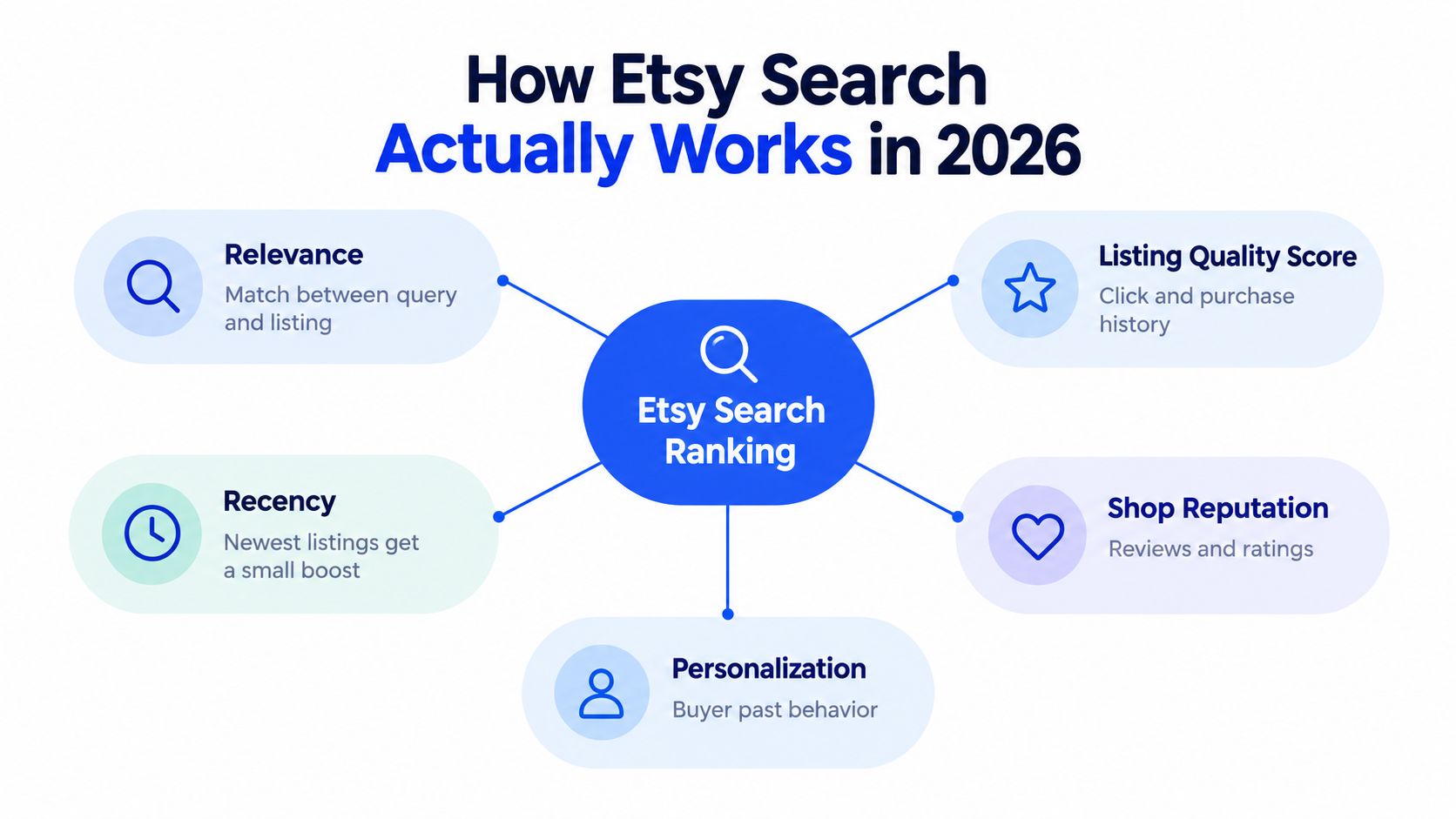
Etsy search isn't a simple “newest item first” system. Etsy's model has developed from a recency-heavy approach toward relevance-first matching, with ranking influenced by the listing, the shop, and buyer behavior.
The first gate is relevance. Etsy looks at the information that describes the product, including:
Titles and tags, which help connect the listing to the shopper's words.
Categories and attributes, which add structured meaning to the item.
Descriptions and other listing data, which contribute to Etsy's broader understanding of the product.
Listing quality signals, including how shoppers respond after seeing the listing.
Shop and customer-service signals, which affect the trust context around the listing.
Matching comes before ranking
Etsy's public explanation of how search works makes the sequence important. Titles, tags, categories, and attributes help Etsy match a listing to a query. Ranking signals matter after that match exists.
That means a beautiful listing with excellent reviews can still fail to appear for an important phrase if its title, tags, category, or attributes don't describe the product in the way buyers search. Conversely, an accurately matched listing can appear but remain far below the listings that earn stronger clicks, favorites, purchases, or trust signals.
Etsy also states that the Search Visibility Page includes shop-quality factors such as average review rating, message response rate, and case rate from the past three months. These aren't substitutes for relevant keywords. They are part of the wider quality picture that can influence placement once Etsy understands what the listing offers.
Platform state matters too
A keyword audit won't fix a shop that's in vacation mode. Etsy says listings are temporarily removed from search while the shop is in that state. This is a useful reminder that an Etsy listing not showing up in search isn't always an SEO problem.
New listings can receive a small temporary boost while Etsy learns how buyers interact with them, but that short-lived opportunity doesn't guarantee lasting visibility. Older assumptions that recency alone will keep a product near the top are incomplete. Relevance gives the listing a chance to enter the right search, while quality and buyer response help determine whether it stays competitive.
Diagnosing Your Visibility Problem Step by Step
Don't change the listing until you've collected evidence. Random edits make it harder to tell which action helped and can move the product away from the language buyers use.
Start with the shop and listing state
Open the listing in Shop Manager and confirm that it's active, available, and visible to buyers. Check whether the whole shop is in vacation mode, then look for warnings or recommendations in Etsy's Search Visibility Page.
Etsy's Search Visibility Page guidance is useful because it separates actionable visibility issues from general ranking advice. Look specifically for notices involving the primary photo, shop policies, categories, or shipping expectations.
Use Search Analytics as your evidence
Search Analytics can tell you more than a private search from your own browser. Review the listing's:
Impressions: If Etsy has recorded impressions, the listing has appeared to shoppers somewhere. Zero impressions calls for a matching or eligibility investigation before a ranking campaign.
Search queries: Look for the exact phrases that produced visits. A query that doesn't match your intended product description may indicate that Etsy is associating the listing with a different audience.
Average position: A recorded position means the listing is participating in search, even if it appears too far down for most shoppers to discover.
Historical performance: Etsy allows sellers to review performance across specific days, months, or full years. Compare the period when visibility changed with edits, shop-state changes, or a shift in the product's demand.
A phrase in both the title and tags receives more relevance than a phrase used in only one of those fields, according to Etsy's search matching guidance. Check exact coverage before replacing every keyword.
For a separate way to monitor position changes, an Etsy rank checker can complement Etsy's own analytics. It shouldn't replace Search Analytics, because a rank snapshot doesn't explain impressions or the queries that generated visits.
Make the diagnosis
If the listing has no matching query and the visibility page flags an issue, treat it as not eligible or poorly matched. If it has impressions and a low average position without a blocking warning, treat it as indexed but weakly ranked. If it appears for some phrases but not the one you expected, the listing is probably indexed, but its language and structure don't support that target query well enough.
Fixing the Most Common Visibility Blockers
Once the diagnosis is clear, fix the largest barrier first. A listing with no eligibility or matching signal needs a different repair from one that receives impressions but ranks low. Changing tags will not solve a blurry primary image, an incomplete policy, or an overly broad category.
Repair eligibility and matching first
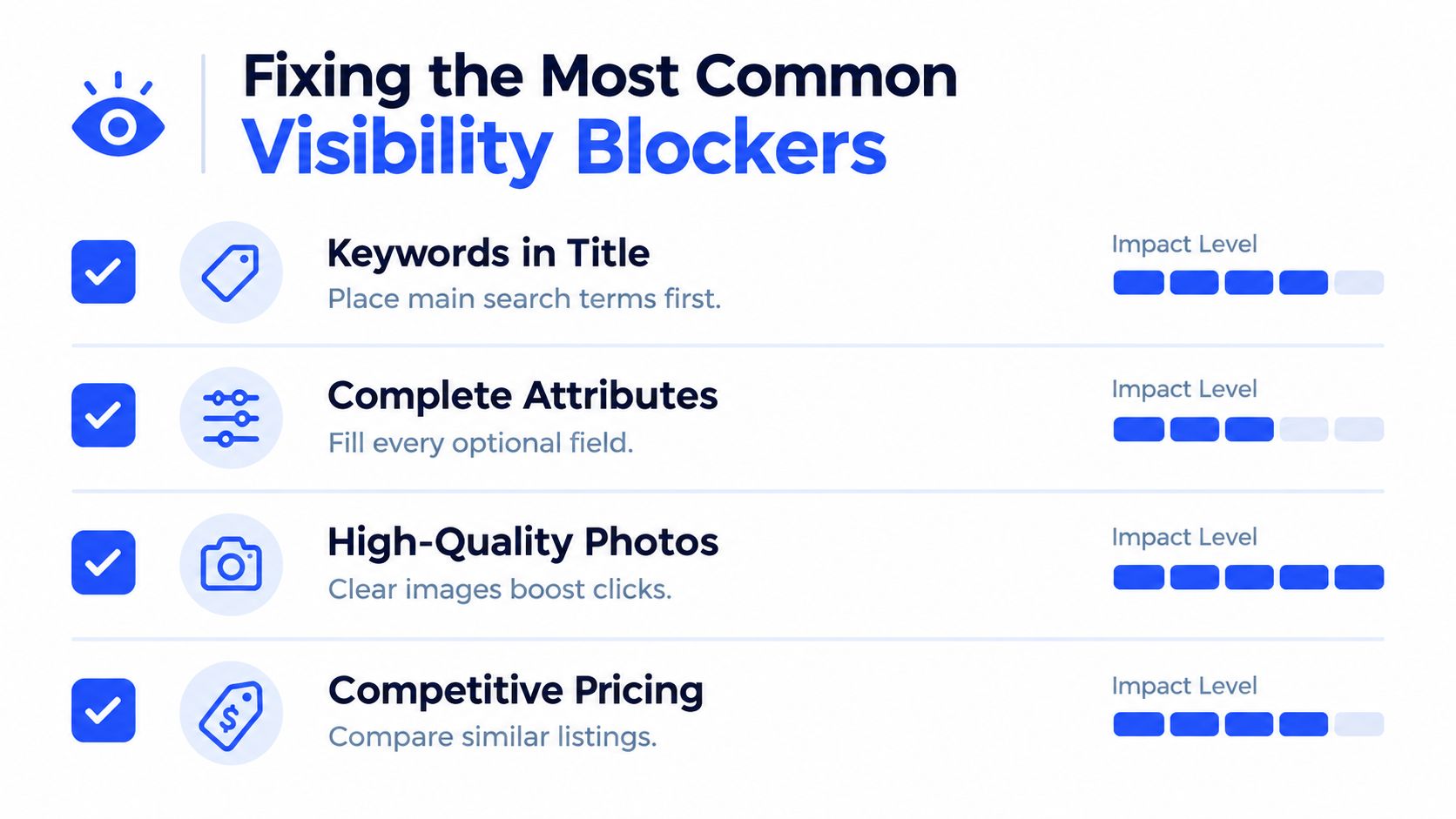
Start with the phrase a buyer would type, rather than a poetic product name. “Ocean Glow” creates a mood, but it does not tell Etsy whether the item is a blue glass pendant, wall print, or candle. State the clearest product type near the start of the title, then reinforce it with accurate tags, category, and attributes.
A listing must match a query through its titles, tags, categories, and attributes before ranking signals can help it appear higher. Etsy's search matching guidance explains this separation between matching and ranking. The Search Visibility Page provides a practical checklist for issues such as a weak primary image, missing policies, or a category that is too general.
Use this repair order:
Title and tags: Include the main buyer phrase naturally in both where it accurately fits. Avoid turning the title into repeated, unreadable keywords.
Category and attributes: Select the most specific accurate options. Structured fields give Etsy details that a paragraph may leave unclear.
Primary image: Replace a low-resolution or collage-style first image with a clear view of the product. The image must meet Etsy's requirements and give shoppers a reason to click.
Policies and shipping: Complete required shop information and address any buyer-friendly shipping recommendation shown in the visibility guidance.
Description: Explain the item in ordinary buyer language, including its material, use, recipient, and relevant characteristics. Remove phrases that attract shoppers looking for something else.
Improve ranking after the listing matches
If the listing has impressions but a low position, the problem has shifted from eligibility to response. Make the first image easier to understand, ensure the title describes what the image shows, answer purchase questions in the description, and clarify variations and delivery details.
Etsy also considers engagement, customer service, and conversion behavior. A listing can match a query and still rank below competitors when shoppers skip it or leave without buying. Keyword edits alone cannot repair unclear presentation or buyer hesitation.
Check international performance separately. Translation, buyer location, and language can affect how a product performs across markets. Review the wording for the audience you want to reach instead of assuming one phrase works identically everywhere.
For practical editing guidance, review these Etsy SEO tips. Make focused changes that improve clarity, then allow enough time to evaluate the result. Constant edits erase the comparison needed to learn which change helped.
Building a Sustainable Ranking Strategy
Visibility improves more reliably when sellers treat search as a measurement process rather than a one-time title rewrite. The strongest workflow is small, documented, and tied to what Etsy reports about the listing.
Use a priority order
First, protect eligibility. Keep the listing active, resolve Search Visibility warnings, choose accurate structured fields, and make sure the shop can serve buyers under its stated policies.
Second, strengthen relevance. Review the exact queries that produced visits, then compare them with the product's title, tags, category, attributes, and description. Keep phrases that accurately describe the item and remove language that attracts the wrong shopper.
Third, improve the click and purchase experience. Your primary photo should communicate the item quickly. The remaining images, description, variations, and policies should answer the questions that stop a buyer from moving forward.
Finally, monitor shop-level trust. Etsy says search ranking includes the shop's average review rating, message response rate, and case rate from the past three months. Those signals sit outside a single listing, so fixing one product won't compensate for a shop experience that repeatedly creates buyer friction.
Relevance earns inclusion. A clear offer and dependable shop experience give shoppers a reason to respond.
Review trends instead of chasing daily movement
Etsy's Search Analytics can show average position, impressions, and the queries that generated visits. Use those fields to record a baseline before editing, then compare performance over a meaningful observation period rather than reacting to every manual search.
A practical review asks:
Did the listing begin appearing for the intended phrase?
Are impressions growing without attracting the wrong audience?
Is the average position improving, staying flat, or weakening?
Are visits turning into favorites or purchases?
Did a shop-level warning appear at the same time visibility changed?
Etsy says it considers how often a listing converts views into purchases, alongside relevance and customer-service signals. That makes conversion a diagnostic clue, not merely a sales outcome. If impressions rise but purchases don't, improve the offer and presentation before adding more keywords.
Organic Optimization vs External Ranking Services
DIY optimization gives you control and costs time rather than a campaign fee. It's the sensible starting point when the listing has a visibility warning, weak category choices, unclear photography, or an obvious mismatch between the product and the target phrase. No outside service can make an inaccurate listing relevant.
Organic work also compounds your understanding of the shop. You learn which phrases produce visits, which photos earn attention, and where buyers hesitate. The trade-off is that you must perform the research, make the edits, track results, and accept that Etsy doesn't promise a fixed search position.
An external ranking service makes more sense when the listing is already accurate and presentable, but you need focused support around one important search phrase. The risks are control and expectation. A service targeting a phrase can't repair missing policies, weak product-market fit, poor photos, or a shop-level quality issue, and no responsible provider should promise that every listing will rank for every query.
Upglider describes a focused campaign for one Etsy listing and one agreed phrase of three or more words, with a top-15 ranking objective within 9 to 21 days and campaign options lasting 30, 90, or 180 days. Its assessment occurs before payment, and the service says it works without Etsy account passwords. Those terms define a narrow ranking intervention, not full-shop SEO, advertising management, or listing redesign.
Choose based on the bottleneck:
Your situation | More appropriate first move |
|---|---|
Etsy flags a photo, policy, category, or shipping issue | Fix the visibility blocker yourself |
The listing doesn't match the buyer's wording | Rewrite the listing around accurate search language |
The listing receives impressions but stays weak for one strategic phrase | Consider focused external support |
The shop has broader service or conversion problems | Improve the customer experience before buying ranking help |
External help can save time, but it shouldn't replace diagnosis. Confirm what will be measured, which phrase is targeted, how long the work runs, and what the provider does if the listing never becomes eligible for that search.
Open your Etsy dashboard today and classify the listing before editing it. Check its active status and Search Visibility warnings, review impressions and exact queries in Search Analytics, then make one focused change to the highest-priority issue. If the listing is eligible but still needs concentrated support for a specific phrase, review the campaign terms at Upglider and compare them with your own organic plan before deciding.