You publish a listing you're proud of, check the search results, and find it buried far below the products you thought it could compete with. Then you edit the title, search again, and see a different order. Etsy rankings can feel arbitrary, especially when your own listing appears in different places from one search to the next.
The system is less mysterious once you separate being eligible to appear from being chosen for a prominent position. Etsy first finds listings that match a shopper's query, then orders those listings according to signals connected to relevance, engagement, trust, freshness, and the shopper's context.
Why Etsy Rankings Feel Random and What Is Really Happening
A new seller might refresh Shop Manager late at night, see impressions without orders, and assume Etsy has decided to hide the shop. The listing may have excellent photos, a thoughtful description, and a product people genuinely want. Yet a manual search places it deep in the results, while another shopper sees something else entirely.
That doesn't necessarily mean Etsy rankings are broken. It means Etsy search isn't one permanent leaderboard. The marketplace evaluates a query, gathers potentially relevant listings, and then sorts those listings using several signals at once. The order can change with shopper behavior, filters, location, price, and the listing's own history.
The two decisions behind every search
Etsy's published explanation describes a two-stage process:
Query matching: Etsy gathers listings that match the shopper's words. It assesses the title, tags, description, category, and attributes. Exact keyword matches can provide stronger relevance signals.
Ranking by predicted value: Etsy orders the matching listings according to how likely it believes each one is to attract engagement and a purchase. Views, clicks, favorites, purchases, listing quality, shop quality, service performance, shipping conditions, recency, and other context can affect that order. Etsy's Seller Handbook explains the ranking process.
This explains a common frustration. A listing can be relevant enough to enter the search, yet still appear below another relevant listing with stronger engagement or trust signals. Keywords help you get into the room. They don't guarantee the front seat.
Practical rule: Treat a search phrase as a measurement target, not as a permanent position your listing owns.
A better mental model for your shop
Think of Etsy search as a changing decision loop:
A shopper enters a phrase.
Etsy finds listings that could satisfy it.
Etsy predicts which matching listings the shopper may engage with and buy.
Shopper interactions provide new evidence.
Etsy uses that evidence in future ranking decisions.
The useful question isn't “What is my Etsy score?” Etsy doesn't present sellers with one universal score that explains every position. Ask instead: Which search phrase am I targeting, what signals does my listing currently send, and what evidence is Etsy receiving from shoppers?
That shift prevents wasted effort. You can improve matching through titles, tags, categories, and attributes. You can improve the chance of engagement through photos and clear offers. You can protect trust through reliable service and complete shop information. You can measure the result through search data rather than one personalized search page.
How Etsy Decides What Shows Up in Search
Etsy search works like a coffee shop with a crowded queue. When someone asks for a “personalized ceramic mug,” the barista first checks which drinks on the menu fit that order. Only after creating that smaller group does the barista decide which available option to recommend first.
Etsy follows a similar funnel. The first stage is about matching. The second is about ordering.
Stage one matches the shopper's request
Etsy examines the language and structure of a listing. Its published criteria include:
Titles, where the product's main meaning should be clear.
Tags, which give Etsy additional phrases to associate with the item.
Descriptions, which support the listing's subject and use cases.
Categories and attributes, which help place the item in the right product context.
Suppose your product is a handmade walnut cutting board. A title and tag set that clearly describes a “personalized walnut cutting board” gives Etsy a stronger basis for considering the listing for that phrase than vague wording such as “beautiful kitchen gift.”
Exact matches can receive stronger relevance signals, but relevance still has a limited job. It helps Etsy decide whether your listing belongs in the candidate pool. It doesn't tell Etsy that shoppers will click, favorite, or purchase it.
Stage two orders the matching listings
Once Etsy has a relevant group, the system predicts which listings are most likely to satisfy the shopper. Etsy says it uses information learned from shopper behavior to personalize which relevant listings appear earlier.
That behavior can include views, clicks, favorites, and purchases. Etsy also considers listing and shop quality, customer-service performance, shipping conditions, shop location, and marketplace diversity. Customer-service signals include the average review rating, message-response rate, and case rate over the previous three months.
A coffee shop wouldn't recommend a drink solely because its name matches the customer's request. It would also consider whether customers enjoy it, whether the shop serves it reliably, and whether it fits the person standing at the counter. Etsy's second stage works on the same principle.
Stage | What Etsy Evaluates | Where It Lives in Your Shop |
|---|---|---|
Matching | Titles, tags, descriptions, categories, and attributes | Listing fields and product classification |
Ordering | Engagement, predicted purchase likelihood, quality, trust, freshness, shipping, service, and shopper context | Listing performance, shop operations, and buyer interactions |
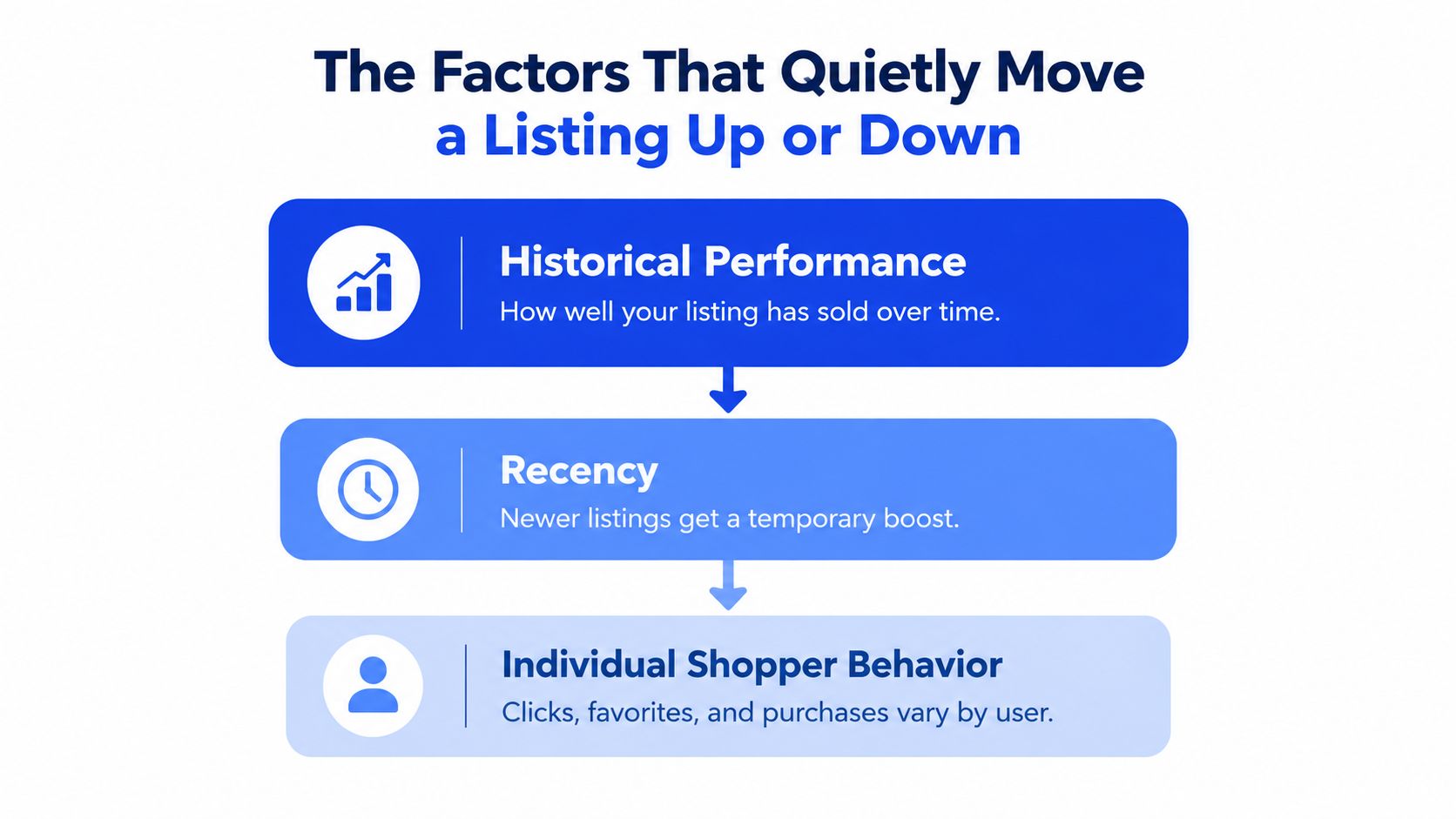
New listings can receive a temporary boost, and renewed listings can receive a smaller comparable boost. Etsy uses that period to collect interaction data and estimate listing quality. That boost creates an opportunity to gather evidence, not a promise of lasting visibility.
For a deeper look at the search process and focused listing promotion, see how Etsy search ranking works. The main lesson is simple: matching opens the door, while shopper response and shop quality influence where you stand inside the room.
The Factors That Quietly Move a Listing Up or Down
Most Etsy ranking advice becomes confusing because it treats every signal as equally important. They aren't equal in function. Some signals help Etsy understand what your product is, while others help Etsy estimate whether shoppers will respond well to it.
A practical way to sort them is into four groups: matching, engagement, trust, and freshness.
Matching gives the listing a chance
Titles, tags, descriptions, categories, and attributes describe the item to Etsy. If you sell a printable wedding seating chart, your listing should make that product clear through its product type, relevant phrases, and accurate category choices.
This is table stakes, not a magic lever. Adding unrelated phrases may expand the words associated with the listing, but it can weaken clarity for shoppers and create a mismatch between the search and the product. A listing that matches “wedding seating chart template” but looks like a generic poster may still struggle to earn clicks.
Engagement supplies evidence
Etsy looks at interactions such as views, clicks, favorites, and purchases because those actions help it estimate conversion potential. A listing that receives attention and purchases gives Etsy more useful evidence than a listing that only contains a well-chosen keyword.
The signals interact. A stronger main image may improve the chance that a shopper clicks. A clearer description, accurate price, and convincing product presentation may help the shopper continue toward purchase. You can't force genuine engagement through a keyword edit alone.
Trust protects visibility
Etsy identifies customer and marketplace experience as ranking considerations. Average review rating, message-response rate, and case rate over the previous three months are customer-service signals Etsy specifically names. Positive reviews, a completed About page, and complete shop policies may help, while recent cases or intellectual-property issues may reduce visibility. Etsy's published ranking criteria outline these shop-quality considerations.
These factors aren't attached only to one title or tag. A beautifully optimized listing can still face difficulty if buyers encounter slow communication, unclear policies, or service problems elsewhere in the shop.
Freshness creates a window, not a foundation
Newly published listings receive a temporary recency boost, and renewed listings receive a smaller comparable boost. Etsy uses this period to gather interaction data, so freshness can help a listing collect initial evidence.
Sellers waste energy when they treat renewal as a permanent ranking strategy. Recency may create an opening, but it won't replace relevance, engagement, or dependable service. Think of it as a short test window that becomes useful only when the listing is ready to convert attention into meaningful actions.
The useful question is not “What trick boosts rank?” It's “Which signal does this action change, and will shoppers respond to the change?”
For a more detailed discussion of phrase selection and listing relevance, review this guide to Etsy keyword ranking. That distinction helps you ignore tactics that sound technical but don't improve any input Etsy evaluates.
What Sellers Can Actually Change on a Listing
Start with the edits that improve clarity before spending time or money on promotion. A listing becomes easier for Etsy to match when its product type, language, category, and attributes all point in the same direction.
Improve the listing's meaning first
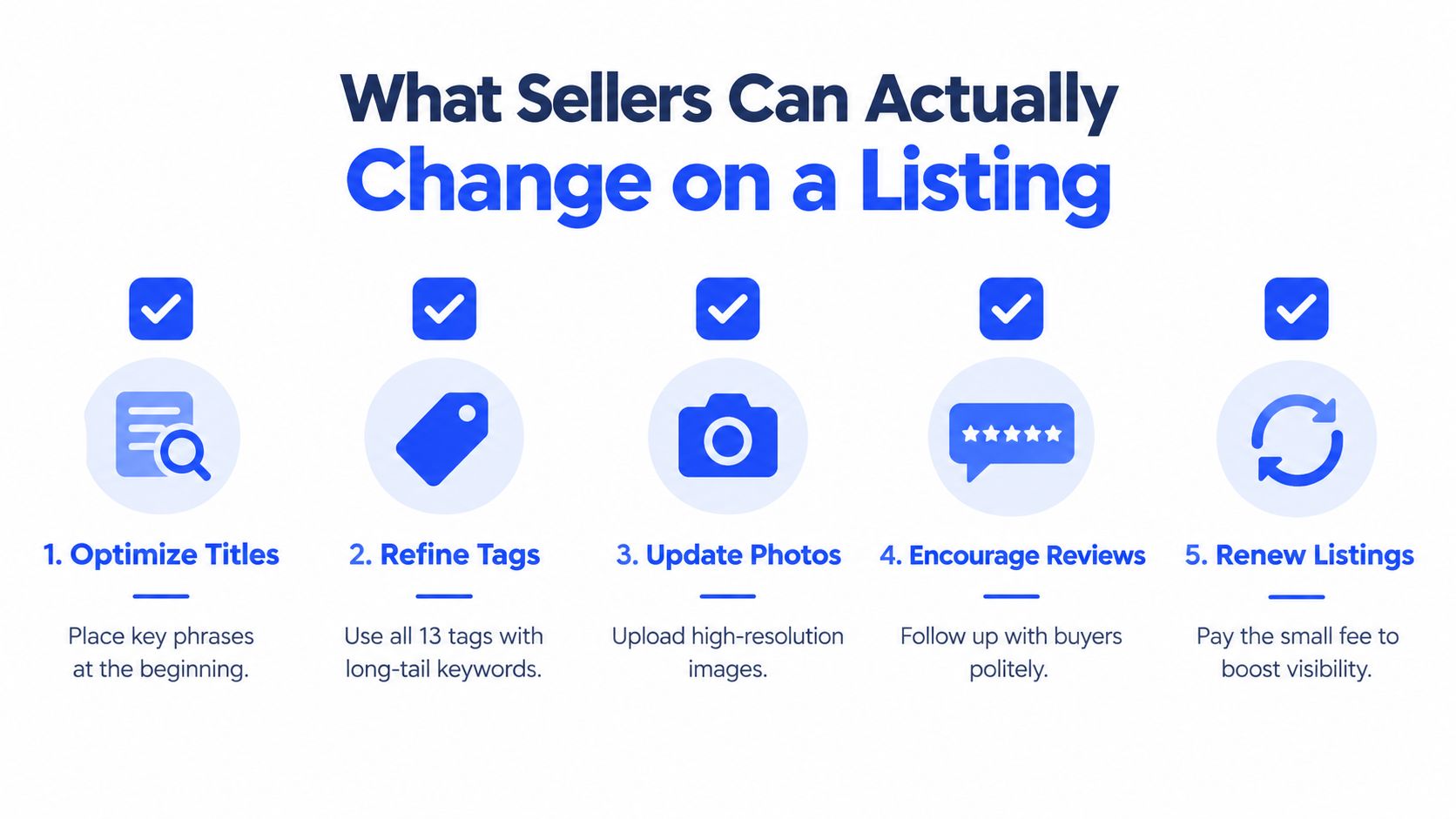
Write the title for a shopper who is scanning quickly. Put the clearest product phrase early, then add useful modifiers such as material, recipient, style, or use case when they describe the item. Avoid turning the title into a string of repeated terms. Natural wording helps a shopper understand what they'll receive.
Use tags to cover distinct ways a buyer might describe the same product. Etsy allows 13 tags, so use the available space to express relevant variations rather than repeating one phrase. A handmade “linen table runner” might also be described through an appropriate material, room, occasion, or style phrase, provided each term accurately fits the item.
Categories and attributes deserve equal attention. Choose the most accurate product path and complete relevant attributes because these fields give Etsy structured information that free-form wording can't provide.
Support the promise across the listing
Your description should confirm the title rather than introduce a different product. Explain dimensions, materials, delivery details, personalization steps, and intended use in plain language. This reduces uncertainty after the click.
Photos influence the engagement stage because shoppers decide whether a result deserves attention before reading every word. Use a clear first image, show scale and detail, and include images that answer practical questions. For a digital product, show the included pages or formats. For jewelry, show the item worn or held when that helps communicate size.
The system connection is direct: better clarity can support clicks and purchases, while misleading presentation can produce attention without conversion.
Test one meaningful change at a time
If a listing receives impressions but few clicks, inspect the first image and the title's opening language. If it receives clicks and favorites but few purchases, examine the offer, product details, delivery expectations, and overall confidence created by the page.
Make a focused change, then watch Search Analytics and the listing's engagement rather than changing every field at once. You won't know which adjustment mattered if you rewrite the title, replace every photo, change the price, and alter the tags on the same day.
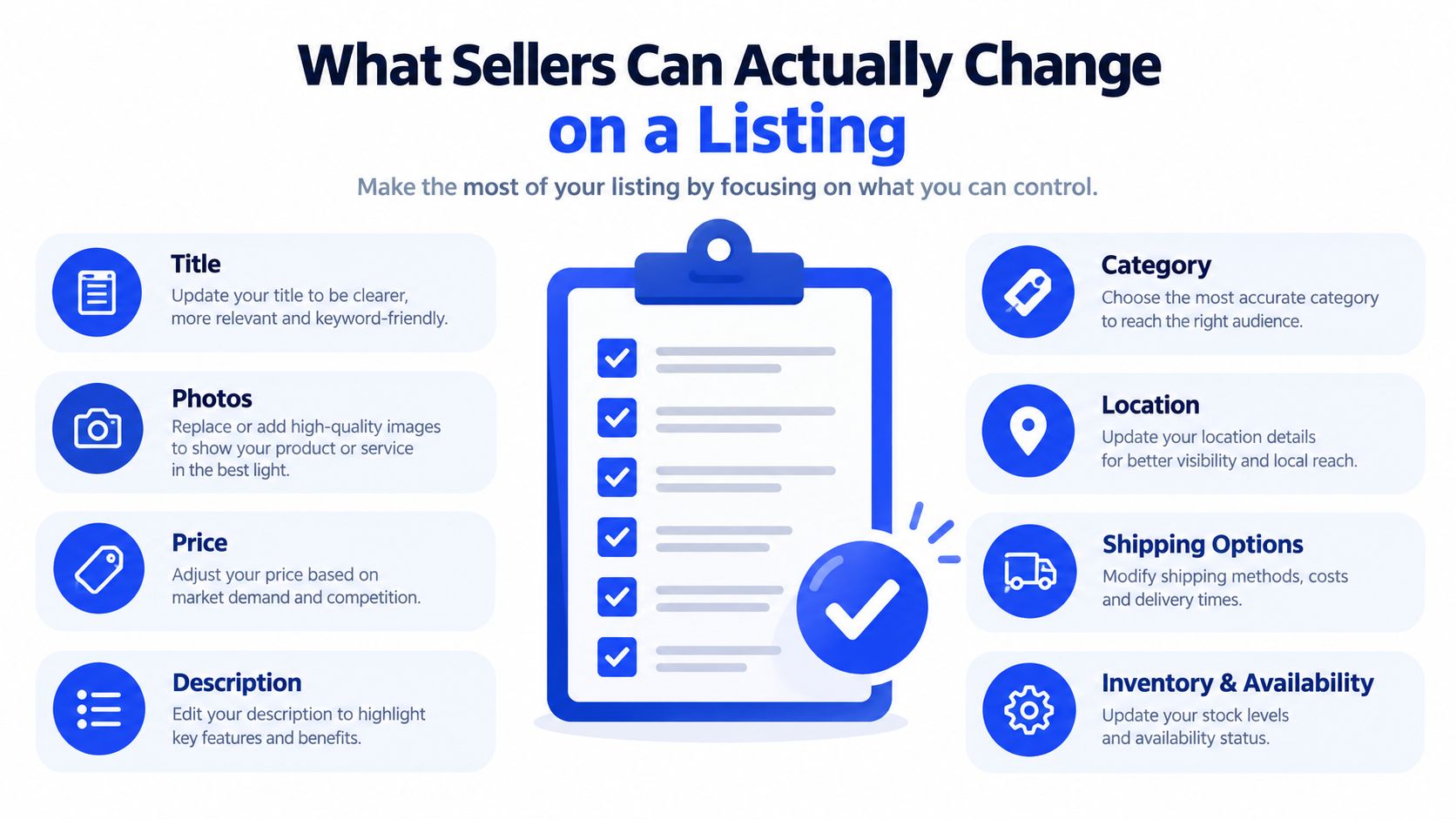
Renew a listing only when the timing supports a real business reason, such as a planned promotion or seasonal selling window. The temporary recency signal can help Etsy collect fresh interaction data, but repeated renewal without a stronger offer or better presentation doesn't solve weak buyer response.
A sensible order of work is:
Correct the category and attributes.
Clarify the title and tags.
Strengthen the first image and supporting photos.
Improve details that affect purchase confidence.
Test pricing or presentation when the data points to an offer problem.
Use freshness strategically rather than treating it as a daily ritual.
How External Ranking Help Fits Into the Picture
On-listing improvements can make a product easier to understand, but a new or stagnant listing may still lack enough engagement history to compete with established results. That's where focused external promotion can fit, provided the campaign sends relevant shoppers toward a specific listing rather than creating disconnected traffic.
Broad Etsy marketing may include shop redesign, advertising, social media, email, product photography, and content. A narrow ranking campaign has a different purpose. It selects one listing and one search phrase, then tries to improve visibility for that defined target.

What a focused campaign can and cannot do
The useful connection is behavioral. External promotion may help a chosen listing receive more relevant exposure and interactions. Etsy can then evaluate those interactions alongside the listing's relevance, quality, and shop signals. Promotion doesn't remove the need for a clear product, persuasive photos, accurate targeting, or dependable service.
Upglider is one example of this narrow model. Its service targets one Etsy listing for one agreed search phrase of three or more words, aims for a top-15 position within 9 to 21 days, and maintains the position during a 30, 90, or 180-day campaign. It says campaigns work without Etsy account access and include a money-back guarantee if the agreed top-15 target isn't reached within 21 days. The Etsy annual report provides the marketplace figures used to frame this scale.
That scale matters. In its 2025 annual report, Etsy reported 86.5 million active buyers and 5.6 million active sellers, or roughly 15.4 active buyers per active seller, calculated by dividing the two figures. The ratio is only a broad marketplace comparison, not an estimate of any shop's audience, but it shows why focused visibility for one phrase can matter in a mature marketplace.
When the model makes sense
External help may be worth considering when:
A new shop needs a defined visibility target: You want to test one product and one phrase rather than spread effort across an entire catalog.
A flagship listing has stalled: The product and shop are sound, but the listing needs concentrated exposure during an important selling period.
A seasonal launch has a clear window: You can prepare relevance and conversion elements before promotion begins.
You want to preserve account control: A provider that works from a public listing URL and keyword doesn't need your password.
It's a poor fit when the listing itself is unclear, the search phrase doesn't describe the product closely, or your shop has unresolved service and policy problems. Promotion can bring attention, but it can't make an unsuitable product relevant or turn weak buyer experience into lasting trust.
Measuring Your Position Without Fooling Yourself
A search result you see isn't a universal rank report. Etsy can personalize placement using the query, category, price, location filters, and shopper behavior. Two people can search the same phrase and receive different ordering, so a single screenshot from your account is weak evidence.
Choose a measurement layer
Etsy Search Analytics is the strongest first source because it connects search activity to your own listings. Etsy reports that the tool can show queries generating impressions, matching tags, conversion performance from search, and average position. Those fields help you understand not only where a listing appears, but whether the appearance produces useful shopper behavior.
A manual search is cheaper and easy to repeat, but it remains noisy. If you use it, keep the phrase, marketplace context, filters, device, and search process consistent. Don't compare a filtered mobile result today with an unfiltered desktop result tomorrow.
Third-party rank trackers can help reveal directional movement, especially when they apply a consistent checking method. They shouldn't replace Etsy's own performance data or be treated as an unquestionable reading of what every shopper sees. An Etsy rank checker can be useful for trend monitoring, but the tracker's methodology matters.
Track outcomes beside position
Define the target phrase before you begin. Write down the exact wording, the relevant market or location, the device context, and the date you'll review it. Then look at average position together with:
Impressions, which show whether Etsy is exposing the listing.
Clicks, which indicate whether the result earns attention.
Favorites, which show a meaningful form of interest.
Purchases, which provide the clearest commercial outcome.
A position change without more impressions or stronger buyer actions may not improve the business. Conversely, a listing can generate useful sales while its manually observed position moves around because Etsy is personalizing results.
Measure the listing's performance in context. Rank is a signal, not the whole result.
Realistic Timelines and a Plan You Can Stick To
Relevance edits can become useful relatively quickly, while engagement-based movement usually needs time because Etsy evaluates shopper interactions as they accumulate. Don't judge a major change from one search or one quiet day. Use Search Analytics and a consistent review routine.
A practical planning rhythm
For a fresh listing, use a 30-day sprint. Tighten the product language, complete categories and attributes, improve the first image, and choose one clear phrase to monitor. If a relist supports a planned promotion, use it deliberately and study the resulting impressions, clicks, favorites, and purchases.
For a plateauing listing, use a 90-day plan. Review the images, clean up irrelevant tags, address purchase objections, and consider a focused external ranking campaign if the listing is already relevant and ready for shoppers. Keep the test narrow enough that you can identify what changed.
For a seasonal launch, use a 180-day horizon. Prepare the relevance work before demand peaks, schedule freshness around the selling window, and decide in advance whether a longer paid maintenance period fits the product and budget. A timeline is useful only when the listing can convert the attention it receives.
Avoid three recurring traps:
Daily rank screenshots: They encourage reactions to personalized noise.
Keyword-only thinking: Relevance gets consideration, but engagement, trust, freshness, and operations influence placement.
Mismatched traffic: Exposure from people who aren't genuine Etsy buyers may create activity without useful purchase evidence.
Start today with one listing, one search phrase, and one measurable improvement. Open Search Analytics, record the current baseline, fix the clearest weakness, and review the result on a consistent schedule instead of chasing every position change.
If you want focused help with a specific Etsy listing, visit Upglider to review the available single-listing campaign options, target requirements, measurement process, and campaign terms before deciding whether external promotion fits your shop.