Most Etsy shop ranking advice stops at keywords. That advice is too small for how Etsy works. A listing has to match the search first, then it has to earn its place against other matched listings through shopper response, listing quality, and shop health.
That means the actual work is not stuffing tags. The actual work is building a listing that Etsy can understand, buyers can trust, and shoppers can convert on. If the title is clear but the photos, service signals, or conversion rate are weak, the listing can still lose visibility.
How the Etsy Search System Actually Works
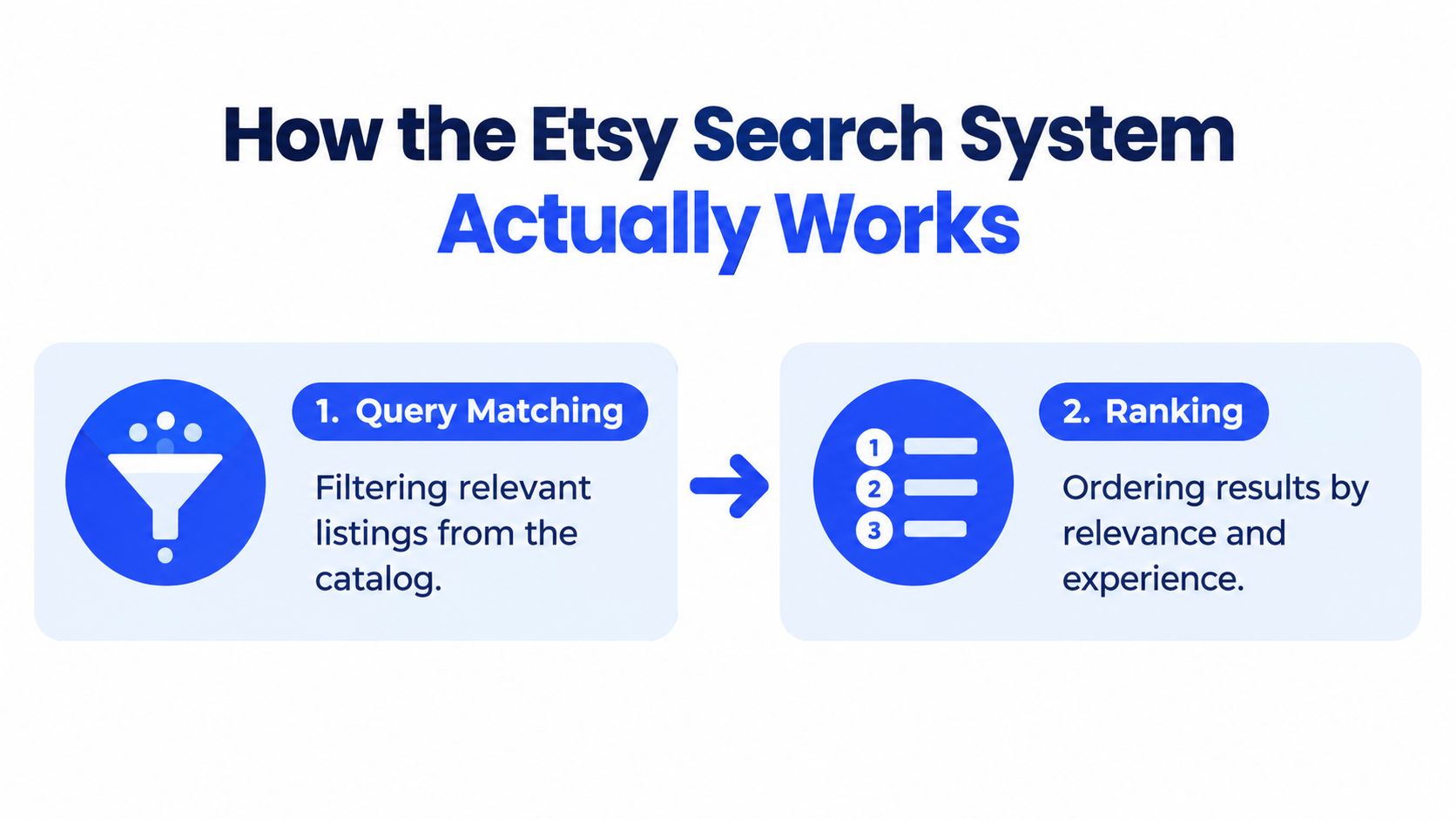
The mistake most sellers make is treating Etsy shop ranking like a single switch. It isn't. Etsy uses a two-stage retrieval and ranking system, first matching the query to the catalog, then ordering the matched listings by relevance and performance signals, according to Etsy's search policy documentation. You can see that split clearly in Etsy's own explanation of how search works and how query matching comes before ranking in Etsy's search and recommendation policy.
Why matching comes before ranking
A listing can't compete for a strong position until Etsy decides it belongs in the result set at all. That's why titles, tags, attributes, and categories matter so much at the front end. If your product doesn't match the buyer's phrase closely enough, the rest of the listing won't save it.
Practical rule: first make the listing eligible, then make it competitive.
Many sellers confuse a temporary visibility bump with durable placement. New or relisted items can get a small boost so Etsy can observe shopper response, but that does not mean the listing has earned stable rank. Once that testing window passes, performance has to hold up on its own.
The search system also explains why a position is never just a permanent property of a listing. Visibility changes with shopper context, engagement, and marketplace conditions, so a screenshot of one result page only tells you what happened in that moment. If you want to understand ranking, you have to think in terms of matching quality and conversion quality together.
One useful external reference is this plain-language overview of Etsy search ranking mechanics, but the main point stays the same, keyword fit gets you into the race, buyer response decides how far you go.
Shop Health Signals That Influence Placement
Search placement on Etsy is tied to the shop, not just the listing. Etsy states that average review rating, message response rate, and case rate from the previous three months are included in ranking considerations. That matters because a listing with decent keyword fit can still lose to a competitor whose shop looks more reliable to Etsy and to buyers.
Trust is part of visibility
Think about the buyer's side of the search page. Two products can look similar, but one shop answers messages quickly, keeps reviews strong, and avoids cases. That shop sends cleaner signals, and Etsy has every reason to favor it when results are otherwise close.
This is why customer experience belongs in any serious Etsy SEO plan. A seller can do the keyword work correctly and still underperform if the back end feels messy. Slow replies, unresolved disputes, and shaky review patterns don't just hurt conversion after the click, they affect how Etsy evaluates the shop.
A listing can be relevant and still rank poorly if the shop creates doubt.
That's the trade-off many people miss. Fast keyword wins can be undone by weak service behavior, while steady shop health can lift the same listing over time. The practical move is to treat response time, order handling, and review management as ranking work, not as admin tasks on the side.
A useful way to judge your own shop is simple. Ask whether a stranger landing on the shop would see signs of reliability, consistency, and follow-through. If the answer is shaky, the search system may be reading the same way.
Optimizing Listings for Query Matching
Before a listing can rank, it has to be found for the right phrase. The cleanest way to do that is to start with one exact buyer query and build the listing around that intent, not around a pile of loosely related words. Etsy's system looks at titles, tags, attributes, and categories, so the job is to make the same concept visible in all the right places without sounding stuffed or unnatural.
Put the buyer's phrase where Etsy expects to see it
Use the exact phrase buyers are most likely to type, then spread that idea across the title, tags, category, and attributes. If the phrase fits naturally in both the title and the tags, Etsy treats it as more relevant than if it appears in only one place. That's a small detail with big consequences because it tells Etsy the listing is tightly aligned with the query.
A strong listing also needs the basics in place. Etsy says a listing must have at least one image, recommends a primary image that is at least 2,000 pixels wide and 2,000 pixels high, and says using the most specific category available helps visibility, according to the Search Visibility Page guidance.
Start with exact intent: choose one multi-word phrase a real buyer would use, not a broad theme.
Match the phrase naturally: place the concept in the title and support it with tags and attributes.
Use the narrowest fit: select the most specific category available, so Etsy can sort the item correctly.
Clear policies also matter here. Etsy recommends adding a return policy, including a policy that says no returns, because completeness helps the shop look finished and trustworthy. That doesn't replace relevance, but it supports it.
For a deeper breakdown of phrase placement and tag structure, this guide to Etsy keyword ranking can help you pressure-test the basics. The main idea is simple, search visibility starts with precise matching, not decorative wording.
Using Conversions to Drive Search Placement
Conversion is not just a sales metric. On Etsy, it's part of ranking. Etsy says it evaluates how well a listing converts, meaning how many shoppers view it and then purchase, to estimate buyer interest and improve engagement-based placement, according to Etsy's search guidance. That makes conversion optimization a ranking intervention, not a cosmetic tweak.
Fix what happens after the click
A listing that gets attention but doesn't sell gives Etsy weak proof that the product matches buyer intent. That's why untargeted traffic can be a bad trade. It may raise visits, but if shoppers bounce without buying, the listing doesn't get the signal it needs.
Start with a baseline. Record impressions, visits, favorites, and orders for the target listing, then change only the parts that affect decision-making, such as the first image, title clarity, price presentation, and shipping explanation. Keep the listing's intent the same so you can tell whether the changes helped or just confused the page.
More clicks are not the goal. Better buyer response is.
Sellers often overcorrect here. They chase traffic from everywhere, but Etsy cares about what that traffic does. A smaller stream of relevant shoppers can be more useful than a larger stream of mismatched visitors because the platform is reading behavior, not vanity volume.
Keep the comparison window fixed and separate organic activity from paid or external traffic. If orders improve after the page gets clearer, you've improved the signal that Etsy values. If visits rise and orders stay flat, the issue isn't visibility alone, it's the page's ability to close the sale.
Measuring Visibility in a Personalized Search
Etsy doesn't promise one fixed rank for every shopper. Its own documentation says ranking can vary by shopper, query, location, and the listing's accumulated engagement data, which means the result page you see isn't the only version that exists, according to Etsy's ranking guidance. That's why one screenshot is a weak way to judge performance.

Rank checks need context
A position check only matters if the conditions are controlled. Use the same search phrase, the same date, and similar account conditions when you compare results, or the data gets noisy fast. Personalized search means one buyer may see your listing high on the page while another barely sees it at all.
That's why Etsy Stats is more useful than a vanity rank snapshot. Impressions tell you whether the listing is being shown. Visits tell you whether it earns the click. Favorites and orders tell you whether the traffic is worthwhile.
If you want a practical way to think about measurement, compare rank checks with behavior, not against them. A listing that looks strong in one test but produces weak impressions or orders is not winning. The reverse is also true, a modest result page position can still matter if it drives real shop activity.
For sellers who want to understand measurement discipline more closely, this overview of rank tracking is a useful companion read. The key point is that visibility is personal and dynamic, so the safest metric is the one that connects search exposure to actual shop outcomes.
Building Long-Term Ranking Momentum
The fastest way to chase Etsy visibility is to keep changing everything at once. That usually creates noise, not momentum. A better approach is to pick one listing, one phrase, and one objective, then build around a clean measurement window so you can see whether the work actually moved the needle.
A narrow push beats a scattered one
Focused ranking campaigns can make sense, especially for a launch, a seasonal item, or a listing that already has strong product potential but weak exposure. Upglider is one external option that works on one listing and one agreed search phrase at a time, which fits sellers who want a narrow ranking effort without handing over account access. The important part is not the service itself, but the discipline of keeping the target specific.
A realistic momentum plan looks like this in practice. First, choose the listing with the best product-market fit. Then clean up matching, confirm the page converts, and decide how long you want to evaluate the visibility push. That sequence matters because ranking work without a product that converts is just temporary exposure.
Don't try to fix the whole shop at once. Fix the listing that can win.
The long-term trade-off is straightforward. Broad changes can improve the whole shop slowly, while targeted ranking work can create useful visibility on a single item faster. Neither replaces the other. The sustainable path is to keep the shop healthy, keep the listing relevant, and use focused campaigns only where the product can hold demand once attention arrives.
That's the practical answer to Etsy shop ranking. Start with eligibility, strengthen trust signals, improve conversion, then measure visibility against real behavior. If you need help turning one listing into a controlled ranking campaign, review your target phrase, tighten the page, and choose the path that gives you a specific result you can track.