
Rank tracking is the regular measurement of where your Etsy listing appears for specific search keywords over time. Some enterprise systems retain 18 years of ranking history, showing how position checks have developed into long-term visibility analysis.
You've polished the photos, written a thoughtful title, added relevant tags, and set a price that feels fair. Then the waiting starts. A few views appear, but sales stay quiet. You search Etsy for your target phrase, scroll through the results, and still can't find your own product.
For Etsy sellers, the question isn't only whether a listing is attractive. It's whether shoppers can find it. Rank tracking gives you a way to measure that visibility instead of relying on occasional searches and guesswork.
The Mystery of Missing Sales
Mara opened her Etsy shop with a small collection of handmade jewelry. Her favorite listing featured hammered silver earrings. The photos were bright, the description answered common buyer questions, and the title used the phrase she expected shoppers to search.
Still, the listing attracted little attention.
She searched Etsy for “handmade silver earrings” and did not find her product near the top. Later, she thought she saw it much farther down. The next day, its position appeared different again. Without a record of each search, Mara could not tell whether the listing had really moved, whether the change was temporary, or whether Etsy had displayed results differently for her search.
The uncertainty points to a problem many Etsy sellers face. A listing can be carefully made and still struggle to reach shoppers because product quality and search visibility are different things. Strong photos and persuasive copy can help after someone opens the listing. Search visibility determines whether that person gets the opportunity to see it at all.

Turning uncertainty into evidence
Mara might have changed the title, replaced every tag, or lowered the price immediately. Those actions would not answer the main question: where does this listing appear for the search phrases that matter?
Rank tracking supplies a record. It checks a listing's position for selected keywords and preserves those observations for comparison. If the listing rises after a title or tag update, Mara has a change to examine. If it falls, she has a clearer starting point for finding a possible cause. A single search is like glancing at a shop sign while walking past. Repeated checks show whether its position is staying steady or changing.
Etsy search visibility depends on more than a keyword appearing somewhere in a title. Etsy identifies tag and title relevancy, item attribute relevancy, listing quality, customer and market experience, and free shipping for U.S. shoppers as factors in search display order. Etsy's listing optimization guidance also explains that exact keyword matches can receive stronger relevance treatment. For sellers, that means tracking should connect a listing's position with the wording and listing details being tested.
Practical rule: Don't treat a quiet listing as proof that the product is unwanted. First find out whether the right shoppers can see it.
For more possible causes, sellers can review an Etsy listing not showing up in search. Rank tracking cannot guarantee sales, but it can show whether search visibility is giving a listing a fair chance.
What Rank Tracking Actually Means
At its simplest, rank tracking measures where your Etsy listing appears when a shopper searches for a chosen keyword. If someone searches for “ceramic coffee mug,” your listing may appear near the beginning, farther down the results, or not within the tracked result range.
It is similar to recording a runner's place throughout a race. One observation tells you where the runner stood at one moment. A series of observations shows whether the runner is moving forward, losing ground, or holding a steady position.
The same principle applies to Etsy. You select a keyword, identify the listing you want to monitor, and record the listing's position at regular intervals. Over time, those records form a position history.
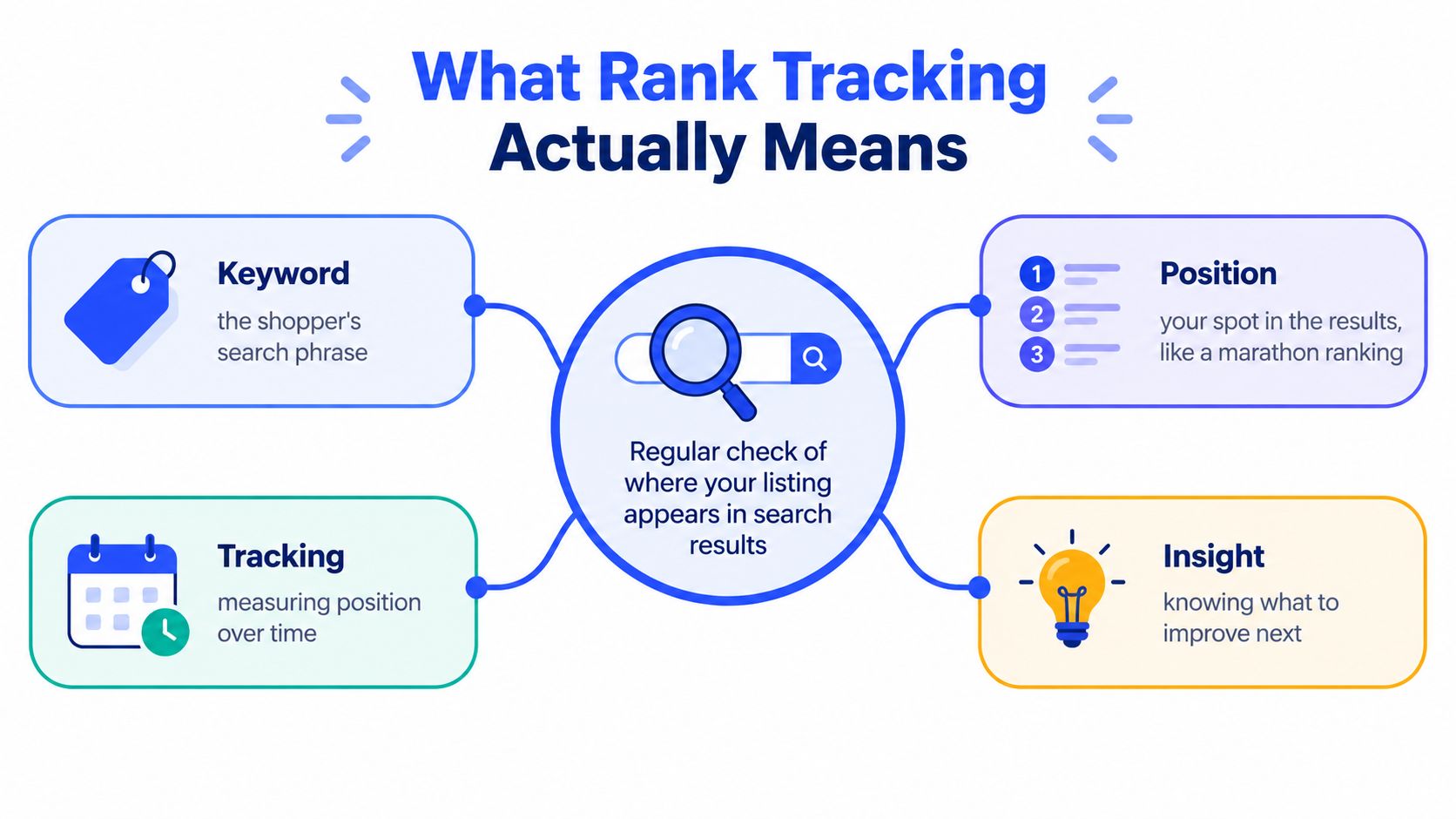
Four parts of a useful tracking system
Keyword: This is the shopper's search phrase, such as “minimalist gold necklace.” A broad product description isn't enough. You need to choose the specific phrases connected to the listing and its intended audience.
Position: This is the listing's place in the results for that keyword. A position is useful only when you know the search phrase, marketplace, device, location, and date connected to it.
Tracking: This means checking the position repeatedly rather than relying on one search. Historical records help separate a lasting change from a short-lived fluctuation.
Insight: This is the decision that follows the data. You might decide to keep a successful phrase, review a weak listing, or examine whether a change affected visibility.
Why one search isn't enough
A manual search is a snapshot. It can be affected by location, device, personalization, changing results, or the exact wording you entered. It also encourages a common mistake, sellers search their own product once, see a position, and assume that position represents the listing's permanent rank.
Rank tracking is more useful because it turns that snapshot into a pattern. General SEO tracking systems store position data over time so marketers can compare historical changes, identify fluctuations, and connect movement with updates. This overview of SEO rank tracking describes the practice as historical measurement rather than a one-time check.
For an Etsy seller, the plain-language definition is this: rank tracking tells you where a listing appears, for which phrase, and how that position changes. It doesn't replace conversion data, favorites, views, or purchases. It gives those business metrics a visibility context.
How Rank Tracking Works in Practice
A practical tracking process starts with a small, deliberate keyword set. Choose phrases that describe what a shopper might type and that match the listing's product, style, use, or audience. A seller of ceramic drinkware might monitor “handmade ceramic mug,” while a jewelry seller might track “silver statement earrings.”
The system then checks the selected phrase on Etsy and looks for the listing in the results. It records the position, date, keyword, and listing URL. Repeating that process creates a timeline that can show whether visibility is improving, holding steady, or changing unpredictably.
Read the record as a timeline
Suppose a mug listing appears in one position after a title revision, then remains around a similar area across later checks. That pattern provides more useful evidence than a single encouraging result. If several keywords move at once, you can examine what they have in common.
A tracking record can help you ask better questions:
Did the listing appear for the intended phrase? If not, review relevance, attributes, listing quality, and the phrase itself.
Did the position change after an edit? Mark the date of the title, tag, photo, price, or shipping change.
Is the movement consistent or isolated? One unusual check deserves caution. Repeated movement deserves investigation.
Did user behavior change as visibility changed? Compare ranking observations with views, clicks, favorites, and purchases.
Etsy says listing engagement includes clicks, views, favorites, and purchases, while shop-quality signals include review rating, message response rate, and case rate measured over the past three months. Etsy's explanation of how search works shows why ranking should be read alongside buyer behavior and shop experience.
Choose a sensible checking frequency
Important keywords deserve regular checks, especially during a launch, seasonal promotion, or major listing update. Current rank-tracking guidance describes daily refreshes as standard for competitive keywords, while some systems still update weekly. AgencyAnalytics' rank tracker FAQ explains why that difference matters.
A weekly check may be adequate for a stable listing where you're watching a broad trend. More frequent monitoring gives you a closer view when conditions change quickly. The right question isn't “What is my rank today?” It's “What pattern do these observations reveal, and does the pattern connect with buyer activity?”
You should also annotate meaningful events. Write down when you changed a tag, added an attribute, introduced free shipping, renewed a listing, or began a promotion. Those notes turn a line chart into a decision record. Without them, you may notice movement but struggle to identify what might have influenced it.
For a focused way to inspect an Etsy listing's search position, sellers can use an Etsy rank checker. Whatever method you choose, keep the measurement consistent so comparisons remain useful.
Manual Tracking Versus Automated Tools
Manual tracking costs little and shows how Etsy search appears from a seller's viewpoint. You enter an exact keyword, search for the listing, record its position, and repeat the check later. This hands-on process can reveal how product photos, filters, attributes, free shipping labels, and similar items shape the results page.
It works well for a new shop with a few listings and a short list of priority phrases. For example, a seller can compare a listing targeting “linen tote bag” with one using a broader phrase, then note whether the exact keyword appears in visible results. The weakness is consistency. Checks are easy to forget, and a spreadsheet offers limited history once a shop has many listings or keywords.
A side-by-side choice
Approach | Useful for | Main limitation |
|---|---|---|
Manual spreadsheet | A small shop learning how Etsy search behaves | Changes can go unnoticed between checks |
Automated tracker | Sellers monitoring multiple listings or regular campaigns | Requires setup and careful interpretation |
Search Console-style performance data | Understanding clicks and impressions from search | It does not replace selected keyword position history |
Combined workflow | Connecting ranking movement with shopper behavior | Takes discipline to maintain |
Automated tools run scheduled searches, save position history, and flag movement that deserves review. Some also compare visibility across devices, locations, competitors, and search-result features. SE Ranking's position tracking guide describes the shift from checking a few terms manually to monitoring groups of keywords.
Automation does not explain every ranking change. A tool may show that a listing moved after you added free shipping, changed a tag, or improved an exact keyword match. You still need to inspect the listing and search results before deciding which change mattered.
Match the method to the shop
A seller with one new listing can begin with a spreadsheet. A growing shop with many products may use automated checks to avoid spending hours searching Etsy. An established seller running a seasonal campaign can combine scheduled monitoring with manual review of the actual results page.
For sellers seeking outside help with one listing, Upglider offers campaigns focused on moving a chosen listing into Etsy's top 15 results for an agreed search phrase and maintaining that placement during a 30, 90, or 180-day campaign, with the stated objective set within 9 to 21 days from confirmed payment. Upglider's Etsy ranking service describes the campaign scope and measurement approach.
The method matters less than the record you keep. Note the keyword, search conditions, listing changes, free shipping status, and shopper actions. A modest system that you review regularly gives clearer guidance than a complex dashboard left untouched.
Real Use Cases for Etsy Sellers
Rank tracking becomes easier to understand when you follow sellers at different stages.
A new shop owner might publish a collection of handmade candles and receive very little search activity. Instead of rewriting every listing at once, the seller chooses a few relevant phrases for one product. The position history shows whether the listing appears at all and whether its visibility changes after the seller improves the title, tags, and attributes.
That information helps the seller avoid random edits. If one phrase produces visibility while another doesn't, the seller can inspect the difference in wording and product relevance. The result isn't a guaranteed sale. It's a clearer basis for the next decision.

Seasonal launches need timing
A seller preparing holiday ornaments doesn't only care about eventual visibility. The listing needs to be discoverable while shoppers are actively looking for that type of product. Regular tracking can show whether the selected phrases are gaining visibility as the season approaches or whether the listing needs attention earlier.
New and renewed listings also deserve careful interpretation. Etsy says newly created listings receive a small, temporary search boost, and renewed listings receive a similar but smaller boost. Etsy's search and recommendation policy explains why an early position may not represent the listing's long-term performance.
A growing shop can use rank tracking to sort attention across products:
Strong visibility: Keep monitoring and examine whether shopper engagement supports continued investment.
Weak visibility: Review keyword relevance, attributes, listing quality, and customer experience before making broad changes.
Unstable visibility: Increase observation frequency and annotate changes so temporary movement doesn't trigger a rushed reaction.
Established shops can prioritize
A seller with many listings may have limited time for optimization. Rank data helps identify which products deserve a closer look. A flagship necklace that appears for an important phrase but receives little engagement may need better photos or clearer positioning. A seasonal product that loses visibility may need a review of timing, relevance, or customer experience.
Free shipping also deserves careful consideration for U.S. shoppers because Etsy identifies it as one of the top factors in search display order for that audience. Exact keyword matching matters too, since Etsy says exact matches can rank higher based on relevance. Those are specific signals to test and document, not vague suggestions to add words everywhere.
The best use case is not chasing a number for its own sake. It's connecting a seller's action with a listing's visibility, then checking whether shoppers respond. Rank tracking helps answer “what changed?” so the seller can spend less time guessing.
Turning Rankings Into Better Decisions
A ranking report earns its place when it changes the next action. Position is a clue, not a business result. A listing may appear near the top and still need better photos, clearer pricing, stronger trust signals, or a closer match to what buyers want.
Use three questions to read the report:
Can shoppers find the listing?
Do they engage after finding it?
Do those visits produce the shop outcomes you want?
The first question concerns visibility tracking. The second and third require engagement and sales data. Etsy's documented signals include clicks, views, favorites, purchases, reviews, message response rate, and case rate. Together, they help explain what happens after Etsy shows a listing.
Use changes as small tests
Changing the title, tags, photos, shipping offer, and price all at once makes the result difficult to interpret. Choose one focused adjustment, record when you made it, and continue watching the selected phrases. This approach cannot prove that one edit caused every movement, but it creates a clearer trail.
A seller might revise a phrase so it describes the product more precisely. If visibility improves afterward, the seller can examine whether the wording better matches shopper intent. If the position stays flat, the next review might cover attributes, listing quality, customer experience, or competition for that phrase.
Etsy search guidance also makes exact matching and attributes relevant, as explained in this overview of how the Etsy search algorithm works. For U.S. shoppers, free shipping also deserves testing because Etsy identifies it as one of the top factors in search display order for that audience. These are specific signals to document, not reasons to add keywords everywhere.
A sudden drop calls for calm analysis. Other listings may have changed, the search layout may look different, or the marketplace may have recalculated relevance. This guide to how rank tracking works explains that volatility can produce position swings that do not necessarily reflect content quality alone.
A ranking change is a question to investigate, not a verdict on your product.
Think beyond a single position
Modern search measurement can include total visibility, result features, and AI surfaces. Traditional blue-link rank may not show the full opportunity when answer features or zero-click behavior reduce visits. This discussion of modern rank tracking and AI visibility cites AI Overviews appearing on roughly 48% of queries and 68% of U.S. Google searches ending without a click. Those figures describe broader search, not Etsy's marketplace.
For Etsy sellers, the practical lesson is narrower. A rank number does not promise traffic or sales. Compare it with views, clicks, favorites, purchases, reviews, and listing changes to follow the path from search exposure to buyer action.
Rank tracking gives a seller a repeatable record of where a listing appears for chosen phrases. Start with one important listing and a small group of relevant searches. Record the baseline, annotate meaningful edits, and use the results to decide what deserves attention next.
Choose one Etsy listing and one specific search phrase today. Record its position, review the title, tags, attributes, shipping offer, and buyer experience, then check the result consistently over time. If you consider an external campaign, review Upglider's ranking campaign details and compare its measurement method with your own visibility goals before deciding.