Etsy SEO isn't just about adding keywords. With 86.5 million active buyers and 5.6 million active sellers in Etsy's reported 2025 results, visibility depends on matching a specific query and then earning clicks, favorites, and purchases from shoppers who see your listing. Etsy's 2025 marketplace results put that competition into perspective.
You may have a well-made product, polished photos, and a shop you're proud of, yet your listing still sits in search. The usual mistake is treating Etsy shop SEO as a keyword exercise. Sellers keep rewriting titles while ignoring the first image, shipping offer, reviews, and the gap between visits and orders.
The process works in two stages. First, Etsy needs enough information to understand what your item is and which shopper queries it matches. Then shoppers need a reason to click, favorite, add the item to a cart, or buy it. Relevance gets your listing considered. Engagement helps Etsy decide whether it deserves stronger placement.
Why Etsy SEO Matters in a Crowded Marketplace
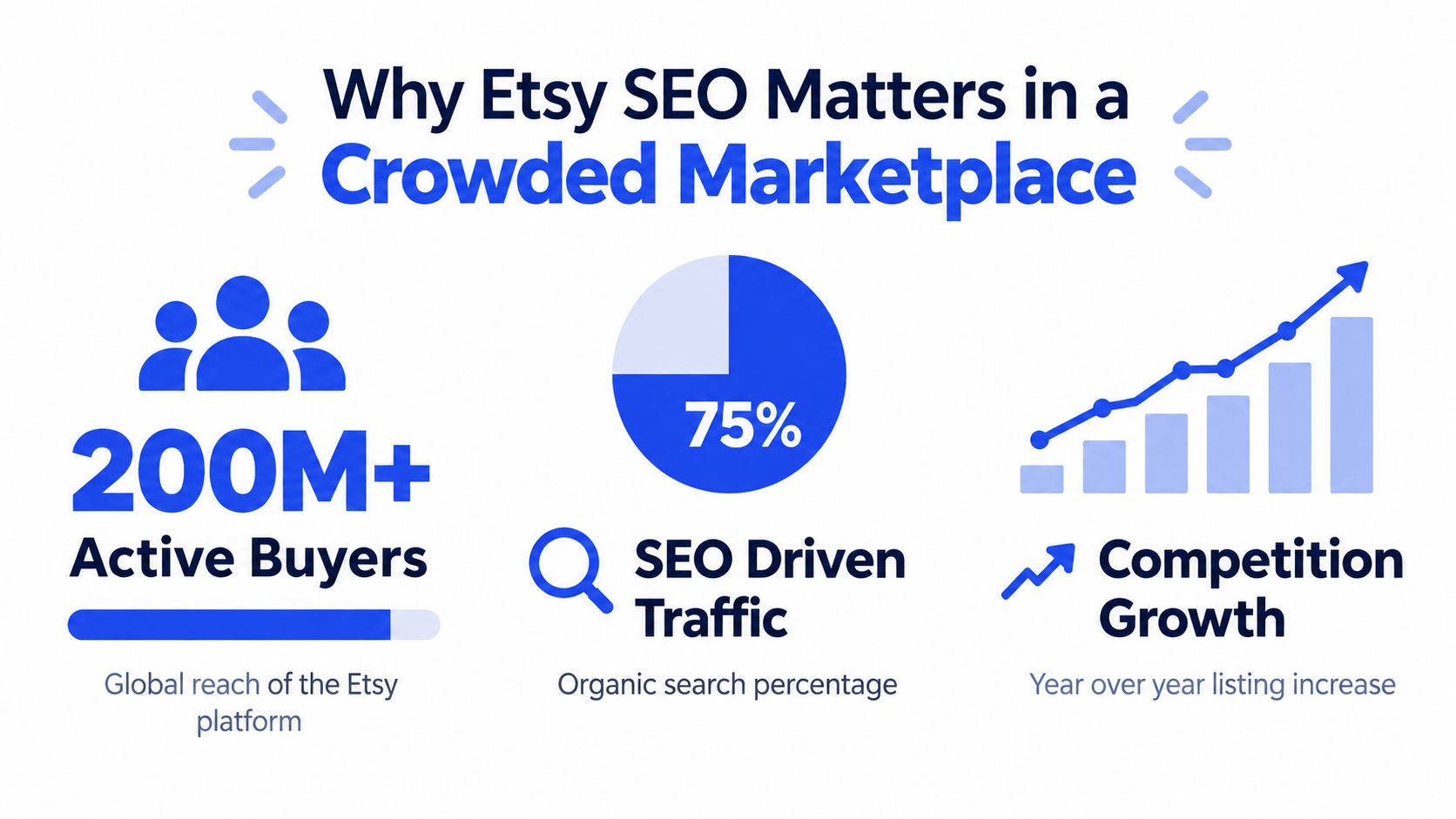
A listing can be well made and still receive little attention if it fails to match how shoppers search. Etsy reported 17.2 million gross buyer additions in the fourth quarter of 2025, including new and reactivated buyers. That expanding audience brings fresh demand, but also new wording, preferences, and expectations for sellers to address.
The marketplace is also international. In 2025, 74% of Etsy marketplace gross merchandise sales came from U.S. buyers and 26% from buyers outside the United States. Etsy's full-year disclosure of regional sales shows why language, shipping clarity, delivery expectations, and product positioning can affect performance beyond one local market.
Relevance gets you into the conversation
Etsy search first evaluates whether a listing fits the shopper's query. Titles, tags, descriptions, categories, and attributes give Etsy information about the item. A listing for a “ceramic mug” may also compete with products described as “stoneware coffee cup” or “handmade pottery mug.”
Precision usually beats a broad, vague title. “Gift for her” describes an occasion, while “personalized blue ceramic coffee mug” identifies the product and gives both Etsy and the shopper more context. The goal is to select language that reflects real buyer intent, then apply it consistently across the listing.
Engagement determines whether visibility lasts
A relevance match only earns consideration. Etsy also responds to what shoppers do after seeing the listing. Clicks, favorites, and purchases provide stronger evidence than an impression with no further action. A relevant listing with a weak thumbnail, unclear offer, or poor buying experience can lose ground to another relevant listing that turns attention into orders.
This creates a practical two-stage workflow. First, make the item easy for Etsy to classify and match. Then improve the elements that influence the shopper's next action, such as the first image, price presentation, shipping information, reviews, and product expectations. Track visits against favorites and orders so you can tell whether a visibility problem is a conversion problem.
Practical rule: Ask two questions: “Does this listing clearly match the query?” and “Does the offer give the right buyer a reason to click and purchase?”
For a concise explanation of what Etsy SEO means for shop owners, start with the two-stage principle. Relevance opens the door, engagement keeps it open.
Building Query-Matched Listings for Etsy Search
Start with one specific buyer phrase, not a pile of loosely related words. A query such as “personalized ceramic coffee mug” gives you a clear target for the title, tags, imagery, and description. Etsy's documentation states that exact keyword matches may receive stronger relevance than partial matches, and that search matching uses titles, tags, descriptions, categories, and attributes. Etsy's search guidance supports treating the entire listing as a connected relevance system.

Choose the phrase before writing the listing
The strongest target phrase usually describes what the product is, who it serves, or how the buyer will use it. “Wedding seating chart template” is more actionable than “wedding decor.” “Minimalist weekly planner printable” tells the shopper and Etsy what kind of item they're looking at.
Use the chosen phrase naturally in the title. Keep the wording readable, because a title that looks like a keyword dump can reduce confidence even if Etsy understands it.
A practical title structure might look like this:
Product first: Personalized ceramic coffee mug
Useful qualifier: Blue stoneware cup
Buyer context: Custom gift for coffee lovers
The exact structure will vary by product. The principle doesn't. Lead with the phrase that best identifies the item, then add supporting details that apply.
Use all 13 tags without cloning the same phrase
Etsy provides 13 tags per listing. Use the available space to cover close variations, materials, occasions, audiences, and use cases rather than repeating one phrase with minor changes.
For the mug example, relevant tags might address “custom coffee cup,” “blue pottery mug,” “personalized gift,” or “handmade stoneware.” Don't add “best mug ever” unless buyers use that language and the product supports the claim. Irrelevant tags may create mismatched impressions, which can produce weak engagement.
For deeper keyword planning, explore this practical guide to Etsy long-tail keywords.
Complete categories and attributes
Categories and attributes aren't administrative details to skip. They help Etsy narrow the meaning of your listing and can connect it with filtered searches. Select the most accurate category, then complete every relevant attribute, such as color, material, size, occasion, or recipient.
Write the description for both clarity and coverage. Explain what the item is, what the buyer receives, important dimensions or materials, personalization details, processing information, and answers to predictable questions. Don't paste a keyword list at the bottom. Use related terms in sentences that help the shopper decide.
Treat relevance as a quality check
Before publishing, read the listing as if you've never seen the product. Can you identify the item, its main use, and its distinguishing feature from the title and first lines of the description? If the answer is no, adding more tags won't solve the underlying problem.
Boosting Listing Quality Signals That Drive Rankings
Two listings can target the same phrase and perform very differently. One may have a sharp first image, clear pricing, convincing reviews, and a straightforward shipping offer. The other may be equally relevant but look uncertain or difficult to buy. Etsy uses shopper behavior after search exposure to assign listing-quality signals, including whether people favorite or purchase the item. Etsy's explanation of listing quality makes the trade-off clear: visibility without meaningful action isn't the same as useful visibility.
Fix the first decision shoppers make
The primary image earns the initial click. It should show the product clearly at thumbnail size and communicate the feature promised by the query. If the target phrase is “personalized birthstone necklace,” the image should make the necklace and its personalization potential immediately understandable.
Secondary images can answer objections. Show scale, texture, packaging, customization options, or the item in use. Avoid making the buyer search through decorative images to understand what they'll receive.
Price and shipping shape the click too. A low price won't rescue an unclear offer, and a premium price can work only when the listing communicates why the product warrants it. State shipping expectations plainly, especially when international buyers may compare several similar products.
Build confidence after the click
Reviews, shop presentation, and customer service influence the buyer's willingness to proceed. Etsy considers shop and customer-service signals such as average review rating, message response rate, and case rate over the previous three months. These aren't substitutes for a relevant listing, but they can affect the trust needed for engagement and conversion.
Use this checklist when a listing gets impressions but weak activity:
Primary image: Does the product read clearly in search results?
Offer: Does the price match the perceived value?
Shipping: Are cost and timing easy to understand?
Description: Does it remove practical doubts?
Reviews: Do existing buyers reinforce quality and accuracy?
Customer service: Are messages handled consistently?
New listings receive a small temporary search boost while Etsy observes buyer interaction. Etsy says that boost may last from several hours to several days depending on query frequency, while renewed listings receive a smaller boost. Treat that period as an observation window, not a shortcut. Your job is to make the listing ready before publishing, then watch how shoppers respond.
The ranking question changes after the first impression: Etsy isn't only asking whether your item matches the query. It's also looking for evidence that shoppers value the match.
Tracking Metrics That Show If Your SEO Is Working
Etsy Stats should help you diagnose a listing, not just reassure you that activity exists. Start with impressions. If a listing receives few impressions, investigate relevance first. The title, tags, category, attributes, and description may not give Etsy a strong enough connection to the intended query.
Visits answer a different question. When impressions exist but visits remain weak, inspect the click-through experience. The primary image, title wording, price, and visible offer may not stand out against competing results. Changing tags alone won't solve a thumbnail problem.
Read the funnel in order
Use the metrics as a sequence:
Impressions show that Etsy exposed the listing.
Visits show that shoppers clicked.
Favorites and carts show stronger interest.
Orders show that the listing converted interest into a purchase.
A listing with impressions but few visits needs a presentation review. A listing with visits and favorites but few orders may have a pricing, shipping, description, trust, or product-fit issue. That distinction keeps you from making random edits.
Conversion matters because Etsy uses it as part of listing quality. Etsy describes a quality score based on how well an item converts, including whether shoppers favorite or purchase after seeing it in search. It also uses past shopper behavior to predict whether people may purchase similar listings in the future.
Review shop-level signals regularly
Etsy also evaluates customer-service information, including average review rating, message response rate, and case rate over the previous three months. These signals sit above the individual listing, so a strong product page can't completely compensate for unreliable shop operations.
Keep a simple review routine. Compare impressions, visits, favorites, carts, and orders for each priority listing, then write one diagnosis before changing anything. A rank-tracking workflow can add another layer of visibility, especially when you need to monitor a chosen phrase over time. Learn how rank tracking works before selecting a tool or service.
Don't change the title, photos, price, and shipping all at once if you want to learn what helped. Make a focused adjustment, allow enough activity to observe a pattern, and record the result.
Your Step-by-Step Etsy SEO Campaign Workflow
A repeatable campaign prevents the common cycle of publishing, waiting, and changing everything without knowing why. Run the following process for one listing at a time, especially when you're launching a new product or refreshing an important seasonal item.
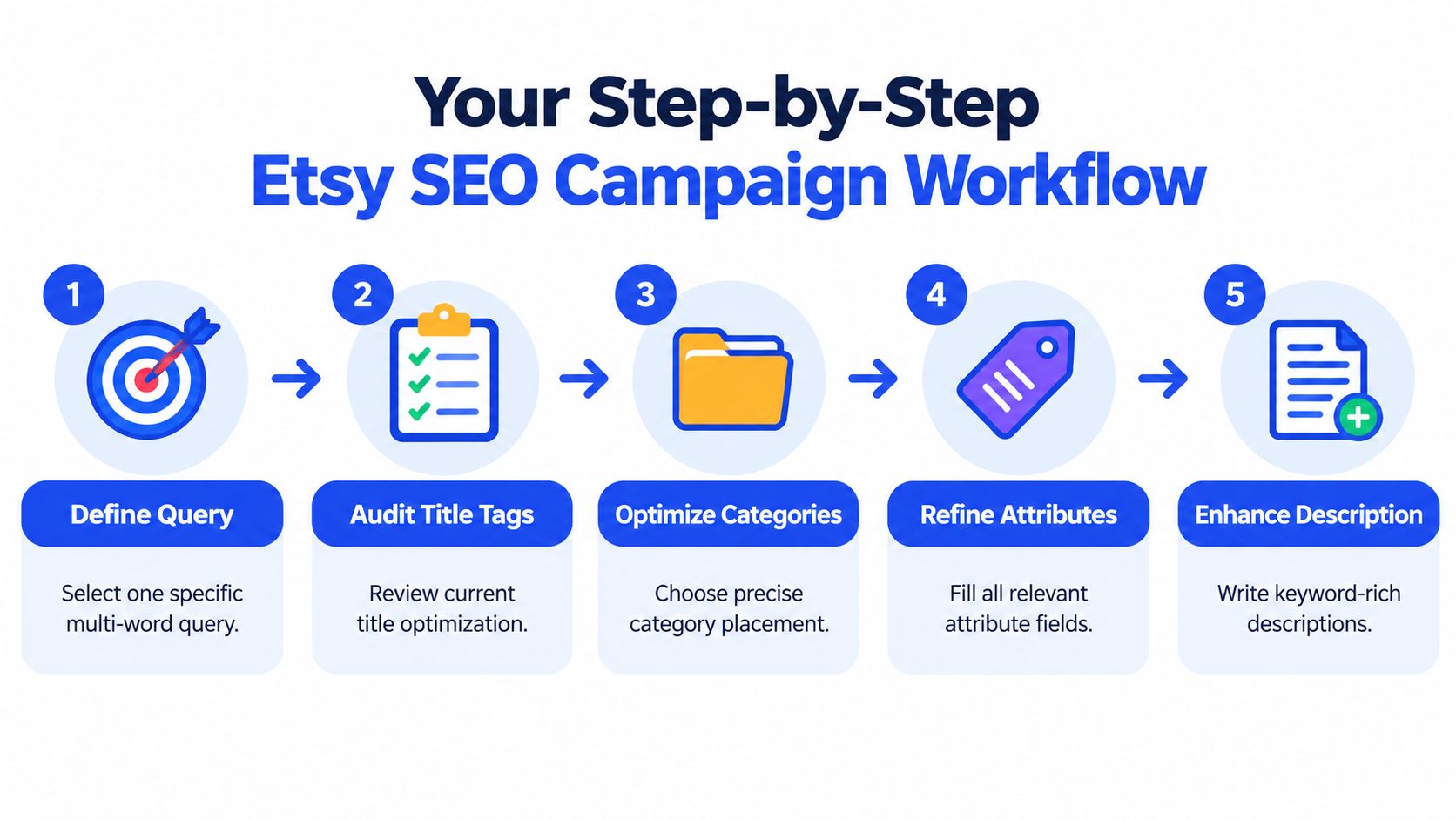
1. Define one specific query
Choose a multi-word phrase that describes the product accurately. “Custom dog portrait” gives you a more useful starting point than “pet art.” The phrase should be specific enough to express buyer intent while still representing the item you sell.
Don't target a phrase just because it sounds popular. If the product doesn't satisfy the query, the resulting impressions are unlikely to produce strong engagement.
2. Audit the listing for semantic coverage
Check the title, all 13 tags, category, attributes, and description. Look for missing information, conflicting wording, and repeated tags that could be replaced with useful variations.
The audit should answer one question: could Etsy understand the product from several consistent signals, or is the target phrase appearing in isolation? Add related language only when it describes a real product feature, use case, audience, or occasion.
3. Verify the first image and offer
Place the target product promise in the buyer's first visual encounter. If the query includes personalization, show the personalization clearly. If size or format matters, use an image or description that removes ambiguity.
Then review price, shipping, processing information, and reviews together. A shopper who clicks because of a strong image still needs a coherent offer before purchasing.
4. Measure the complete engagement path
Record impressions, visits, favorites, carts, and orders. Avoid judging the listing only by its position or impressions. Etsy's documented search system considers how shoppers respond after exposure, so the path from search result to purchase matters.
A listing that earns visits but no orders requires a different response from one that barely receives impressions. Keep those diagnoses separate.
5. Diagnose relevance or engagement
Low impressions usually point toward a relevance issue. Recheck the target phrase and the listing fields.
Low visits with impressions usually point toward a click problem. Rework the primary image, title clarity, price presentation, or offer.
Visits without orders usually point toward conversion friction. Review product fit, shipping, description, trust signals, and the expectations set by the images.
Etsy's own guide to how search works supports this two-stage approach: define a query, audit semantic coverage, verify presentation, measure engagement, and diagnose the result.
Don't optimize the wrong stage. More tags won't repair a weak thumbnail, and a beautiful image won't compensate for a listing Etsy can't match to the shopper's query.
A keyword-focused external option also exists. Upglider works on one public Etsy listing and one agreed phrase of at least three words, with campaign options lasting 30, 90, or 180 days, without requiring Etsy account access. Treat any external ranking service as separate from listing quality work, because the title, offer, images, and customer experience still determine how shoppers respond once they arrive.
Key Takeaways and Next Steps for Ongoing Optimization
Etsy shop SEO works best when you stop treating ranking as a single keyword problem. Relevance plus engagement gives you the operating model:
Choose one clear query: Build the listing around a specific phrase that accurately describes the product.
Cover the meaning completely: Align the title, tags, category, attributes, and description instead of repeating one keyword.
Improve the buyer decision: Make the first image, price, shipping, reviews, and product details support the promise made in search.
Track the path: Use impressions, visits, favorites, carts, and orders to identify the stage that needs attention.
Protect shop trust: Maintain reliable communication and customer service because Etsy evaluates shop-level signals as well.
The most useful optimization habit is diagnostic discipline. Low impressions call for a relevance audit. Impressions without visits call for a presentation review. Visits without orders call for a conversion review. That logic prevents endless title edits when the problem is the product page.
Don't overhaul every field at once. Pick one priority listing, define its query, audit the full listing, improve the first impression, and record the baseline metrics. Then make the next change based on shopper behavior rather than guesswork.
Review your highest-potential listings this week. Choose one query of three or more words, rewrite the title and tags around genuine product details, complete every relevant attribute, replace a weak primary image, and check the resulting impressions, visits, favorites, carts, and orders in Etsy Stats. That is how a vague SEO task becomes a measurable campaign.
Open one listing in your Etsy shop today and run the five-step workflow from query selection through engagement diagnosis. If you want external support for a specific listing and phrase, review the available Etsy ranking campaign options at Upglider, then make your decision only after checking the listing's relevance, presentation, and conversion readiness.