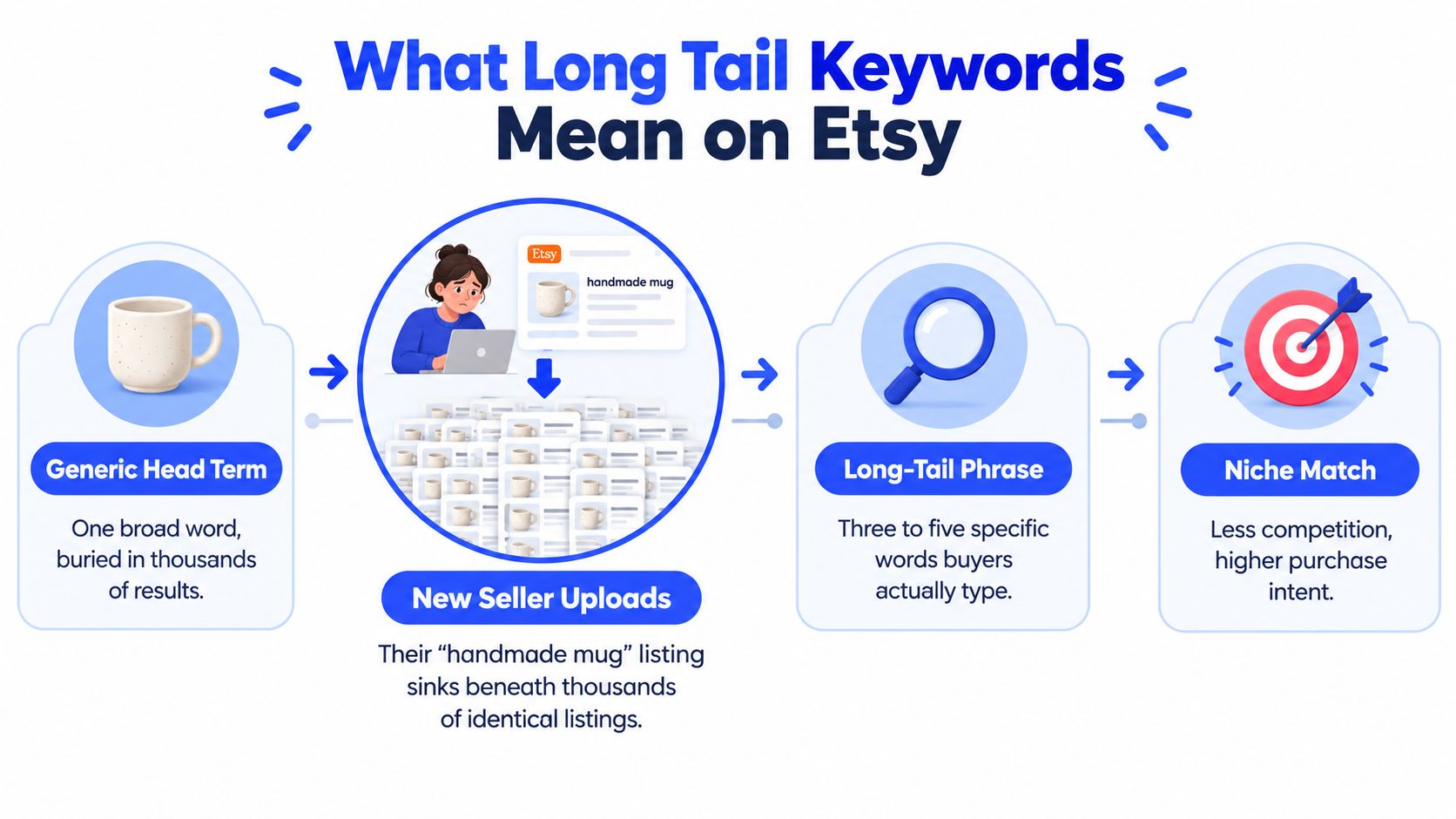
You've made a thoughtful product, photographed it well, and published the listing. Then you search Etsy for “mug” and can't find it. Your title, “handmade mug,” describes the item, but it also places your listing in a broad crowd of sellers using nearly the same words.
That's where Etsy long-tail keywords become useful. Instead of competing for one general term, you can target a phrase that identifies the product, the buyer, the occasion, or the intended use. Etsy's own guidance connects these specific phrases with stronger purchase intent, while independent 2026 keyword data shows that most Etsy searches happen at the low-volume, highly specific end of the market.
What Long Tail Keywords Mean on Etsy
A long-tail keyword is a specific search phrase made from several words. “Mug” is broad. “Handmade birthday mug for sister” tells Etsy and the shopper much more about the product and its purpose. Other examples include “handmade ceramic coffee mug with floral design” and “personalized dog mom coffee mug.”
The difference is buyer intent. Someone searching for “mug” might be browsing. Someone searching for “handmade birthday mug for sister” has already narrowed the product, recipient, and occasion. Etsy's seller handbook guidance on keywords explains that long-tail phrases are less popular than generic terms, but their specificity can help them convert better because they match what a shopper wants.
Why specificity matters
Independent 2026 Etsy keyword data supports this pattern. Among 72,451 Etsy terms with full data, 75.9% receive under 100 searches per month, while only 0.1% exceed 20,000 monthly searches, according to the 2026 Etsy search report from Listogics. The report also places the median Etsy search term at about 3 searches per month.
That doesn't mean low-volume phrases are worthless. It means Etsy demand is fragmented across many detailed searches. The same report says average competing listings rise from roughly 54,539 on low-demand terms to about 1,961,799 on the highest-demand terms. Broad phrases bring more potential shoppers, but they also place your listing in a much larger competitive field.
Practical rule: Choose the phrase that best describes why someone would buy the item, not simply the word that names the item.
For a single listing, use a simple workflow. First, build possible phrases from the product. Next, validate them with Etsy search behavior and trend signals. Finally, apply one main phrase consistently across the listing without making the copy sound repetitive.
Building a Seed List From Your Product
Start with the product itself, not a keyword tool. A handmade ceramic mug contains several details that a shopper might include in a search, and each detail gives you a new direction.
Use a spreadsheet with one column for each attribute. For the mug, begin with the material and making method. Possible entries include “ceramic mug,” “handthrown stoneware mug,” and “pottery coffee cup.” Then add the person who might receive it, such as “coffee lover,” “sister,” “teacher,” or “father.”
Mug Attribute Buckets That Build Long Tail Phrases
Material | Recipient | Occasion | Style | Use Case |
|---|---|---|---|---|
Ceramic mug | Coffee lover | Birthday gift | Minimalist mug | Office desk mug |
Handthrown stoneware mug | Sister | Father's Day | Floral patterned mug | Morning coffee mug |
Pottery coffee cup | Teacher | Retirement gift | Rustic mug | Travel commuter mug |
The next step is combination. Pair two or three relevant buckets instead of joining every detail you can think of. “Minimalist handthrown ceramic mug for coffee lovers” describes material, style, and recipient intent. “Floral ceramic mug for sister birthday gift” combines design, recipient, and occasion.
Not every combination deserves a place in your listing. A phrase such as “office desk mug” may fit a compact, spill-resistant product, but it could misrepresent a delicate handmade cup. Relevance comes before length.
For a faster starting point, compare your draft list with a dedicated Etsy keyword research tool, then return to Etsy to check whether the wording sounds like something a buyer would type.
Capture buyer language
Write down phrases in the form shoppers might use them. “Ceramic vessel with floral surface treatment” may be accurate craft language, but “floral ceramic coffee mug” is easier to understand and more likely to match a marketplace search.
Aim to collect several variations around the same product. Keep one phrase focused on the product, another on the recipient or occasion, and another on the style or use case. This gives you a useful seed list without forcing every attribute into one awkward title.
Validating Phrases With Real Etsy Data
A seed list contains possibilities, not proven targets. Validate each phrase inside Etsy before changing a listing.
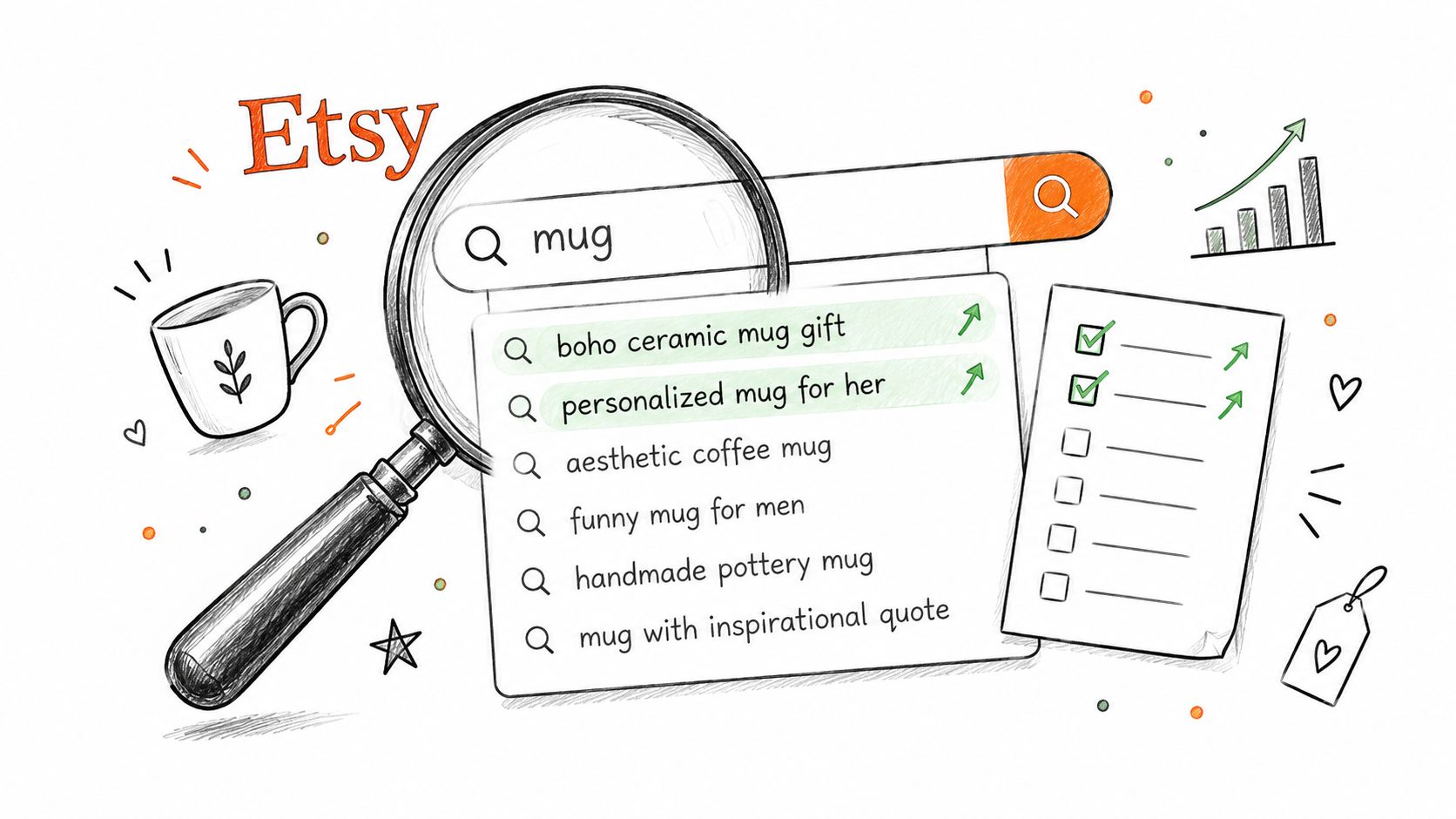
Begin with Etsy autocomplete. Type the broadest useful part of the phrase into the search bar and record the suggestions that appear. If you start with “ceramic mug,” note the more specific completions Etsy offers. These suggestions can reveal the language shoppers use, but they shouldn't be treated as guaranteed search-volume figures.
Next, search the candidate phrase and inspect the related searches on the results page. Look for close variations that preserve the original buying intent. “Ceramic mug for coffee lover” and “handmade coffee lover mug” may describe similar products, but one could fit your item more naturally than the other.
Read competition carefully
Listing counts can help you compare phrases, but don't turn a single threshold into a universal rule. A phrase with very few results may be highly relevant but too narrow to create regular discovery. A phrase with a huge result set may attract attention while making it difficult for a new listing to stand out.
Compare the first page instead. Do those listings sell products like yours? Do their photos, materials, occasions, and recipients resemble your offer? If the results are full of unrelated products, the phrase may be broad or ambiguous even if it sounds attractive.
Use a rank-checking workflow for Etsy listings to monitor whether a chosen phrase is producing visibility over time, but separate ranking from sales. A listing can appear for a phrase and still fail to earn clicks if the image, price, or promise doesn't fit the query.
Separate buying intent from browsing intent
Words such as “gift,” “personalized,” “for teacher,” and “birthday” often signal a purchase purpose. Words such as “ideas” may indicate that the shopper is still browsing. Neither type is automatically bad, but a listing designed to sell a finished product should usually prioritize phrases that describe a ready-to-buy item.
Check trend movement before committing to a seasonal phrase. Google Trends and Etsy category trend information can help you see whether interest is stable, rising, or tied to a short occasion. A long-tail phrase works best when it combines specificity with a real buying moment.
Where Etsy Actually Reads Your Keywords
Etsy doesn't rely on a single text field. Its explanation of how Etsy search works says search matches can come from tags, titles, listing descriptions, categories, and attributes. When those terms match a shopper's query, Etsy may consider the listing more relevant.
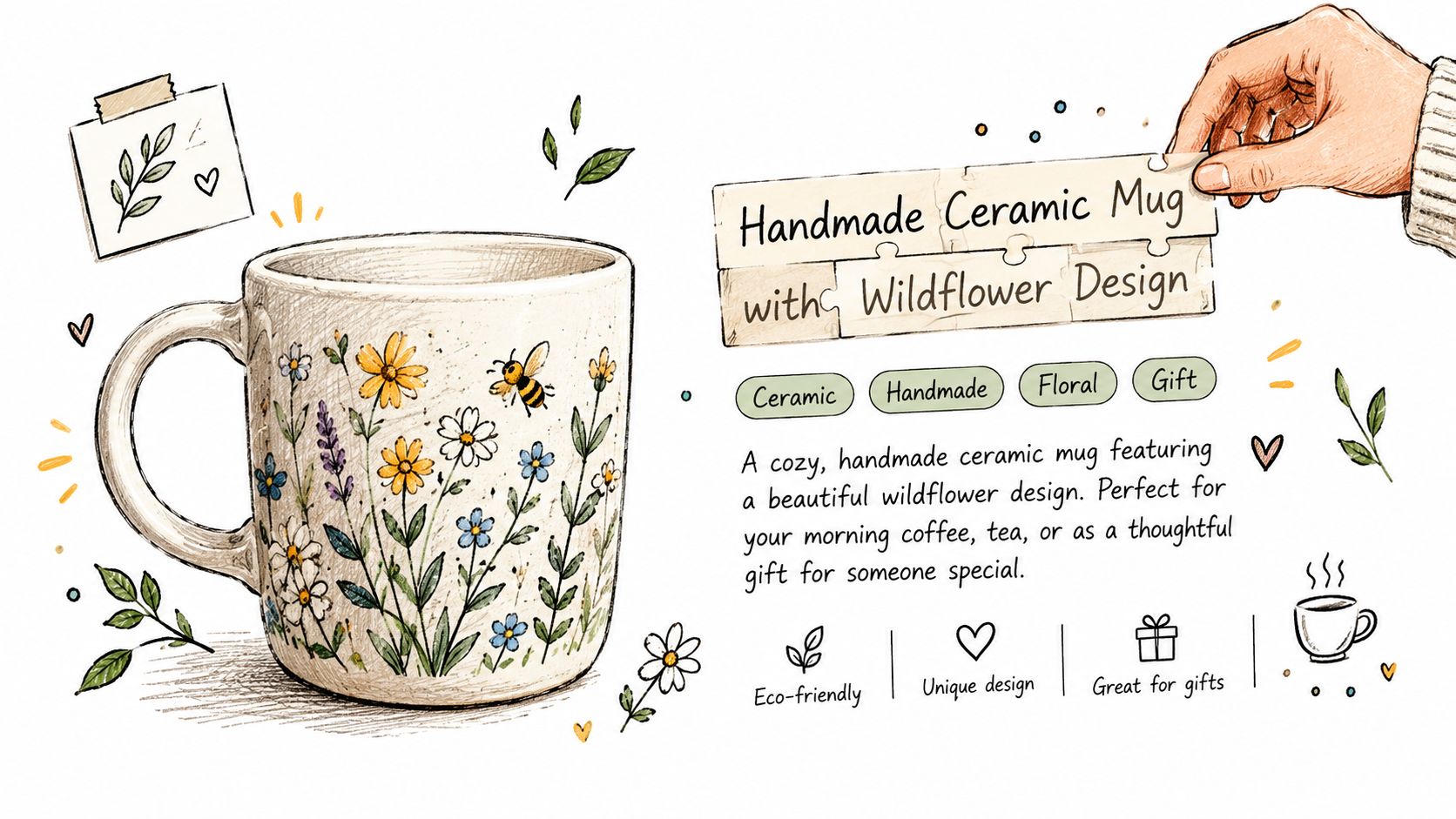
That changes how you should write. You don't need to force every idea into the title because the rest of the listing gives Etsy additional context. A title such as “Handmade Ceramic Coffee Mug” communicates the core product immediately. The description can then explain the floral design, intended recipient, making process, and care instructions in natural language.
Match fields to their jobs
Use the title to state what the product is in language a shopper can scan. Use tags to cover relevant variations that don't fit comfortably in the title. Use the description to clarify details and answer questions that support the search match.
Categories and attributes deserve equal care. Selecting the correct category tells Etsy what kind of item you're selling, while attributes such as material, color, occasion, or recipient can support more precise matching. If your mug is intended as a teacher retirement gift, selecting a relevant occasion or recipient attribute can reinforce that context without repeating the same wording throughout the prose.
Listing Area | Strength Signal | Long-Tail Role |
|---|---|---|
Title | Clear product relevance | States the primary phrase naturally |
Tags | Phrase variation and coverage | Adds related buyer wording |
Description | Context and product explanation | Expands intent and answers questions |
Category | Product classification | Places the item in the right marketplace context |
Attributes | Structured product details | Supports specific matches such as material or occasion |
Etsy also says it translates seller keywords to serve buyers according to their query and language settings. That means localization matters, but you don't need to create awkward multilingual titles. Write clear English first, choose accurate structured details, and remember that Etsy's translated keyword system can affect how international buyers discover the listing.
Search relevance begins with clarity. If a shopper has to decode the title, Etsy has less precise information to work with.
Weaving Keywords Into a Listing
Choose one primary long-tail phrase for the listing. Suppose the phrase is “handmade ceramic coffee mug for book lovers.” Your job isn't to repeat it mechanically. Your job is to make the listing consistently communicate that product and audience.
Start the title with the clearest version:
Handmade Ceramic Coffee Mug for Book Lovers, Floral Stoneware Cup
This title identifies the item, its audience, and a design detail. It doesn't need several repeated versions of “mug” or “coffee mug.” Repetition can make the title harder for people to read without adding useful context.
Build supporting variations
Use tags to cover related ways a buyer might describe the same item. You might include phrases related to a reading gift, a floral mug, a stoneware cup, or a cozy coffee accessory, provided each one accurately describes the product. Avoid adding unrelated terms just because they seem popular.
The opening of the description should sound like a sentence, not a keyword list:
This handmade ceramic coffee mug for book lovers is handthrown from stoneware and finished with a soft floral design for slow morning coffee.
Then move into the information a buyer needs. Explain the material, capacity if you provide it, finish, care, personalization options, dispatch details, and the reason the item makes a suitable gift. The phrase has done its work once the reader understands the product.
Keep the visual language aligned
Use a descriptive first image filename and accessible alt text where your publishing workflow supports them. For example, a file could be organized as handmade-ceramic-coffee-mug-book-lovers, while the alt text could describe the object and its design for people who can't see the image. Don't treat image wording as a substitute for Etsy's primary listing fields.
Compare the difference:
Before: Handmade mug, ceramic cup, coffee cup, gift mug
After: Handmade Ceramic Coffee Mug for Book Lovers, Floral Stoneware Cup
The second version gives the shopper a clearer reason to click. The tags and description can add supporting details, while the photos prove that the listing matches the promise.
DIY Optimization or Hand It to a Ranking Service
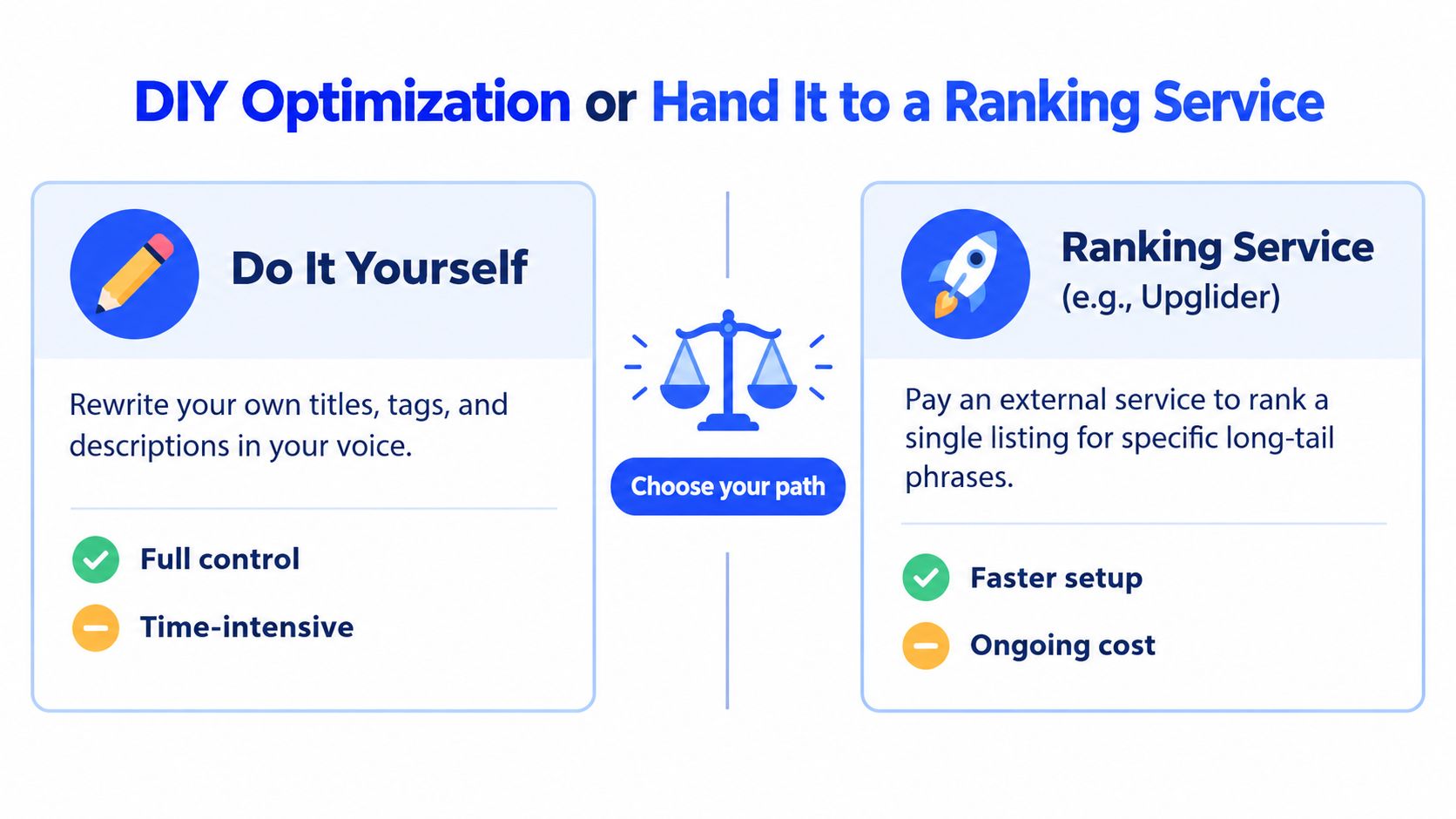
Do-it-yourself optimization gives you direct control over the wording, product positioning, and testing process. It also asks you to spend time learning Etsy search, reviewing competitors, rewriting listings, and checking whether the changes attract the right visitors.
A maker with one strong product and ten hours a week can use that time to build a repeatable system. The work compounds across a growing catalog because each new listing teaches you more about buyer language. The trade-off is that results won't arrive on your preferred schedule, and you still need to monitor engagement and sales after publishing.
A busy shop owner may choose a different path. If one hero product supports an upcoming launch or holiday push, paying for focused external help can be more practical than learning every part of Etsy optimization immediately. Upglider is one example of a service that targets a selected Etsy listing for a specific phrase and works toward placement within Etsy's first 15 results, subject to its assessment and campaign terms.
Choose based on the job
Choose DIY if:
You're building a catalog: You want lasting control over titles, tags, descriptions, categories, and attributes.
You have time to learn: You're willing to compare queries, study buyer language, and revise carefully.
Your products change often: You need to adjust messaging as materials, designs, and occasions shift.
Choose a service if:
One listing matters most: You have a flagship product that deserves focused attention.
Time is the constraint: You'd rather pay for a defined ranking task than develop the process yourself.
The campaign has a clear target: You can name one specific listing and one relevant search phrase.
Neither path fixes an unsuitable keyword or a weak product page. Validate the phrase first, make the listing genuinely relevant, and then decide whether you want to manage the optimization personally or delegate a narrowly defined ranking task.
Common Mistakes and a Simple Checklist
Many sellers assume the biggest keyword will bring the best result. Etsy's ranking policy says relevance is only one part of placement. Etsy also considers signals such as clicks, views, favorites, purchases, recency, shop and listing quality, shipping, and the buyer's context, as described in its search and recommendation policy.
That makes keyword stuffing especially unhelpful. Repeating “personalized mug” in the title, every tag, and each paragraph doesn't create a stronger reason to click. Use variations that add meaning instead, such as “personalized ceramic coffee mug for teacher retirement gift.”
Mistakes to remove
Chasing broad seasonal wording: “Christmas gift” says little by itself. “Personalized ceramic Christmas mug for grandmother” gives the occasion and recipient more clearly.
Ignoring engagement: A phrase may be relevant, but weak clicks or purchases can signal that the photo, offer, or product doesn't satisfy the search.
Changing everything too often: If you rewrite the title, tags, and description constantly, you make it harder to understand which change affected the listing.
Forgetting translation: English wording may be translated for international search, so clear, natural phrases are safer than slang or obscure abbreviations.
Using the same phrase everywhere: Let the title state the main promise, then use tags and description wording to add useful variations.
Etsy gives new listings a small temporary search boost so it can learn buyer behavior. Treat that early period as a reason to make the listing accurate and appealing, not as a reason to publish an unfinished page and hope the algorithm carries it.
A five-step weekly check
Assign one primary long-tail phrase to each of your top three listings.
Add two supporting variations in the tag fields, using wording that remains relevant.
Place the main phrase naturally near the start of the description.
Use one product image that clearly reflects the phrase, such as a book-themed mug shown beside a reading setup.
Compare the listing with relevant competitors and recalibrate the phrase if the search results reveal a different buyer intent.
Open your top three Etsy listings today, write down the broad term each one currently targets, and replace it with a specific phrase that names the product, buyer, occasion, or use case. Check each phrase in Etsy autocomplete, update the listing naturally, and track whether the right shoppers begin to find and engage with your products.