You've found a phrase that describes your product, but your keyword dashboard makes the decision harder. Search volume looks promising, competition looks intimidating, and another tool gives you a different impression. You still don't know whether to put that phrase in your listing.
The best keyword tool for Etsy depends on the decision you need to make. My recommendation is eRank for comparing markets and competitive difficulty, Marmalead for examining engagement and listing quality, and Etsy's own search-term feedback for checking what brings shoppers to your shop. Choose a research workflow before choosing a subscription.
What Makes an Etsy Keyword Tool Different
Suppose you sell a handmade dining table. A general SEO dashboard might help you explore furniture-related topics, but your immediate problem is narrower: finding language that accurately describes the item a shopper can buy from your listing.
You don't need a bigger collection of loosely related words. You need phrases that distinguish your product from alternatives without promising something it doesn't offer.
That difference should shape how you evaluate tools. A dashboard can look impressive while leaving you unable to explain why a particular phrase belongs on your listing.
Start with the decision you're stuck on
The useful question isn't whether a tool has lots of features. It's whether those features resolve your current uncertainty.
Discovery: You know the product, but need specific ways to describe it in shopper language.
Validation: You have candidate phrases, but need to compare demand, competition, and engagement.
Diagnosis: You've published the listing, but need to understand whether the problem is targeting or presentation.
Monitoring: You've committed to a phrase and need a consistent way to assess progress.
These are different jobs. Don't buy a subscription mainly because it solves a problem you might have later.
Judge phrases against the actual product
For the table seller, material, style, intended room, and dimensions might help distinguish relevant searches. Those details should come from the item itself, not from whichever suggestion receives the most attractive score.
A useful exercise is to explain each candidate phrase without looking at its metrics. If you can't say why a buyer using that phrase would reasonably choose your product, set it aside.
Practical rule: Research should help you describe the product more precisely, not persuade you to describe a different product.
Keep a shortlist with a plain-language reason for accepting or rejecting each phrase. That makes later decisions easier than revisiting an unexplained collection of saved keywords.
For a structured approach to building that shortlist, use this Etsy keyword research guide. The aim is a defensible selection, not a spreadsheet that keeps growing while the listing stays unchanged.
How Etsy Search Actually Works
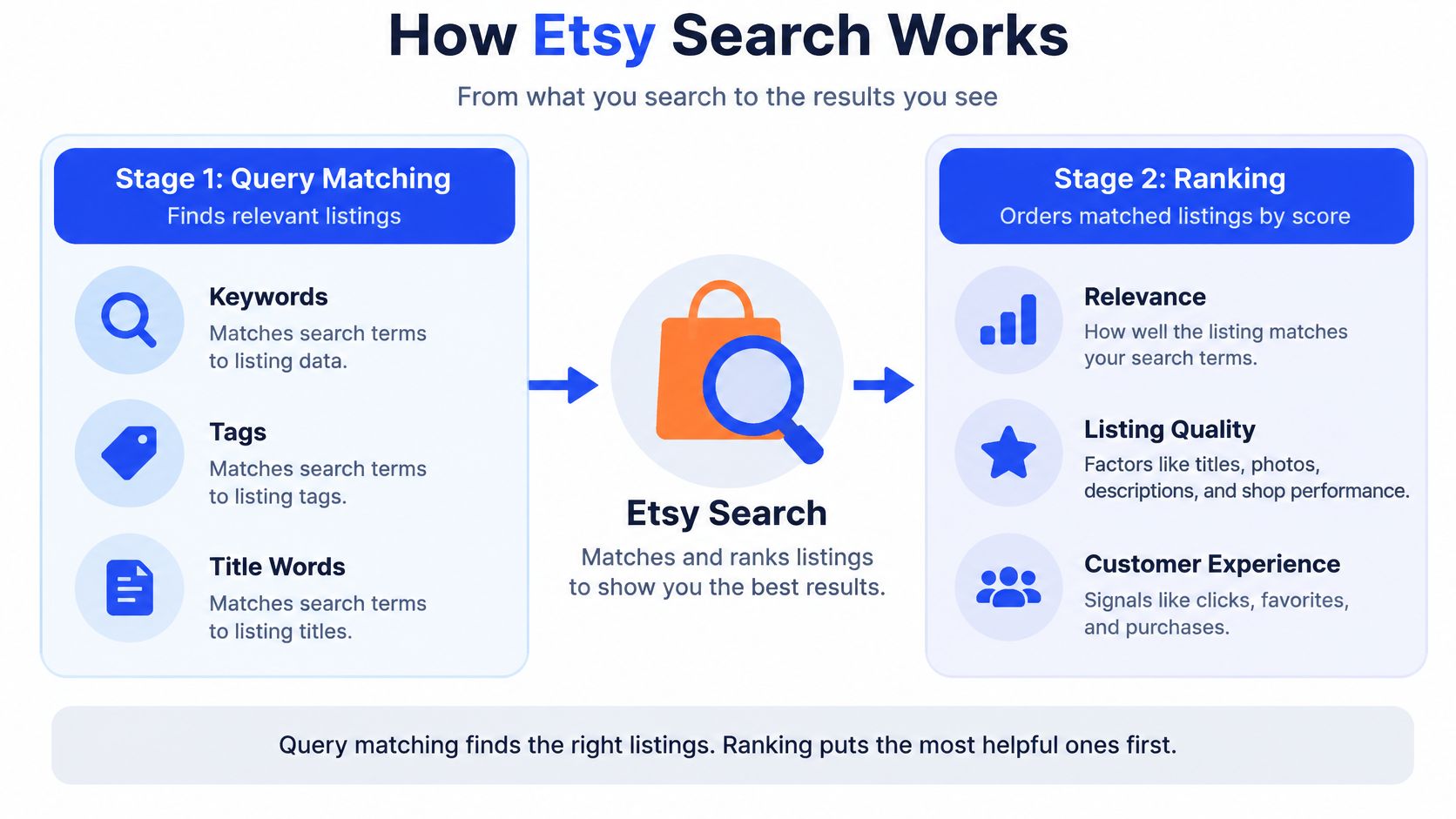
Query matching and ranking are different problems. Etsy first identifies listings relevant to a search, then orders those eligible listings. Its explanation names conversion rate as a major ranking consideration alongside keywords and describes relevance across titles, tags, categories, attributes, descriptions, the first photo, and reviews. Customer-service signals include average review rating, message response rate, and case rate from the previous three months, according to Etsy's explanation of how search works.
Matching makes the listing eligible
Think of matching as the relevance check. Your listing needs to communicate what you sell clearly enough for Etsy to connect it with an appropriate search.
Etsy recommends phrase-level tags such as “dining room table”, rather than splitting the idea into “dining,” “room,” and “table.” It also recommends using all 13 tags and provides search-term feedback through Shop Stats, as described in its official keyword guidance.
That creates a practical research loop: discover plausible phrases before publishing, then inspect the terms that bring actual visitors afterward. Suggestions help you form a hypothesis; shop feedback helps you judge whether it deserves continued attention.
Ranking determines placement
A relevant phrase doesn't give every matching listing an equal claim to visibility. Sellers still need to examine the offer shoppers encounter, including the photograph, product information, and reasons to trust the shop.
Consider listings targeting the same search but presenting very different buying experiences. A keyword tool can help compare their targeting, but a difficulty score can't fully capture those differences.
Search volume helps assess potential interest, not the sales your listing will receive.
Competition metrics help frame the challenge, not predict your final position.
Exact phrase alignment supports relevance, but doesn't replace a convincing listing.
A keyword score is evidence for a decision. It isn't a promise about placement.
When a phrase looks suitable but results disappoint, don't assume the next tag change is the answer. Inspect whether the listing makes the product, its value, and the buying conditions clear.
This Etsy search algorithm guide provides additional context for separating a matching problem from a ranking problem. Keeping that distinction clear prevents endless keyword editing when another part of the listing needs attention.
Top Etsy Keyword Tools at a Glance
Choose the row that matches your next decision, rather than treating this as a league table. Pricing descriptions below deliberately avoid fixed amounts or assumed feature access. Check the current offering before paying.
Etsy Keyword Tools Quick Comparison
Tool | Primary Strength | Pricing Model | Best For |
|---|---|---|---|
eRank | Historical phrase comparison and competitive research | Plan-based access; verify current limits | Sellers comparing candidate searches and needing position checks |
Marmalead | Engagement analysis and listing diagnostics | Free tools documented; verify paid access and terms | Sellers assessing phrase engagement and listing weaknesses |
Etsy Shop Stats | Search terms associated with actual shop traffic | Native shop reporting rather than a separate research subscription | Checking whether published listings attract relevant searches |
Etsy Marketplace Insights reports | Context for emerging and seasonal demand | Seller Handbook reports rather than a keyword-tool subscription | Deciding which trend ideas deserve investigation |
Read each row as a different job
eRank fits a comparison-led workflow. Use it when your question is which candidate phrase deserves further investigation. Its strongest role in this comparison is helping you examine alternatives before committing effort.
Marmalead fits a diagnostic workflow. It's the more natural starting point when you want to examine shopper engagement and the listing itself together, rather than stop at a demand estimate.
Shop Stats serves a different purpose. It provides feedback about your own shop, so treat it as a reality check rather than a replacement for exploring possible searches.
Marketplace reports are useful for generating timely questions. A trend may deserve investigation, but you still need to decide whether your particular product belongs in that conversation.
Turn the comparison into a buying decision
Before opening either commercial tool, write down what you expect to decide during the session. A useful research question is specific enough that you'll know when you've answered it.
For a new listing: Which relevant phrase should lead the targeting?
For an existing listing: Does its current search language match the product and offer?
For a seasonal product: Is the proposed phrase worth testing during the selling window?
For a focused campaign: Can you establish a baseline and monitor the agreed query?
Don't expect identical readings across different dashboards to be a prerequisite for action. Instead, record which tool and metric informed your decision, and use a consistent method when reviewing it.
The table is a starting filter, not a reason to subscribe to everything. If your current question is already answered by your shop's search-term feedback, another dashboard may add work without resolving anything new.
eRank vs Marmalead Compared in Detail
Choose eRank when you need stronger comparative evidence before selecting a phrase. Choose Marmalead when you need to examine engagement and listing execution more closely. Both support research, but they put different information in the foreground.
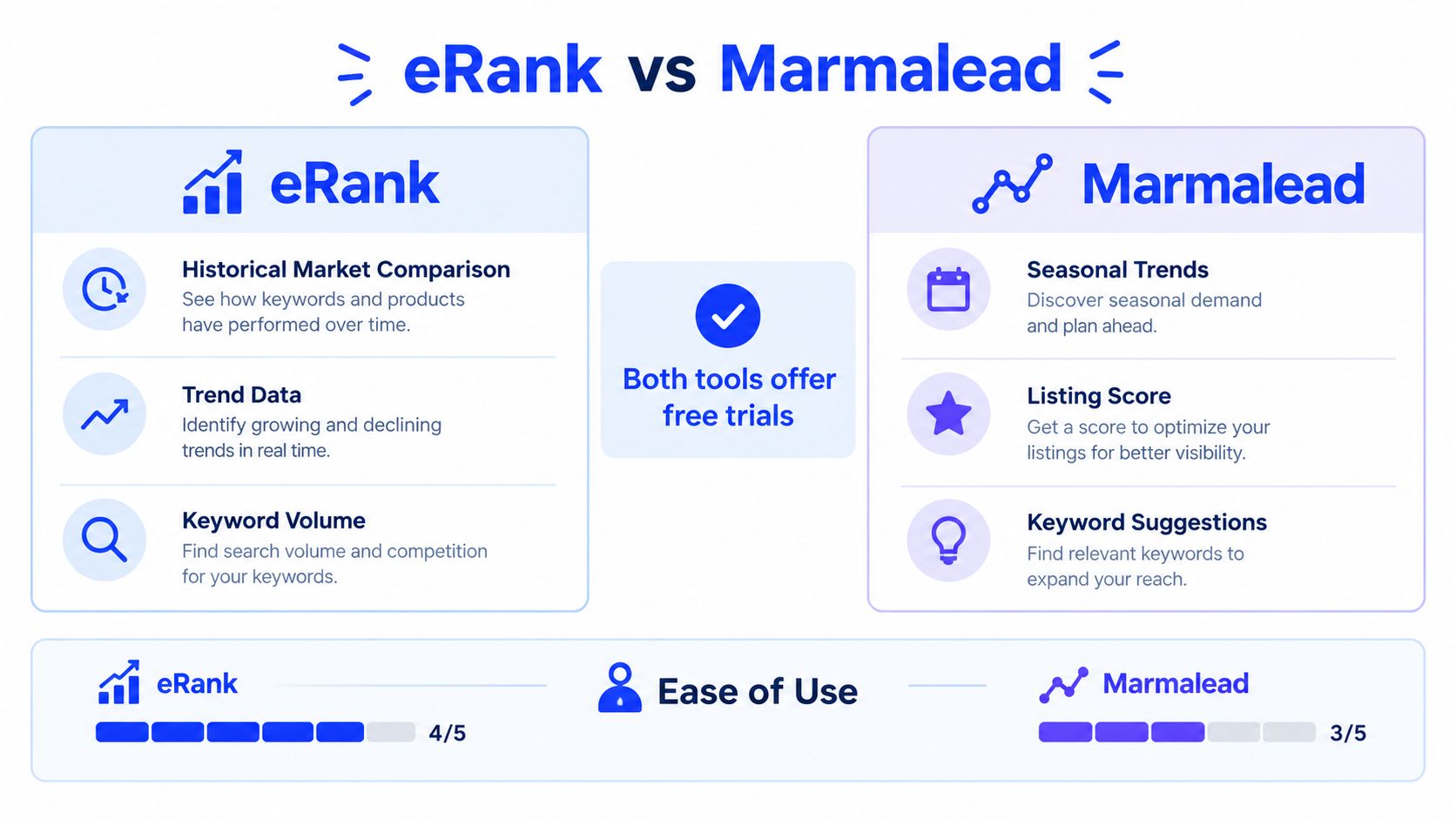
Treat the visual as an overview of positioning rather than evidence for trial availability or usability scores. Verify access terms directly, and judge ease of use by completing your own research task.
Where eRank is the stronger choice
eRank reports 15 months of historical search data across multiple markets, alongside search volume, competition, click-through indicators, and position-checking capabilities. Its keyword research also exposes the Top 100 listings, with information including estimated sales, average price, views, favorites, and processing times, according to eRank's keyword research documentation.
The practical advantage is context. Instead of accepting a phrase because demand looks attractive, you can investigate the listings already associated with it and decide whether your offer belongs alongside them.
Inspect the product mix as carefully as the metrics. If the leading results mostly represent a different item, price position, or buying intention, apparent opportunity may be a poor fit for your listing.
A sensible eRank session should end with a decision record: the candidate phrase, its historical pattern, the competitive evidence, and your reason for proceeding. Estimates describe patterns, and they say nothing definitive about a competitor's actual business.
Where Marmalead is more useful
Marmalead documents long-tail suggestions, similar shopper searches, engagement levels, forecasting, seasonality, competition meters, listing letter grades, SEO factors, and sales factors. Its analysis can examine the first 42 organic listings, excluding ads, or expand to 100 or 500 listings, according to Marmalead's free-tool documentation.
That makes it useful when the difficult question is whether apparent interest is commercially meaningful. Look for whether engagement evidence supports the phrase, then inspect the listings behind the summary rather than accepting the headline score alone.
Its listing grades also give you a way to organize an audit. Use them to identify changes worth considering, not as proof that a listing will sell after reaching a particular grade.
The same documentation includes a vendor claim of 95% accuracy for its 30-day keyword forecast. Treat that figure as a product claim, since no independent benchmark validates it.
Which would I choose?
For a phrase shortlist and a competitive baseline, I'd start with eRank. For a listing that needs closer engagement and presentation analysis, I'd start with Marmalead.
Don't pay for both to settle a disagreement between numbers. Add a second tool only when it answers a distinct question your existing workflow leaves unresolved.
Free vs Paid Keyword Tools for Etsy
Stay free until you can name the decision that requires paid access. A subscription is justified by useful work you can complete, not by the reassurance of having more metrics available.

When free access is enough
A new shop owner can begin by defining the product accurately, exploring candidate phrases, inspecting relevant listings, and reviewing shop feedback as it becomes available. There's no need to purchase advanced analysis before you've established what you're trying to learn.
Use whatever free access is currently available to complete a real task. Don't judge it by how many dashboard panels you can open.
Keep it free if you can build a relevant shortlist and make a clear publishing decision.
Consider upgrading if an access limit repeatedly prevents a necessary comparison.
Delay the purchase if you're still unclear about the product's audience or distinguishing features.
Avoid assuming that every free tier lacks tracking or that every paid tier includes the history you need. Confirm the exact entitlement for the plan under consideration.
When paid access earns its place
Consider an established seller preparing a focused launch. They may need to compare historical patterns, inspect competitors, preserve research records, and revisit positions during the selling window.
In that situation, paid access can make sense if it supports those recurring tasks. The relevant comparison is the subscription cost against the work it enables and the uncertainty it helps resolve.
Before paying, write an acceptance test. For example: can you research the intended market, compare the phrases on your shortlist, and retain enough information to explain the final choice?
Upgrade test: If you can't describe what you'll do differently with paid access, keep your current setup.
Also check whether the bottleneck is research at all. If you already have a defensible phrase but haven't improved confusing product information or unsuitable photographs, buying more keyword data postpones the work you've already identified.
The best paid tool isn't necessarily the tool you keep indefinitely. Review whether you still need its features once the research task or selling window has passed.
Choosing a Tool for Long-Tail Ranking Campaigns
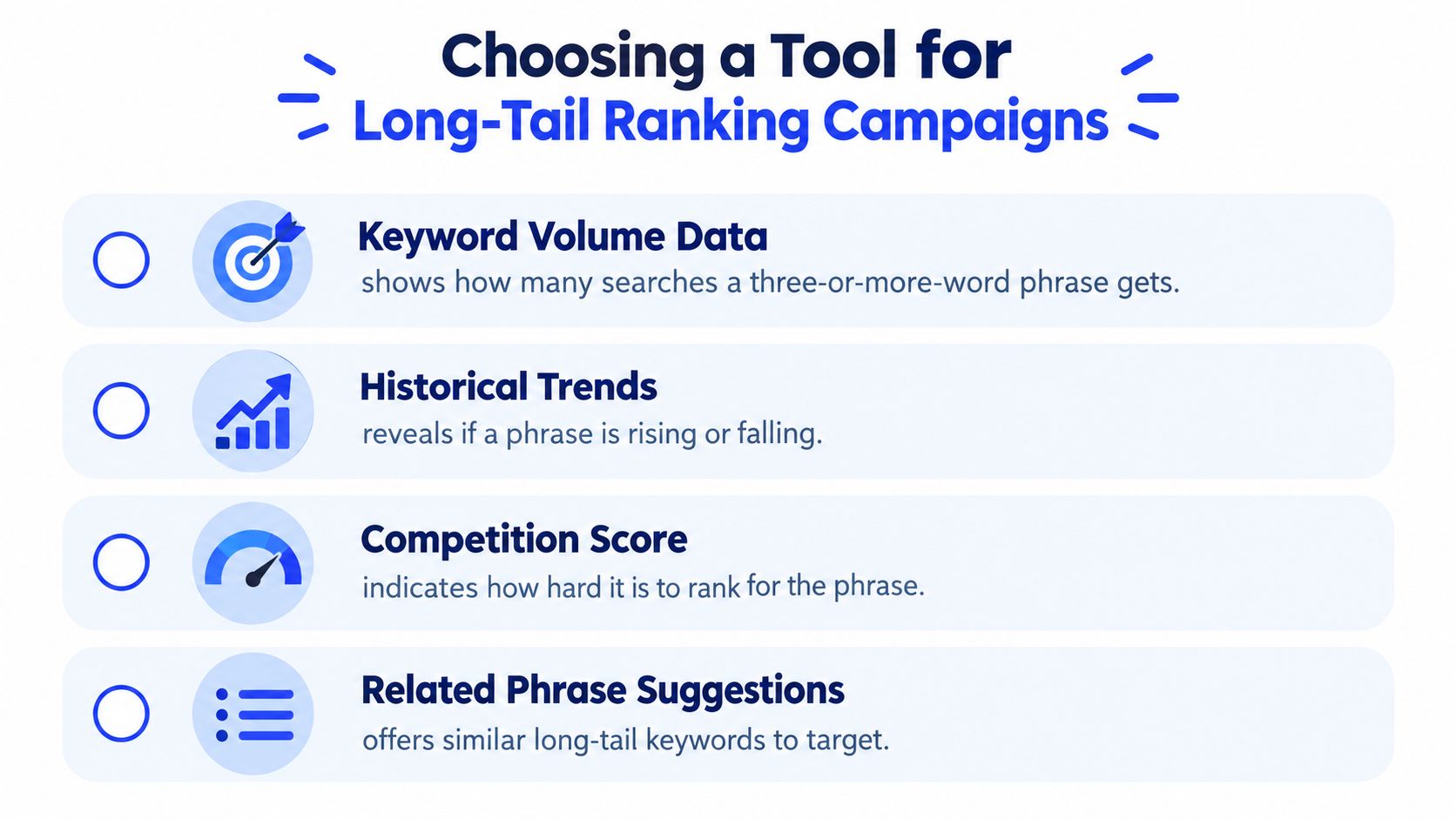
For a focused ranking campaign, phrase validation and position monitoring matter more than an attractive volume estimate. You're choosing a defined search target, not collecting general ideas for future listings.
Build a campaign-ready research record
Begin with the listing, not the service. State exactly what the item is, who it suits, and which details distinguish it from nearby alternatives.
Then use your chosen research tool to document the proposed phrase. The long-tail keyword guide for Etsy can help you move from a broad product description toward a more specific target.
Validate the wording: Every meaningful part of the phrase should accurately describe the item.
Record demand context: Save the historical pattern and engagement indicators available in your tool.
Inspect the competition: Examine the actual products and offers behind the competitive summary.
Establish measurement: Record the starting position and decide how subsequent checks will be performed.
Reject a phrase when the search intent doesn't fit, even if the estimated competition looks manageable. A campaign should pursue visibility in front of suitable shoppers, not merely an easier position.
Separate research from campaign execution
A keyword tool supports selection and measurement. A ranking service performs a different role, and its scope should be explicit before payment.
Upglider is an independent option offering campaigns for an individual listing and an agreed phrase of three or more words, with a top-15 objective and a pre-payment case assessment. Its stated campaign scope includes external promotion without Etsy account access; that is a service offering, not an Etsy endorsement or a guarantee of sales.
If you consider any provider, ask how it measures positions, what activity it performs, what maintenance includes, and which refund conditions apply. Don't leave those questions until after the campaign starts.
The research record should also guide the conversation with the provider. Share why the phrase fits, what competitive evidence you reviewed, and what you expect to monitor.
A ranking objective can be clearly defined without pretending it answers every commercial question. Decide separately how you'll assess the traffic and orders associated with the campaign, so placement doesn't become the only result you examine.
Using Trend Data Without Hurting Your Listing
A rising phrase is a reason to investigate, not an instruction to rewrite your listing. Keep the product's durable description intact and test trend language only when it adds accurate, useful context.
Etsy's Spring/Summer 2025 Marketplace Insights used searches and sales from the three months ending February 20, 2025, compared with the same period a year earlier. Its Fall/Winter 2025 report used the three months ending September 2, 2025, with the same year-over-year approach, according to Etsy's seasonal marketplace insights.
Those are historical observation windows, not evidence that a phrase remains attractive today.
Run a controlled trend test
Check product fit first: The trend should describe a genuine style, material, use, or occasion associated with the item.
Preserve the core wording: Keep the product identity clear instead of replacing it with broad trend terminology.
Record the change: Save the previous wording, your reason for editing, and the evidence you'll review.
Set a review date: Reassess whether the phrase still belongs when the relevant selling window changes.
Don't change the title, tags, photographs, and offer together if your aim is to learn whether trend wording helped. A narrower edit is easier to interpret.
Know when to stop
For a durable listing, I'd favor evergreen product language unless a trend adds a precise reason to buy. For a seasonal item, timely wording may deserve more attention, but it still needs a removal or review plan.
Remove trend language when it no longer describes the buying occasion, when the product's relevance is strained, or when your review doesn't justify keeping it. Don't preserve an experiment because researching it took effort.
Start with a listing you want to improve. Write a relevant phrase shortlist, choose the tool that answers your biggest unresolved question, and record your baseline before editing or commissioning a campaign. Make the next decision from that evidence, not from whichever dashboard displays the most encouraging score.