“Use popular keywords and fill every title with them” is still the most common Etsy SEO advice. It's also incomplete. Etsy says search visibility isn't determined by keywords alone. Search first finds listings that match a shopper's query, then ranks those listings using broader marketplace signals, including listing quality, engagement, customer experience, recency, location, and personalization. Etsy's explanation of how search works should be the starting point for judging any Etsy SEO course.
That changes the buying decision. A course can teach you how to research phrases and improve listings, but it can't guarantee a position or fix a product that shoppers don't trust. A focused ranking service may suit a seller who wants a specific result without studying. The right choice depends on whether you need durable skill, a practical diagnosis, or visibility for one priority listing.
Why You Might Not Need an Etsy SEO Course
An Etsy SEO course sounds like the obvious first purchase, especially when your shop has little visibility. It isn't always the right one. Before paying for lessons, identify the problem you're trying to solve.
A new seller usually needs a complete foundation. That means choosing relevant categories and attributes, writing accurate listing copy, creating convincing photos, setting a realistic delivery promise, and understanding how shoppers search. A course can provide structure when every part of the shop feels unfamiliar. You can also begin with Etsy's own guide to selling on Etsy, then pay for training only when free guidance leaves a specific gap.
An established seller faces a different problem. If one flagship product has stalled, studying an entire curriculum may delay the work that matters. You might need a sharper search phrase, a listing audit, better conversion signals, or a controlled test on one product. In that situation, a course is useful only if it helps you diagnose the exact failure rather than sending you through generic lessons about tags.
Three seller situations
You're new and willing to learn. A course can shorten the path from confusion to a repeatable process, provided it teaches more than keyword placement.
Your shop is established but one listing has stopped moving. An audit, mentor, or focused experiment may be more useful than broad training.
You make products all day and have little time for SEO. Paying for implementation can be rational. You're buying saved time, not permanent expertise.
A course won't choose a product with strong buyer demand, produce trustworthy photographs, answer customers promptly, or make a weak offer convert. Etsy connects search placement with listing engagement and customer experience, so visibility without sales can become an expensive distraction.
Practical rule: Study when you want a skill you'll reuse across the shop. Delegate when you need a specific listing investigated or promoted within a defined selling window.
The honest question isn't “Which Etsy SEO course is best?” It's “Do I need to learn Etsy search, improve one listing, or reach a target position without becoming an SEO student?” Answer that first. Curriculum comparisons make more sense afterward.
How Etsy Search Ranks Listings
Etsy search is not a title formula. It works in two stages: first, it matches a shopper's query with listing information; then it orders eligible listings using broader signals and shopper context. Etsy's Seller Handbook explanation of search is a stronger foundation than any course promise built around one keyword tactic.
The first stage works like a librarian sorting relevant books. The librarian checks the title, subject labels, description, and classification. Etsy's query matching examines titles, tags, descriptions, categories, and attributes. Accurate information gives a listing a chance to enter the right group of results. Vague or mismatched fields can keep a relevant product out of that group.
The second stage resembles a curator choosing which books receive the most prominent display. Etsy applies Context Specific Ranking, which weighs signals beyond the words in a listing. Listing quality, engagement, customer experience, recency, location, and shopper-specific personalization can all affect placement.
For example, a listing may match “custom ceramic mug” closely, yet appear below a competitor with a higher review rating and stronger shopper response. Relevance gets the listing considered. The wider ranking signals influence where it appears.
What this means for course buyers
A credible course must teach both stages. Etsy says exact keyword matches can improve perceived relevance, but keywords are only one part of the system. Any course that presents exact matching as a guaranteed ranking formula ignores what happens after matching.
Use this workflow:
Choose a specific, commercially meaningful phrase that accurately describes the item.
Place it naturally in relevant structured fields, including the title and tags.
Reinforce the product's meaning through the description, category, and attributes.
Improve the listing experience so shoppers understand the item and feel confident buying it.
Measure visibility separately from clicks, orders, and conversion behavior.
Etsy recommends multi-word tags and long-tail phrases because they can express buyer intent more precisely than broad terms. That does not mean every long phrase will rank or sell. It means your course should teach a defensible match between the shopper's wording and the product's offer.
Search results also vary by shopper and context. One screenshot cannot prove a universal position. Location, filters, device, prior behavior, inventory, and indexing timing can change what a shopper sees. A useful course should teach sellers to test patterns across these conditions rather than treat one observation as a stable ranking result.
What a Good Etsy SEO Course Covers
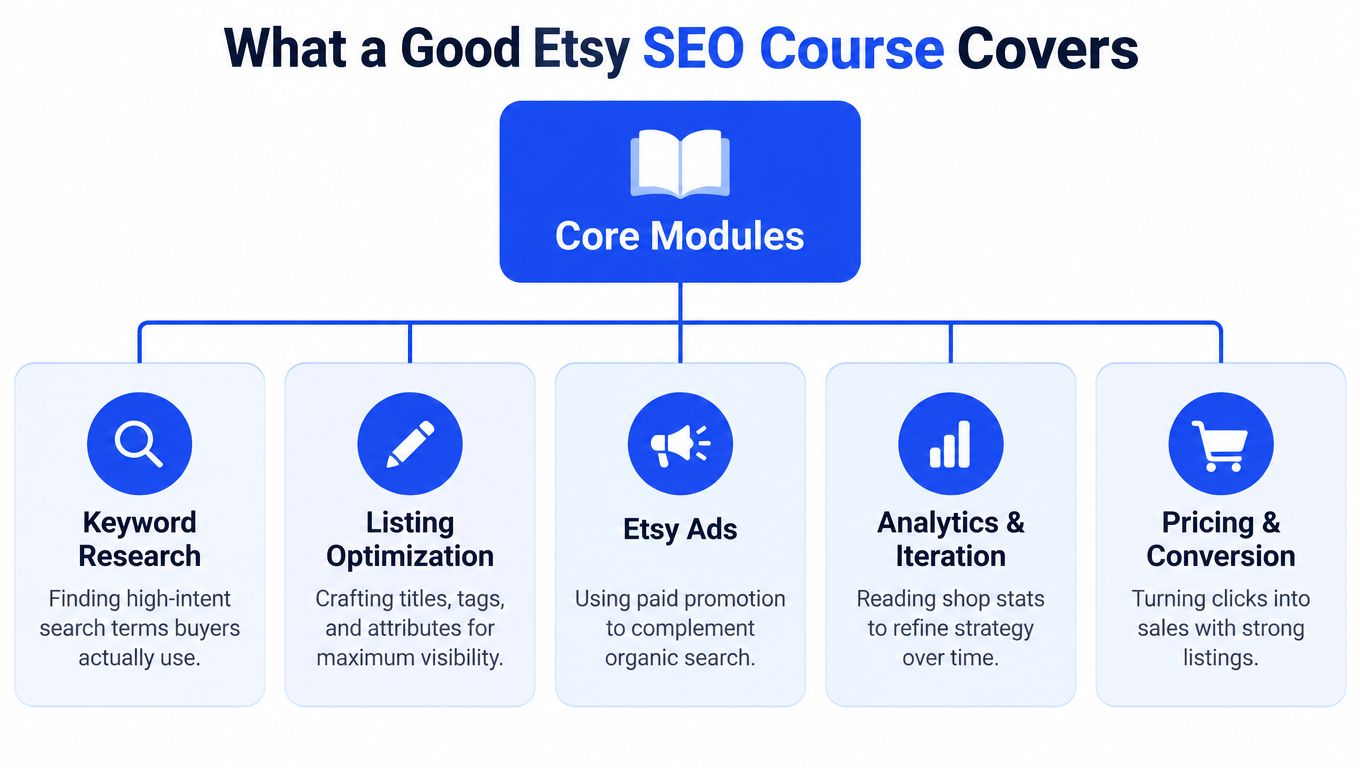
A worthwhile course follows Etsy's documented search framework instead of reducing SEO to tags. It should improve decisions about the product, target phrase, listing, and buyer experience after the click. Judge the training by the actions it teaches, not by how many modules it lists.
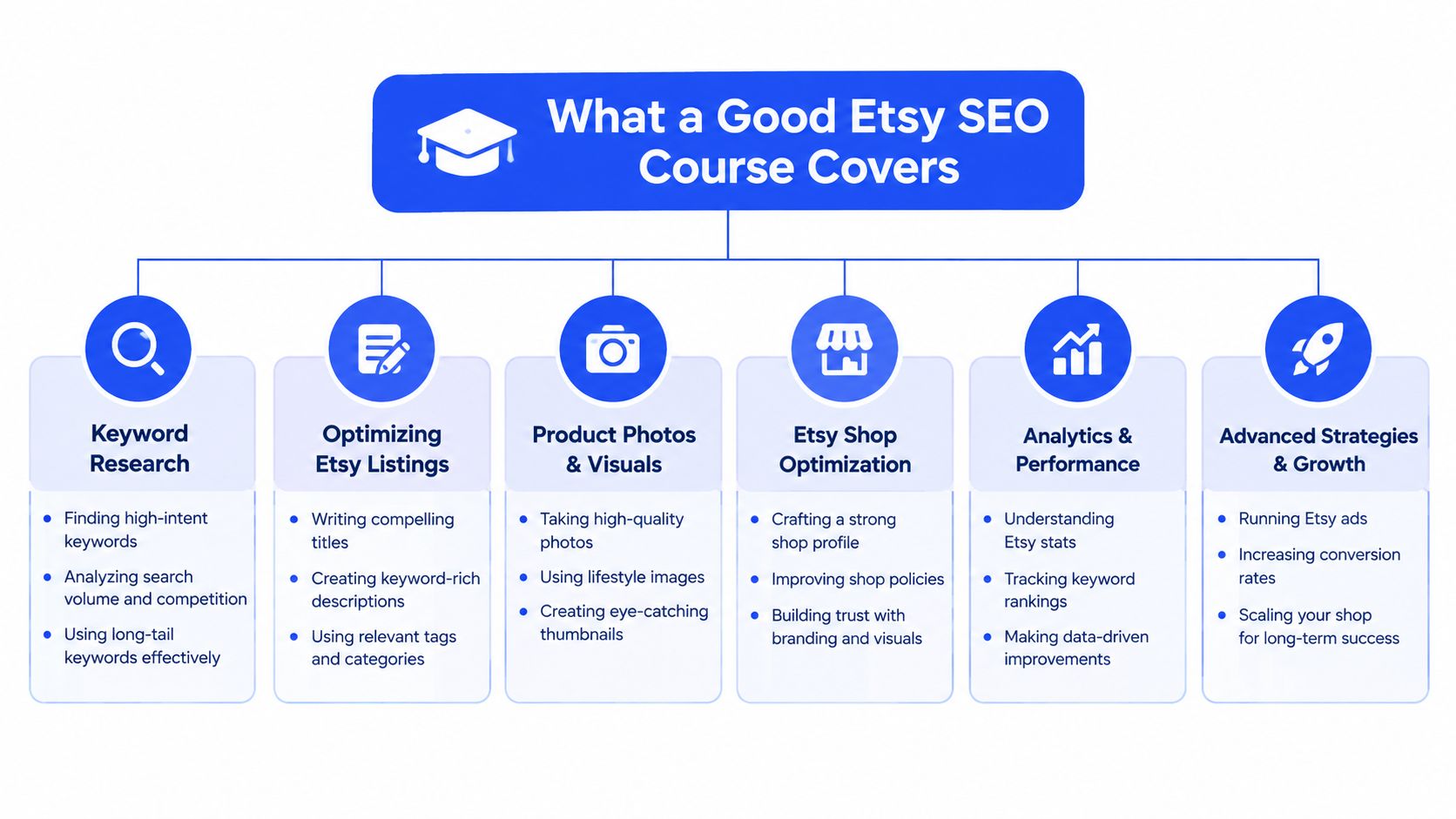
Keyword research should come first, focused on relevance and buying intent rather than the largest available term. The course should teach you to separate broad wording from descriptive multi-word phrases, confirm that the phrase accurately describes the item, and select language that reflects what a buyer may want. It should also show how to build one focused target phrase instead of filling a listing with loosely related words.
Titles and tags need to be readable, specific, and useful to shoppers. Etsy allows up to 13 tags per listing and recommends using all of them, with multi-word phrases written naturally. Etsy's tag guidance explains that attributes can function like tags. A strong lesson therefore covers relevant color, occasion, style, size, and other attributes, rather than treating the title as the only field that matters.
The modules that deserve your money
Categories and attributes: The course should explain how accurate classification helps Etsy interpret the item and match filtered searches.
Listing presentation: Photos, descriptions, price, delivery information, and variations influence whether a visitor feels ready to buy.
Customer experience: Customer-service signals belong in the curriculum, not in a separate afterthought.
Measurement: Learn to track visibility, clicks, purchases, and changes separately. A ranking screenshot is not commercial proof.
Etsy says that increasing conversion rate may improve search ranking. Photography and offer clarity therefore belong in SEO training. A listing can match a phrase and still lose the sale when the first photo creates doubt, the description leaves basic questions unanswered, or the delivery promise does not suit the shopper.
Customer service also belongs in the syllabus. Etsy's search documentation connects placement with recent customer-experience signals. A course that spends hours on tags while ignoring those signals teaches only part of Etsy search.
Reject courses with three warning signs:
Guaranteed ranking language: Keyword placement cannot guarantee universal search position.
A motivation-heavy syllabus: Lifetime access has little value when lessons lack implementation detail.
No conversion or service coverage: This usually indicates a recycled keyword tutorial rather than Etsy-specific training.
The strongest course leaves you with a repeatable operating system. You should know which phrase you are targeting, why it fits, what you changed, how long you will observe the result, and which business outcome matters.
Courses vs Self-Study vs Specialist Services
There are three practical ways to improve Etsy search performance: learn through a structured course, study independently, or hire a specialist for a narrow outcome. None is automatically superior. Each solves a different constraint.
Path | Time Required | Typical Cost | Outcome Type | Skill Built |
|---|---|---|---|---|
Structured course | Steady study and implementation | Paid training | Broader shop improvement | Repeatable SEO process |
Self-study | Flexible, but often slower | Free or low-cost resources | Incremental listing improvements | Research and testing judgment |
Specialist service | Limited seller time | Service fee | Focused result for an agreed listing or phrase | Little direct skill transfer |
A structured course suits a seller who wants ownership of the process. You get a sequence, examples, and often some accountability. The trade-off is time. You still have to research phrases, rewrite listings, improve presentation, answer customers, and watch the data.
Self-study is the sensible route for a careful seller with patience. Etsy's Seller Handbook gives you the platform's own search principles, and listing experiments can teach you how your products behave. The weakness is diagnosis. Beginners often change titles, photos, tags, prices, and shipping information together, then can't tell what caused the result.
A specialist ranking service is narrower. It may target one listing and one agreed phrase rather than teach full-shop marketing. That can suit a seasonal product, a stalled flagship listing, or a maker who would rather spend time producing than studying. It won't automatically improve your photography, product-market fit, customer service, or broader strategy.
Match the path to the constraint
Choose a course if your constraint is knowledge. Choose self-study if your constraint is budget and you can tolerate a slower learning curve. Consider a specialist if your constraint is time and you have one commercially important listing.
A managed service can also be useful when you need outside execution rather than another dashboard to operate. A managed SEO service should still explain its target, measurement method, scope, and limitations before payment.
Don't compare these options only by price. Compare the outcome you receive. A course gives you education, self-study gives you control, and a specialist campaign gives you concentrated implementation. Some sellers eventually use all three, but they shouldn't pay for a broad course when the immediate need is a single, measurable ranking objective.
How to Vet an Etsy SEO Course Before You Pay
Treat the sales page as advertising until the syllabus proves otherwise. A polished promise, a long list of modules, and enthusiastic testimonials don't show whether the course reflects Etsy's current search framework.
Start with the search model. Does the course explain query matching first and ranking second? Does it discuss titles, tags, descriptions, categories, and attributes together? If the lesson reduces Etsy SEO to repeating a phrase in a title, stop there.
Use a practical quality check
Look for these specific elements before buying:
Complete tag guidance: Etsy allows up to 13 tags, and its guidance favors relevant multi-word phrases. The course should explain how to use distinct phrases rather than repeat near-identical terms.
Attribute instruction: It should show how attributes support matching and filtering for details such as color, occasion, size, or style.
Conversion work: Photos, price, delivery expectations, product clarity, and trust signals should appear alongside keyword research.
Service standards: The material should address reviews, message-response behavior, and cases, not just copywriting.
Measurement discipline: You should learn how to record the query, date, location, device, filters, and listing changes before drawing conclusions.
Current policies: Etsy guidance changes, so the instructor should show when lessons were updated and distinguish platform documentation from personal opinion.
A clear refund policy: Know the terms before payment. “Lifetime access” isn't a substitute for satisfaction protection.
Specific shop evidence: Ask whether the instructor can demonstrate recent work on real listings without making unsupported performance promises.
Etsy explicitly says exact keyword matches may improve perceived relevance, but customer-service signals such as review rating, message-response rate, and case rate over the prior three months also influence placement. That sentence should be reflected in the curriculum, not buried in a footnote.
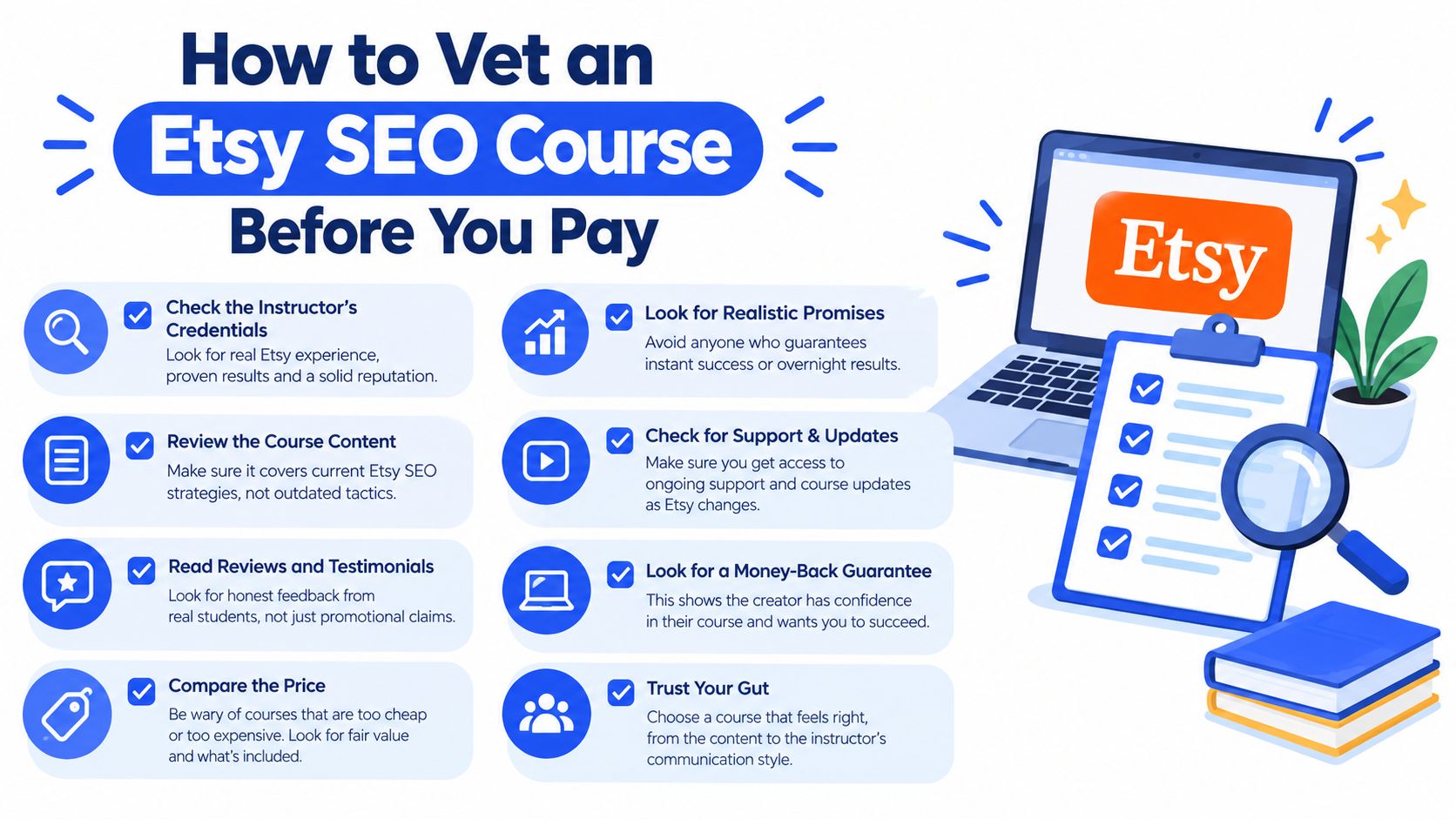
Ask one decisive question before you pay: Will this course help me make and measure a better decision for my shop, or will it only give me more keywords? If the answer is unclear, keep studying free material and request a sample lesson. A trustworthy instructor should be comfortable showing the actual method.
When a Ranking Service Beats Studying
Studying is the wrong trade when you have one priority listing, a narrow selling window, and no desire to become your own SEO operator. In that situation, a focused campaign can make more sense than a broad Etsy SEO course, provided the provider defines the target and the measurement clearly.
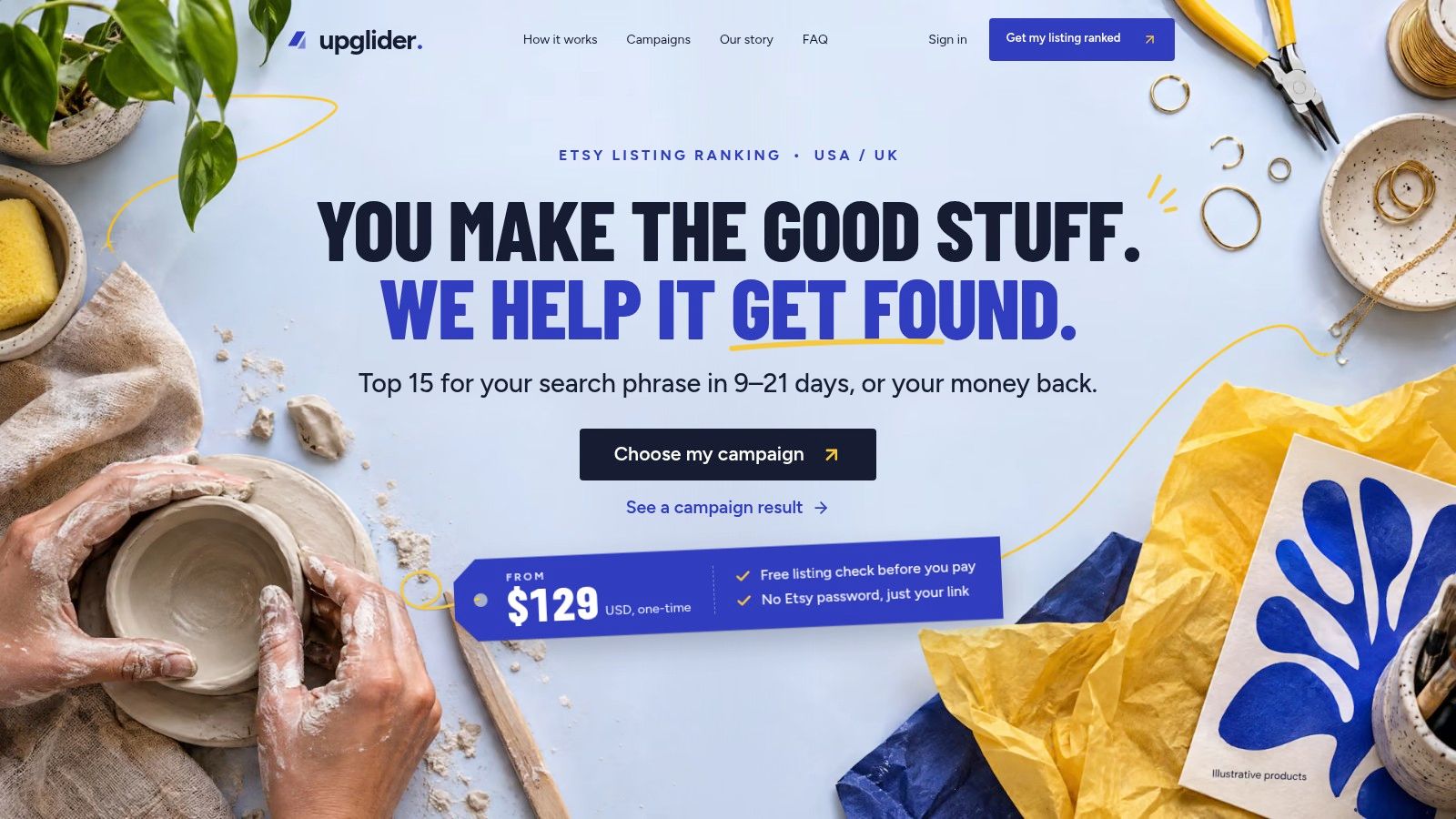
Upglider works as one example of this narrow model. It assesses the listing and phrase before payment, targets a top-15 position for an agreed multi-word query, offers 30, 90, or 180-day campaigns, and doesn't automatically renew. Its published terms describe a target window of 9 to 21 days, with a money-back guarantee if the agreed top-15 result isn't reached within 21 days. The service's published campaign details should be checked before committing because terms can change.
The scope matters more than the promise. The campaign covers one listing and one phrase, not a full-shop marketing program. It isn't an ads-management service, a photography package, or a listing redesign. You still need a product that fits the phrase and a page that can convert the visitors you attract.
How to assess the fit
Use a ranking service only after answering four questions:
Which listing matters most right now? Pick one product, not an entire catalogue.
What exact phrase describes it? The phrase should be specific, commercially relevant, and long enough to represent real intent.
Is the listing ready for attention? Check the first photo, description, price, delivery promise, variations, and customer trust before sending more shoppers.
How will position be measured? Confirm the search context, reporting method, campaign duration, and what happens if the target isn't reached.
A focused service is useful when you value a defined position more than SEO education. It's less suitable when your shop has weak products, unclear positioning, poor customer service, or several listings that need coordinated work.
Don't confuse ranking with business success. Etsy's system considers engagement and customer experience, so a top position can expose a weak offer just as effectively as a strong one. Buy a campaign for a well-chosen listing, not as a substitute for making that listing worth buying.
Picking the Right Path for Your Shop
Choose based on the listing's immediate decision, then run a small test before committing money.
A seller with one handmade wedding sign has a seasonal phrase, strong photos, and a listing that already converts. A specialist assessment or focused ranking campaign may be the practical choice, because the need is a defined search opportunity rather than broad SEO training. The seller should request the target phrase, scope, measurement method, campaign length, and any guarantee in writing.
A different seller has several related products, inconsistent titles, and no repeatable research process. That shop gains more from an Etsy SEO course or guided study. The useful course is the one that makes the seller better at researching phrases, writing listings, measuring results, and improving them. Anything beyond that is marketing.
If neither option fits, pay for a shop-specific review before choosing a course or service. A mentor should examine the actual listings, customer experience, and conversion barriers, then identify the first change to test. Abstract keyword advice will not resolve a weak offer.
Start with one priority listing and one measurable business goal. For the wedding-sign seller, that may mean testing a specific phrase during the buying season. For the growing catalogue, it may mean building a repeatable process across several listings. Pick the route that produces the next useful decision, not the one with the longest curriculum or boldest ranking promise.