You can do everything right on a listing and still feel invisible. The photos are clean, the title sounds polished, the description is thoughtful, and yet the views barely move because your item is sitting in a marketplace where millions of sellers are all trying to win the same glance. That's why Etsy listing help is less about “making it pretty” and more about solving a visibility problem inside a crowded search system.
That shift matters. Etsy reported 5.6 million active sellers and 86.5 million active buyers at the end of 2025, plus about $10.46 billion in gross merchandise sales for the year, which works out to roughly 15 buyers per active seller (Etsy's 2025 results). In a place that busy, one listing doesn't just need to exist, it needs to earn attention.
A lot of sellers hear “listing help” and think it means one thing, usually keywords. In practice, it can mean several different jobs, from search alignment to visual clarity to safer outside promotion. Some of those jobs are technical, some are creative, and some are about protecting your account while you get help from outside your shop.
Practical rule: if a listing isn't getting seen, ask two questions first, is it hard to find, or hard to buy once someone finds it?
That one question keeps you from fixing the wrong problem. A listing with weak search matching needs different help than a listing that gets clicks but doesn't convert. The guide below walks through the difference in plain language, so you can judge any offer for Etsy listing help with more confidence and less guesswork.
Introduction Why Great Listings Still Go Unseen
A seller opens her shop, uploads a handmade candle, writes a careful description, and waits. The product is good, the photos look polished, but the dashboard stays quiet because the listing is buried behind stronger matches, stronger engagement, or both. A beautiful listing can still sit unnoticed if Etsy does not know who to show it to.
The first mistake is treating Etsy listing help like one vague service. It is not. One kind of help improves search matching, another improves click-through, another strengthens trust, and another helps bring in outside attention without handing over account access. If those jobs get mixed together, sellers often buy the wrong help for the problem in front of them.
A better way to read the situation is simple. A listing first enters the search aisle, then keeps its place at eye level, then persuades the shopper to act. Each stage calls for different tools. A title tweak can help with discovery, but it cannot fix weak product photos or a shop that feels unresponsive.
Etsy's own ranking guidance makes that clear. Search depends on relevancy, listing engagement rate, recency, listing and shop quality, customer service quality, shipping, and translations/language (Etsy search and recommendation policy). In plain terms, one listing does not win on keywords alone.
That is why this topic needs a step-by-step explanation instead of a shortcut. The task is separating a listing that is buried from a listing that is seen but does not persuade buyers once they arrive. When you know which problem you are solving, the next decision gets much easier.
How Etsy Search Decides What Shoppers See
A listing can be well made and still get buried if Etsy cannot match it to shopper intent. Search works like a crowded market aisle. The item has to fit the query, earn attention, and keep proving it belongs there. That is the heart of Etsy listing help that changes visibility.
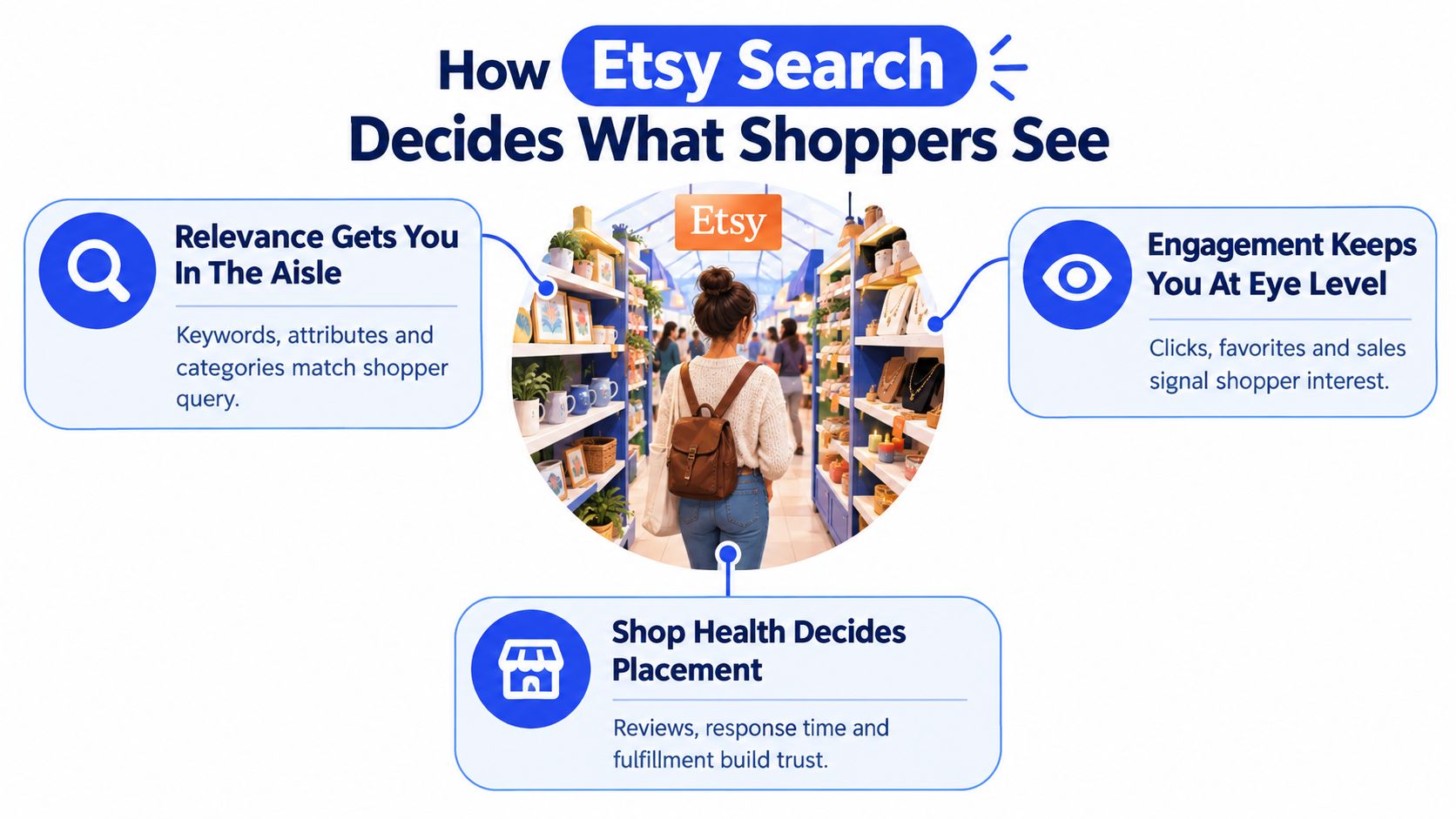
Relevance Gets You in the Aisle
Etsy says search uses relevancy as a core ranking signal, along with listing and shop factors, shipping, and language (Etsy search and recommendation policy). That means title, tags, and attributes help Etsy decide whether a listing belongs in the results for a shopper's phrase. If those pieces do not line up with how people search, the listing starts out behind.
Many sellers focus on a single keyword and leave the rest thin. A title can help a listing get considered, but it cannot do all the work alone. If the product page does not match the search intent, Etsy has little reason to keep showing it.
Engagement Keeps You at Eye Level
Etsy also weighs listing engagement rate. Clicks, favorites, and purchases shape how prominently a listing can remain positioned for a query, as the Etsy search and recommendation policy explains. Search visibility depends on more than first discovery, it also depends on sustained shopper interest.
A listing with decent keywords but weak photos can stall for that reason. The system sees what shoppers do after they arrive. If they click away quickly, or never click at all, the listing loses ground in a busy aisle.
Shop Health Decides Placement
Etsy also includes listing and shop quality in search, and shop-wide signals from recent activity matter too. The Etsy seller handbook points to average review rating, message response rate, and case rate, along with the core page elements, item title, description, images, and video. Search is never only a keyword check.
A listing sits inside a shop, and Etsy reads both together.
New listings get a short temporary boost so Etsy can learn how buyers respond, and renewed listings get a similar but smaller boost (Etsy search and recommendation policy). That early lift helps the system test the item. It does not replace relevance or engagement, and it fades if the listing does not earn interaction.
For a beginner-friendly overview of the basics, this guide to what Etsy SEO is is a useful companion read.
The Four Jobs Behind Effective Etsy Listing Help
A good listing can fail for four different reasons, and each one needs a different fix. One seller needs better search matching. Another needs stronger photos. Another needs clearer copy. Another needs outside visibility that brings shoppers in without risking the account.
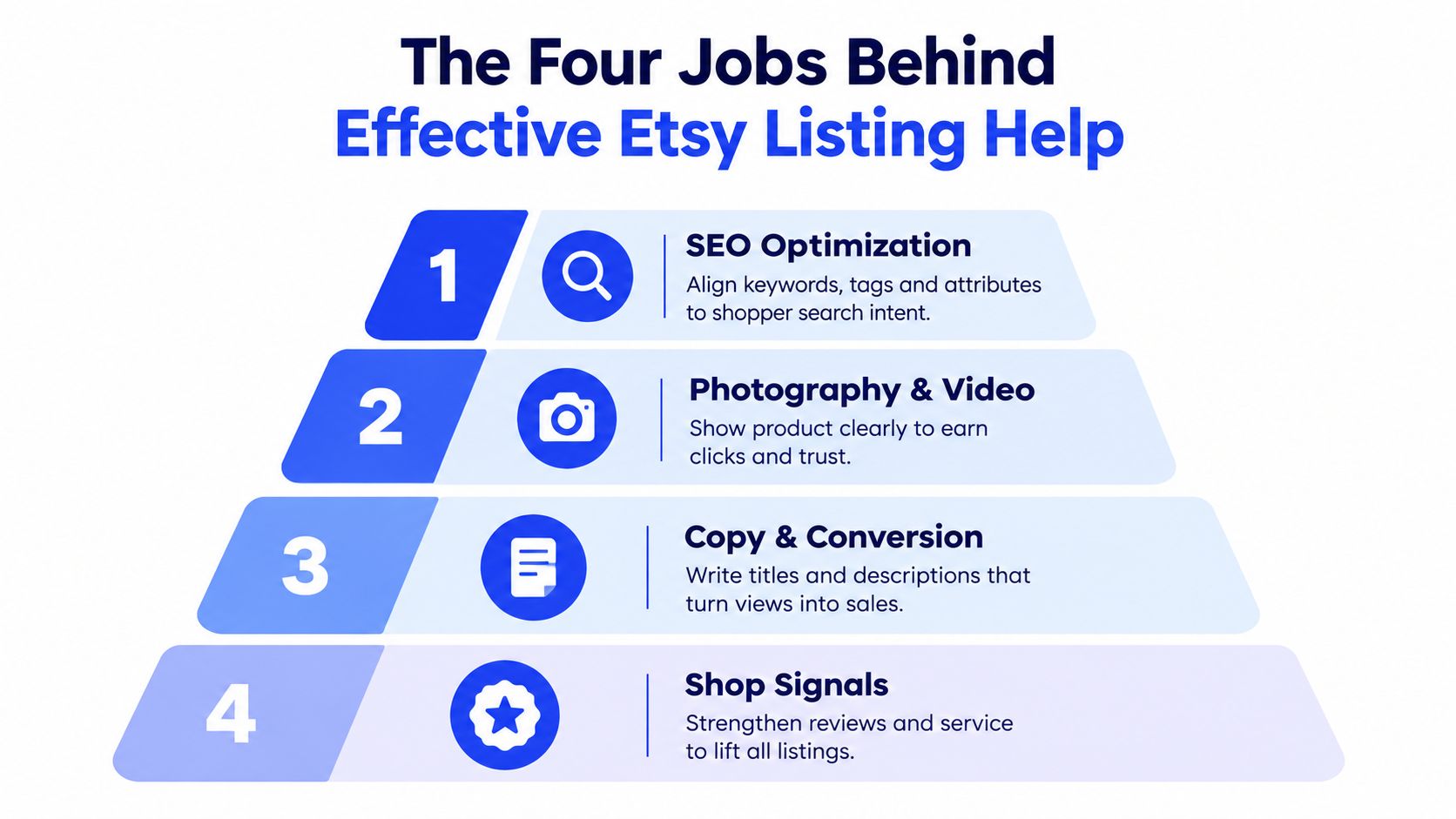
SEO Optimization
This is the job many think of first. It means aligning keywords, tags, categories, and attributes with how shoppers search. A handmade mug titled only with a cute collection name won't help Etsy understand the product, but a clear title can.
SEO is not about stuffing in every related phrase you can think of. Etsy's own guidance says listing optimization depends on item title, description, images, and video, which means relevance and presentation have to work together (Etsy seller handbook). A search phrase gets the listing considered, but the rest of the page has to carry the shopper forward.
Photography and Video
Photos and video do more than look nice. They help earn the click and build trust once someone opens the listing. A printable might need a clean mockup, while a ceramic mug may need close-up texture shots, scale, and a short video showing the glaze in light.
Many listings lose attention here. Buyers can't touch the product, so they use the visuals as a substitute for handling it. If the images are vague, dark, or cluttered, the shopper leaves before the copy even gets a chance.
Copy and Conversion
Copy is where the listing starts feeling clear instead of generic. The description should answer what the item is, who it's for, what comes with it, and what the buyer should expect. Good copy removes hesitation.
A handmade candle listing, for example, might be found through a search phrase about gift ideas, but the description still has to tell the buyer about scent profile, size, use, and shipping expectations. The page must turn interest into confidence.
Shop Signals
Shop signals are the trust layer. Review quality, response habits, and service consistency all influence the way listings are read by buyers and by Etsy's system. A listing can't carry a shaky shop forever.
For a shop selling a handmade mug, that means the listing is only part of the job. If the customer service is slow or the shop feels inactive, the listing has to work harder to overcome doubt.
If you want an example of a service that focuses on a single listing and a single search phrase, one option in the market is Upglider's Etsy SEO service, which is built around ranking a chosen listing rather than broad shop marketing.
How to Get External Help Without Sharing Account Access
The safest outside help is the kind that can work from a public listing URL and a search phrase. If someone needs your password just to review a listing, that's a red flag. If they ask to edit your shop directly when the task is supposed to be external promotion, that's another red flag.
Etsy's account-safety guidance says sellers should use stronger security practices, and its fraud-help guidance tells users who suspect compromise to change their password and enable two-factor authentication (Etsy account safety and privacy). That's a clear signal that password sharing isn't part of routine legitimate help.
Safe vs Risky External Help Checklist
What to Check | Safe Signal | Risk Signal |
|---|---|---|
Access required | Only a public listing URL and agreed keywords | Passwords, login codes, or full account access |
Scope of work | External promotion or listing analysis | Unclear edits inside your shop manager |
Measurement method | A disclosed way to track ranking or visibility | “Trust us” with no measurement details |
Security posture | Mentions account safety, two-factor authentication, and no password sharing | Dismisses security concerns or asks you to bypass them |
Payment terms | Clear campaign length and renewal terms | Auto-renewals hidden in fine print |
A clean provider should be able to explain the work without touching your account. They should also tell you how they measure progress before you pay. If they can't explain those two things, keep looking.
Practical rule: if the work is about visibility, the provider should need visibility data, not your login.
That's especially important if you're outsourcing help because you're busy, not because you've given up control. A legitimate external service can review the page, work from the public link, and report back without ever asking for your password. That keeps your shop secure and your options open.
What a Focused Ranking Campaign Should Deliver
A narrow ranking campaign should feel specific, like tuning one radio station instead of trying to scan the whole dial. It should focus on one listing and one search phrase, with a clear way to measure progress and a defined end point.
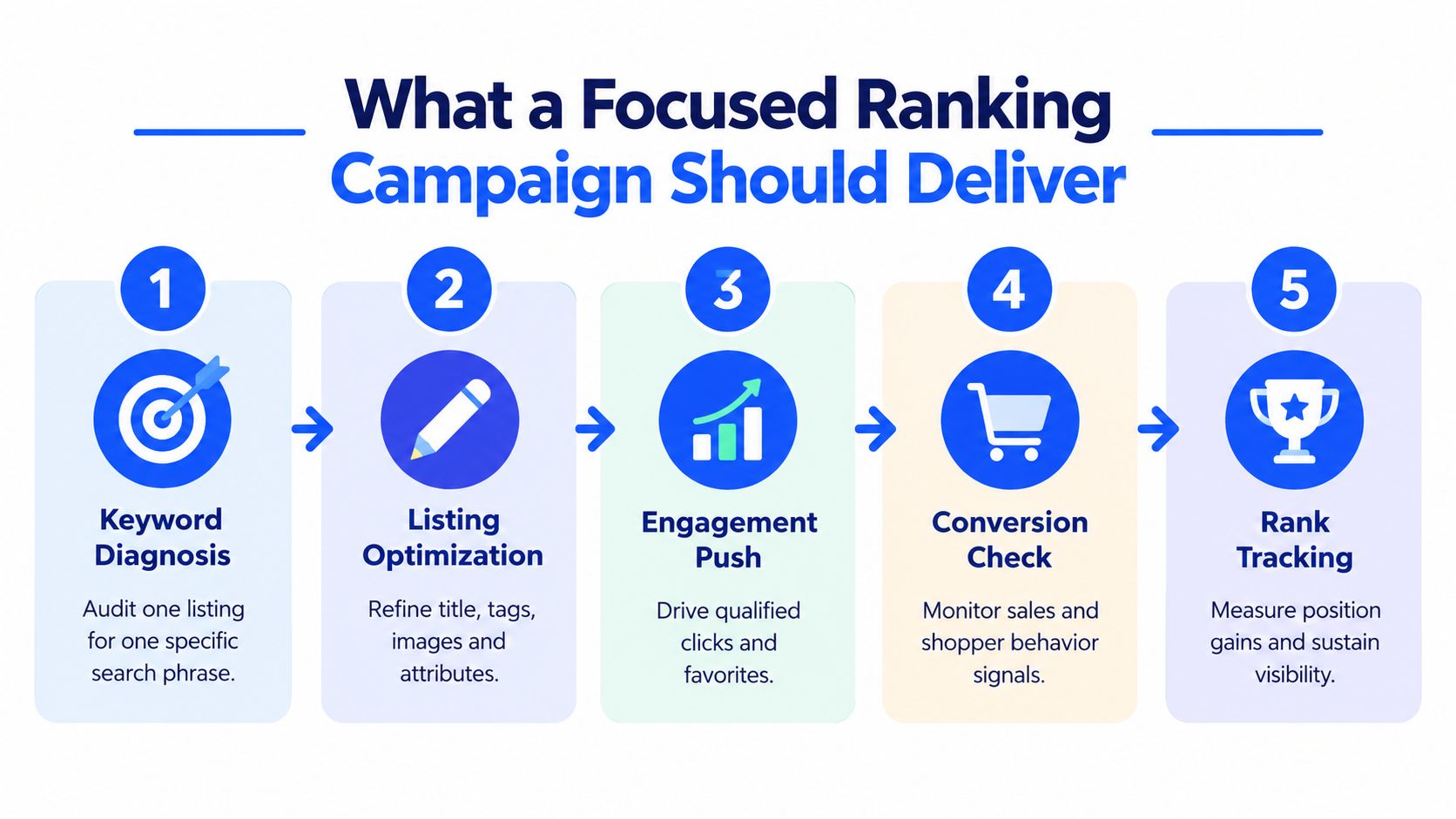
Start With a Case Assessment
Before money changes hands, the listing and phrase should be checked for fit. The question is simple: does the search phrase match the item, does the page have enough detail to compete, and is the target realistic for the shop? Without that review, you are guessing.
A good assessment also helps avoid phrases that are too broad or too short. The strongest candidates usually describe buyer intent clearly, so the work has a fair chance of showing a result.
Expect a Defined Campaign Window
A focused campaign should have boundaries. Clear start, clear finish, and clear reporting points give you a record of what was done and when.
The exact length matters less than the structure. If a provider cannot tell you when the campaign begins, when updates arrive, and when the work ends, the offer is too loose to judge.
Look for Transparent Tracking
You want step-by-step updates, not a mystery box. A status dashboard, progress notes, and a disclosed ranking method help you check the work instead of just hoping it helped.
For a practical example of how a modest campaign can be structured, this guide to what an affordable Etsy SEO campaign should include is useful because it keeps the focus on one listing, one phrase, and a fixed period.
Treat Add-Ons Carefully
Extra keywords should be priced separately and explained plainly. If a provider says every variation is included with no limit, ask how they decide which phrases get attention. Scope matters, and unclear scope usually creates confusion later.
A focused campaign should tell you what it is doing, why it chose that listing, and how success will be measured before you pay.
That is the standard. If the offer feels fuzzy, the result will probably feel fuzzy too.
Why Your Shop Health Shapes Every Listing Result
A listing does not stand alone. Etsy looks at shop-wide trust signals too, so even a strong product page depends on the shop around it. Reviews, message habits, and steady service all affect how ranking work performs.
The seller handbook notes that recent shop-quality factors include average review rating, message response rate, and case rate. Those signals sit beside the listing itself, which is why a page can look polished and still struggle if the shop feels unstable.
The encouraging part is that shop health usually comes from a few steady habits, not a full rebuild. Reply to messages promptly. Ship on time. Keep policies clear. Show the kind of consistency that tells buyers the shop is cared for.
A handmade seller does not need to become a customer service machine. Clear communication and reliable fulfillment reduce hesitation, while confusion or delay makes buyers pause. That trust helps the listing do its job in a crowded marketplace.
Choosing the Right Etsy Listing Help for Your Next Step
A new shop often has a simple problem, buyers have not yet had a reason to stop and click. A stalled flagship item points to a different problem, the listing may be getting seen, but it is not carrying enough weight to keep momentum. A seasonal launch needs help that is focused, quick, and tied to one clear target.
The right support depends on the bottleneck you are trying to clear. A shop with weak search alignment needs different help than a shop with steady traffic and low conversion. If you want outside ranking help, security and measurement matter just as much as visibility.
Etsy's scale makes that choice feel sharper. The marketplace had 5.6 million active sellers and 86.5 million active buyers at the end of 2025, with about $10.46 billion in gross merchandise sales that year, according to Etsy's 2025 results. In a market that large, attention is limited, so every clear signal has to do its job.
Before you hire anyone or change a listing, use a simple filter.
Define the problem: Decide whether the listing is hard to find, hard to trust, or hard to buy.
Choose one target: Pick one listing and one search phrase before you seek outside help.
Ask about access: Confirm that no password or account login is needed.
Ask about measurement: Get the ranking method and reporting format in writing.
Check the timeline: Make sure the campaign has a clear start and end, with no hidden renewal.
Protect the shop: Keep your security settings current and enable stronger protection if needed.
That filter keeps the work grounded in the issue, not in a vague promise. If you want to compare a narrow ranking approach with broader sitewide services, start with this overview of ecommerce SEO service options and choose the path that matches your shop's actual problem.