You're probably looking at two SEO quotes right now that cost roughly the same and sound equally convincing.
One promises sitewide growth, technical fixes, content, and “authority building.” The other promises to push a specific listing or product page higher for a defined search term. Both call themselves an ecommerce SEO service. Only one is likely to fit what you need.
That mismatch is where sellers waste money. They buy a broad retainer when they really need a focused ranking push on a small number of SKUs. Or they buy a listing campaign when the problem sits in crawl issues, weak category pages, or missing schema across the store. The service isn't bad. The shape is wrong.
Organic search still carries serious weight in ecommerce. Similarweb's 2025 benchmark says organic search accounts for 23.56% of ecommerce website traffic, while other industry summaries report 43% of ecommerce traffic and 23.6% of ecommerce orders, with organic and paid search together contributing 65% of sessions (ecommerce search benchmarks collected here). If you improve visibility in the right place, you're not just chasing vanity traffic. You're affecting discovery and purchase volume.
Why Comparing Ecommerce SEO Service Models Matters Before You Sign
Most buyers compare providers the wrong way. They compare agencies against freelancers, or monthly price against monthly price. That's not the decision. The decision is scope.
One service model works at the listing level. It tries to improve visibility for a single product, SKU, or marketplace listing against a specific query. The other works at the store level. It fixes technical problems, improves collections and product pages across the domain, and tries to grow organic revenue across the catalog.
If you miss that distinction, the reporting will confuse you fast. A listing service can show ranking movement for one term and still do nothing for your store's wider search performance. A generalist retainer can improve indexation, schema, and category visibility while your favorite hero SKU still doesn't move right away.
What buyers usually get wrong
They assume “SEO” is one service with slightly different packaging. It isn't.
Use this early filter before you sign anything:
Buying question | If the answer is yes | Better fit |
|---|---|---|
Are you trying to move one important listing quickly? | One SKU matters more than the rest right now | Platform-specific listing service |
Do you sell mainly on Etsy, Amazon, or another marketplace? | The platform controls the SERP and listing rules | Platform-specific listing service |
Is your own store underperforming across many pages? | The problem isn't isolated to one item | Generalist ecommerce SEO retainer |
Are technical issues, schema, and category pages part of the problem? | You need sitewide fixes | Generalist ecommerce SEO retainer |
Practical rule: If your revenue depends on a handful of listings, buy focused ranking help. If your revenue depends on search visibility across the catalog, buy a storewide program.
The good news is that this is fixable if you catch it early. Most underperforming engagements aren't doomed because the provider is fraudulent. They fail because the service scope doesn't match the storefront.
The Two Main Ecommerce SEO Service Models Explained
There are only two service shapes that matter here. Everything else is packaging.
Platform-specific listing service
This model is narrow by design. The provider works on individual listings inside a marketplace or platform environment such as Etsy, Amazon, Faire, or an app marketplace. The goal is usually simple: improve the position of one listing or a small batch of listings for agreed search phrases.
Typical work includes keyword targeting per listing, title rewrites, tag or attribute cleanup, listing-level testing, and rank tracking inside that marketplace.
A concrete deliverable example looks like this: the provider takes one Etsy listing, targets one agreed multi-word search phrase, adjusts the listing inputs that affect relevance, then tracks whether that listing moves into stronger placement for that term.
Etsy's own search policy supports why this model exists. Etsy says visibility is driven mainly by relevancy, listing engagement rate, and recency, and relevant keywords in tags, titles, descriptions, categories, and attributes help a listing appear (Etsy ranking factors summarized from Etsy's guidance). Etsy also states that exact keyword matches may rank higher, and renewed or new listings can receive a temporary boost lasting from a few hours to a few days depending on demand (Etsy search, advertisement, and recommendation policy).
Generalist ecommerce SEO retainer
This model is broad. The provider works across the entire storefront and usually focuses on Shopify, WooCommerce, BigCommerce, Magento, or custom DTC sites.
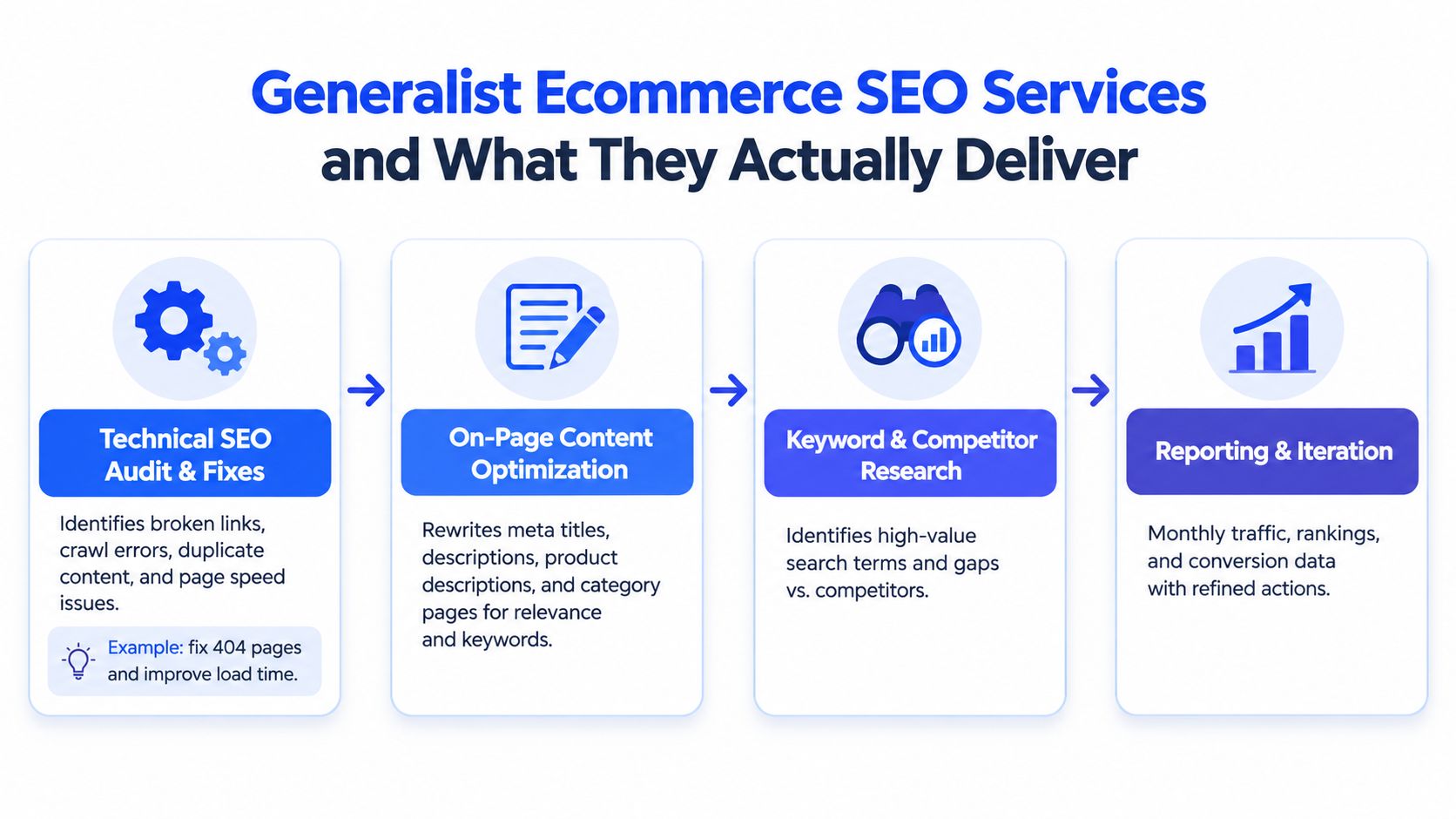
The deliverables are different from the start: technical SEO audits, indexation fixes, product and category page optimization, internal linking, structured data deployment, and content that supports category and buying intent.
A concrete example looks like this: the provider audits crawl waste, fixes duplicate or weak pages, adds product schema, improves collection page copy, and builds search-focused buying guides that support category rankings.
Here's the basic workflow most generalist programs follow:
If you want a plain-language breakdown of what falls under storewide work, this guide on what ecommerce SEO services actually cover is a useful reference.
The split is about scope, not talent
Don't make the mistake of thinking one model is “advanced” and the other is “basic.” Good practitioners exist in both.
The difference is the unit of success:
Listing service: per-listing rank, impressions, listing traffic
Generalist retainer: sitewide organic sessions, indexed pages, category visibility, organic revenue
That's why so many proposals feel comparable when they aren't. They solve different problems.
Side by Side Comparison of Scope Deliverables Timelines and Guarantees
A buyer should compare these service models the same way they compare fulfillment partners or ad channels. Line by line. Not by vibe.
Platform-Specific vs Generalist Ecommerce SEO Service Comparison
Criteria | Platform-Specific Listing Service | Generalist Ecommerce SEO Retainer |
|---|---|---|
Scope | One listing, one SKU, or a small batch inside a marketplace | Whole storefront across product, category, and technical layers |
Deliverables | Title edits, tags, attributes, listing keyword tests, listing-level rank reports | Technical audit, schema rollout, category and product optimization, content, internal linking, reporting |
Timelines | Short sprints tied to listing movement and maintenance | Longer cycles because fixes, indexing, and content need time to compound |
Guarantees | Often tied to a ranking window or defined placement target | Should focus on deliverables and process, not hard ranking promises |
Measurement | Marketplace ranking dashboard, listing-level traffic, search term tracking | GA4, Search Console, indexed page health, page-level and category-level performance |
Timelines aren't interchangeable
A listing service often operates like a campaign. It can target one phrase, one product, and one platform-specific result set. That narrower job allows tighter reporting and faster visible movement. Buyers get misled.
A generalist retainer usually works in cycles because storewide SEO depends on technical implementation, recrawling, internal link redistribution, schema validation, and content indexing. That work compounds, but it doesn't behave like a single-keyword sprint.
The seller who wants one seasonal hero product to rank soon shouldn't buy the same service as the brand trying to clean up a 5,000-product Shopify catalog.
Guarantees need context
A money-back clause can make sense in a narrow listing campaign because the target is defined in advance. A broad retainer promising rankings or revenue on a fixed schedule is where I get skeptical.
You should read any SEO guarantee the same way you'd read a paid media performance promise. Ask what's guaranteed: work output, ranking position, traffic, or revenue. Those are not the same.
If you're reviewing guarantee language, look at how guarantee terms should be framed and limited and compare that against what your provider is promising.
Reporting cadence is where the models diverge hardest
A platform-specific pitch often looks more impressive because the reports are tighter. Daily position checks. Search phrase tracking. Listing screenshots.
That reporting can be useful. It's also almost useless for diagnosing why a standalone store isn't indexing category pages or why product schema is broken. The reverse is also true. Search Console and GA4 reports won't tell an Etsy seller much about listing recency, exact-match phrasing, or listing-level engagement shifts inside Etsy search.
Different service shape. Different instrumentation.
Platform Specific Ecommerce SEO Services and What They Actually Deliver
Platform-specific work is SKU work. If a provider can't tell you exactly what they're doing to a listing, they're probably not doing much.
What a serious listing campaign includes
At minimum, the provider should define the listing, the target phrase, and the baseline position before work starts. Then the actual deliverables should be concrete.
Platform-Specific SEO Service Deliverables by Component
Deliverable Component | What Provider Produces | Typical Measurement |
|---|---|---|
Keyword targeting | One agreed search phrase or a small mapped set of phrases for one listing | Baseline and ongoing rank checks for those phrases |
Listing copy refinement | Revised title, tags, attributes, and description alignment | Position change and listing discovery for target terms |
Listing metadata cleanup | Category, attributes, and relevance inputs corrected | Better match quality against query intent |
Listing media support | Image naming, alt text, and presentation guidance where the platform allows | Indirect lift through stronger listing relevance and engagement |
Reporting | Listing-level dashboard or periodic ranking updates | Placement trend, impressions, and listing traffic where available |
What good measurement looks like
The best providers define success before they invoice. They say which keyword they're tracking, which geography or marketplace context matters, and how position is checked.
Weak providers hide behind vague words like “exposure,” “boost,” or “visibility.” Reject that immediately if there's no keyword baseline attached. “Visibility” without a tracked phrase is just sales language.
Independent benchmark data also shows why position tracking matters so much. The first organic position typically captures about 27.6% CTR, compared with 15.8% for position two and 11.0% for position three (benchmark summary on click concentration). If a provider is selling ranking movement, they need to show ranking movement clearly.
Where this model pays off
This model works best when one listing matters more than the rest. Common examples:
Seasonal push: You need a holiday, wedding, or event-driven item visible during a narrow sales window.
New listing launch: You want early exposure on a fresh product before buyer history exists.
Marketplace-only seller: You don't need a sitewide SEO retainer because you don't depend on your own domain for search traffic.
Test before broader investment: You want proof that a specific product has search demand before expanding inventory.
One example in this category is Upglider, which runs one-time Etsy ranking campaigns for a single listing and a single agreed search phrase, with a top-15 objective and defined campaign lengths rather than a broad shop retainer.
What to reject
Don't buy a listing campaign if the provider won't answer these questions:
Which phrase is being tracked
What counts as success
How long the ranking needs to hold
Whether reporting is marketplace-native, third-party, or manual
What happens if the target isn't reached
If those answers are fuzzy, the service is fuzzy.
Generalist Ecommerce SEO Services and What They Actually Deliver
Generalist retainers are where most ecommerce brands should spend SEO budget once the problem is bigger than one listing. This model wins when search performance depends on the store's structure, speed, indexing, schema, and category depth.
The core deliverable stack
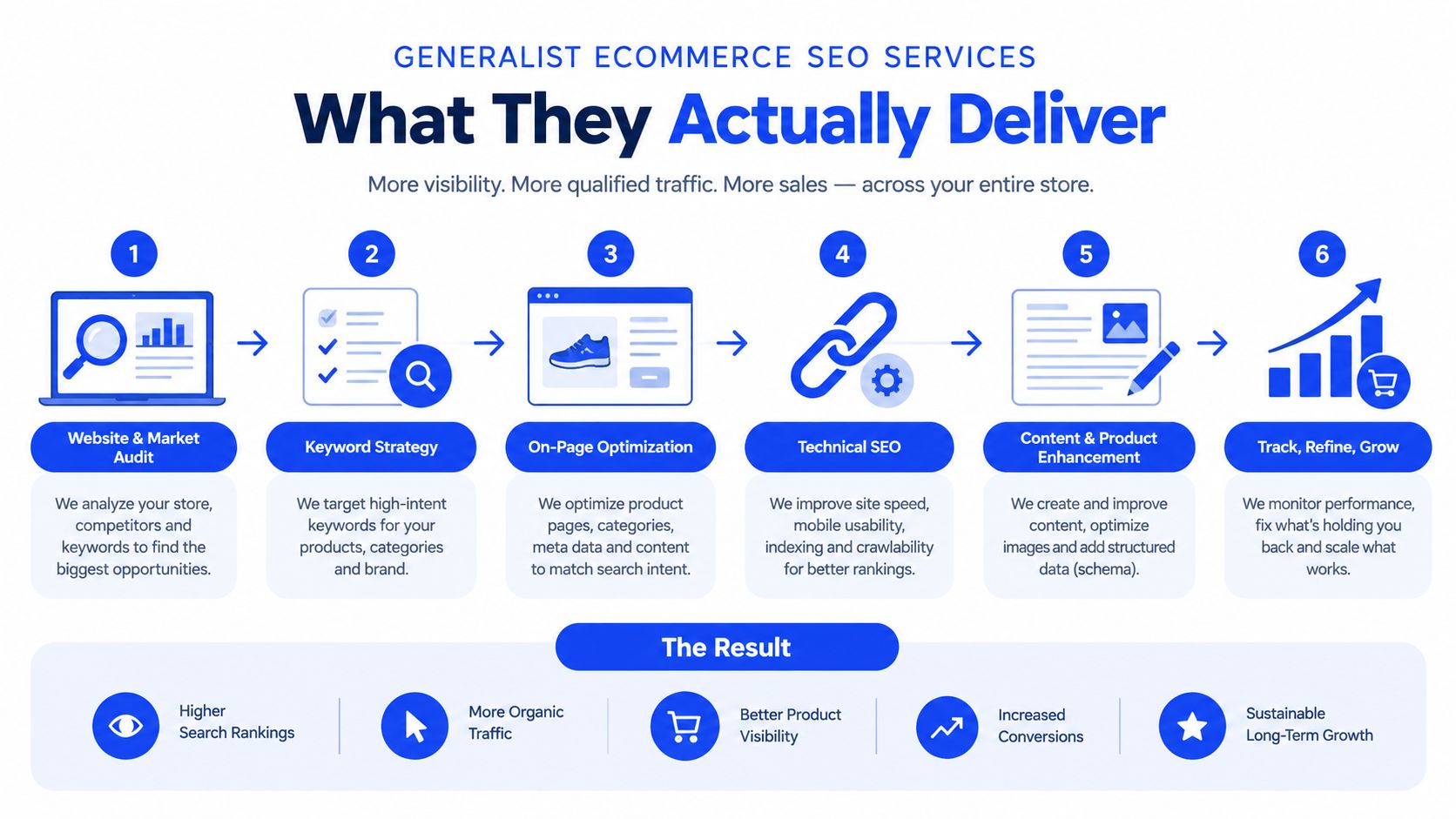
A proper storewide ecommerce SEO service should cover the technical layer first, because weak plumbing makes every later deliverable less effective.
That usually means crawlability, indexation control, canonical handling, duplicate page cleanup, page speed work, and mobile performance review. On revenue pages, product and category optimization follows. Then structured data, internal links, and supporting content.
Benchmarks back up the revenue angle here. Ecommerce organic conversion rates typically sit around 1.8% to 4.2%, with richer product schema and faster mobile load times clustering at the upper end (ecommerce conversion and technical SEO benchmark summary). Google-focused ecommerce guidance also targets LCP under 2.5 seconds and INP under 200 ms, while click-through rate falls sharply by ranking position, with the #1 organic result averaging about 27.6% CTR, #2 about 18.7%, and #3 about 10.2% (CTR and performance guidance summary).
Here's the general workflow visually:
What monthly work usually includes
A real retainer usually covers several streams at once:
Technical maintenance: fixing crawl errors, duplicate paths, weak canonicals, and indexing problems
On-page optimization: improving category templates, product titles, descriptions, headings, and metadata
Schema deployment: product, breadcrumb, review, and related structured data where relevant
Content support: buying guides, comparison pages, and category support pages that help transactional pages rank
Internal linking: strengthening pathways between categories, products, and supporting content
What's often excluded
This catches buyers all the time. Many retainers do not include development hours for deep theme changes, replatforming, paid media management, feed optimization, or CRO testing unless stated directly.
Ask what happens after the audit. If the provider identifies a technical issue, do they implement the fix, brief your dev team, or just put it in a slide deck? Those are very different outcomes.
Buy deliverables, not diagnoses. A beautiful audit with no implementation path is expensive paperwork.
Why this model has changed
A lot of outdated SEO retainers still overemphasize blog output. That's weak ecommerce strategy. Recent industry commentary on AI search and richer product SERPs points in a different direction: generic informational clicks are getting squeezed, and ecommerce SEO needs tighter product and category execution, stronger structured data, trust signals, and measurement beyond classic blue-link ranking (industry analysis on ecommerce SEO adapting to AI-driven SERPs).
For ecommerce stores, that means the retainer should be product-led and category-led first. Content still matters, but it should support buying intent, not distract from it.
Marketplace Listings vs Standalone Stores Which Service Model Wins
The answer is usually obvious once you stop pretending Etsy and Shopify behave the same way. They don't.
Service Model Fit by Storefront Type
Storefront Type | Best-Fit Service Model | Primary Reason | Watch Out For |
|---|---|---|---|
Etsy shop | Platform-specific listing service | Search performance depends heavily on listing-level relevance and engagement inputs | Paying for broad “brand SEO” that doesn't move listing placement |
Amazon seller account | Platform-specific listing service | Catalog visibility is tied to listing optimization and marketplace mechanics | Providers who talk mostly about Google SEO |
eBay or similar marketplace seller | Platform-specific listing service | Marketplace search rules dominate discoverability | Reporting that doesn't isolate listing-level performance |
Shopify or WooCommerce store | Generalist ecommerce SEO retainer | Technical health, category structure, schema, and domain authority shape outcomes | Thin retainers that only produce blog posts |
Hybrid brand with marketplace and DTC store | Split budget by channel | Different search systems require different work | One provider claiming the same service covers both equally well |
Marketplace sellers should lean narrow
If your sales live inside a marketplace, buy the service that works at the listing level. That's where control exists. Etsy is the clearest example. Exact-match relevance, listing engagement, categories, attributes, and recency all influence where a product shows up. That means a focused campaign can target one listing with clear intent and measurable rank movement.
This is especially useful for new shops, seasonal launches, and hero products that need visibility now rather than a broad education in search strategy.
Standalone stores should lean broad
If your business depends on Shopify, WooCommerce, BigCommerce, or a custom DTC site, the broad retainer usually wins. Your rankings aren't determined by listing fields alone. They're shaped by crawlability, collection architecture, Core Web Vitals, internal links, schema, and how much authority the domain has built around the category.
A newer industry summary illustrates the compounding effect of broad organic coverage: the average ecommerce brand ranks for 1,783 organic keywords and gets an estimated 9,625 monthly visits from organic search alone (ecommerce keyword and traffic benchmark summary). That's why broad storewide optimization often outperforms SKU-by-SKU thinking on owned sites.
The hybrid case needs budget separation
Brands selling on both Etsy and a DTC store often make a messy mistake. They hire one provider and expect one dashboard to tell the full story.
Don't do that. Split the budget by channel objective:
marketplace budget for listings you need to move
DTC budget for category, product, and technical SEO on the main store
Those are separate systems. Treat them that way.
How to Evaluate Any Ecommerce SEO Service Before Paying
Most proposals can be judged in ten minutes if you know what to look for.
Check the proof against your situation
The provider should show work on stores or listings similar to yours in platform, catalog size, and search reality. A marketplace case example doesn't validate a Shopify retainer. A content-heavy DTC case example doesn't validate an Etsy ranking campaign.
Look for proof that matches your operational context, not just your product niche.
Demand named deliverables and a timeline
If the proposal says “ongoing optimization” without naming what gets delivered, push back. You need a list.
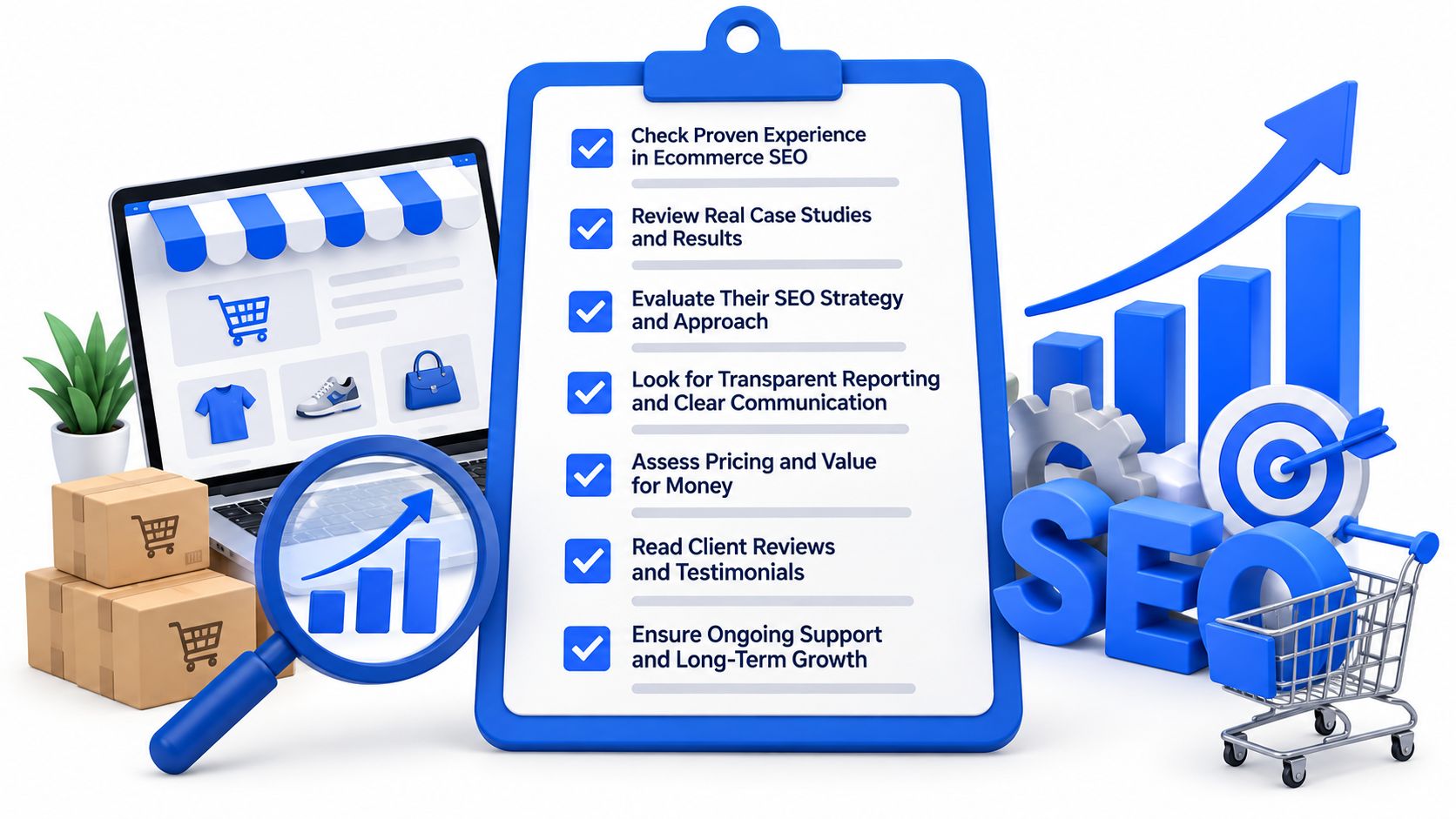
Use this checklist:
Deliverables named clearly: titles, tags, schema, technical fixes, category rewrites, internal links, content assets
Timeline attached: when the audit lands, when changes start, when reporting begins
Measurement defined: what counts as a ranking, a session, or a successful campaign
Ownership terms stated: who owns the content, edits, and acquired assets
Exit protection included: refund, stop clause, or defined review point if month-one work misses the agreed output
This visual checklist is a good standard to use while reviewing proposals:
You can also compare your shortlist against this practical guide on what ecommerce SEO services cover and how to choose a provider.
Know the red flags
These are the patterns I'd reject first:
Screenshot-only proof: easy to cherry-pick, hard to verify
Package names without outputs: “Growth,” “Accelerate,” and “Scale” don't mean anything
Revenue guarantees on full-store SEO: not credible
No baseline measurement: impossible to judge success
One-size-fits-all language: usually means the provider doesn't understand your platform
If the provider can't define the work before payment, they'll hide behind ambiguity after payment.
My blunt recommendation
If you're a marketplace seller with a small catalog and one or two listings matter most, default to a focused listing-ranking campaign first.
If you run a standalone store and the issue spans categories, technical performance, schema, and site architecture, hire a generalist retainer that includes actual technical SEO. Not just keyword research and content briefs.
Common Questions Buyers Ask After Comparing Ecommerce SEO Services
Are Etsy SEO, Amazon listing optimization, and Shopify SEO basically the same thing
No. They share keyword research fundamentals, but they're different service tracks in practice. Etsy and Amazon work inside marketplace search systems. Shopify SEO depends on your own site's technical health, category depth, and domain authority.
How long should results take
For listing campaigns, movement on individual products can happen faster because the scope is narrow and the target is explicit. For storefront-wide SEO, results usually take longer because implementation, recrawling, and index changes need time.
A recent ecommerce-focused industry discussion also argues that buyers should judge some SEO investments at the page or query level, not only by full-shop growth, especially for launches, low-authority pages, and seasonal listings (analysis of focused page-level ecommerce SEO work).
Should I trust guarantees
Trust narrow guarantees more than broad ones. A listing service can reasonably define a position target and a review window. A full-store retainer promising specific rankings across the board is usually overselling.
Also protect your account. If you're using a marketplace service, favor providers that don't require login access where possible. Etsy's own security guidance emphasizes optional two-factor authentication, and its sign-in security code flow expires quickly if not entered within five minutes (summary of Etsy account security guidance).
If you're choosing between two SEO quotes, stop comparing provider labels and start comparing service shape. Buy a listing campaign when one SKU needs to move. Buy a generalist retainer when the whole store needs stronger search infrastructure. That decision matters more than the logo on the proposal.