You've photographed your products, written careful descriptions, and opened your Etsy shop. Then the first few days pass with almost no views. The silence can feel like a verdict on your work, but it usually isn't. A beautiful product can still disappear when shoppers can't find it, don't understand what it is quickly, or don't feel confident enough to buy.
That's the practical problem Etsy shop marketing must solve. You're not trying to make every possible marketing channel work at once. You're trying to identify where a listing is losing momentum, then spend your limited time on the change most likely to improve discovery or conversion.
Introduction Why Great Products Still Need Marketing on Etsy
Etsy is a large marketplace, not a quiet craft fair with a few neighboring stalls. By the end of 2024, Etsy reported more than 100 million active listings, around 8 million sellers, and 96 million buyers globally, according to the Etsy overview and marketplace history. Etsy also reported US$12.6 billion in gross merchandise sales, US$2.81 billion in revenue, and US$303 million in net income in 2024. Those figures show why the platform remains commercially important, but they also explain why a new listing can struggle to earn attention.
A maker might launch a handmade ceramic mug with excellent glazing and still receive little traffic. A printable designer might create a useful budget worksheet, yet use words shoppers never type. A jewelry seller might have strong product photos, but the first image may not communicate the style, size, or occasion clearly enough to win the click.
The first question isn't, “How do I promote everything?” It's, “Where does the buyer journey break?”
Etsy's own framework gives you a useful sequence:
Can shoppers find the listing?
Do they click or view more of the shop?
Does the listing turn attention into an order?
Does the shop create enough trust for future purchases?
That order matters. Sending social traffic to a listing with unclear keywords may produce attention without useful search learning. Paying for ads before improving the thumbnail can make an expensive problem more visible instead of fixing it.
The simplest Etsy marketing rule: improve one important listing before trying to promote the whole shop everywhere.
This guide treats Etsy shop marketing as a system. You'll start with Etsy's own metrics, then connect those numbers to search relevance, listing quality, channel selection, customer service, seasonality, and focused ranking work. By the end, you'll have a way to decide what deserves your next hour.
How Etsy Measures Shop Marketing Success
Think of your Etsy shop as a stall in a busy market. Visits are people who walk to your stall. Views are the times they look at individual products. Orders are purchases. The conversion rate tells you how often visits become orders, while views per visit shows whether visitors browse one product or explore several.
Etsy defines these core measures in its Shop Stats Glossary. Etsy calculates conversion rate as orders divided by visits, so the number helps you separate a traffic issue from a selling issue. Etsy makes these figures available in the Stats dashboards in Shop Manager and the Seller App.
Read the numbers as a diagnosis
Start with visits and views. If both are low, shoppers may not be reaching your shop or finding enough relevant listings. That points toward search terms, listing coverage, external discovery, or a weak promotional path.
If visits are present but a particular listing receives few views, the listing may not be attracting enough internal browsing. Your thumbnail, product positioning, or connection between related listings may need attention.
If views are healthy but orders remain scarce, examine the listing as a sales page. Buyers may be unsure about dimensions, materials, file contents, personalization, shipping, or how the product solves their problem. Your traffic isn't automatically valuable just because it exists. The shopper must recognize the product and feel safe buying it.
Use views per visit carefully
A visitor who views several relevant products may be comparing designs, looking for a matching item, or checking your shop's credibility. A visitor who leaves immediately may have found a mismatch between the search result and the listing page.
Don't treat one weak number as a final judgment. Review a group of listings and look for patterns. If every listing has low visibility, focus on shop-wide discoverability. If one product gets attention while similar products don't, study what that listing communicates more clearly.
The goal isn't to chase a perfect dashboard. It's to answer a practical question: Do you need more qualified traffic, more clicks from existing exposure, or stronger conversion after the click?
Etsy SEO and Listings That Match What Shoppers Search
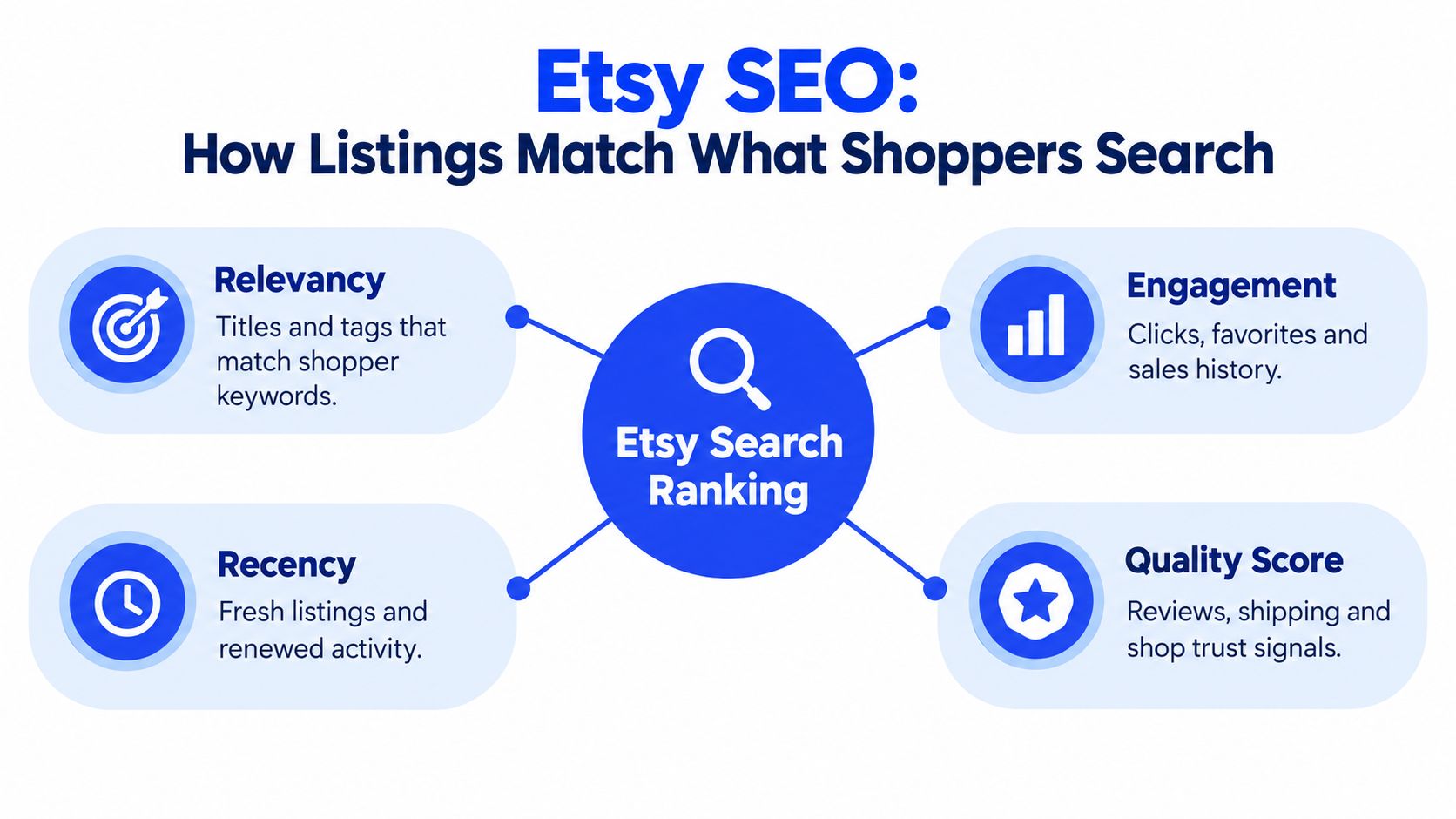
Etsy search starts with a match between the shopper's query and your listing. Etsy describes relevancy through the relationship between search terms and the words used in titles, tags, descriptions, and attributes. Its search and recommendation policy also explains that engagement, recency, listing quality, customer service, and shipping factors contribute to visibility.
That means Etsy SEO isn't a contest to insert as many words as possible. It's closer to labeling a shop shelf accurately. If a shopper searches for a “personalized wooden recipe box,” a listing with that specific product language gives Etsy a clearer reason to consider it than a title filled with broad words such as “gift,” “home,” and “beautiful.”
Build around one clear search intent
Choose a phrase that describes what the buyer wants, not merely what you call the product internally. A printable seller might distinguish between “meal planner printable,” “wedding planning checklist,” and “minimalist weekly planner.” These phrases attract different needs, even if all three are digital downloads.
Etsy recommends using strong keywords early in titles and in the first line of descriptions. Its keyword guidance for sellers emphasizes matching listing language to what shoppers search for.
Use the same core idea naturally across:
Title: Lead with the strongest, most specific phrase.
Tags: Add close variations and related buyer language.
Attributes: Select accurate options because they help describe the item's category and characteristics.
Description: Explain the product in plain language, beginning with the main use or benefit.
Keyword proximity also matters. Keep closely related words near one another rather than scattering them through an awkward title. A readable title helps the shopper confirm they're in the right place.
Relevance earns consideration, not guaranteed placement
A relevant listing still needs to perform after Etsy shows it. Etsy uses engagement signals such as clicks, views, favorites, and purchases. New or renewed listings receive a temporary visibility boost, and that boost declines as Etsy gathers buyer behavior.
This creates a useful distinction. Keywords help Etsy understand when your listing belongs in a search. Photos, price, clarity, reviews, and product fit help shoppers decide whether to engage. If shoppers repeatedly skip a relevant result or fail to purchase after viewing it, visibility can weaken over time.
Check each listing with three questions:
Would a real buyer use these words in a search?
Does the first image confirm the product immediately?
Does the page answer the buyer's main hesitation before they need to message you?
For broader content and marketing resources, you can also explore the Upglider blog. Keep the work specific. One well-matched phrase and a clear product page are more useful than a long list of disconnected keywords.
Choosing Your Marketing Channels Without Burning Out
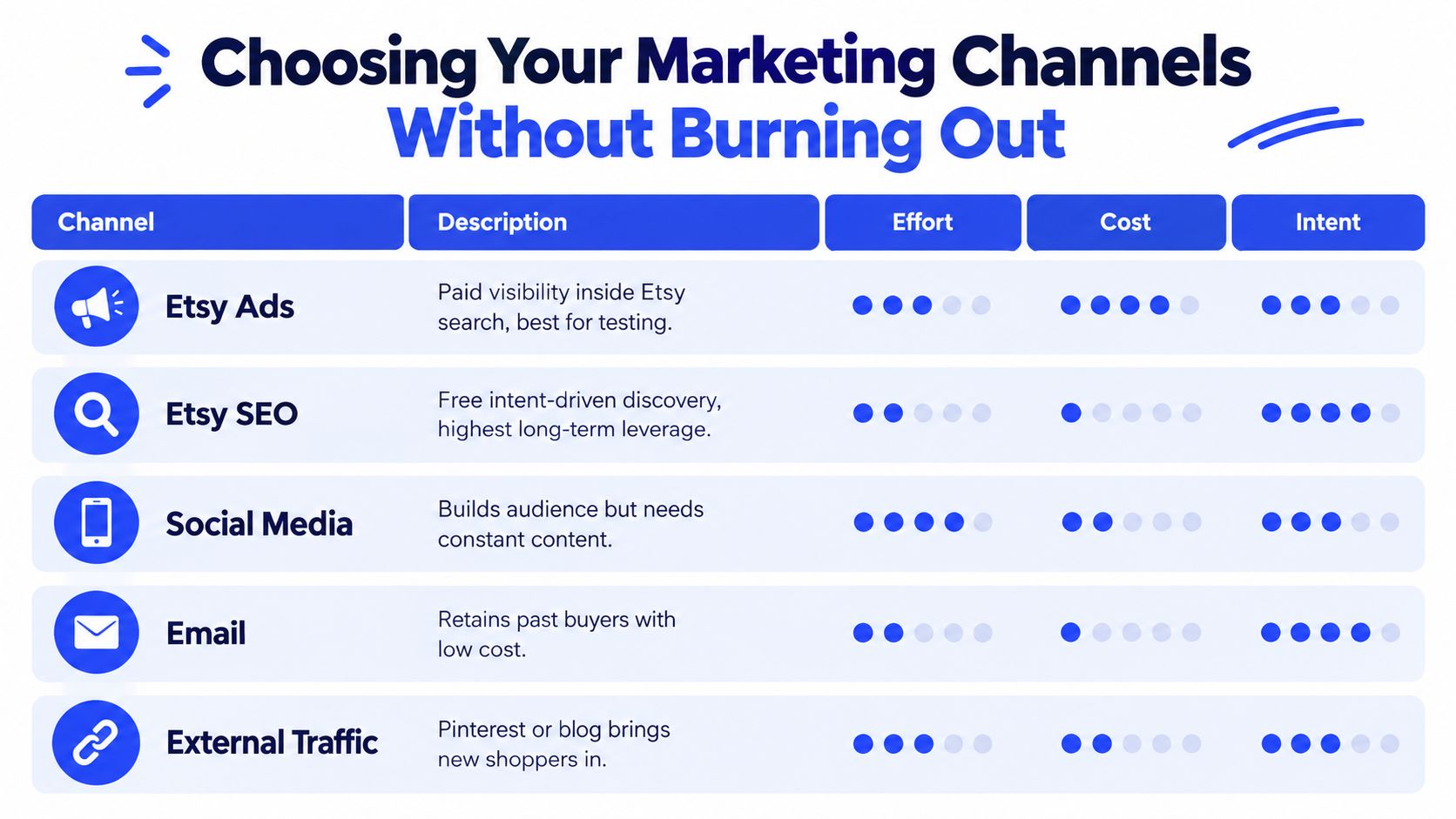
Each Etsy marketing channel performs a different job. Etsy SEO captures shoppers who already have an idea in mind. Etsy Ads buys visibility within Etsy. Social media creates attention and familiarity, but it usually requires ongoing content. Email helps you reconnect with people who already know your work. Pinterest or a blog can bring external discovery, though those channels take time to build.
The mistake is treating these channels as interchangeable. A person searching Etsy for a specific product has stronger immediate intent than someone casually scrolling through a social feed. That doesn't make social media unimportant. It means you should use it for the job it handles best.
Match the channel to the bottleneck
Bottleneck Best First Channel Time Needed When to Add Next Shoppers can't find the listing Etsy SEO Focused listing work Add Etsy Ads after the listing is clear Shoppers see the listing but don't click Thumbnail and listing optimization Short testing cycle Add social content that demonstrates the product Shoppers click but don't buy Listing conversion work Product-page review Add retargeting through existing audiences Past buyers don't return Email Regular but manageable Add social posts that support launches Product has a seasonal window Etsy SEO plus planned promotion Preparation before demand peaks Add ads when the listing is ready
Etsy Ads can help test demand or amplify a listing that already communicates well. They can also waste budget when the listing has an unclear title, weak images, or poor buyer fit. Paid exposure doesn't repair a confusing product page.
Use off-Etsy channels with a clear expectation
Social content works best when it shows the product in use. A jewelry seller can show scale on a person, a printable seller can demonstrate the download and print experience, and a maker can show texture or construction. These demonstrations answer questions that a static promotional caption may leave open.
Email serves a different purpose. A past buyer already understands your style, so a new collection, matching item, or seasonal release may feel relevant without requiring cold discovery. Keep the message useful, with product education or a practical idea rather than a constant sales request.
Pinterest and blog content can support longer-term discovery, but they shouldn't replace listing fundamentals. If your Etsy search language is vague, publishing more external content may send more uncertain shoppers to the same weak page.
Use one or two channels you can maintain. A small, consistent system beats a scattered presence that leaves your listings, messages, and orders unattended.
A Simple Weekly System for Limited Time and Budget
A useful Etsy marketing routine protects the parts of the shop that create lasting value. Start with listing improvement, add promotion only where it supports a clear product, serve buyers promptly, and then read the data before choosing the next task.
The four-part loop
Optimize. Choose a small group of important listings. Improve the main search phrase, title order, tags, attributes, first image, or description opening. Don't change everything at once if you want to understand what helped.
Promote. Share one useful social post, review Etsy Ads activity if you're running ads, or send a relevant message to your existing audience. Promotion should point toward listings that are already understandable.
Serve. Reply to buyer messages and fulfill orders reliably. Etsy considers shop-level trust and operational signals, so customer service isn't separate from visibility.
Measure. Review visits, views, orders, conversion rate, and views per visit in Etsy Stats. Look for patterns rather than reacting to a single day.
Etsy's seller guidance on search identifies review rating, message response rate, case rate over the past three months, and overall customer service quality as relevant shop signals. Etsy also says a complete About page and completed shop Policies may support search placement. Shipping settings matter too, and Etsy states that US free shipping, shipping under $6 to US buyers, or Delivered Duty Paid shipping can improve visibility, as explained in its search ranking guidance.
Fit the routine to your week
With roughly three hours, spend most of the time improving listings and reviewing Stats. Reserve a short block for promotion and customer messages. With roughly six hours, add a second listing review, create stronger product demonstrations, and examine which listings deserve paid testing.
Pause a tactic when it consumes time without helping the diagnosed problem. Don't keep producing social posts if search visibility is the issue. Don't keep editing keywords if shoppers arrive and leave because the product details are unclear.
For sellers comparing tools or services for their workflow, Upglider's pricing information can be reviewed alongside the cost and time of doing the work yourself. The important choice is not the number of tools you use. It's whether each tool supports a defined bottleneck.
Seasonality and Trends With Real Listing Examples
Trend data becomes useful only when it changes a listing decision. Etsy's Spring/Summer 2026 Seller Trend Report, summarized in this trend analysis for Etsy sellers, reports search-demand changes including Wall art decor at +110%, Gallery prints at +80%, Wall decor mirrors at +50%, and Abstract art at +38%. These figures don't mean every seller should immediately create generic wall art. They suggest that existing products may deserve a closer look for specific demand alignment.
Reposition an existing listing
Suppose you sell a minimalist botanical print. If the product fits a gallery wall, you might revise the title, tags, attributes, and first image to clarify that use. The product hasn't changed. The buyer-facing explanation has become more precise.
A handmade seller could make a similar decision with a wall mirror. Rather than adding broad trend words, the seller should show the mirror in a room, state its dimensions clearly, and use only accurate phrases that describe the design and intended setting.
Relaunch when the product needs a new promise
A printable artist may have an abstract design with weak visibility because the listing presents it as merely “modern art.” A relaunch could involve new mockups, a clearer room-style position, and search language that matches the actual visual product. The seller should preserve what remains true and remove claims that don't fit.
A jewelry maker might apply the same reasoning to a personalized piece. If demand is seasonal, the listing can foreground the relevant recipient or occasion only when the item serves that use. The goal is not to attach a trend to an unrelated product. It's to make the existing buyer intent visible.
Hold back when effort won't pay off
Some listings need too much redesign, weak materials, or an unclear audience before trend timing can help. Hold those products while you strengthen a listing with a clearer promise and better evidence of use.
Seasonality also rewards preparation. A product should be searchable and visually ready before the buying window becomes crowded. Use demand signals as a reason to prioritize, not as permission to abandon your shop's actual strengths.
Putting It All Together and Deciding What to Do Next
Etsy shop marketing becomes easier when you stop treating visibility as one giant problem. Begin with Stats. Decide whether the weakness is discovery, engagement, or conversion. Then improve one high-potential listing before expanding into multiple channels.
A broad shop strategy makes sense when several listings already have clear positioning and you can maintain the customer experience behind them. Concentrating on one listing makes more sense when you have limited time, a seasonal product, or one item with stronger reviews, better images, clearer demand, or a more specific search phrase.
Your next 30 days can follow a simple order:
Choose one listing: Pick the product with the clearest buyer use and strongest commercial potential.
Improve its match: Align the title, tags, attributes, and description with one specific search intent.
Improve its click: Replace or refine the first image so the product is immediately understandable.
Protect trust: Keep messages, policies, shipping information, and fulfillment reliable.
Measure the response: Review visits, views, orders, conversion rate, and views per visit before making the next change.
Add one channel: Use Etsy Ads, social media, email, or external traffic only after you know what the listing needs.
Some sellers prefer to learn and manage Etsy SEO themselves. Others don't have the time, or they'd rather not share account access with a service provider. Upglider's process focuses on one Etsy listing and one agreed search phrase, with ranking campaigns available for 30, 90, or 180 days, a stated top-15 objective within 9 to 21 days, and no Etsy account access required. It's a focused ranking option, not a replacement for product quality, customer service, or full-shop marketing.
The best next step is concrete. Open Etsy Stats, select the listing you most want to grow, and write down its main search phrase, current first image, and latest performance pattern. Improve that listing before you spend another hour trying to market everything at once.
Choose one high-potential Etsy listing today, rewrite its first search phrase and opening description around the words your buyer uses, then review its Stats after your next focused marketing cycle.