An Upglider campaign starts with assessment, then aims for a 9 to 21 day ranking push, and can run for 30, 90, or 180 days depending on the term you choose. That fixed timeline matters when you're trying to move one Etsy listing instead of guessing which week your shop will finally get noticed.
You usually feel the pressure before a campaign even starts. The listing is live, the product looks strong, and the question is simple: how long do you keep pushing before the market gives you a clear answer? A campaign schedule solves that problem by turning the work into dated milestones instead of vague effort. For a seller trying to grow one listing without handing over account access, that kind of structure is easier to manage and a lot easier to trust.
What to Expect from Your Campaign Schedule
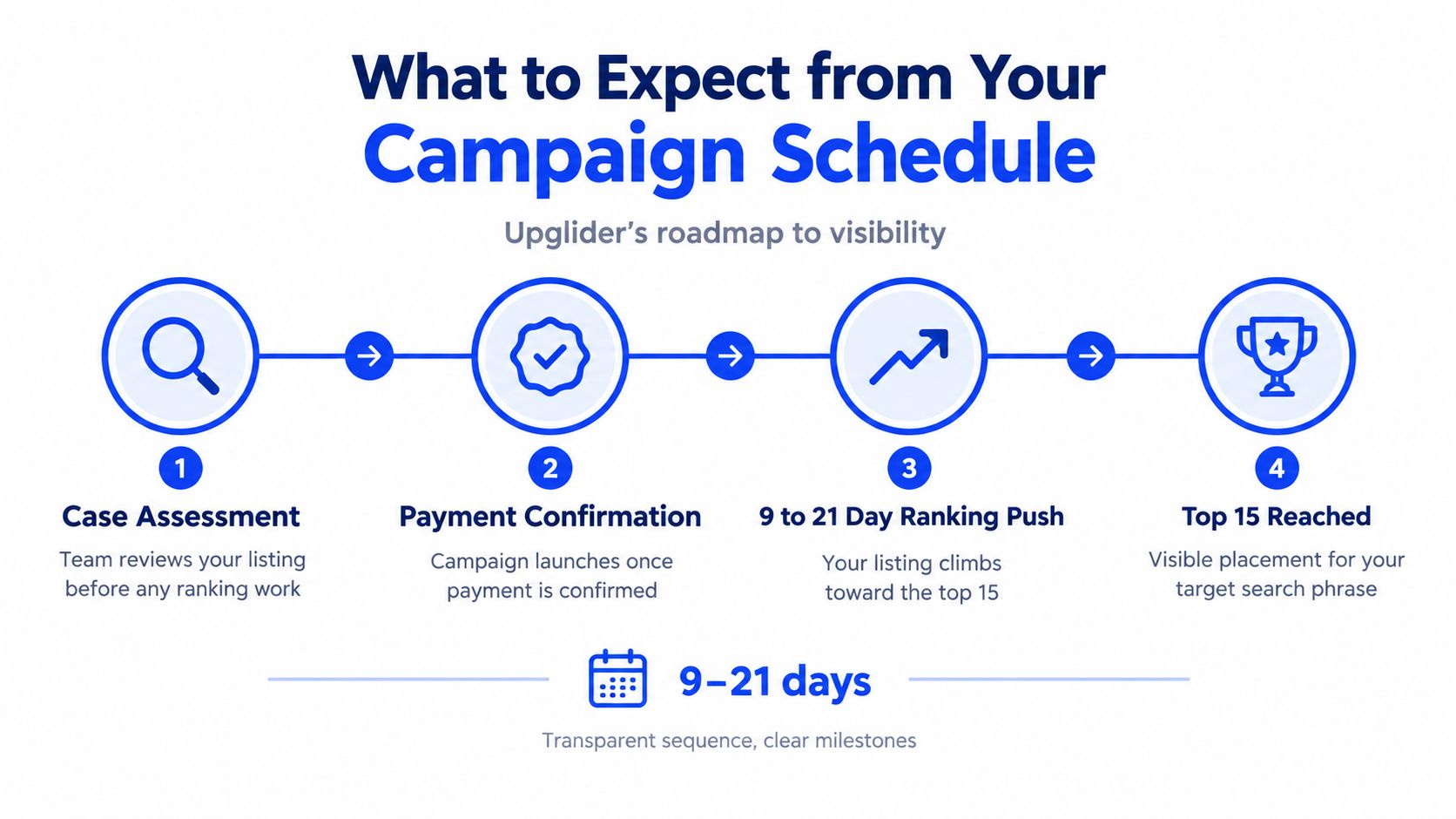
A good campaign schedule is a roadmap, not a vague promise. For Etsy ranking work, each step needs a date, a gate, and a clear outcome. In practice, that means the listing is reviewed first, payment is confirmed next, the active push starts after that, and the position is tracked through the rest of the term.
The sequence sellers can actually track
A fixed schedule removes guesswork. You know when the case assessment happens, when payment clears, when the ranking phase begins, and when the top-15 check should happen. That matters because Etsy search is not static, and a listing can move while the campaign is still being set up.
Practical rule: if a timeline does not say when the work starts and when success is measured, it is too loose to manage.
The schedule also separates the work into stages you can review on a calendar. Early work is about readiness, the middle is about movement, and the later phase is about holding position. That is easier to manage when one listing has to carry the campaign, because you can see which date matters and what result should follow.
What the first email should answer
The first exchange should settle the listing, the target phrase, and the campaign length. You should also know how the ranking target will be measured, because Etsy search depends on relevance, quality, engagement, and recency. Etsy's search ranking guidance
A useful schedule is one you can mark on a calendar without translating marketing jargon. If the dates are clear, the work is easier to review, and the campaign becomes a process instead of a gamble.
The Pre-Payment Assessment Phase
The assessment stage is where a serious campaign earns trust. Before any ranking work begins, the listing has to be reviewed for fit, because not every product and phrase deserves the same effort. The wrong target wastes time, and a weak listing can make even a good campaign look ineffective.
I've seen this gate work best when the review is blunt. A seller may love a phrase because it feels perfect, but if the product is too broad, too niche, or too underprepared for that query, the campaign starts on the back foot. That's why the review needs to check the listing itself, the search phrase, and how hard the ranking job is likely to be in that niche.
The practical advantage is simple. You're not paying to discover basic problems after the work has already started. You're deciding up front whether the campaign has a real chance to move a single listing into the right search results.
What gets checked before payment
The review stage should cover the exact listing, the phrase you want to rank for, and whether the target is realistic for that product. It should also make payment terms clear before you commit. If the provider accepts bank transfer, instant bank transfer, or crypto, that should be settled before launch, not after the work is already underway.
A seller should treat this phase like a filter, not a formality. If the listing is misaligned with the phrase, the schedule needs to be adjusted before any ranking push begins. If the term is too competitive for the product's current state, the smarter move is to change the target or delay the campaign rather than force a weak start.
A clean assessment protects the schedule later. It keeps the campaign from burning time on a setup that was never ready.
For a practical checklist of what belongs in this stage, the campaign requirements guide is the right place to start. The point is not to make the process more complicated, it's to keep the calendar honest before the paid period begins.
Choosing Your Campaign Duration
The campaign length should match the job you need done. A short test, a quarter-long push, and a half-year hold are different commercial decisions, even if they all use the same ranking method. Choosing the wrong term is how sellers end up either stopping too early or paying for time they don't need.
30 days for a fast test
A 30-day campaign works when you want to see whether one listing can gain traction without a long commitment. It suits new products, fresh optimizations, or a seller who wants a quick read on whether a phrase is worth deeper investment. The risk is lower, but the time pressure is higher, so the product and targeting have to be ready.
90 days for steadier holding power
A 90-day campaign fits a listing that already has some promise and needs a more stable runway. It gives the ranking more room to settle and gives you more time to watch whether traffic turns into sales. For many shops, this is the middle ground between a quick experiment and a long seasonal hold.
180 days for longer commercial windows
A 180-day campaign suits sellers who want a long stretch of maintained visibility in one search category. That kind of term makes sense when one product carries a big part of the shop's strategy, or when the selling window is long enough that a short burst would be wasted. It also gives more room for inventory planning, because the campaign and your stock decisions stay aligned.
The trade-off is budget control versus time to compound. Upglider's campaigns are paid once with no automatic renewal, so the length you choose should match your sales cycle, not your hope. If you're planning a seasonal launch, the duration should map to the period when buyers are most likely to convert, not just the period when you first want attention.
The 9 to 21 Day Ranking Push
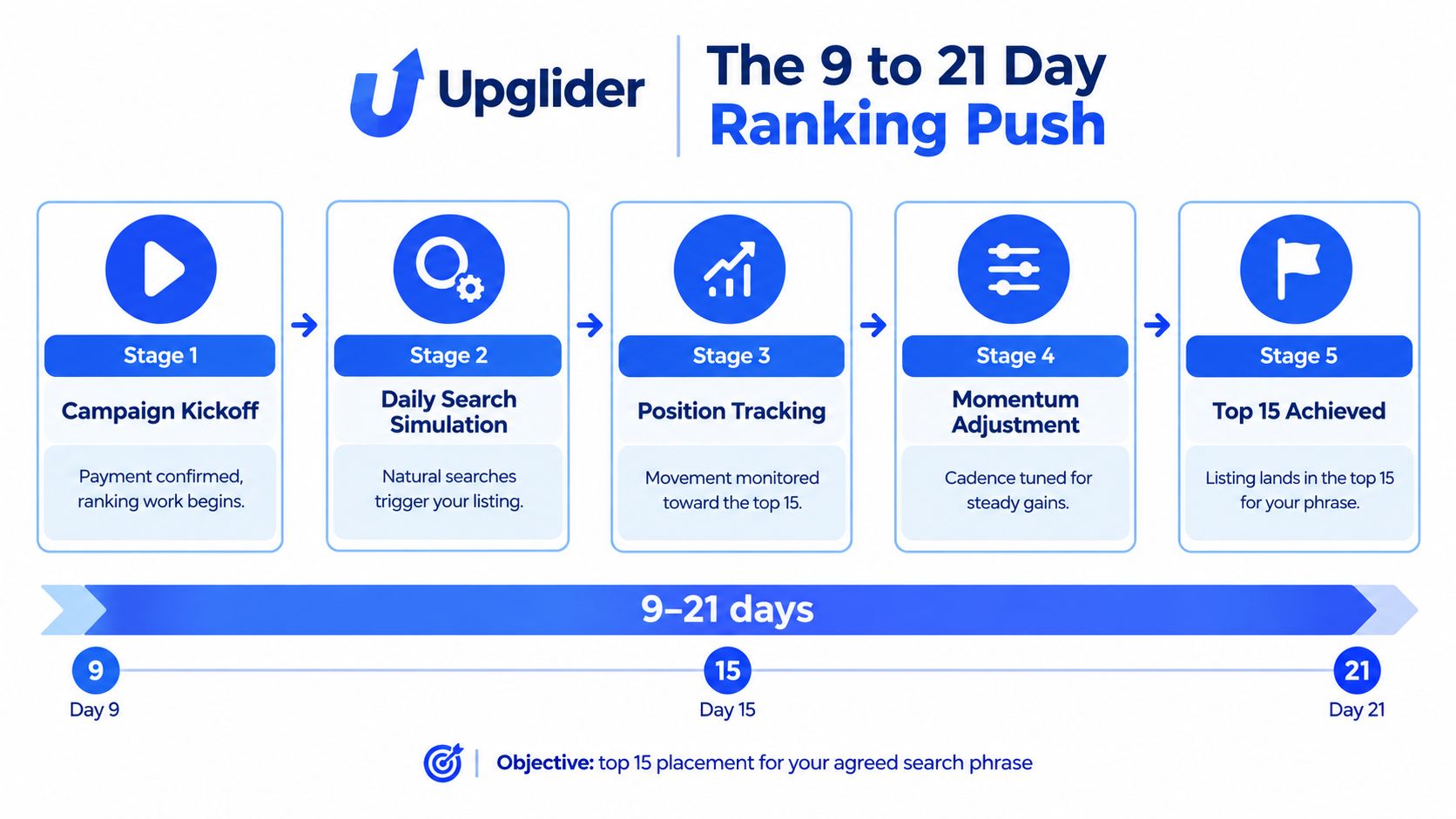
Once payment is confirmed, the active ranking phase begins. This is the part sellers watch most closely, because it is where the listing is pushed toward the top 15 for the agreed phrase within the 9 to 21 day window.
What the active phase is doing
The goal in this window is controlled movement, not random visibility. Etsy's search system looks at relevance, listing quality, engagement, and recency, so ranking work has to support those signals without pretending one tactic can carry the whole result. Etsy also says shoppers' views and purchases matter, which is why the position can move unevenly before it settles. Etsy's ranking factors.
During this stretch, the listing is worked through its public URL, so you do not need to hand over your account password. That matters for sellers who want support without giving up control of the shop. It also keeps the campaign focused on the listing itself instead of turning into a full-store intervention.
How the days usually feel
The first part of the push is about kickoff and early signal generation. Then the position is monitored as the listing starts to move, because search visibility rarely climbs in a straight line. A healthy schedule accepts fluctuation as part of the process, especially while the system is still responding to new activity.
By the middle of the window, the focus shifts to momentum. If the listing is close to the target, the work has to support that movement rather than restart it. If the top 15 is reached early, the schedule does not end there, because a position that appears once and disappears the next day is not a stable result.
What to watch, and what not to overread
Track the right thing at the right time. Early on, watch placement movement and campaign progress. Later, care about whether the ranking holds inside the agreed target window. That split keeps you from making bad decisions based on a single day's fluctuation.
Don't confuse temporary movement with a finished result. A campaign is winning when the position becomes usable, not when it flashes once.
For sellers who want a plain explanation of how position tracking is handled, the rank tracking overview is the relevant reference. The important part for your schedule is simple, the push has a start date, a target window, and a result that should be visible before the initial phase ends.
Monitoring and Maintenance Over Time
Once the ranking target is reached, the work shifts from pushing to holding. That change matters because the rest of the paid period is about protecting a position that already cost time and effort to win. A listing that slips back out of sight too quickly has not really been scheduled well.
Why maintenance is its own phase
Maintenance is not just waiting. It is the period where the campaign keeps pressure on the listing so the search position doesn't decay as buyer behavior changes. Etsy's ranking signals can move with engagement and recency, so a listing needs ongoing attention if it is meant to stay visible through the full term.
A dashboard earns its keep here. A step-by-step status view lets you follow updates without needing to understand every mechanical detail behind them. You can see what has happened, what is being monitored, and whether the listing is still sitting in the right range for the agreed phrase.
What a seller should use the dashboard for
The dashboard should help you answer practical questions, not replace your judgment. Is the listing still in the target range? Is the campaign still aligned with the original phrase? Are there any notes that explain a sudden change in position? Those are the questions that help you plan stock, customer service, and any follow-up promotion.
Check movement regularly: Review whether the listing stays within the intended range instead of only looking at launch-day excitement.
Read the studio notes: Use the notes to understand why the position changed, especially if the listing serves multiple markets.
Keep the term in mind: Compare the live status against the phrase you approved, not against a broader wish list of keywords.
Plan around the paid window: Use the remaining term to support fulfillment and inventory, because the visibility work is already underway.
The reason this phase works is that it turns the campaign into a controlled holding pattern. You're not restarting the process every week. You're watching one listing stay relevant while the term runs its course.
The Money-Back Guarantee Window
The guarantee window is the part of the schedule that makes the risk easier to evaluate. If the listing does not reach the top 15 for the agreed phrase within 21 days of confirmed payment, the refund condition applies. That gives the campaign a measurable finish line instead of a vague promise.
Why that matters for a seller
A guarantee only helps if the target is specific. Here, the target is one listing, one agreed phrase, and one time window. That makes the outcome clear enough to judge, which is exactly what a seller needs when paying for ranking work.
The structure also keeps the provider accountable inside the active phase. If the target is reached early, the schedule keeps it in place for the paid term. If the target is missed inside the window, there is a defined fallback instead of a drawn-out argument about whether the effort “counted.”
A low-risk campaign is not one with no stakes. It is one where the finish line is clear before the money changes hands.
For sellers comparing options, the practical advantage is that the schedule already contains the failure case. That is better than a loose marketing arrangement where progress is hard to measure and results are easy to debate. The guarantee terms are the part that make the timeline feel disciplined instead of open-ended.
The value is confidence. You can commit to a defined campaign without treating the payment like a blind bet. The timeline has a built-in checkpoint, and that is exactly what makes it usable for a shop owner who needs to plan around inventory, launches, and cash flow.
If you're planning a listing push right now, map your next campaign to a single phrase, a single product, and a single calendar window, then compare that plan against your inventory and launch dates before you start. A clean schedule is easier to manage, easier to measure, and easier to trust when the work begins.