Most advice about hiring an Etsy SEO expert starts with the wrong recommendation: overhaul the entire shop, sign a monthly retainer, and rewrite every listing. That can be useful for a mature shop with broad problems, but it's excessive for many sellers. If one product has clear demand and weak visibility, a targeted, single-listing ranking campaign is often the more sensible first move.
Etsy is a crowded marketplace. Independent reporting based on Etsy marketplace data estimates 5.6 million active sellers and 86.5 million active buyers at the end of 2025, while Q2 2026 reporting put those figures at 5.706 million sellers and 86.969 million buyers. The same reporting places Etsy's gross merchandise sales at about $2.5 billion in Q1 2026. These marketplace figures explain why visibility matters, but they also reveal the problem. You're competing inside a vast catalog, so a broad promise to “improve SEO” isn't enough. You need to know which listing, query, and buyer response the work is meant to improve.
What an Etsy SEO Expert Actually Does
Keyword stuffing isn't Etsy SEO. Adding the same phrase repeatedly to a title, tags, and description won't rescue a listing with poor photography, unclear buying information, weak customer experience, or little buyer engagement.
Etsy's own search guidance says ranking is primarily influenced by tag and title relevancy, but Etsy also considers listing quality, customer and marketplace experience, recency, shop location, and shop diversity. The platform gives a new listing a small temporary boost so it can collect interaction data and estimate quality and relevance.
That changes what you should expect from an expert. The job isn't to find phrases and insert them. The job is to make the listing relevant before the click, persuasive after the click, and trustworthy when the buyer is ready to purchase.
Relevance is only the first gate
A capable specialist examines whether the target phrase describes the product. Etsy says listings can match a shopper's query through titles, tags, attributes, and categories, and exact keyword matches may rank higher than partial matches. Etsy's search explanation supports a straightforward rule: use precise language, select the most accurate category, and don't force a popular phrase onto an unsuitable product.
The expert then checks the post-click experience. Does the primary image explain the product immediately? Do the remaining photos answer practical objections? Is personalization clear? Are dimensions, materials, processing information, shipping expectations, and returns easy to find?
A relevant listing that fails to convert sends a different signal from a relevant listing that earns clicks, favorites, purchases, and positive customer responses. Etsy's system therefore makes ranking a balancing exercise, not a one-keyword trick.
Trust affects visibility
Etsy's guidance also notes that a completed About section, completed shop policies, and positive reviews can improve placement. Those details aren't decorative profile elements. They help buyers assess whether the seller is credible and whether the purchase feels safe.
Practical rule: Hire an Etsy SEO expert who can explain what happens after the shopper clicks, not just which tags they'll add.
A useful overview of how Etsy SEO works should leave you with the same conclusion. A specialist should connect search terms to listing structure, visual presentation, customer expectations, and shop experience. If the proposal contains only a spreadsheet of keywords, you're buying research, not a complete optimization service.
Core Services and Tangible Deliverables
A full agency overhaul is rarely the right first purchase for an Etsy shop. Start with work you can inspect, apply, and measure. For many sellers, a targeted, single-listing ranking campaign exposes the underlying problem with less cost and risk than a broad retainer.
The first deliverable should be a listing or shop audit. It needs to identify mismatches between the product and its target phrases, weak image sequencing, missing attributes, confusing variations, incomplete policies, and friction in the buying process. A useful audit goes beyond “improve your photos.” It explains what the primary image fails to communicate, which buyer questions remain unanswered, and what a replacement image should show.
What a serious package should include
A focused Etsy SEO engagement may produce several distinct work products:
Keyword and intent map: Relevant phrases grouped by buyer purpose, such as gift searches, room décor searches, or personalized product searches.
Title and tag revisions: Natural, accurate copy that reflects the product instead of repeating disconnected terms.
Category and attribute review: Corrections to the classification fields Etsy uses to understand and match the listing.
Competitor gap analysis: A comparison of competing listings' photography, pricing presentation, product options, delivery information, and buyer reassurance.
Photography recommendations: Specific guidance for the primary image, product scale, detail shots, use-case images, and personalization examples.
Conversion notes: Recommendations for descriptions, variations, policies, shipping clarity, and other factors that affect the buying decision.
Measurement plan: A defined target phrase, baseline position, review schedule, and clear interpretation of progress.
Etsy's search visibility guidance says active listings need at least one image, a clear and well-lit primary photo, a specific category, and a return policy to qualify for priority placement. It also recommends a high-resolution primary image of 2000 pixels or more. For U.S. listings, Etsy says domestic shipping prices below $6 receive priority in search. These checks belong in the audit. You should not discover them after paying for vague optimization work.
One-time work versus ongoing management
A one-time package fits a shop with a few weak listings and an owner who can implement recommendations. A targeted ranking campaign is often the better starting point when you want to test one product, one buyer intent, and one measurement plan before committing to broader work.
An ongoing retainer earns its place when you need continuing testing, seasonal updates, new listing optimization, competitor monitoring, and regular review of search and sales data. Ask for the exact division of labor. Will the specialist rewrite the copy or send suggestions? Will they edit images or describe the changes? Will reports show ranking positions, clicks, orders, and revenue, or only impressions without context?
A deliverable is valuable when it changes a decision. “Your visibility improved” is not a deliverable. A revised title, prioritized photo brief, target phrase, and clear measurement method are.
How to Vet Candidates and Ask the Right Questions
Treat the hiring conversation like a working interview. Don't be impressed by a polished agency deck or a list of generic SEO services. Ask questions that force the candidate to explain how Etsy shoppers behave and how the candidate will respond when the first optimization doesn't produce sales.
Start with the listing itself. Give the candidate one product and ask:
Which buyer would search for this product, and what would that buyer type into Etsy?
Which phrase would you target first, and why does it fit the product?
What would you change before touching the tags?
How would you judge whether the problem is poor ranking, weak click-through, or weak conversion?
What information would you need from my shop before making a recommendation?
How will you measure progress, and how often will you report it?
A genuine marketplace specialist won't promise that one keyword automatically creates sales. They'll ask about product-market fit, price positioning, photographs, reviews, shipping, variations, and the buyer's reason for purchasing.
Listen for post-click thinking
The candidate should understand that a listing can receive exposure without producing meaningful business results. Ask how they'd respond if the product appears for the target phrase but attracts few clicks. The right answer may involve the primary image, title clarity, product styling, or the match between the phrase and the image.
Then ask what they'd do if clicks arrive but purchases don't. That answer should move toward product information, price presentation, delivery expectations, social proof, personalization instructions, and buyer confidence. Anyone who responds by adding more tags is treating a conversion problem as a keyword problem.
Separate Etsy specialists from generalists
Google SEO experience can help with research and content, but Etsy has its own marketplace context. A generalist may talk about backlinks, domain authority, technical crawling, or long-form blog content while ignoring categories, attributes, variations, reviews, shop policies, and listing photography.
Use this guide to managed SEO services as a useful comparison point, but don't let the word “managed” replace a clear scope. You should know whether the provider is optimizing your shop, promoting one listing, managing Etsy Ads, advising on conversion, or performing several of those tasks.
Ask for a sample report with personal information removed. If the provider can't show the kind of decisions and evidence you'll receive, don't assume the missing detail will appear after payment.
Reject vanity reporting. Impressions can rise while orders remain unchanged. Search position can improve for an irrelevant phrase. A serious provider connects visibility to the listing's commercial purpose and tells you what the data can and can't prove.
Broad Agency Retainers Versus Focused Ranking Services
A full-shop agency retainer and a focused ranking campaign solve different problems. Choosing between them depends on whether your shop has a structural weakness or one high-potential listing that needs concentrated exposure.
A traditional agency is the better fit when your catalog has inconsistent branding, incomplete policies, poor photography across many products, weak product positioning, and no repeatable optimization process. You're paying for diagnosis, coordination, ongoing work, and strategic direction.
A focused campaign makes more sense when the shop is functional but one listing deserves attention. This could be a seasonal product, a flagship item, a new release, or a listing tied to a specific long-tail phrase. You avoid paying for a full catalog rewrite before proving that the product and query deserve more investment.
One focused provider, Upglider, offers campaigns for one listing and one agreed search phrase of three or more words. Its stated objective is a top-15 position within 9 to 21 days, with position maintenance for a selected 30, 90, or 180 days, and the service says it doesn't require Etsy account access. The provider's campaign details should still be checked before purchase because terms and availability may change.
Comparing Etsy SEO Engagement Models
Feature | Traditional Agency Retainer | Focused Ranking Campaign |
|---|---|---|
Primary scope | Whole-shop strategy and continuing optimization | One listing and one specific phrase |
Best fit | Shops with broad operational and presentation problems | Sellers with a clear product and a concentrated visibility goal |
Typical work | Audits, catalog updates, content, photography guidance, reporting, and ongoing strategy | Ranking support, defined target, progress tracking, and position maintenance |
Access expectation | May require collaboration or listing access, depending on the provider | Can be structured around a public listing URL and agreed phrase |
Commitment | Recurring relationship and continuing budget | Fixed campaign period, such as 30, 90, or 180 days |
Main trade-off | Broader support, but higher cost and less focus per listing | Narrower scope, but lower risk when one listing is the priority |
Don't choose a retainer because it sounds more thorough. Choose it when you'll genuinely use the breadth. If your immediate question is whether one product can win visibility for one well-matched phrase, a targeted campaign gives you a cleaner test.
Don't choose focused ranking support if the listing itself is weak. No ranking service can compensate for an unsuitable product, misleading imagery, confusing personalization, poor fulfillment, or an unattractive offer. Visibility should expose a sound listing, not hide its flaws.
Pricing Structures and Security Red Flags
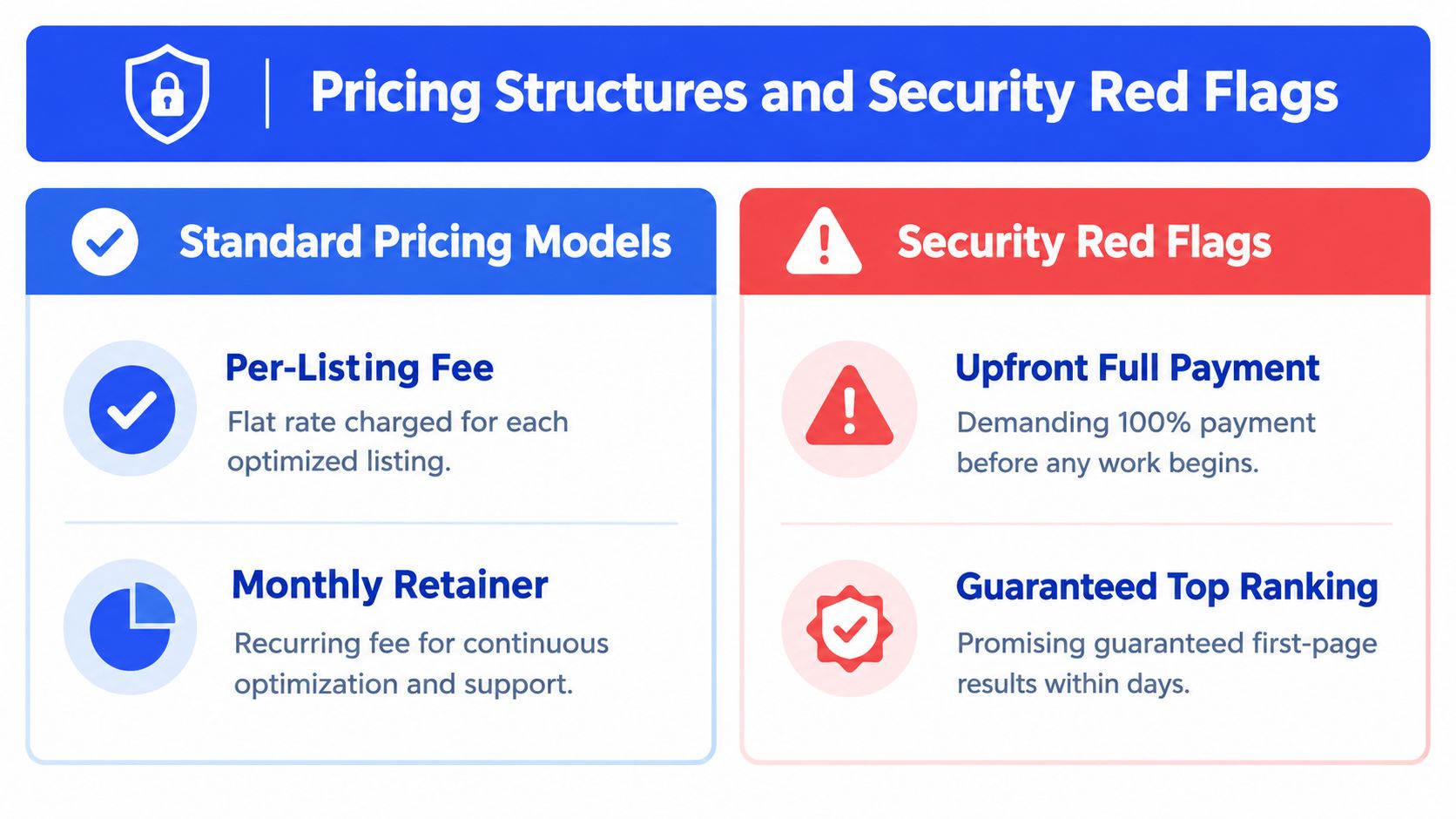
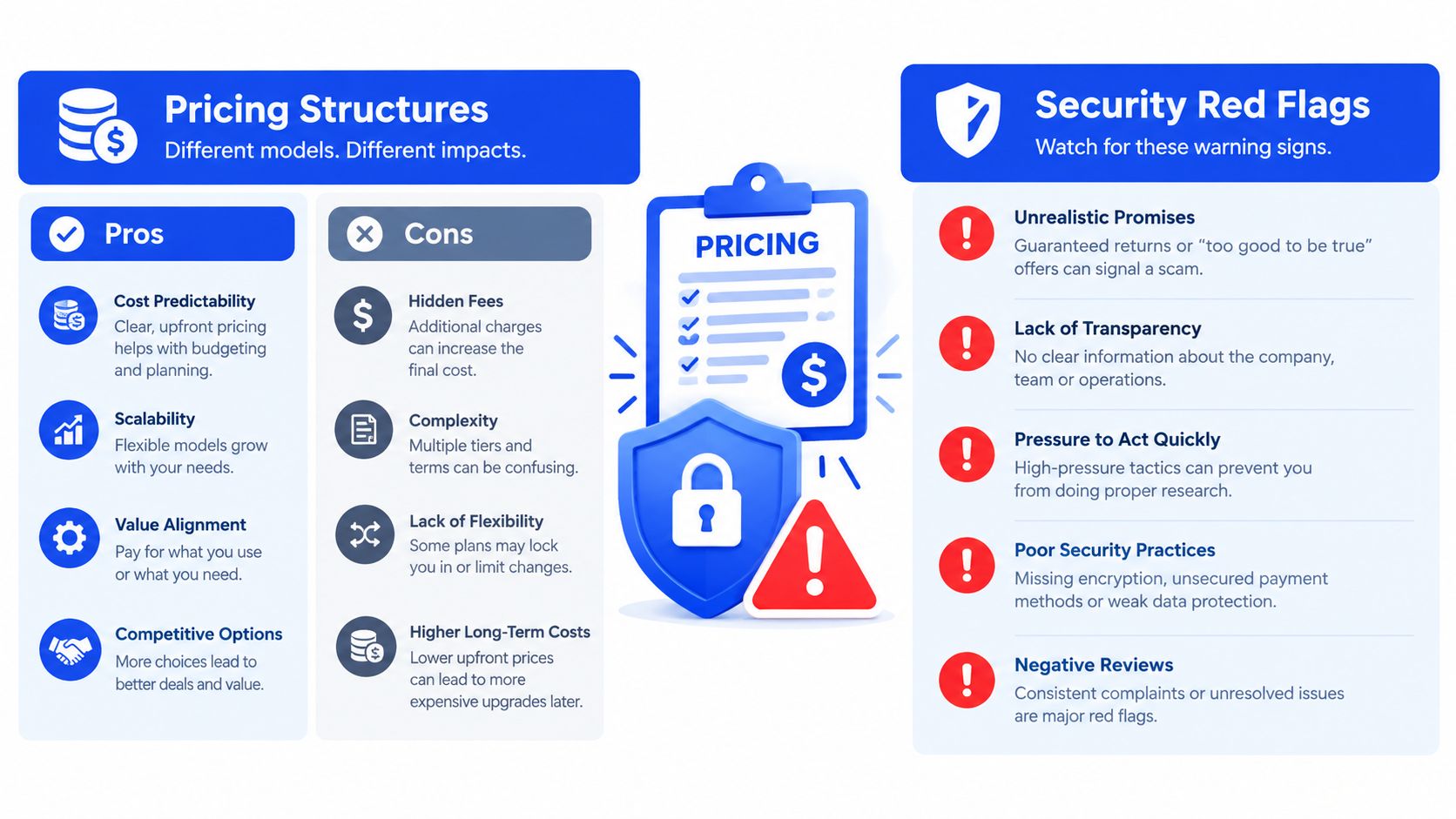
Pricing should match the work. A per-listing fee is easy to understand when the provider is rewriting a defined set of listings. A monthly retainer can be reasonable for continuing strategy and implementation, but only if the contract names the work delivered each month.
The dangerous offers are the ones that remove uncertainty by making promises no honest provider can control. Etsy search is personalized by shopper behavior and location, and ranking depends on multiple signals. A guarantee of universal first place, immediate sales, or permanent visibility is a warning sign, not a competitive advantage.
Protect your account before discussing payment
Never hand over your Etsy password to a provider for ordinary SEO work. If a service can operate through a public listing URL, shared documents, or approved platform permissions, there's no reason to expose your account credentials.
Account access also creates operational risk. A provider could alter titles, prices, policies, photos, or listings without a clear approval process. If access is necessary for a separate service, use the narrowest available permission, document what the provider can change, and remove access when the work ends.
Watch for these signals:
Guaranteed top ranking: A promise of first-page or number-one placement within days ignores personalization, competition, and listing quality.
Full payment before explanation: You should receive the scope, target phrase, measurement method, cancellation terms, and tax treatment before paying.
No defined listing: “We'll improve your shop” isn't a measurable objective. The provider should identify what they'll work on.
Password requests: External promotion and advisory work shouldn't require your login.
Unclear renewal terms: Check whether the service renews automatically and how you cancel it.
Vanity-only reporting: Reports that show impressions without clicks, orders, or meaningful ranking context don't tell you whether the work helped.
Read what an affordable Etsy SEO campaign should include before comparing quotes. The point isn't to find the cheapest provider. It's to compare like with like, then reject a proposal that makes you surrender control without giving you a defined outcome.
Security boundary: Don't trade your shop credentials for a ranking promise.
Ask how the provider handles failure. A credible contract explains what happens if the target isn't reached, how results are checked, and whether a refund or another remedy applies. Keep payment records, preserve copies of your original listing assets, and make sure you understand whether taxes or transaction fees are included.
Aligning Optimization with Real Buyer Demand
The best Etsy SEO expert can't make an uninteresting query commercially valuable. Start by choosing the right product and phrase, then decide how much optimization it deserves.
Search demand on Etsy is heavily shaped by commercial, seasonal, and gift-related intent. Recent eRank coverage of top Etsy searches in Q4 2025 highlights terms such as stickers, earrings, wall art, personalized gift, gift for him, gift for her, and gift for mom. The same coverage reports “gift for mom” up 1,607% and “phone case” up 176% in Q4 2025.
Those jumps don't mean you should copy the terms into every listing. They show why timing and intent matter. A seller with a personalized necklace may get more value from a specific gift phrase that matches the product than from a broad term that attracts shoppers looking for something else.
Pick a phrase with a product attached
Choose one listing that already has a credible offer. Then identify a phrase of at least three words that describes the product, its use, or the buyer's purpose. “Wall art” is broad. A phrase describing a particular room, style, recipient, or personalization need may be more useful if the product fits it.
Ask four questions:
Does the phrase describe the item exactly?
Does the buyer's intent match the product's price and format?
Can the primary image satisfy the promise made by the phrase?
Will the product remain available and fulfillable during the demand window?
A short-lived demand spike can justify a focused campaign, but it also creates a deadline. Seasonal products need completed images, accurate processing information, dependable stock, and clear shipping expectations before visibility arrives. Otherwise, the campaign may send attention to a listing that can't convert or ship in time.
Avoid broad optimization by default
A full-shop overhaul spreads effort across products with different audiences and commercial potential. Targeted work concentrates the test on one listing and one buyer intent segment. That makes the decision cleaner: if visibility improves but sales don't, investigate the offer and conversion experience; if the phrase proves irrelevant, change the target rather than rewriting the whole catalog.
Search results can vary by shopper and location, so don't treat one manual search as universal proof. Record the agreed measurement method and judge the campaign against the phrase and market it targets.
Your Action Plan for Launching a Campaign
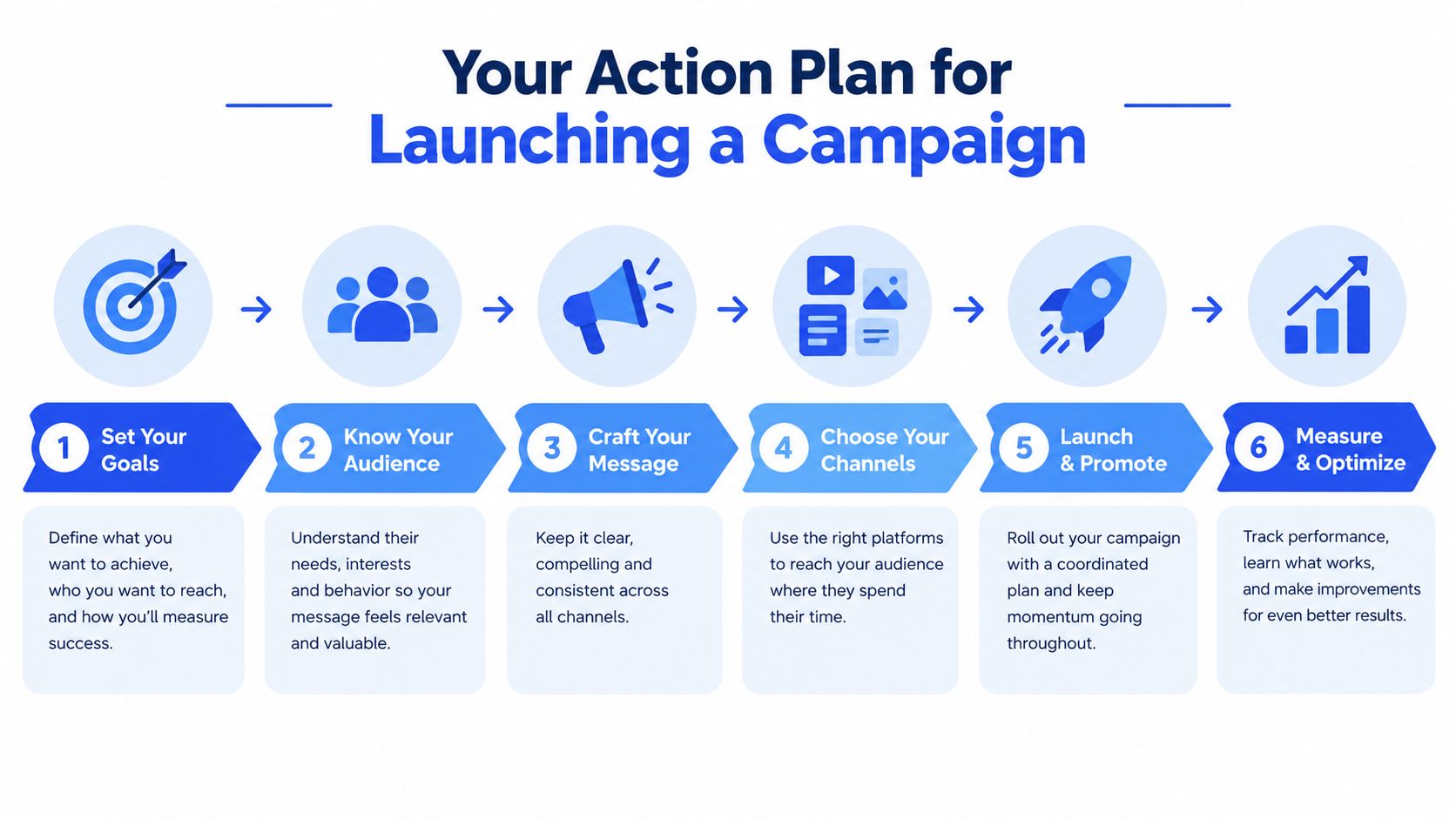
Start with the listing, not the retainer. A focused ranking campaign is a lower-risk test than a full-shop overhaul, provided the product can convert the attention it earns.
Choose one listing. Select a product with a clear buyer, reliable fulfillment, healthy margins, and enough inventory or production capacity to handle demand.
Audit the primary image. Make the product immediately understandable, well lit, accurately represented, and shown at a useful scale. Etsy recommends a high-resolution primary image of 2000 pixels or more, so check the file before launch.
Complete the listing foundation. Confirm the category, attributes, tags, title, description, variations, shipping information, return policy, and shop policies. Etsy identifies a required image, clear primary photo, specific category, and return policy as factors for priority placement. Review Etsy's visibility checklist before hiring anyone.
Select one phrase. Choose a specific query that matches the item and buyer intent. Popularity alone is not a reason to target it.
Get the scope in writing. Confirm the listing URL, target phrase, market, campaign length, reporting method, payment terms, refund conditions, and whether automatic renewal applies.
Monitor decisions, not noise. Use the provider's dashboard or reports to review ranking progress, listing changes, clicks, favorites, and orders where available. Judge performance at the agreed 30, 90, or 180-day point instead of changing several variables every few days.
Set expectations before work begins. Better search visibility does not guarantee profit. If exposure produces no orders, examine the product, images, price, delivery offer, reviews, and description before paying for more keyword work.
A broad agency retainer can wait until your results show a wider problem. Start with one strong listing, one exact phrase, corrected buyer-facing weaknesses, and a written proposal with measurable deliverables. Reject guaranteed-ranking promises, protect your account credentials, and avoid providers that require your password.
Choose the listing with the clearest buyer intent this week. Complete its photos and policies, then test the smallest focused engagement that can produce useful evidence about its search potential.