With 89.6 million active buyers and 5.6 million active sellers as of December 31, 2024, according to Etsy's 2024 annual report, you aren't trying to be found in a small directory. You're competing for attention in a crowded market. That's why the top keywords on Etsy for your shop aren't the most searched words. They're the phrases that bring the right buyer to the right listing, at a level of competition you can realistically handle.
What Top Keywords on Etsy Means and Where to Find Them
Top keywords on Etsy are the phrases that bring relevant buyers to your listing, not just the most-searched words.
That difference matters. "Tote bag" may attract many searches, but it doesn't say who the bag is for, what it's made of, or why someone's buying it. "Personalized canvas tote for teacher gift" is narrower and clearer. It names the product, the material, the recipient, and the occasion, so the shopper who clicks is more likely to want that exact item.
Five Places to Look for Phrases
No single source tells you everything. One shows wording, another shows your own results, and another shows direction over time. Use each for what it does well, and don't treat any one result as proof on its own.
Method | What it shows | Main limit |
|---|---|---|
Etsy search suggestions | Phrases shoppers type, in the order Etsy suggests them | Shows wording, not how many buyers search or how hard the phrase is |
Competitor tags and titles | Phrases that successful shops use on similar products | Shows what they use, not whether it brings them sales |
Your Search Analytics | Queries that already showed your listings, with average position | Covers only queries your listings already appear for |
Etsy trend reports | Searches that rose sharply over a recent comparison period | Directional and time-bound, not a permanent ranking |
Third-party keyword tools | Estimated search volume and competition scores | Estimates differ between tools, so check them against Etsy data |
Start by typing a short product phrase into Etsy search and writing down the longer suggestions. Then open a few strong competitor listings and note the words they repeat in titles and tags. After that, compare both lists with your own Search Analytics, because those queries already connect real shoppers to your shop.
Practical rule: Check at least two sources before you choose a phrase. If shoppers suggest it and your own data or a competitor's listing supports it, you've got a stronger reason to test it.
A useful short list contains phrases you can describe in plain words. If you can't say who would search it and why, it's probably too broad, even if a tool calls it popular.
How Etsy Ranks Your Listing and What Else Moves It
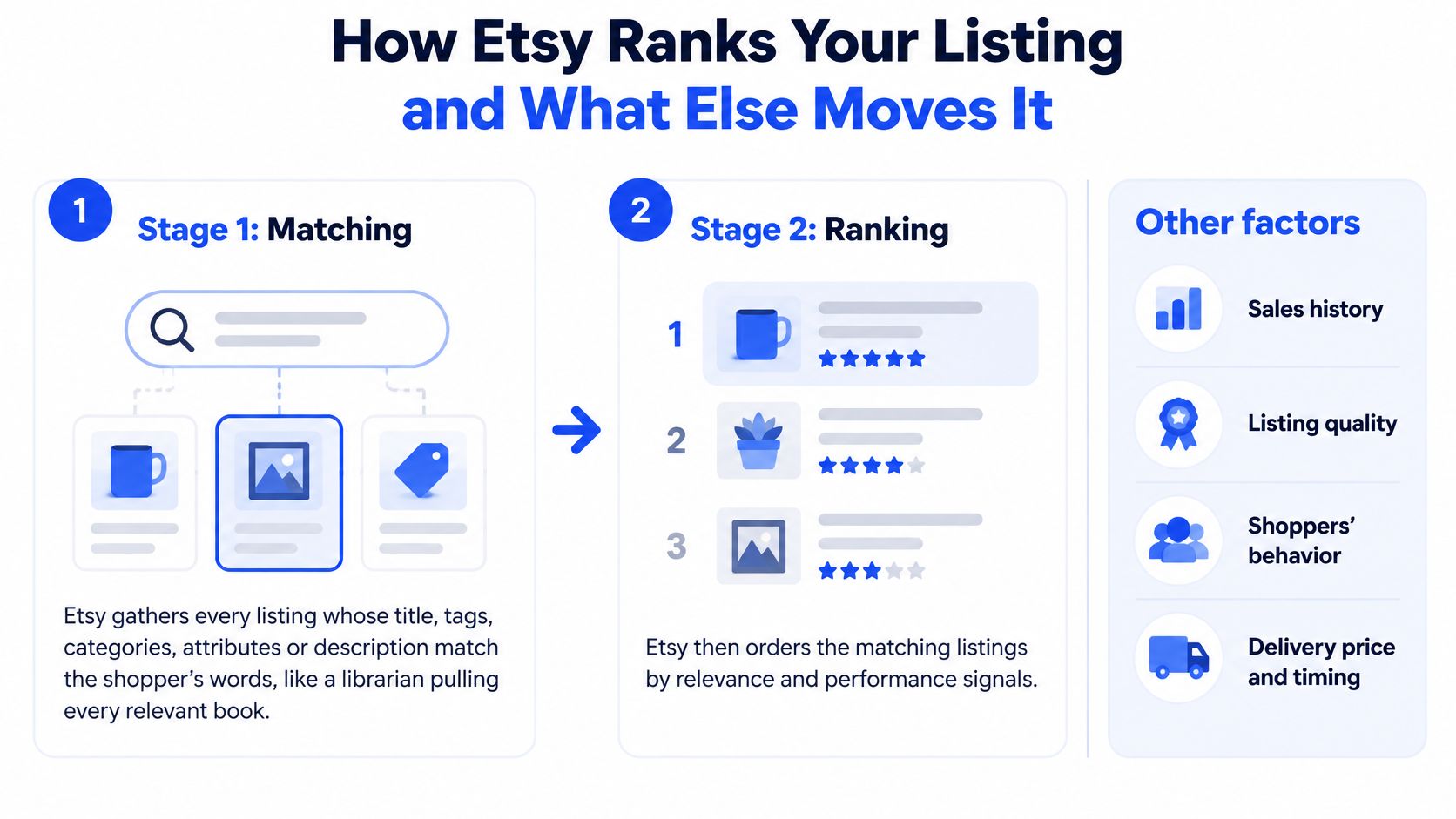
Etsy search works in two stages. First comes matching. Etsy gathers every listing whose title, tags, categories, attributes, or description match the shopper's words, like a librarian pulling every book on a subject. A match gets you into the pool, but it doesn't give you a high spot.
Second comes ranking. Etsy orders those matching listings by signals such as clicks, views, favorites, purchases, listing engagement, shop quality, customer service, and buyer context. Our guide to how the Etsy search algorithm works explains that ordering step in more detail.
Wider Factors You Can't Fix With Wording
Etsy's Seller Handbook guide to search placement names listing quality, customer and marketplace experience, recency, shop location, and shop diversity as placement criteria. It also says positive reviews, a completed About section, and completed shop policies can help search placement.
Do these three checks before you rewrite a listing:
Read recent reviews: Look for repeated complaints about shipping speed, packaging, or product quality, then fix the cause.
Complete your About section: Say who makes the items, how they're made, and what buyers can expect from your shop.
Complete your shop policies: State your processing time, shipping approach, and return terms in clear, simple language.
Say a new shop chooses a strong, specific phrase but has no reviews, an empty About section, and vague policies. Better wording alone won't close those gaps. Keywords get a listing into results, while shopper response and shop quality help decide where it lands.
Judging Intent, Competition and Trend Durability
A phrase is worth targeting when it passes three tests: intent, competition, and durability. Relevance runs through all three, because a popular phrase that doesn't describe your item won't help you sell it.
Intent asks whether the phrase names a product plus a buyer clue, such as a recipient, occasion, material, or style. "Diamond ring" could mean many different purchases. "Diamond ring for 10th anniversary gift" describes a clearer buyer and a clearer reason to buy.
Competition asks what already ranks. Search the phrase and study the first page. If those listings match your product, price range, and style, you're in the right contest. If they're mostly unrelated items or far larger shops, expect slow progress and consider a narrower phrase. Choosing long-tail keywords for Etsy listings often makes that narrowing step easier.
Criterion | Strong sign | Weak sign |
|---|---|---|
Intent | Names the product plus a recipient, occasion, material or style | A single broad word such as 'tote bag' |
Competition | First-page listings closely match your product and price | First page is full of unrelated items or much larger shops |
Relevance | The phrase is accurate for the item and fits its category and attributes | The phrase is popular but describes something you do not sell |
Durability | Growth holds over several months and fits a product you can restock | A spike tied to one event that will fade before your stock sells |
Durability needs care with trends. Etsy's trend reporting in the Seller Handbook showed embroidered straw bags increased by 20,000% and wall-art decor increased 110% in a recent comparison. Those are directional figures for one period, not permanent rankings.
Take "tote bag" through the tests and it fails intent, because it names no buyer, and its first page is crowded. "Personalized canvas tote for teacher gift" passes intent. For competition, you'd check whether page one shows similar canvas totes at a similar price. If part of the phrase rides a spike, pair it with a stable partner such as "canvas tote for teacher gift," then watch impressions, clicks, and sales. Seasonal sellers carry the highest timing risk, so don't build stock around one rising phrase alone.
How to Place Keywords in Your Listing
Once you've chosen a phrase, place it where Etsy and shoppers can understand it. Don't scatter the same words everywhere. Build coverage with accurate, varied wording.
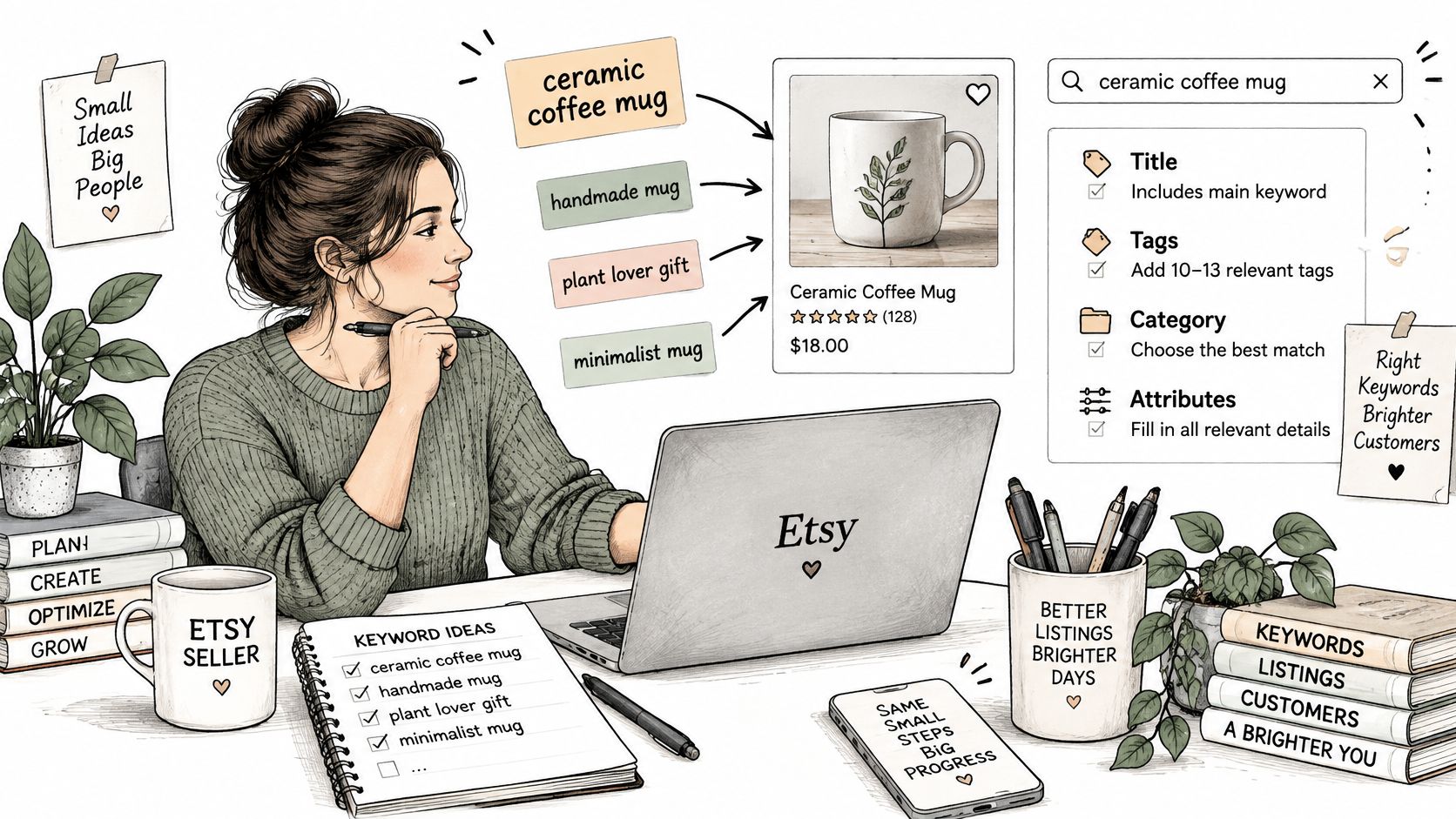
Pick one main phrase for the listing, plus two or three supporting phrases that describe the same item in different ways.
Check category and attributes such as material, color, and occasion, because Etsy matches search terms against these fields too.
Fill all 13 tag slots with natural, multi-word phrases. Etsy's shop optimization checklist recommends using all 13 available tags and making them multi-word, natural-sounding phrases. Each tag can run up to 20 characters.
Vary your tags by material, recipient, occasion, style, and use case. Repeating the same words in every tag adds little new coverage.
Put the main phrase in the title and description in plain sentences, not as a repeated list. These title and tag examples show how that reads in practice.
Check the first photo, price, and shipping details. Once a phrase brings a shopper in, those details must support a click and a purchase.
Leave the listing unchanged for a full selling cycle before you judge it, so the data reflects the new wording rather than daily noise.
A narrower phrase may bring fewer impressions but stronger buying behavior, because the shoppers who find it already want something close to your item.
Within that cycle, look for your phrase in Search Analytics. If it never appears, the problem starts with matching. If it appears but doesn't lead to clicks or orders, the problem sits after the match.
Measuring Results with Search Analytics
Open Etsy Search Analytics to see which queries brought your listing into view, which tags matched them, your average search position, and conversion data. That view helps you separate two different problems. Matching problems happen before the click, when Etsy doesn't show your listing for the phrase. Conversion problems happen after shoppers see or open it.
Reading the Four Common Symptoms
Symptom | Likely cause | Next action |
|---|---|---|
Low impressions for the target phrase | The phrase is too narrow or not in tags, title or attributes | Check placement and add the phrase to an unused tag slot |
Impressions but few clicks | The first photo or title does not match what the phrase promises | Rework the first photo and the opening of the title |
Clicks but few purchases | Price, shipping or description does not support the buyer's intent | Review price, shipping terms and the opening of the description |
Phrase not in results at all | The phrase is too broad or describes a different product | Replace it with a more specific phrase that fits the item |
Low impressions mean Etsy isn't connecting your listing to the phrase often enough, so check tags, title, and attributes first. Impressions without clicks point to the search result itself, especially your first photo and the opening words of your title. Clicks without purchases tell a different story: the phrase did its job, but price, shipping, or the description didn't close the sale. If the phrase never appears at all, replace it with a more specific phrase that fits the item.
You can also check position yourself. Rankings are checked on etsy.com in English, in a fresh private browsing window with no Etsy account signed in, on a desktop screen, with no filters and the default sort. Search your exact phrase that way and count the first 15 organic results. Ads and Etsy's own modules don't count.
Compare results over several weeks, not a single day. One quiet day proves very little, while a steady pattern tells you which fix to make next.
Choosing Your Next Step for One Listing
Pick one listing that already has sales potential and one phrase of three or more words that passed your intent, competition, and durability tests. Don't try to improve your whole shop at once. One listing and one phrase give you a result you can read.
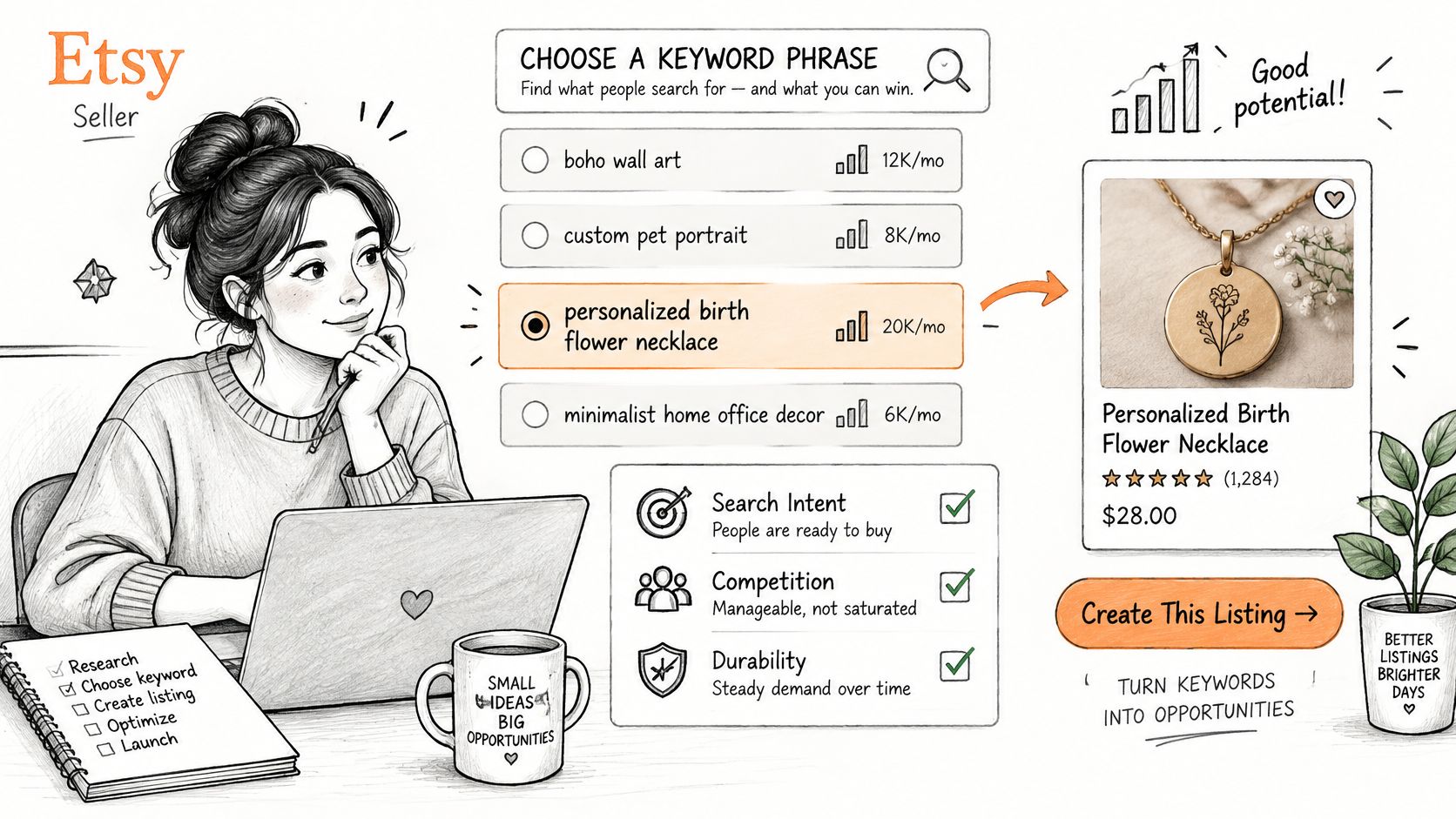
Your organic next step is simple. Place the phrase using the steps above, measure for a full selling cycle, and check the position yourself on etsy.com while signed out. If impressions rise but clicks stay flat, improve the first photo and title before you choose a new phrase.
If you want outside help on that single phrase, we can help. Upglider is an independent Etsy SEO service that is not affiliated with or endorsed by Etsy. We work on one listing for one approved phrase, aim to place it among the first 15 organic results within 21 days of confirmed payment, and maintain that position during a 30, 90, or 180-day campaign.
Campaigns start from $129 USD as a one-time payment, with no automatic renewal. We only need a live listing link, never your password, and we measure rankings in the USA and UK search markets only.
Start with organic work when a phrase is broad or untested. Consider a campaign when one proven phrase must rank through an important selling window.
Choose your strongest listing today, write down one specific three-word or longer phrase for it, and check where it stands while signed out on etsy.com. If that phrase is proven, relevant, and tied to a selling window you can't afford to miss, send us the live listing link and the phrase, and we'll assess it for a focused ranking campaign.