Etsy reported 86.5 million active buyers and 5.6 million active sellers as of December 31, 2025, with more than 100 million items listed for sale, according to Etsy's annual filing for that year. Jewelry is a major category on the marketplace, but a large audience does not guarantee a profitable sale.
A $34 necklace still has to cover silver, bench time, its box, Etsy fees, postage, and the occasional refund. Sales can look healthy while each piece leaves too little to pay you for your work.
Set a profit floor for every listing: the lowest price that covers its costs and leaves room for earnings. Use that floor before deciding whether to promote a piece, offer free shipping, or list it again.
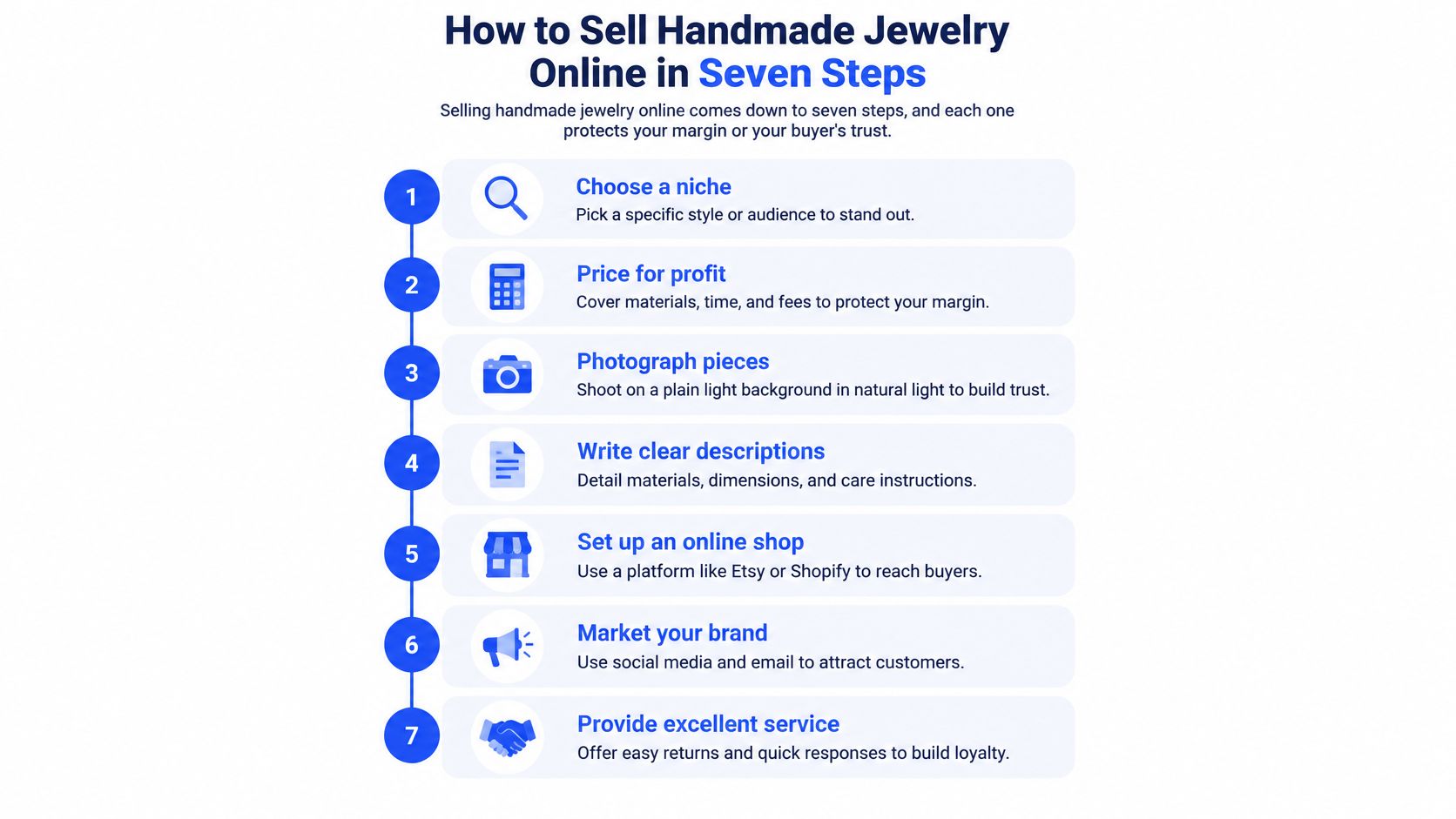
How to Sell Handmade Jewelry Online in Seven Steps
A large share of U.S. consumers surveyed in 2025 said they had bought jewelry online, according to The Plumb Club's Industry and Market Insights study, conducted with Qualtrics and Paola De Luca. For a small jewelry shop, online demand only matters if each sale clears its profit floor after materials, labor, fees, shipping, and returns.
Use these seven steps to build a listing that earns trust and has room to make a profit:
Confirm each piece fits your shop. Make or assemble the item yourself, and use photos of the actual finished piece.
Choose a specific buyer and product. A birthstone necklace for new mothers gives your shop a clearer focus than “jewelry.”
Price from the full cost. Include materials, your time, packaging, fees, shipping you absorb, and a reserve for returns.
Photograph the piece clearly. Show close-ups, its scale, and how it looks when worn.
Write a useful listing. Use a plain title, relevant tags, accurate product details, and an honest shipping estimate.
Review each listing's views, favourites, and sales monthly. Look for where interest drops off.
Change the weakest part first. Make one adjustment, give it two weeks, then review the result before changing something else.
Small shops often lose margin by matching a competitor's price without counting their own costs. A low price may bring sales while leaving too little to replace materials or pay for time. Photos and listing details matter too: buyers need enough information to judge the piece before ordering.
Check Your Pieces and Niche Before You List
Etsy's rules allow handmade items a seller creates by hand or with personal or computerized tools, including hand-assembled products made by combining commercial components into a unique finished item, per Etsy's creativity policy. Listings must be made or designed by the seller, and seller-made products must use original photos or videos showing the final product.
Put plainly: a beaded bracelet you designed and strung from bought beads qualifies. A ready-made gold-plated chain you bought finished, photographed with the supplier's stock image and listed as your own work, doesn't. Neither does the same chain photographed by you, because your work didn't create the finished piece.
Work through these five steps before you publish anything.
Sort your stock into three piles. Made by you, assembled by you, resold.
Remove or relabel anything resold. If it can't be described as your design or your assembly, it stays out of the shop.
Choose a niche by material, recipient or occasion. A birthstone necklace for mothers is a niche. Minimalist gold-filled hoops for people who never change earrings is a niche. "Handmade jewelry" isn't.
Write your buyer in one sentence. Something like: a woman buying a gift for a friend who wears simple everyday jewelry. If the sentence doesn't fit on one line, it's still too broad.
Test five to ten designs before you buy bulk components. Small quantities feel expensive per unit. Dead stock costs more.
Trends deserve their own warning, because they're where small shops overbuy. Etsy reported that searches for zodiac jewelry rose 400% in its Spring/Summer 2025 trend data, measured against the same period a year earlier, per Etsy's seller handbook trend report. A number like that proves interest in a theme. It doesn't prove your particular pendant sells at a profit, and it certainly doesn't prove the demand survives the eight weeks between ordering charms and shipping parcels.
Test a rising trend with a small batch or a preorder. Buy the components for ten pieces, not a hundred, and let the first ten tell you whether the eleventh is worth it.
By the end of this step you can state three things for every design: the material, the person it's for, and why it qualifies as handmade. The title, the photos and the price all get easier once those exist.
Price Each Piece to Cover Every Fee
Price equals materials, plus your labour, plus packaging, plus fees, plus the shipping you absorb, plus an allowance for refunds, plus whatever you spend on promotion. What's left is profit, and it's the only figure that decides whether a design stays in your shop.
Go down this table for one piece before you list it, with real numbers rather than guesses.
Cost line | How to calculate it | Common miss |
|---|---|---|
Materials | Add up every component in one finished piece | Price changes when buying single items instead of bulk |
Your labour | Hours spent making the piece times the hourly rate you want | Sanding, polishing and admin are left out |
Packaging | Box, pouch, card and tissue used per order | Gift extras add cost without adding price |
Etsy listing fee | $0.20 per listing, spread across the sales it earns | Renewed after four months if the listing stays up |
Etsy transaction fee | 6.5% of the item, shipping and gift wrap total | Shipping charges raise this fee too |
Payment processing | Fixed amount plus a percentage set by your bank-account country | The rate changes with the country your bank account sits in |
Shipping you absorb | Postage cost minus the amount the buyer pays | Free shipping cuts margin on small orders |
Refund allowance | Average refund rate times the average order value | Sizing questions drive more returns than faults |
Promotion budget | Discounts and sale events divided across units sold | Stacked sales can push margin below zero |
The transaction fee is why shipping structure is a pricing decision, not a postal one. Etsy's standard fee is 6.5% of the total order amount in your listing currency, and that total includes the item price plus amounts charged for shipping and gift wrapping, per Etsy's fees and taxes help page. Put $12 of postage on a $40 necklace and the fee is calculated on $52. Every dollar of postage you add to look generous also raises what the platform takes.
Where the money quietly goes
Payment processing sits on top. For each order through Etsy Payments, Etsy applies a fixed amount plus a percentage, with the exact rate varying by the seller's bank-account country, assessed on the total sale including shipping and applicable sales tax and deducted before the money reaches your payment account, as set out in Etsy's fee policy. That's one reason two shops selling the same necklace earn different amounts. Roughly 48% of Etsy's active sellers are based outside the United States, according to Etsy's 2025 investor presentation, and each country carries its own processing rate and conversion cost.
Now the part that catches people. Say a beaded necklace uses $9 of materials and takes an hour at the bench. Priced at $28 to match the mass-produced version down the road, it leaves about $17 once materials and the transaction fee are out. Packaging, a shipping subsidy and a returned order eat most of that, and you've paid yourself a couple of dollars for the hour plus the twelve minutes of photos, messages and packing tape.
Made-to-order pieces carry more labour per sale but no stock risk. Ready-to-ship pieces ship faster but you've paid for every unsold piece in the drawer. Price both, and know which one funds the other.
Personalisation is time, not a free extra. Stamping a name adds minutes at the bench, a proof message, and a higher chance of a remake. Add the minutes to labour and the remake risk to the refund allowance.
The line I'd draw: when a bestseller's margin falls below the floor you calculated for that piece, stop promoting it. Raise the price, drop the free add-on, or retire it.
Keep sales tax out of your price. It's collected, passed through and remitted, so it isn't margin, and what you must collect and remit depends on where you and your buyer are.
If one design goes out as a set or as variations inside a single listing, the fee math shifts, and how the Etsy listing fee works for multiple items is worth reading before you split one necklace into six variants.
Photograph Pieces So Buyers Trust the Price
Photos carry more of the decision than any other field on the page. A buyer can't weigh a chain in her hand, and 60% of online jewelry buyers hesitate when they cannot see a piece worn in context, according to Corso's guide to handling jewelry returns. That hesitation usually ends in a closed tab.
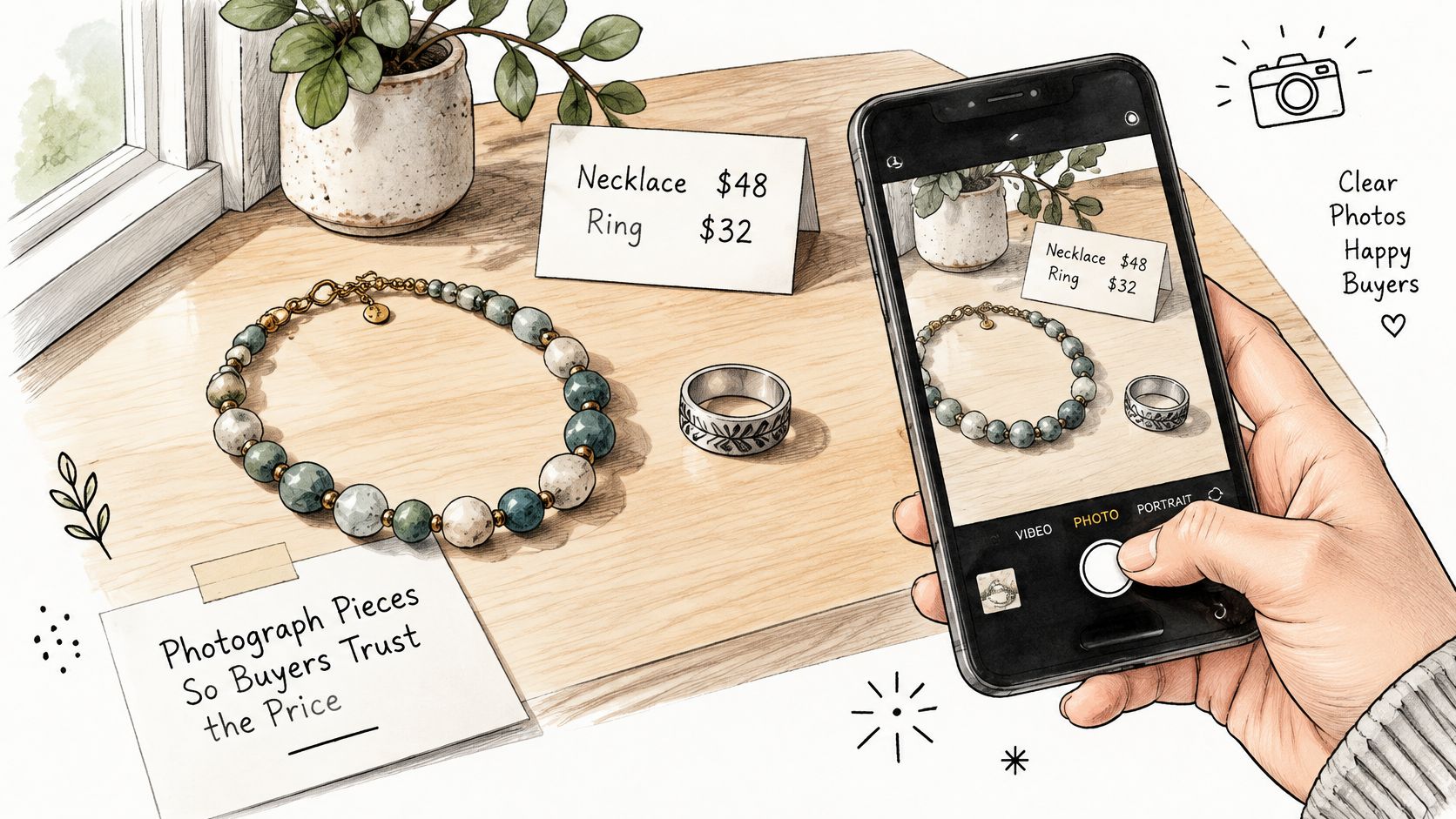
Six steps, in this order.
Shoot near a window on a plain light background. Morning daylight on a white foam board shows the true colour of silver and gold better than any lamp you own.
Take one clean image of the full piece with a ruler or size reference beside it. This answers "how big is it" before anyone has to ask.
Add close-ups of the clasp, the setting, the solder joints and the finish. These are the spots a buyer inspects for craft, and the spots a competitor's photos hide.
Include an on-model shot. A ring on a hand, hoops on an ear, a chain on a neck. Scale is the most common unanswered question in jewelry.
Compare the natural-light frame with an indoor one and keep the one that shows true colour. Warm room light turns rose gold into copper, and the buyer notices in daylight.
Photograph the packaging. The box in the photo should be the box in the parcel, or the unboxing becomes a return reason.
The usual slips are all about flattery over accuracy: retouching that shifts colour, coloured light, and a hero image that only works at full size and turns to grey mush at thumbnail size. Attractive but ambiguous photos earn clicks and then cost you return postage.
Run one check before you publish. View the first photo on your phone, at the size it appears in a search grid, and ask whether the piece and its size are still clear. If the answer is no, reshoot.
The first photo does more work than the other nine combined. Give it the most time.
Write a Listing Buyers Can Find and Trust
Start the title with the phrase a buyer would type, in the words she'd type it. "Birthstone necklace for mom" or "gold filled hoop earrings" beats a string of mood words, because the second version describes your brand and the first describes the search. Keep the title readable. Repeating "necklace" five times doesn't help a human and doesn't help the listing.
Tags are the second chance. Use the full set the platform allows, make each one a phrase someone would search, and don't waste tags repeating the title word for word. Etsy keyword research helps you find the phrases buyers use for pieces like yours.
Then fill every attribute: material, colour, recipient, occasion, style. Attributes are how buyers filter, so an empty field hides the piece from the filtered view entirely.
Answer the questions buyers ask before they buy
The description isn't a place for your life story, at least not first. Answer, in this order: what the piece is made of (gold filled, gold plated or solid 14k are three different products), the exact size in millimetres and inches including chain length, how to care for it, what's in the box, and how long you need before it ships.
Processing time and transit time are two separate numbers. Processing is how long you need before the parcel leaves your hands. Transit is how long the carrier takes. Publish them separately, because a buyer who reads "ships in one to two days" and waits nine days for delivery leaves a one-star review for something you never promised.
Each listing costs $0.20 to publish, whether or not the item sells, and stays active for four months before it expires, per Etsy's fee basics page. That's a planning fact. Seasonal designs published in October and renewed out of habit in February cost money for listings that sit idle. Get seasonal work live before the gift window, then decide on purpose whether to renew.
Five fields to finish before you publish
Title with the buyer's phrase in the first few words
Tags all used, each one a phrase rather than a single word
Attributes complete for material, colour, recipient, occasion and style
Description covering materials, exact size, care, box contents and processing time
Photos with at least one scale shot and one on-model shot
Publish when all five are done. A half-filled listing is one you'll rewrite in three weeks.
Measure Results and Fix What Is Slowing Sales
A listing can make sales and still lose money. Track seven numbers for each piece weekly: impressions, listing visits, favourites, add-to-carts, orders, conversion rate and returns. Compare each listing with its own previous 28 days, not an industry average. Jewelry types, prices and platforms vary too much for a single benchmark to explain your results.
Industry figures can still provide context. One source reports a jewelry conversion rate of about 1.2%, compared with an all-ecommerce average of 2.68%, and jewelry returns of roughly 9.8%, according to Wisepim's jewelry ecommerce figures. Use those numbers as a prompt to investigate, not as targets. A return can erase the profit on a piece after postage, fees and repacking.
You can check your own search position by searching your exact phrase on etsy.com while signed out, in a private window, and noting where your listing appears. It takes about two minutes. For more on checking rankings yourself, read this guide to the Etsy rank checker.
Symptom | Likely cause | First fix |
|---|---|---|
Views but few favourites | Photos hide scale or finish | Add an on-model photo and a ruler shot |
Visits but no add-to-cart | Price looks high for what is shown | Put materials, size and finish in the opening lines |
Sales stop after a good month | Listing has slipped down search | Rewrite the title around the phrase buyers type |
Many sales but little profit | Shipping and fees absorbed in price | Recalculate the margin and adjust shipping |
Returns about fit or size | Missing measurements or no wear reference | Add exact dimensions and a worn-size example |
Low search position for your phrase | Title and tags don't match what buyers search | Update title and tags, then recheck after two weeks |
Change one thing at a time. If you rewrite the title, replace the first photo and cut the price in the same week, you will not know which change affected the result.
Give each change two weeks before judging it. Then compare the same seven numbers and check whether the piece still clears its profit floor after fees, shipping and returns.
Launch Your First Listings This Week
One task a day, seven days, in the order that protects your margin.
Day 1: sort your stock into made by you, assembled by you, or resold, and pull anything you can't relabel.
Day 2: build the cost sheet for each piece using the cost lines above and write down its price floor.
Day 3: shoot the first photo set in the six-step order from the photography section.
Day 4: write the title, tags, attributes and description for each listing against the five-field checklist.
Day 5: publish the first five listings and note the date each $0.20 fee was charged, so you know when each expires four months later.
Day 6: check impressions, listing visits and favourites for each listing against its own previous figures.
Day 7: make one change to the weakest listing using the symptom table, then wait two weeks before judging it.
Start with the first piece you can photograph today. The second listing is always faster than the first.
If you'd rather spend the next two weeks at the bench than chasing search positions, that's the part we take on. We move one live Etsy listing into the first 15 results for a single agreed phrase of three or more words, within 21 days of confirmed payment, and hold it there for the length of the campaign, from $129 USD as a one-time payment. We never sign in to your shop, never ask for a password, and never touch your title, tags or photos. To start, all we need is the link to a live Etsy listing and the phrase you want to rank for.