Etsy tags are up to 13 short search phrases on each listing, and each phrase can be up to 20 characters. They help a listing match the words a shopper types.
That cap sits inside a very large search. Etsy reported 86.5 million active buyers and 5.6 million active sellers as of December 31, 2025, in its year-end filing. An active buyer made at least one purchase in the prior 12 months, and an active seller recorded a charge or sale in that period. Your phrases compete in that crowd. They do not buy a rank on their own. They decide which searches the listing can enter.
Treat the 13 slots as a budget, not a box to stuff. Each slot should earn its place with a phrase a buyer would type for this exact item. The rest of this guide shows how to spend that budget, check it, and swap what stops working.
What Etsy Tags Are and How They Work With Titles
Etsy gives each listing a maximum of 13 tags, and each tag is limited to 20 characters. The Etsy seller handbook on tags says every tag creates a chance to match a shopper's search, and it recommends using all 13 spaces.
Picture a shop shelf. The title is the sign above the shelf. Tags are the small labels that say what else is on it. The sign stays readable. The labels cover the extra ways someone might ask for the same item.
How a phrase beats a single word
Etsy's guidance on getting found recommends multi-word phrases rather than isolated words. Its own contrast is clear. Custom bracelet as one tag carries more buyer intent than custom and bracelet as two separate tags. A lone word is too wide. A short phrase names the item and one detail at the same time.
Vary the wording. Different shoppers use different queries for the same product, so near-copies waste slots. Categories and attributes already help matching, so do not spend a tag repeating a fact those fields already hold.
The two steps search actually runs
Search works in order, and mixing the steps is where sellers get stuck.
Qualify. Etsy compares the query with tags, the title, the description, categories, attributes, and the first photo. A listing has to match before it can be ranked.
Place. After a match, Etsy weighs listing engagement, customer experience, recency, and personalized search context. Tags get you into the pool. They do not set the order by themselves.
Each field has one job:
Title: carries the main phrase a buyer should read first.
Categories and attributes: say what the item is, in Etsy's own fields.
Description: repeats key terms in normal sentences.
First photo: must show the thing the tags describe.
Tags: add the angles the other fields leave out, such as a recipient or a gift use.
Practical rule: Would a buyer type this exact phrase to find the item? If not, that slot is not earned.
A clear title can stay short. Move the extra buyer phrases into tags. The title tag examples page shows how that split looks when the sign and the labels do different work.
Filling all 13 slots raises the number of distinct queries a listing can qualify for. Repeating one idea cuts that coverage. Spread phrases across product type, material, style, recipient, use case, and occasion, and keep every phrase true to the item. A gift phrase belongs here when attributes cannot say "gift for mom" on their own.
How to Find Buyer Phrases and Fill All 13 Slots
Start with the words buyers use, not the name you gave the glaze in your studio notes. Three places give you those words without guesswork.
Search suggestions on Etsy appear as you type a product idea. If you type "ceramic mug" and the bar offers "ceramic coffee mug," that longer line is buyer language. Reviews on similar items show how owners describe the piece after they own it, often with a use or a person. Your own title and description already hold phrases you can split into tags, as long as you do not paste the title back in word for word.
The Etsy Seller Handbook, updated in 2026, recommends adding all 13 tags. Each tag is another chance to match a search. An empty slot is a chance you did not take. Our Etsy keyword research walkthrough shows how to collect those phrases before you assign them.
Spend the slots in this order
Say you sell a speckled stoneware mug with a handle, made for a desk, and often bought as a housewarming present.
Product type first. "Ceramic coffee mug" is the core phrase buyers search.
Material next. "Stoneware mug" is a different angle for people who care what it is made of.
Style or finish. "Rustic farmhouse mug" matches the look they describe.
Recipient. "Gift for coffee lover" catches someone shopping for another person.
Use case. "Office coffee mug" matches where it will sit.
Occasion or season. "Housewarming gift" ties the mug to a buying moment.
Remaining spaces. Add distinct angles such as size or colour, for example "speckled blue mug," only if the mug really is that.
Accuracy last. Every phrase must describe something the item really is.
Dimension | Example for a ceramic mug | Why it earns a slot |
|---|---|---|
Product type | ceramic coffee mug | The core phrase buyers search first |
Material | stoneware mug | Adds a distinct search angle for buyers who filter by material |
Style or finish | rustic farmhouse mug | Matches the look buyers describe in their searches |
Recipient | gift for coffee lover | Captures gift intent when buyers shop for someone else |
Use case | office coffee mug | Matches where the item will be used |
Occasion or season | housewarming gift | Connects the item to a buying moment |
Count characters before you save. "Gift for coffee lover" fits. A longer studio name will not. Shorten to the words a buyer would type, and do not cut a word in half.
No two tags should say almost the same thing, and every tag should describe something the item really is.
If two phrases would bring the same shopper, keep the clearer one and spend the other slot on a new angle.
Etsy Tag Examples by Product Category
Gift language is not a filler line. In its Spring and Summer 2024 Seller Trend Report, Etsy reported a 238% year-over-year increase in searches for handmade gifts, comparing January–March 2024 with the same period in 2023, as noted in the seller trend report. A phrase such as "personalized gift for dad" can earn a slot when the item is that gift.
The pattern to copy is simple. Product type, plus material or a clear detail, plus one buyer detail. "Birthstone necklace gift" beats "necklace" because it names the item, a stone detail, and a reason to buy.
Category | Strong tag phrase | Weak tag to avoid | Why it works better |
|---|---|---|---|
Jewelry | birthstone necklace gift | necklace | Names the item, a stone detail and a gift intent |
Home and living | linen throw pillow cover | pillow | Adds the material and the exact item buyers search for |
Art | watercolor botanical print | art | Names the medium and the subject buyers look for |
Printables | printable wedding invitation | printable | Names the item and the event it is for |
Handmade gifts | personalized gift for dad | gift | Pairs gift intent with a specific recipient |
Find your row and build the other slots the same way. A jewelry listing might pair "birthstone necklace gift" with the metal, the style, and the person it is for. A printable stays specific to the event, not the file type alone. "Printable" matches almost everything in that category, so it does not separate your invitation from a planner page.
A home listing should name the exact object. Shoppers search "linen throw pillow cover," not "pillow," when they already know they need a cover. Art buyers often search the medium and the subject together. "Art" is what the category already says.
These lines are starting points. The exact phrases should come from the buyer language you gathered, not from a list that ignores your item. If nobody would type the strong phrase for your product, it is not strong for you. Swap in the words reviews and search suggestions use, and keep the same shape: item, one detail, one buyer reason.
Common Tag Mistakes and How to Fix Them
Most weak tag sets fail in a few predictable ways. Check these first when a listing stalls in search.
The most common miss is the single-word tag. "Mug" matches mugs, mug racks, and mug rugs. You enter a huge pool and look like a weak match. Replace it with a phrase such as "ceramic coffee mug."
Mistake | What it looks like | Fix |
|---|---|---|
Single-word tags | mug | Replace with a multi-word phrase such as ceramic coffee mug |
Near-identical repeats | mug gift, gift mug, mugs as gift | Keep one phrase and use a different buyer angle for each other slot |
Title words repeated in tags | handmade ceramic mug | Keep the core phrase in the title and use tags for the angles the title misses |
Empty slots | 9 of 13 used | Fill all 13 spaces with accurate phrases |
Forced trend terms | Christmas on a summer item | Remove any term the item does not truly match |
Inaccurate descriptors | silver on plated jewelry | Describe only what the item actually is |
What each mistake costs you
A repeat spends three slots on one idea. Keep one gift phrase and give the other slots a material, a room, or a person.
Copying the title is the quiet version of the same waste. If the title already says "handmade ceramic mug," the tags should add "gift for coffee lover" or "housewarming present." The title already did the product-type job.
Empty slots are the cheapest fix. Nine phrases means four searches you never entered. Fill the gaps with accurate lines you have not used yet.
A forced trend brings the wrong season. "Christmas" on a summer picnic set can match a query the item does not serve. Those shoppers leave. Remove any term the item does not match.
An inaccurate word does the same harm faster. Calling plated jewelry "silver" can draw buyers who wanted solid silver. They bounce, and the listing looks less relevant to the people who stay. Describe only what the item is.
If a phrase runs past 20 characters, shorten it to its core words. Do not cut mid-word. "Personalized gift for dad" fits if you trim a filler word, not if you leave "personali" sitting in the field.
Swapping Seasonal Tags Without Losing Core Ones
A fixed tag list can miss a change in what shoppers want. Etsy's Marketplace Insights guidance on seasonal terms recommends using seasonally relevant, top-searched phrases in tags, titles, and descriptions when they fit. Let seasonal phrases take a few tag slots, not the whole list.
The decision rule
Treat your 13 tag slots like a limited budget. Keep durable product phrases in most of them, then use a few to test seasonal or rising terms. For a wedding favor, add a wedding phrase before shoppers begin planning. A Christmas tag on a summer product may match a holiday search, but only if the item suits that buyer's needs.
Before adding a seasonal phrase, check three things:
The item fits. A buyer should look at the product and agree that the phrase describes it.
A buyer might search it. Choose a phrase a shopper could type, not a trend word added just for attention.
The phrase earns its slot. Keep the product's core description covered so the listing remains relevant after the seasonal interest fades.
Holiday, wedding, graduation, and trend-led products all have selling windows. Draft a short list of possible seasonal tags before each window opens. Swap only a few slots, and keep the phrases that accurately describe the product.
When the window passes, replace seasonal tags that no longer fit. Keep the durable phrases for the product type, material, and use. Those can still match a shopper's search long after the holiday ends.
How to Test Your Tags and Measure Results
Etsy does not publish an exact ranking formula. Measure change against your own starting point, not against a score you cannot see.
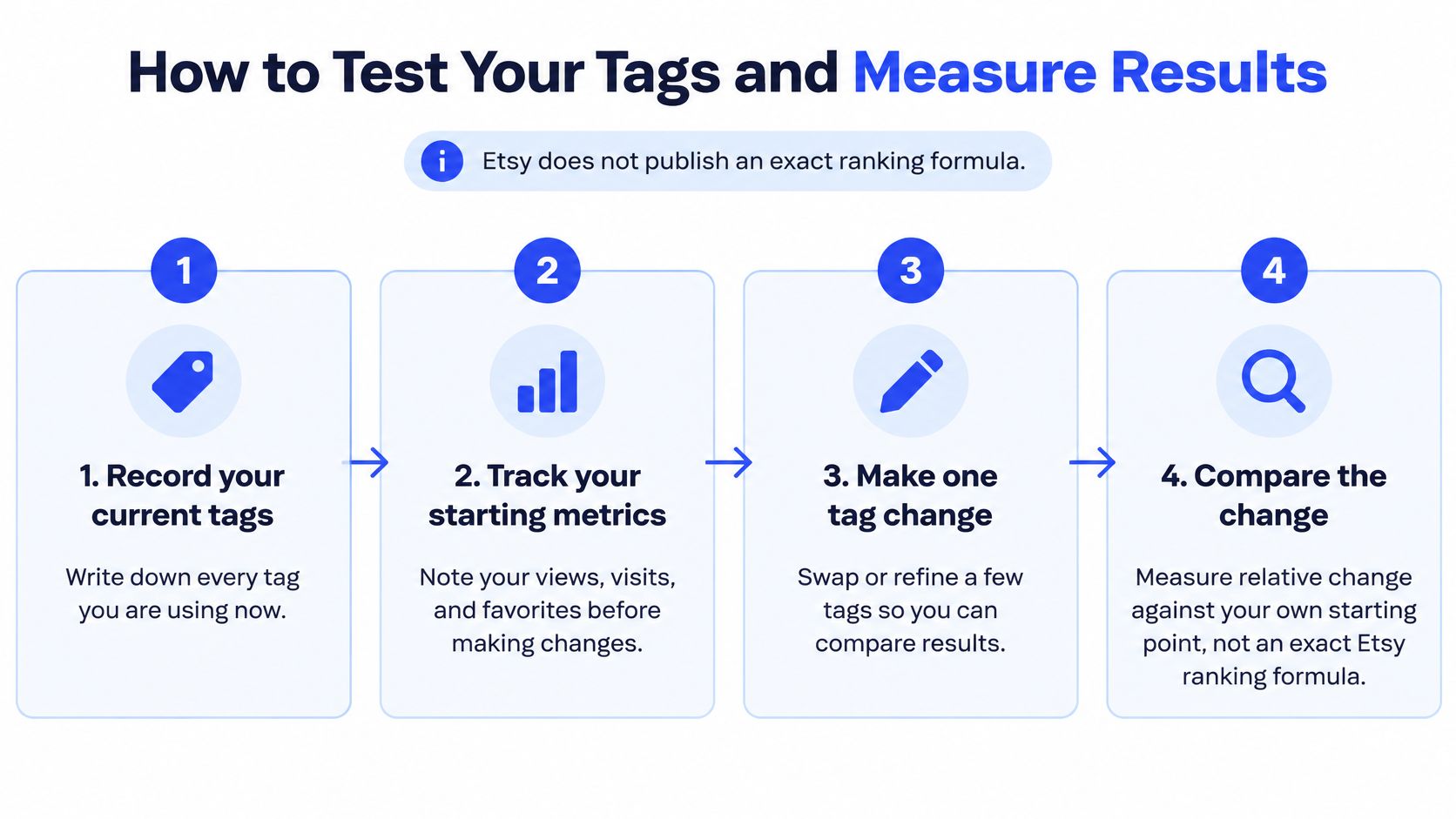
Six steps that keep the test honest
Record the baseline. Write down the current tags, plus views and favorites from your shop stats, before you touch anything.
Change one group. Swap a few related tags, not all 13. If everything moves, you cannot tell which phrase helped.
Check position the same way each time. On etsy.com, open a fresh private window, stay signed out, search in English on a desktop screen, leave filters off, and keep the default sort. Note where the listing sits. An Etsy rank checker habit is just this same signed-out search, repeated.
Wait for a real window. Give the change time. For a seasonal phrase, make the edit before buyers start shopping that moment.
Compare. Set the new views, favorites, and search position next to the baseline. A healthy result is a steady rise in views for the target phrase, not one lucky afternoon.
Keep or revert. Hold the changes that help, put back the ones that do not, and start the next test on a different group.
You can run that signed-out check any time by searching the phrase on etsy.com while signed out. Your own logged-in results are personalized, so they are a poor judge of what a new shopper sees.
Change tags in small groups so a drop is easy to undo. If views fall after you add a gift phrase, that phrase was the variable. Put the old set back and try a different buyer angle next.
Audit Your Tags This Week and Decide What to Do Next
Open your most important listing and run this pass today.
All 13 slots used, with a real phrase in each.
Every phrase accurate to the item in the photos.
Multi-word wording, not one lonely noun.
No near-repeats, and no title line copied into the tags.
Seasonal phrases marked with the selling window they serve.
Keep improving with the test loop, one group at a time, and confirm with the same signed-out search.
If doing that across every listing is not realistic, one outside option is Upglider. We are an independent Etsy SEO service, not affiliated with or endorsed by Etsy. A campaign works to rank one chosen listing for one agreed search phrase. You send a public listing link and the phrase. No Etsy password is needed. We rank listings in the USA and UK search markets only. Whichever route you take, confirm the result with that signed-out search.
Pick the listing that matters most, run the audit this week, and set a date to search the phrase again.
Open that listing now, count the empty or repeated slots, and replace one weak phrase before you close the tab. If you would rather have us work the ranking for a single agreed phrase, send the live Etsy link and the phrase. We never need your password, and you can check the signed-out results yourself on the date you set.