You've photographed your products, published your listings, and checked Etsy Stats again. There's barely any movement, or there are plenty of views but no orders. Both are frustrating, but they need different fixes.
To work out how to get more views on Etsy, first separate a discovery problem from a buying problem. Improve search matching when shoppers can't find you, improve the thumbnail when they scroll past, and improve the purchase details when they visit but don't buy.
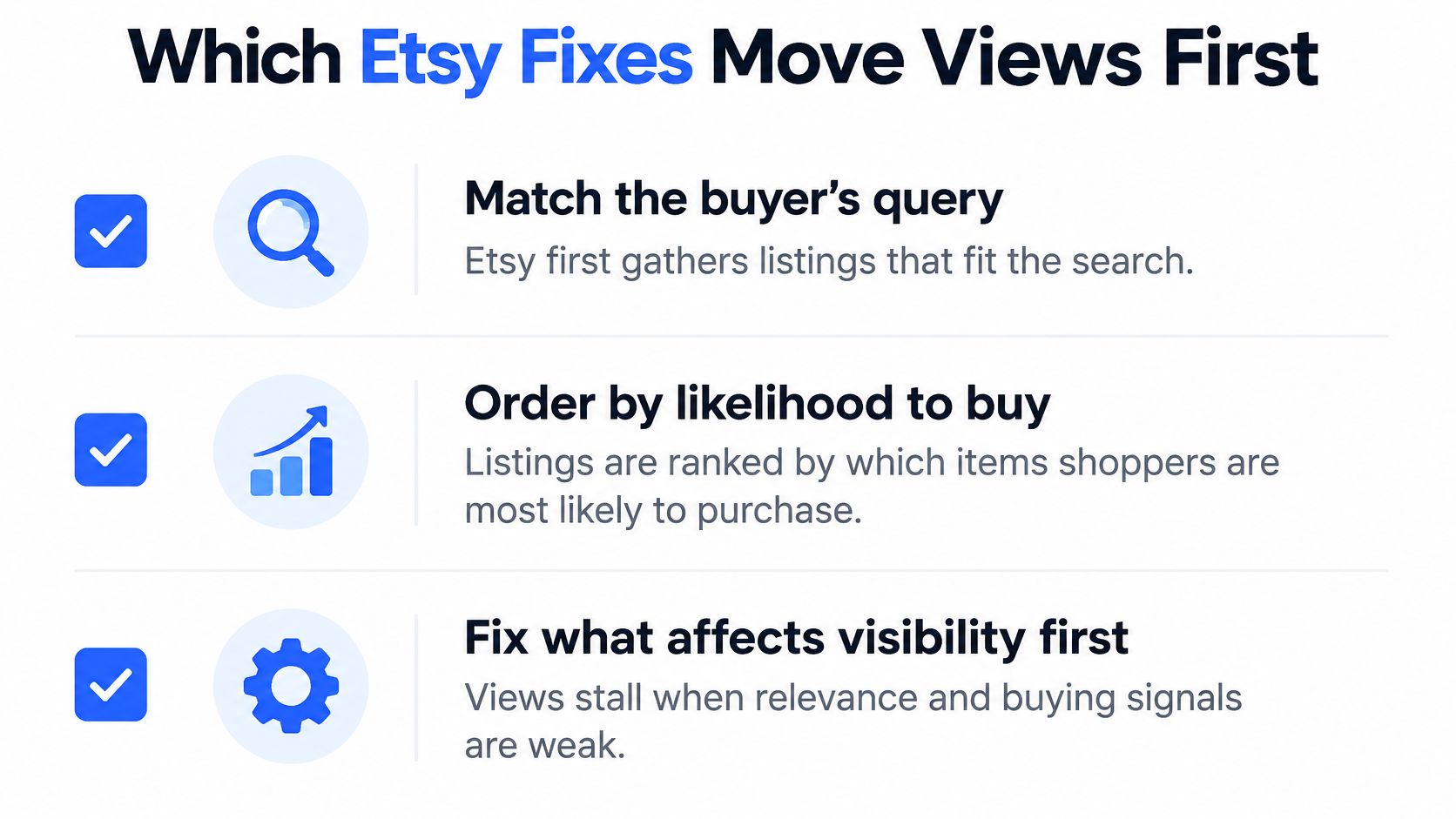
Which Etsy Fixes Move Views First
Etsy doesn't rank listings on keywords alone. According to Etsy's explanation of how search works, it first gathers listings that match a buyer's query, then ranks them by which items shoppers are most likely to purchase.
That means accurate wording gets you into consideration, but product appeal and buyer response help determine what happens next. Rewriting a title won't resolve every visibility problem, especially if shoppers already find the listing and leave without purchasing.
Etsy view fixes ranked by where to start
Fix | What It Changes | Effort | Start When |
|---|---|---|---|
Rewrite title and 13 tags | Search matching | Low, under an hour per listing as a working allowance | Few impressions for your products |
Upgrade the primary photo | Clicks and click-through | Medium, a reshoot or edit | Listing gets impressions but few clicks |
Set most specific category and attributes | Search eligibility | Low | Listing sits in a broad or wrong category |
Add return policy and check shipping | Search priority and buyer trust | Low | Policy is missing or domestic shipping is high |
Review price and description | Conversion from views to sales | Medium | Views are steady but sales lag |
Promote outside Etsy | New visits from other platforms | Medium to high, ongoing | Before a launch or seasonal peak |
Titles and tags connect the product to the buyer's wording. The primary photo helps shoppers recognize it quickly, while categories and attributes describe exactly what it is. Policies and shipping remove uncertainty, price and description help shoppers decide, and outside promotion brings another route to the listing.
Use the symptom, not the table's order, to choose your first move. Few search appearances suggest a matching problem. Appearances without clicks suggest a photo or title problem, while listing views without orders suggest a conversion problem.
Be careful with the labels: a listing view means someone opened it, while an impression means it appeared on a screen. Don't assume Etsy Stats provides an impression count for every organic search placement.
Before editing: Pick your three best-selling and three most-viewed listings, allowing for overlap. Write down the weakest stage for each, then choose the fix.
For a new shop, start with your three strongest listings rather than overhauling everything. Apply the title, tag, and photo checks there first; I'd allow two to four weeks as an initial observation window, not a promised turnaround time.
How to Write Titles and Tags Buyers Search
Start with the buyer's words, not your product nickname. A candle maker might call a product Cozy Candle, but a buyer could search for hand-poured soy candle gift for mom. The latter describes the material, product, and buying occasion.
Treat those phrases as candidates to investigate, not proof of demand. Check the search terms already bringing shoppers to your shop, and use Etsy keyword research to organize possible phrases around the product's actual features.
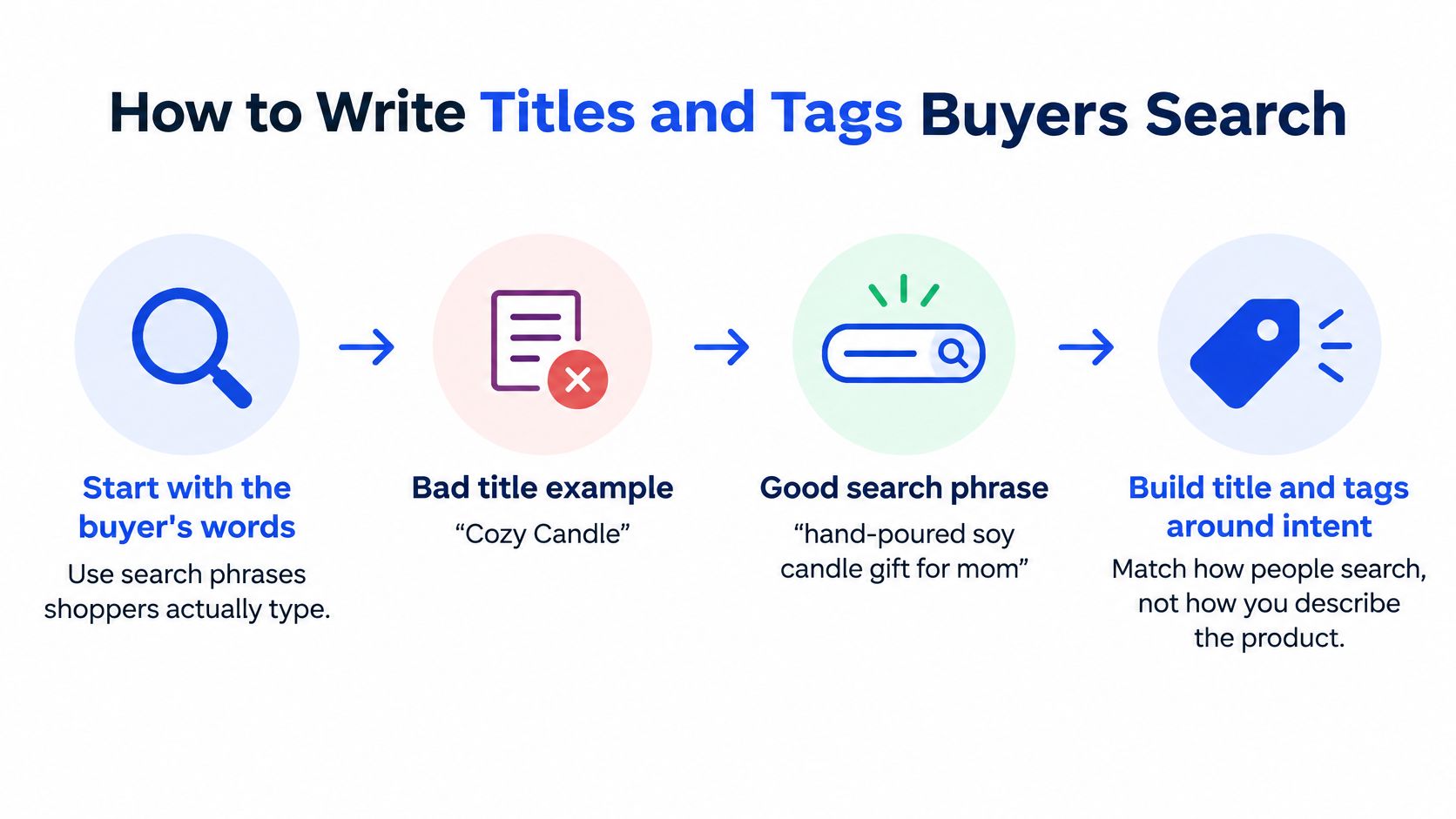
Build around a clear buying intention
Etsy's keyword guidance recommends using all 13 tags as natural-sounding phrases and explains that title-word order doesn't directly determine ranking. Use the following workflow to make the listing readable while covering relevant search angles.
Name the exact buyer phrase. For a suitable product, personalized leather passport holder is more informative than travel accessory. Write down what the buyer wants to purchase before adding recipient or occasion ideas.
Put your two or three strongest phrases near the start of the title. Use them where they read naturally and communicate the product immediately. This is a clarity recommendation, not a claim that front-loading words automatically improves rank.
Use each tag for a distinct, relevant angle. Cover material, use, recipient, style, or occasion where those details apply. Check that each phrase fits Etsy's tag field rather than pasting a long title into it.
Choose the most specific category and applicable attributes. Complete color, material, occasion, and other fields accurately. Don't select an attribute merely because it seems popular.
Review the search terms in Etsy Stats after an observation period. Compare the phrases bringing relevant visitors with those you intended to target. Replace weak or mismatched tags gradually rather than rewriting everything after a quiet day.
Remove repetition without losing relevance
Near-duplicate tags waste space when they describe the same angle. Unrelated terms are worse: someone looking for a different product is unlikely to become a useful visitor just because your listing appears.
Avoid awkward titles that read like disconnected search queries. A title such as Personalized Leather Passport Holder, Monogram Travel Gift tells shoppers what's available without making them untangle a keyword block.
A readable title helps the right shopper recognize the product. More words aren't automatically more useful.
Frequent renewals aren't an effective long-term optimization strategy, so don't use them as a substitute for improving the listing. A finished listing should have a natural title, distinct tags, accurate attributes, and no tag added solely to repeat the entire title. Relevant overlap between a title and a tag is fine; needless duplication is the problem.
Listing Requirements That Affect Search Priority
Etsy's Search Visibility guidance says an active listing should have at least one image, recommends a primary photo at least 2000 pixels wide and 2000 pixels high, and says US listings with domestic shipping prices below $6 receive search priority.
Requirement | Etsy's guidance | Why it matters |
|---|---|---|
Listing image | Include an image in an active listing | Buyers need to see what's for sale |
Primary photo | Use a high-resolution image of a clear, well-lit finished product, not a collage | Shoppers can identify the item |
Category | Choose the most specific available category | Etsy receives a precise product classification |
Return policy | Add a policy, including No returns where applicable | Buyers can understand the terms before ordering |
US domestic shipping | Check eligibility against the shipping-price guidance above | Shipping price can affect search priority |
Check the listing in buying order
Start with the thumbnail, because that's the version shoppers encounter before opening the listing. Then check the settings that describe the product and the purchase terms.
Inspect the primary photo at thumbnail size. Dark lighting, blur, and a product that looks tiny are practical faults to fix. Use a clear finished-product image first, then supporting photos for detail and scale.
Check the category. Choose the closest specific option, not a broad parent category for supposed reach. This guide to Etsy listing categories can help you distinguish marketplace categories from your own shop sections.
Add the return policy. Use No returns where appropriate and permitted, rather than leaving buyers to guess. Make sure the policy matches what you offer.
Review domestic shipping for US listings. Compare the buyer's total cost and your remaining margin before changing the shipping charge.
For example, a shop charging $8 for domestic shipping might test a lower shipping charge with a slightly higher item price. That's a hypothetical pricing test, not a reason to hide costs or reduce your margin blindly.
The shipping threshold is US-specific. UK and other sellers should check their own market's Search Visibility guidance rather than importing the US rule.
With these settings in place, you've addressed the basic checks for competing for priority placement. You haven't secured a position; relevance and shopper response still matter.
Why Views Do Not Turn Into Sales
Conversion rate equals total sales divided by total views, multiplied by 100, and Etsy recommends evaluating it across several months rather than reacting to short-term fluctuations. That guidance also identifies review rating, message response rate, and case rate over the previous three months as customer-service inputs to search ranking.
Conversion matters because Etsy considers whether people who view a listing go on to purchase. A listing can attract attention without giving buyers enough confidence to order.
Symptoms, likely causes and first fixes
These are starting hypotheses, not diagnoses. Check the listing and its traffic before making the suggested change.
Symptom | Likely Cause | First Fix |
|---|---|---|
Views steady, sales low | Photo, price or description | Improve the primary photo and the first two description lines |
Few views, but buyers convert when they arrive | Search matching | Rewrite title, tags and category around buyer phrases |
Views dropped after a keyword change | Too many variables changed, or normal volatility | Revert the change and measure over several weeks |
Many views from broad terms, few buyers | Terms too broad for the product | Target specific multi-word phrases |
Views rising, conversion falling | Shipping, return policy or response times | Check shipping, add a return policy and reply faster |
A conversion problem often starts with unanswered questions. Buyers may like the appearance but still not know the dimensions, material, delivery expectations, or what personalization includes.
Make the opening description lines practical: what it is, its size, its material, and who it suits. Compare the price against similar listings, accounting for materials, finish, personalization, and the total delivered cost.
Say a leather wallet receives 400 views and two sales in a hypothetical test period. If the wallet looks small against a gray background, test a closer image held in a hand; if dimensions are buried, move them into the opening description. Those changes address uncertainty without immediately cutting the price.
Testing rule: Change one element, wait, then compare it against the baseline. Otherwise, you won't know which edit helped.
Don't treat every decline as evidence that the price is wrong. Check whether you attracted different search traffic, changed your shipping terms, or left buyer questions unanswered. Keep helpful replies and accurate fulfillment promises part of the work, not an afterthought to search optimization.
Timing, Renewals and Traffic From Outside Etsy
Seasonal products need preparation before shoppers reach their buying deadline. I'd plan a six-to-eight-week lead-in for Mother's Day, back-to-school products, or winter holiday gifts, then adjust it for your production and delivery times. That's a planning allowance, not an Etsy ranking rule.
Renew only when there's a genuine listing or inventory reason. Paying to renew an unchanged listing isn't a substitute for making the product easier to find or buy.
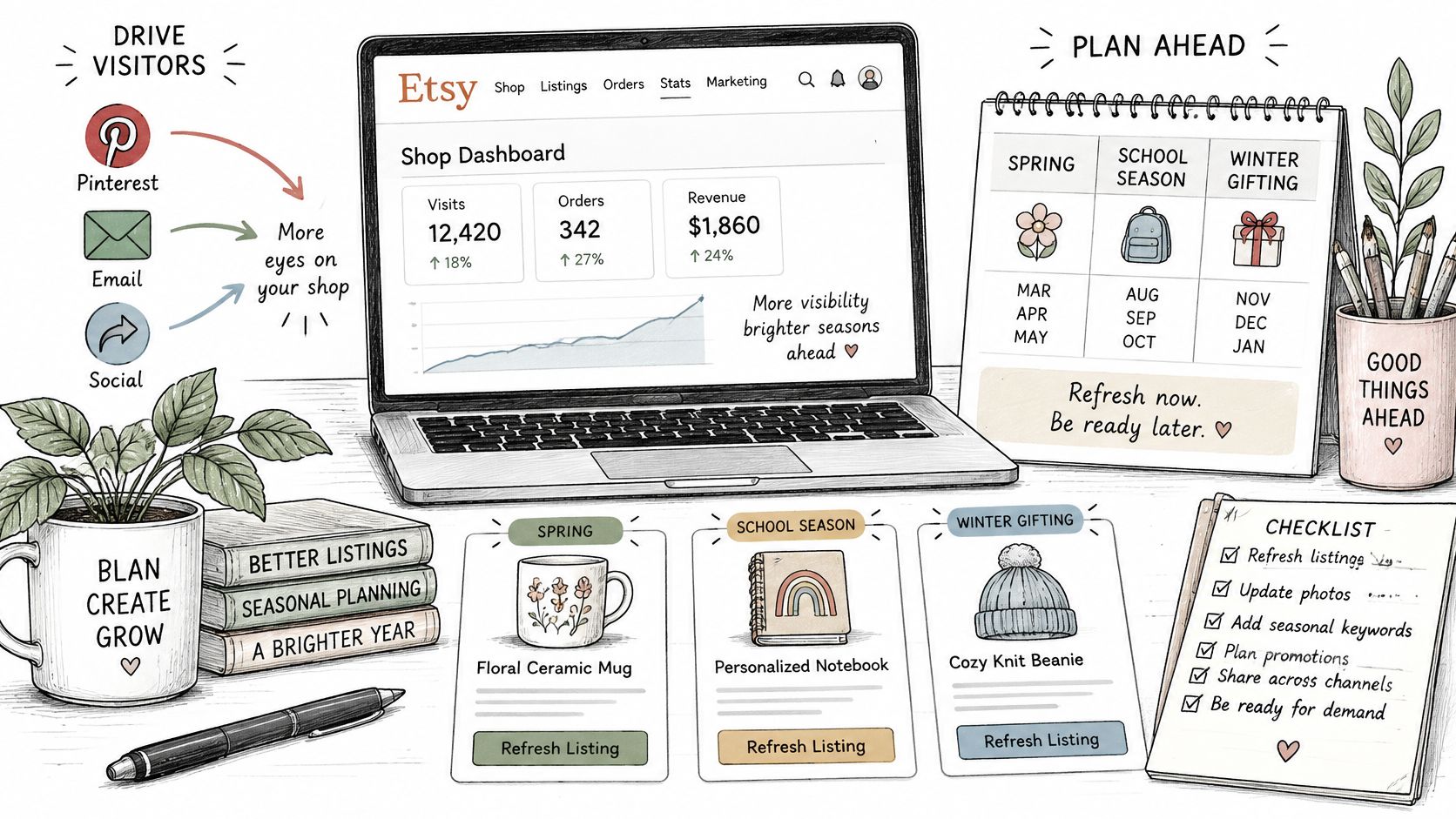
Reach occasional shoppers and returning buyers differently
In its annual reporting for the year ending December 31, 2025, Etsy said approximately half its buyer base purchased once during the year, while the other half bought on roughly five separate days. Don't assume every potential customer will return to discover your next release.
For past buyers: Share relevant launches through an email list they've opted into. A package insert can invite customers to subscribe, but don't add order email addresses to a marketing list without permission.
For visual discovery: Post products on Pinterest or Instagram with a direct listing link and a natural description using the relevant buyer phrase.
For seasonal launches: Show the occasion, ordering deadline, and product clearly rather than publishing a generic promotional graphic.
Use an Etsy shop marketing plan to keep those activities manageable. A useful weekly routine is to create a post or pin for each new listing and record which channels bring purchasing customers.
Treat outside visitors as potential customers, not an automatic ranking boost. The cited Etsy guidance doesn't establish that outside clicks alone improve search placement. Judge the effort by useful visits and orders, not by social likes.
Run a 30-Day Test and Pick Your Next Move
Use a 30-day test as a manageable working window, not proof that Etsy will respond on schedule. Choose a listing with a clear product, reliable fulfillment, and enough buyer activity to make comparison worthwhile.
Keep a simple test record
Record the baseline. Save the previous 30 days of views, favorites, orders, and conversion rate. Note promotions, stock interruptions, or seasonal events that could affect the comparison.
Change one thing. Choose the main photo or title phrasing, for example. Keep a copy of the original so you can reverse the edit accurately.
Check search terms. Review which phrases bring visitors and whether those shoppers are looking for the product you sell. Separate views, favorites, and orders; record impressions and clicks where your reporting provides them.
Compare after the test window. Look at sales per view alongside total orders. If there's too little activity, continue observing rather than forcing a conclusion.
Check your position independently. Search your exact phrase while signed out, using a fresh private desktop window, English, no filters, and the default sort. Note whether the listing appears among the first 15 organic results, excluding ads.
Etsy's full-year results describe ongoing changes to search relevance and buyer-intent systems, so a short dip doesn't prove your edit failed. A private-window search is a repeatable check, not a view of every shopper's results.
Keep a change when conversion and orders hold or improve. Revert when they deteriorate under comparable conditions; if the evidence is unclear, test longer before changing the next variable.
Choose a live listing and record its baseline today. If you want focused ranking help, send us its public link to start an Upglider assessment. Our Etsy SEO campaigns start from $129 USD as a one-time payment and focus on ranking, not guaranteed sales; we don't need your Etsy password. Upglider is independent and isn't affiliated with or endorsed by Etsy.