Publishing any quantity in one Etsy listing costs $0.20 once, not $0.20 per unit up front. Extra $0.20 charges appear only for additional units sold and for renewals.
The familiar advice that Etsy charges per item is easy to misunderstand. It can make a new seller confuse the stock inside a listing with separate listings, or assume that combining everything into one listing removes later fees. Neither assumption gives you a reliable budget.
The useful question is what happened to the listing? Publishing, selling extra units, and renewing are different events. Keep them separate, and your payment account becomes much easier to follow.
What Multiple Items Cost to List
Typing a quantity of 10 doesn't mean paying $2.00 on publish day. You're creating a listing that holds inventory, not creating a separate paid listing for every bowl on your workbench.
Say you make matching ceramic bowls. You photograph the product, write a description, and enter the stock available. The quantity tells Etsy how many bowls buyers can order. It isn't an instruction to bill every bowl immediately.
Think of the listing as a shop shelf label, rather than a stack of individual price tags. You pay to put the label up. Further listing-related charges arise as products leave that shelf or you renew the label.
Separate the listing from the inventory
Your bookkeeping needs distinct places for these events:
First publication: The charge for creating the listing.
Additional units sold: Charges connected to selling more items from that listing.
Renewal: A charge for keeping or putting the listing back into use.
This distinction matters before you've made a sale. Stock sitting in your studio isn't the same thing as stock sold, and neither is the same thing as an expired listing you decide to renew.
Practical rule: Treat the quantity field as an inventory promise, not an upfront fee calculator.
For the bowl seller, a complete sell-through eventually produces a different listing-fee total from publication alone. An unsold listing can also produce another charge if the seller renews it. Your budget therefore needs both a sales expectation and a renewal decision.
The fee is denominated in USD, although your shop account may display a converted local-currency amount. When reconciling charges, compare the event descriptions as well as the displayed amounts.
Use the event table below to identify why a charge appeared. That's more useful than trying to explain every listing-related debit with the word “quantity.”
Listing Fee Events and What Triggers Each
When the $0.20 listing fee is charged
Event | What triggers it | USD charge |
|---|---|---|
Publish the listing | Any quantity of 1 or more | $0.20 once |
Each extra unit in one order | Units after the first in that order, including extra variations | $0.20 per extra unit |
Auto-renew after a partial sale | Some stock remains after the order | $0.20 |
Four-month expiry renewal | Listing expires and seller renews, sold or not | $0.20 |
Manual renewal at any quantity | Seller renews the listing | $0.20 |
Etsy's guidance on listing multiple quantities establishes the $0.20 USD publication charge, additional-unit charges, and renewal after a partial sale. Etsy's Fee Basics explains that extra variations purchased also count as additional items and that listings expire after four months, with a $0.20 fee when renewed.
Publication pays for the listing, not all future sales
The initial publication charge applies whether you offer a single available item or a larger stock quantity. Entering more inventory doesn't multiply that initial charge.
That first fee also covers the first unit sold from the original listing. Don't add another initial-unit fee because a buyer checks out. Otherwise, you'll count the same coverage twice.
The phrase Etsy listing fee multiple items can mislead sellers searching for a simple answer. “Multiple items” might mean more stock inside a listing, more products in an order, or several separate listings. Only the event tells you which fee applies.
Several units in an order create additional-unit charges
When a customer buys several units from the same listing, the original fee covers the first item. Each further item creates the additional-unit charge shown in the table.
Variations don't provide an exception. If a buyer chooses different sizes or colors from the same listing, those are still separate items purchased. Choosing an option isn't itself a chargeable sale, but buying another item with that option is.
For example, a customer choosing a blue bowl instead of a white bowl hasn't bought extra stock. A customer buying both has. Count the items purchased, not the number of choices you offered in the menu.
Partial-sale renewal and expiry renewal are different
A partial sale leaves inventory available. Etsy automatically renews the listing so that remaining stock can stay on sale, creating the renewal charge shown above.
That charge is separate from additional items within the order. When checking a multi-item purchase, look for both the extra-unit charges and any renewal needed to keep the remaining stock live. Don't assume that a sale-related renewal means the listing reached its expiry date.
A time-based renewal has a different trigger: the listing expires and you renew it. That can happen without a sale, so you need to allow for listing expenses even when revenue hasn't arrived.
A sale explains why stock decreased. A renewal explains why the listing continues. Those aren't interchangeable bookkeeping entries.
Manual renewal is another deliberate event. Before renewing, check whether you're extending an existing offer or restoring stock after a sell-out, then record the renewal rather than treating every available unit as a new publication.
Keep other selling fees outside this calculation
Transaction fees and payment-processing fees are separate from listing-related charges. A listing-fee calculation isn't a complete estimate of what Etsy will deduct from a sale.
Payment-processing terms depend on the seller's country. Check Etsy's current fee guidance for your shop rather than copying a rate from another seller's example.
For a clean spreadsheet, use separate columns for publication, additional-unit charges, sale-triggered renewal, expiry renewal, and other selling fees. When a debit appears, assign it to the event that caused it. This prevents both double-counting and the mistaken assumption that the original publication fee covers everything buyers later purchase.
Stock, Variations, or Separate Listings
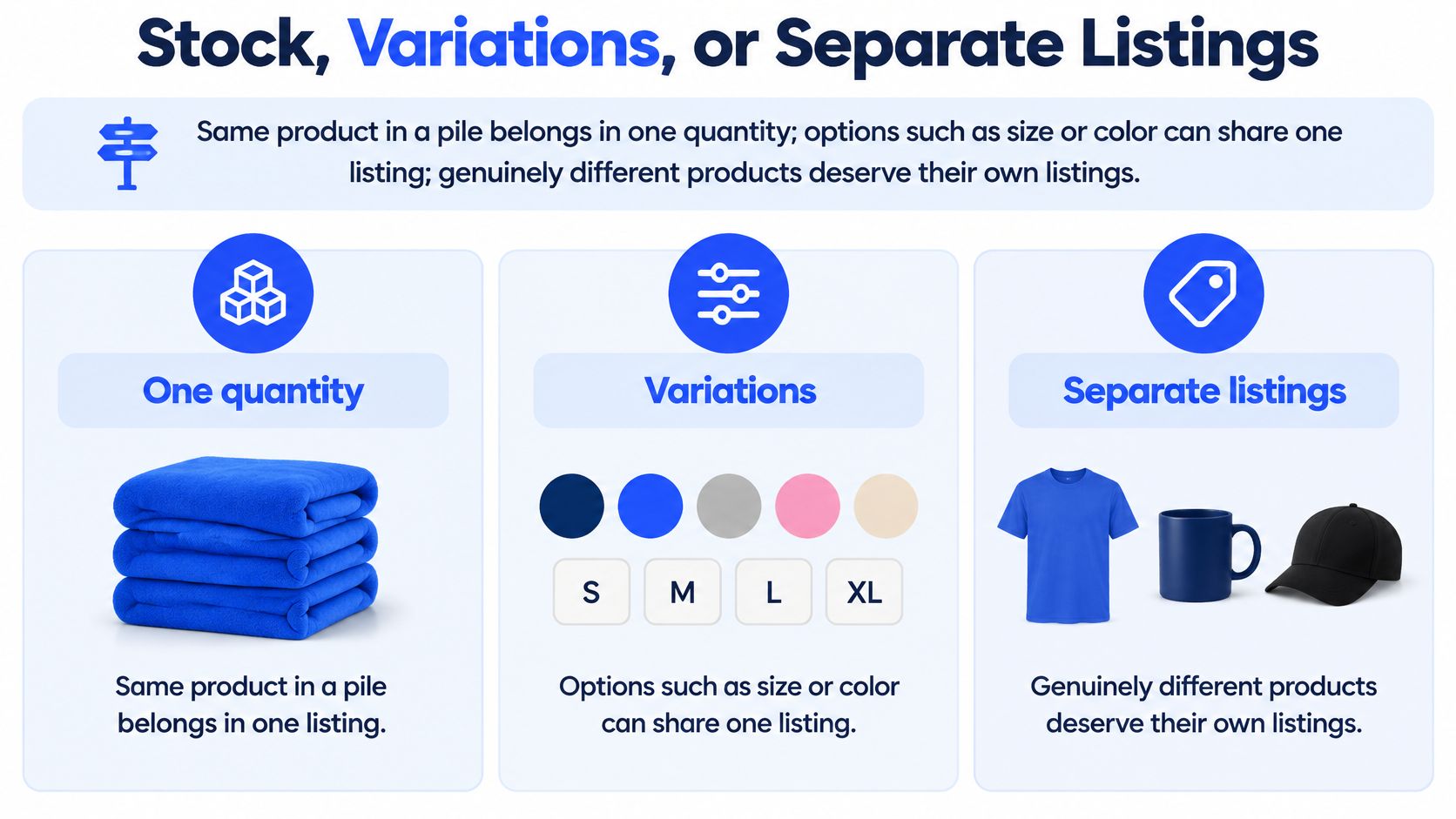
Use quantity for identical stock, variations for options of the same product, and separate listings for different products. Decide what the customer is buying before deciding how to arrange the listing.
A pile of matching bowls belongs in a quantity field. A bowl offered in different glazes may suit variations. A bowl and a wall hanging usually need different photographs, descriptions, and search phrases.
Quantity, variations, and separate listings
Setup | Fee to publish | When several sell | Visibility and stock |
|---|---|---|---|
Same item, quantity 10 | $0.20 | $0.20 for each unit after the first | One result and shared reviews |
One listing with size or color variations | $0.20 | $0.20 for each extra item or variation in the order | One result; buyer picks options |
Two different products, two listings | $0.40 | Each listing covers its own first unit | Two potential search results and separate stock |
Etsy's multiple-quantity rules set the initial listing fee at $0.20 and the additional-item fee at $0.20, including extra variations purchased; publishing two separate listings therefore costs $0.40.
Consolidating saves publication costs, not every future fee
Combining suitable products can reduce what you pay to publish. It doesn't make additional items free to sell.
With separate listings, each listing has its own first-unit coverage. A buyer purchasing an item from each doesn't create a multi-quantity add-on between those listings. Other selling fees still need their own calculation.
Separate listings also create separate opportunities to appear in search, not guaranteed placements. Each can have a focused title, lead photograph, and description. The visibility column describes how you organize the offers, not a promise that Etsy will show them together.
Let the buyer's decision guide the setup
Choose quantity when the buyer doesn't need to distinguish among the available units. Identical ready-made candles, for example, don't need separate listings solely because you have several on the shelf.
Choose variations when the buyer must select a related option before ordering. Use clear labels such as glaze color or bowl size, and make sure the photos show what each choice means. The guide to Etsy listing variations can help you organize those choices.
Split listings when the product needs a different selling explanation. If the title, main photograph, likely search phrase, or stock handling should differ, saving a publication fee may be a poor reason to merge.
The cheapest setup to publish isn't automatically the clearest setup to shop. Keep related options together, but don't make buyers decode unrelated products inside a dropdown menu.
Unsold, Partial, and Sold-Out Stock
Listing fees for a quantity of 10
What happens | Charges | Listing-fee total |
|---|---|---|
Unsold until the four-month expiry, then renewed | $0.20 publish + $0.20 renewal | $0.40 |
3 of 10 sell in one order and 7 remain | $0.20 publish + $0.40 for two extra units + $0.20 auto-renewal | $0.80 |
All 10 sell | $0.20 publish + $1.80 for nine extra units | $2.00 |
That listing is renewed again at quantity 10 | Another renewal, not ten new publishes | $0.20 more |
These scenarios apply the publication, additional-quantity, and renewal rules in Etsy's fees and taxes guide: the 10-unit sell-through example totals $2.00, while expiry renewal and a later manual renewal each add $0.20. The partial-sale row is a worked calculation that includes both additional units in the order and renewal for the remaining stock.
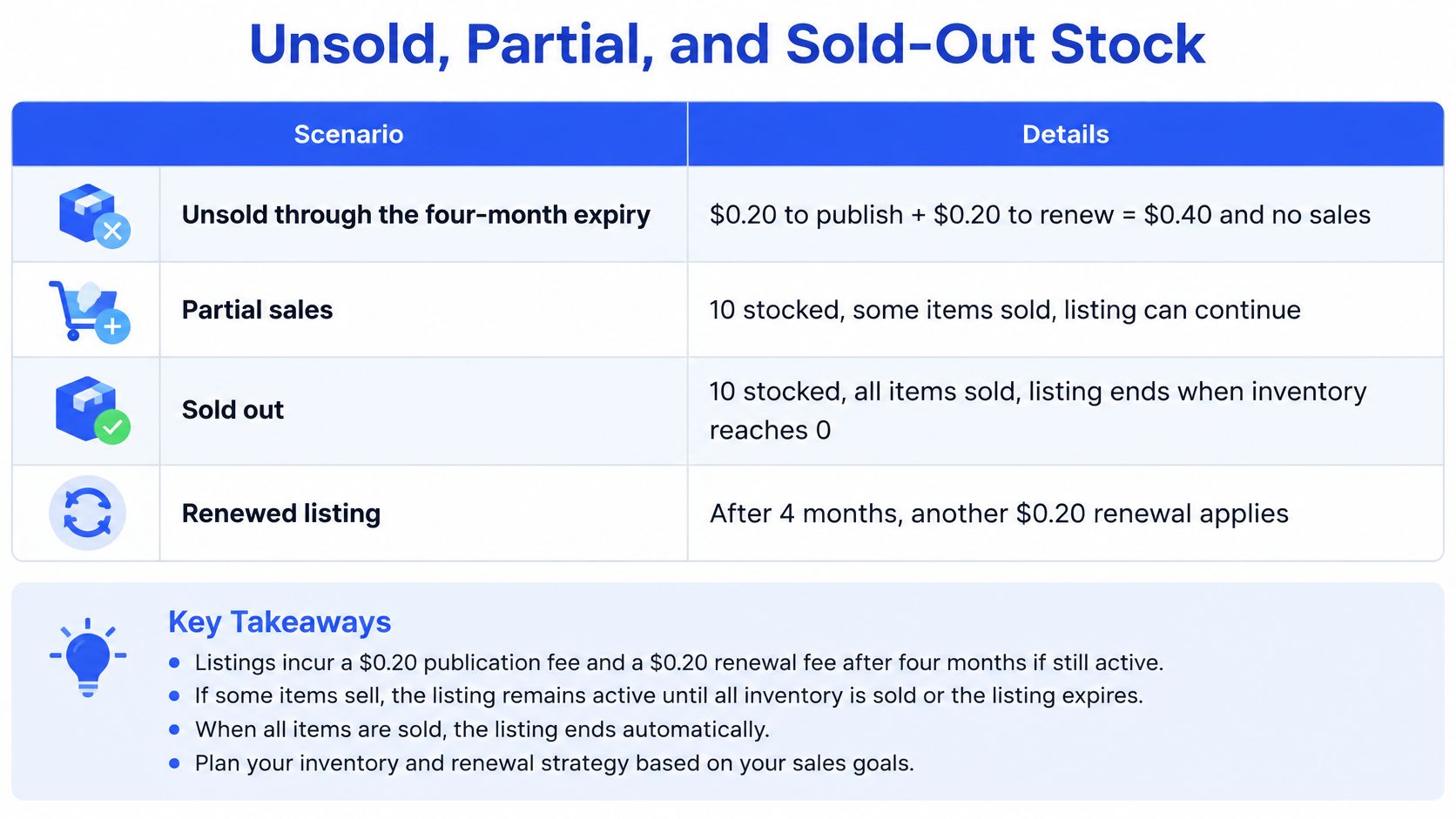
Read the scenario as a sequence
In the unsold case, publication happens first and renewal happens later. There's no sales income to offset either expense. Renewing is therefore a decision about whether the product deserves another selling window, not routine paperwork.
In the partial-sale case, start with publication, then count the additional items purchased, then account for keeping the remaining stock available. The renewal isn't another charge for every unsold item.
For the full sell-through row, assume the stock sells without intervening partial-sale or expiry renewals. Orders spread across several partial sales can produce a different total because renewal events also matter. There's no remaining stock to keep live when the entire quantity sells in that order.
Match the outcome to your shop
Seasonal sellers should pay particular attention to the unsold row. If holiday ornaments miss their selling window, renewing unchanged stock may create an expense without a realistic near-term sales opportunity. Review the occasion, photographs, and timing before extending the listing.
Made-to-order sellers should enter a quantity that reflects production capacity. A smaller quantity can help prevent overcommitting, but it doesn't reduce the fee for renewing the same listing. Don't lower stock based on the assumption that renewal is charged per unsold unit.
Evergreen sellers need to track orders and renewals across the listing's life. A consistently available candle can move through partial sales, restocking, and expiry decisions. Record those events rather than assuming every batch follows the clean sell-out example.
Budgeting check: High quantity doesn't bill every unit today. Future sales and renewal decisions determine the later charges.
Use your Etsy inventory-management process to record remaining stock alongside listing status. That makes it easier to distinguish a product that needs replenishment from one that needs a decision about whether to continue selling it.
Pick the table row that best matches your next four months, then adjust for any additional renewal events you reasonably expect.
Price and Stock With the Fee in Mind
Build a listing-fee cushion into your product cost rather than treating publication as the whole expense. The method is straightforward: divide the expected listing-related total by the number of units you expect to sell.
For the clean bowl sell-out scenario, dividing the batch's listing-fee total by the bowls sold gives the per-bowl allowance. Put that allowance beside clay, glaze, packaging, and labor in your pricing sheet.
Build a cost line you can reconcile
Use a spreadsheet with these separate cost lines:
Production: Materials, making time, and finishing supplies.
Packing and fulfillment: Packaging and any shipping expense you absorb.
Listing allowance: Expected publication, additional-unit, and renewal expenses allocated to sales.
Other Etsy fees: Transaction and payment-processing charges calculated under the terms applicable to your shop.
Don't confuse a future expense allowance with money already deducted. Charging your entire expected sell-out cost to publication overstates the immediate debit. Ignoring later additional-unit charges understates what selling the batch will cost.
The distinction also helps when reviewing profit. Your pricing sheet estimates costs before a sale; your payment account records charges after their triggering events. Compare the two, but don't expect them to match at every moment.
Plan for stock that doesn't sell
If you expect unsold inventory, include a renewal allowance in the forecast. Divide expected costs by the units you realistically expect to sell, not by every unit you hope might eventually find a buyer.
Set available stock according to what you can fulfill during the listing's active period. A large quantity doesn't increase publication costs, but it can obscure production limits or leave stale inventory looking available indefinitely.
For made-to-order products, capacity matters more than an impressive stock number. For seasonal products, decide whether expiry should prompt renewal, revision, or retirement. Quantity alone doesn't prevent wasted renewals.
Price multi-item orders deliberately
When buyers select several variations, price the order with the additional-item fees in mind. Don't assume that a shared listing means all items in the cart share a single final listing expense.
Also distinguish multiple individually purchased items from a product explicitly sold as a set. Define what the buyer receives clearly before applying your cost worksheet; an ambiguous offer makes both pricing and fulfillment harder.
Before approving the price, check:
Sell-out allowance: Have you included the listing-related cost allocated to each sold unit?
Unsold-stock allowance: Can the expected sales cover likely renewal expenses?
Listing structure: Does keeping the products merged still make sense for buyers and inventory control?
Set Quantity Before You Publish
Finish the listing setup before pressing publish. A sensible quantity should reflect the product, your capacity, and the way you expect buyers to order, not an attempt to avoid fees through a stock-field trick.
Use a pre-publication checklist
Classify the offer. Decide whether you're selling identical stock, variations of the same product, or distinct products. Choose the setup that makes the customer's decision clearest.
Enter a quantity you can realistically sell, make, or replenish within four months. For handmade bowls, count finished sellable pieces; for made-to-order work, account for the orders you can complete within your stated processing time.
Write down the expected fee events. Separate the publication cost from additional units you expect to sell. Use the complete sell-through total only when your forecast assumes that outcome, without intervening renewals.
Allow for a possible renewal. Distinguish an expiry decision from a partial sale that leaves stock available, so neither surprises you during reconciliation.
Check the price against the sales forecast. Include the per-unit cushion, then keep transaction fees, payment processing, materials, labor, and fulfillment on their own cost lines.
After publishing, match orders and payment-account entries before reconciling deposits. Label additional-unit charges and renewals so you can explain the difference between order revenue and the money paid out.
Use a consistent Etsy SKU setup to connect each product or variation to your stock records. Clear identifiers help you check what sold without guessing from similar product names.
Improve the offer after the arithmetic is clear
Paying a listing fee doesn't purchase a search rank. Separate listings create separate searchable offers, but the title, photographs, options, and product details still need to help the right buyer understand each one.
Know the fee events before deciding which listing deserves more work. A listing with clear stock, a realistic price, and understandable options is easier to manage than one assembled solely to minimize publication costs.
Before you publish your next product, open its pricing sheet, choose the stock scenario that fits, and record the expected charges. Then check the quantity, renewal setting, title, and lead photograph together, and publish only when you can explain both what the buyer receives and what each fee will pay for.