What if the most searched phrase for your product is the wrong one to target? That's the question most sellers never ask. They find a popular term, add it to a listing, and hope traffic follows.
A good keyword research strategy works the other way round. You start with one listing and the outcome you want from it, then you choose words that fit that job. Volume matters, but it comes last, not first.
The Five-Stage Keyword Research Framework
Keyword research means finding the words buyers type when they're looking for something like your product, then deciding which of those words your listing should answer. It's a short chain of decisions. Each one feeds the next, so you never pick a phrase before you know what it has to achieve.
A shopping list only helps if you know what meal you're cooking. Without the meal in mind, you'll buy ingredients that look popular and still can't make dinner.
Your Roadmap at a Glance
Keyword research stages at a glance
Stage | Question It Answers | Main Output |
|---|---|---|
1. Set the goal | What should this listing achieve? | One measurable outcome such as sales or favorites |
2. Collect buyer language | How do buyers describe what they want? | A candidate list of 20 to 50 phrases |
3. Score the phrases | Which phrases fit this product best? | A ranked shortlist based on intent, result fit and demand |
4. Map phrases to listings | Where does each phrase belong? | One primary phrase per listing plus supporting terms |
5. Measure and adjust | Is the choice working? | Position, views and sales tracked on the same phrase |
Stage 1 stops you chasing traffic you don't need. Stage 2 gives you real buyer words instead of your own shop language. Stage 3 turns that long list into a short, defensible choice.
Stage 4 puts each phrase on the right listing, so your own products don't compete with each other. Stage 5 tells you whether to keep, tweak, or replace a phrase.
Practical rule: Finish one stage before you start the next. A scored phrase with no goal behind it is just a guess with numbers attached.
Most sellers can work through the first three stages for one listing in an afternoon. The list at stage 2 usually holds 20 to 50 phrases, and that's enough. You don't need hundreds.
This order works for any Etsy category, from printables to jewellery to home goods. Read straight through if you're starting fresh, or jump to the stage where you're stuck.
Set the Goal Before You Pick Any Keyword
Four goals cover most Etsy listings. Each one points you toward different phrases, so name yours before you collect a single word.
Sales from ready buyers: You want people who already know what they want and are close to buying.
Favorites and saves: You want browsers to keep your listing for later, often before a birthday or holiday.
First visibility: You're a new shop and you need your first views and clicks to prove the listing works.
Seasonal traffic: You're launching for a selling window and need steady visits during those weeks.
Say you sell handmade ceramic mugs. If your goal is sales from gift buyers in November, you'll look for phrases with a recipient and an occasion in them. If your goal is first views for a new shop in February, you'll look for a narrower phrase where a new listing can realistically appear.
Search is worth this planning. In 2024, the Conductor organic traffic benchmarks analyzed more than 800 domains across seven industries and reported that organic search generated an average of 33% of total website traffic. Etsy search isn't a standalone website, but the lesson holds. Search brings a large share of visitors, so the words you choose shape who arrives.
Write One Goal Sentence
Turn your goal into one sentence with three parts, the listing, the outcome, and the time frame. For example, get the walnut cutting board listing to 10 sales a month from gift buyers by December. That number is your target to test against, not a promise.
The highest-volume phrase is not automatically your goal. A phrase can bring many visitors and no buyers if it describes a different need.
Your goal sentence becomes a filter. When you're torn between two phrases later, ask which one serves that sentence. When a phrase looks popular but points to the wrong buyer, the sentence tells you to drop it.
Write yours now for one listing only. One listing, one outcome, one date. Everything after this gets easier because you've already decided what success looks like.
Find the Words Buyers Actually Use
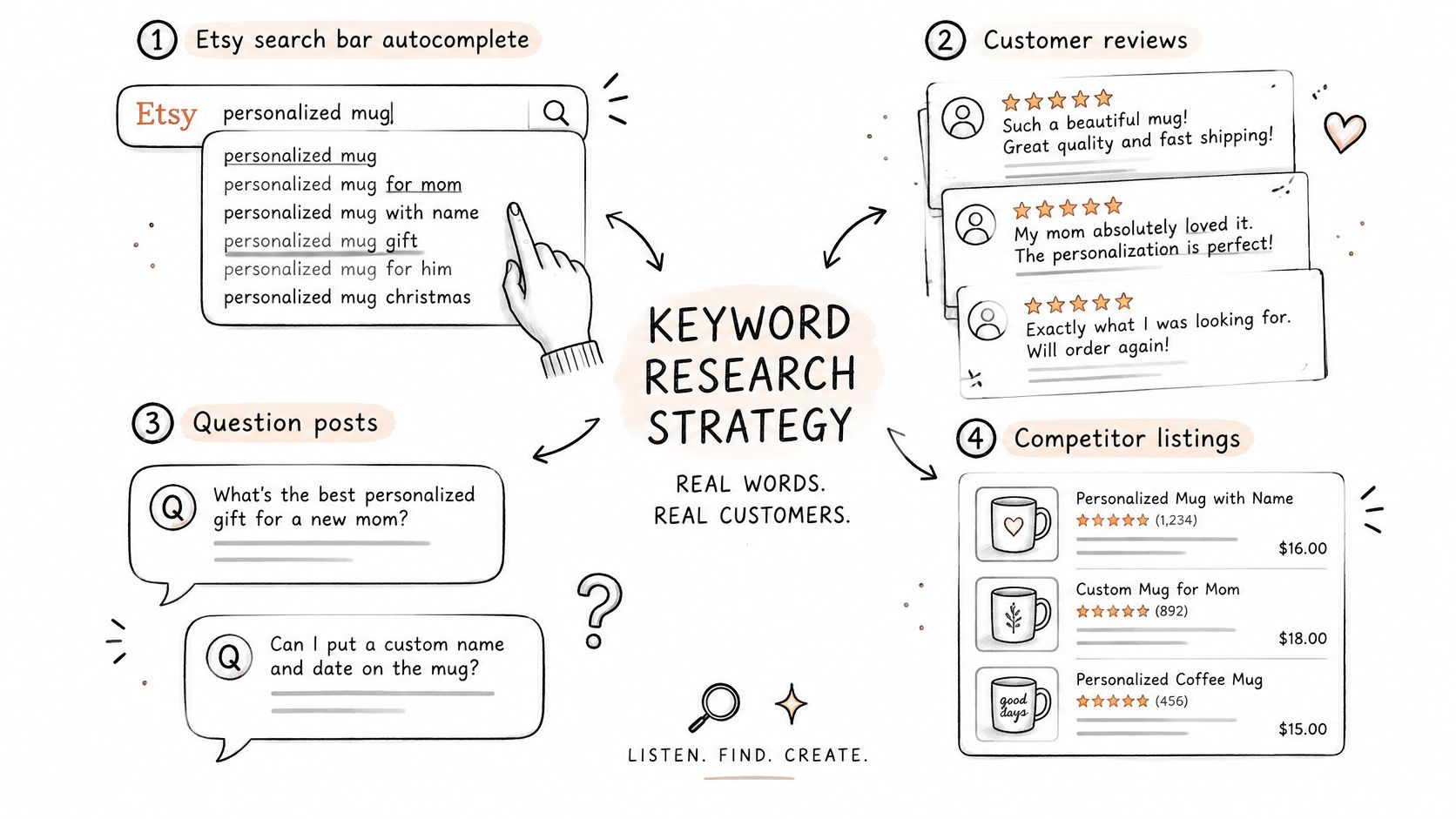
Buyers rarely type the words you'd use in your workshop. You might say hand-thrown stoneware vessel. A buyer types large ceramic coffee mug. Your job is to collect their version.
Four Places Buyer Language Hides
Etsy autocomplete: Type a starting phrase into Etsy's search bar and note the suggestions that appear.
Reviews and questions: Read reviews and buyer questions on your listings and similar ones for the words people repeat.
Competitor titles and tags: Use them as ideas for phrasing, not as text to copy.
Your inbox: Buyer messages often contain the exact product words and use cases people search with.
Compare necklace with minimalist gold birthstone necklace. The first is a short head term. It could mean almost anything. The second tells you the style, material, feature, and product type in one line, so you can match it to a title, tags, attributes, and photos.
That specificity is the point. The Ahrefs guide to long-tail keywords explains that longer, more specific queries can signal a clearer product need and stronger commercial intent, and that you should judge phrases by product type, recipient, style, material, and purchase context, not demand alone. A focused Etsy keyword tool guide can help you check those phrases once you've collected them in buyers' own words.
Treat three or more words as a starting filter, not a target. In 2024, an NP Digital analysis of 579,240 leads found that keywords containing 3 to 6 words generated 46.29% of attributable revenue, while keywords of 7 or more words generated 48.95%. Neither length band wins outright, so use length to narrow the list, then judge each phrase on fit.
Collect 20 to 30 candidate phrases in one sitting, written the way a buyer would say them out loud. Drop phrases that describe a different product, and phrases you can't connect to anything your listing is. Keep the list wide and honest for now. Scoring comes next.
Before you move on, check three things. Every phrase came from a real source above. Every phrase describes your product truthfully. No phrase is there only because it sounds popular.
Score Each Phrase by Fit, Competition and Demand
Scoring turns a long list into a decision you can explain. Use three criteria, in this order. Fit first, demand last.
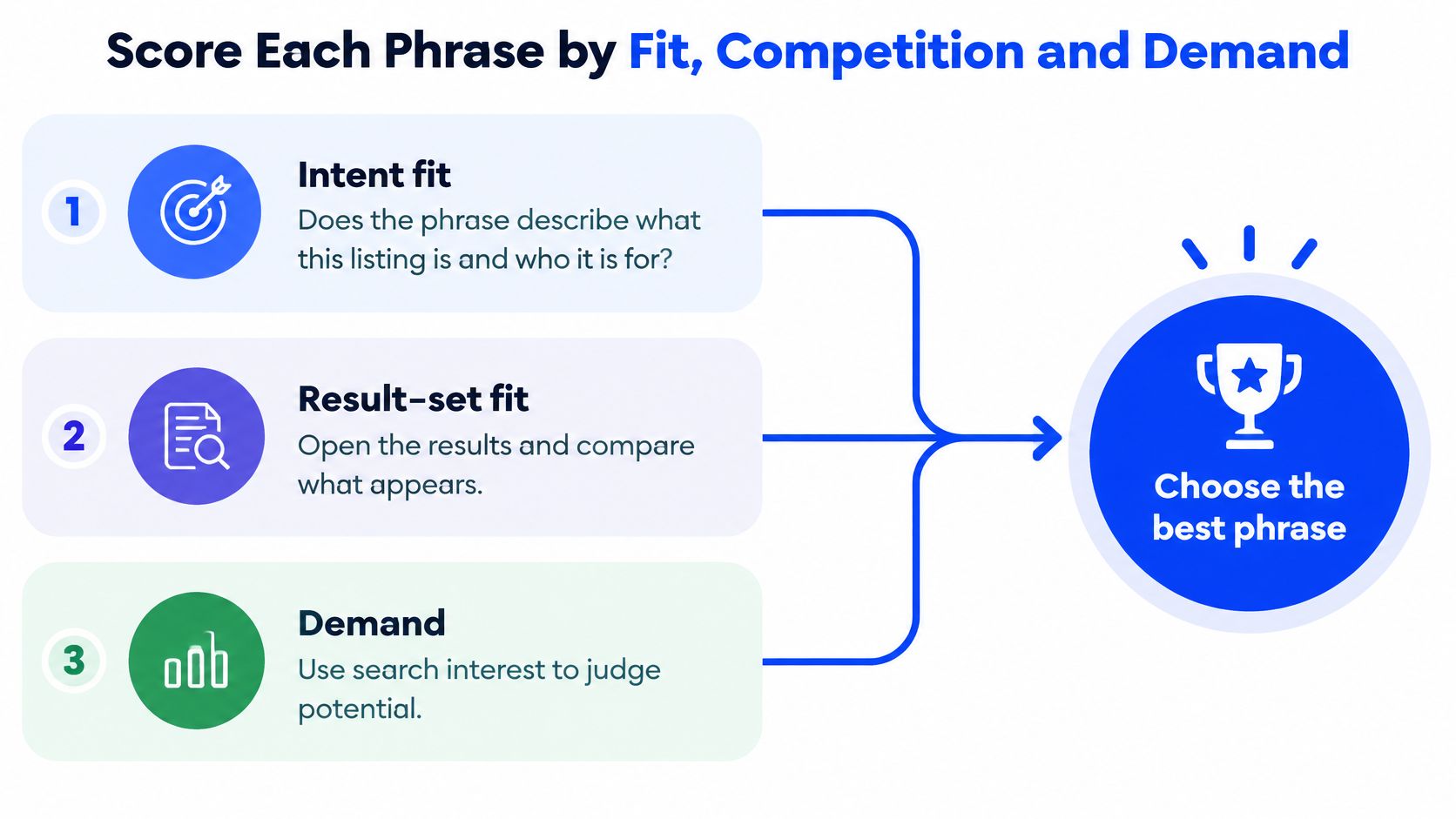
The Three Questions
Intent fit asks, does this phrase describe what this listing is and who it's for? If a buyer types it and lands on your listing, will they feel they've found the right thing? If you have to stretch the meaning, mark it low.
Result-set fit asks what already shows up. Search the phrase on Etsy and look at the results. If most listings sell the same kind of product as yours, the phrase matches that buyer need. If the results show a different product, the phrase probably means something else to buyers, however similar the words look.
Estimated demand asks whether anyone searches this way at all. Google's tools give you a rough sense outside Etsy. As Google's guide to what people are searching describes, Keyword Planner reports average monthly searches over a selected period, affected by location, language, and Search Network settings, and its default 12-month average smooths short-term changes but can hide seasonal peaks. Google Trends helps there, because it compares interest over time and across regions, so you can spot a seasonal rise before it arrives.
Etsy doesn't publish search volume for its own queries. Treat Google figures as a proxy, a rough guide to relative interest, not a promise of Etsy views. A phrase with modest Google demand can still be the right Etsy phrase if the fit is strong.
Reading the Score Table
Example scoring of candidate phrases
Candidate Phrase | Intent Fit | Result-Set Fit | Estimated Demand | Decision |
|---|---|---|---|---|
minimalist gold birthstone necklace | High | High | Medium | Target as primary |
necklace | Low | Low | High | Skip, too broad |
gift necklace | Medium | Medium | High | Test as supporting phrase |
gold necklace for women | Medium | Medium | High | Hold, results look too mixed |
Read each row left to right. The first row wins despite medium demand, because both fits are high. A buyer using that phrase wants exactly this product, and the current results confirm it.
The second row shows the trap. Demand is high, but intent fit is low and the results cover every kind of necklace. You'd compete with everyone and match almost no one in particular.
Rows three and four sit in the middle. Gift necklace can support the primary phrase where gift language fits naturally. Gold necklace for women stays on hold because mixed results suggest buyers using it want several different things.
Tie-breaker: When two phrases score the same, choose the one that matches your listing most closely. Close fit beats extra demand.
Group Phrases Into Clusters for Each Listing
Buyers don't all type the same wording for the same need. One person searches birthstone necklace gift for mum. Another searches mum birthstone necklace gift. Same need, different order and emphasis. That set of related wordings is a phrase family, or cluster.
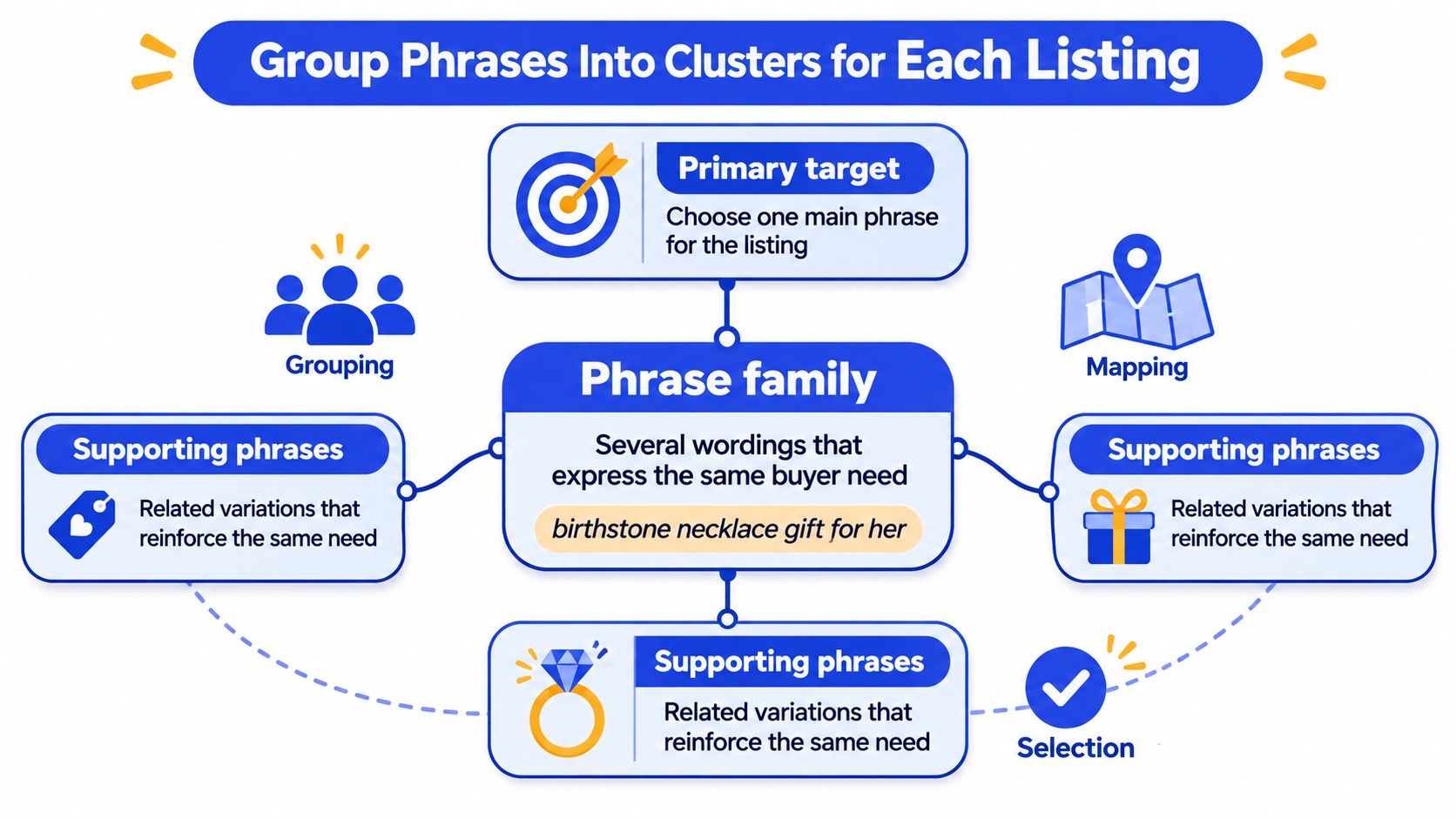
Clusters matter because one good phrase rarely works alone. In the Ahrefs study of 3 million random search queries, the average number-one page ranked in the top 10 for nearly 1,000 other relevant keywords, and the median was approximately 400. That's Google data, not Etsy data, but the principle travels well. Relevance spreads beyond exact wording, so you don't need to force every variation into your listing.
One Primary Phrase Per Listing
Pick one primary phrase from the family for each listing. That's the phrase your title leads with and the one you'll measure. Then choose two or three supporting phrases from the same family for your tags, attributes, and description, only where they read naturally.
Don't give two listings in the same shop the same primary phrase. That's cannibalization. Your own listings end up competing for the same buyer, and neither gets a clear signal.
Say a shop sells three birthstone pieces. The necklace targets minimalist gold birthstone necklace. The bracelet targets gold birthstone bracelet for mum. The ring targets dainty birthstone ring gift. They can share supporting ideas like birthstone gift or personalised jewellery gift, but each primary phrase belongs to one listing.
Every supporting phrase still has to describe the product accurately. If the bracelet isn't gold, gold phrases don't belong on it, however well they scored elsewhere. Buyers who land on a mismatch leave without buying, and that weak response helps no one.
On paper, your cluster map is simple. One row per listing, one primary phrase in the first column, then its supporting phrases beside it. If two rows show the same primary phrase, you've found a clash to fix.
Where Keywords Count on an Etsy Listing
Keywords help Etsy match your listing to a search, but they don't decide the result on their own. Etsy's Seller Handbook guide to how Etsy search works says search considers relevancy, listing quality, customer service quality, engagement, and shoppers' individual habits. Relevancy comes from matches between a shopper's query and your title, tags, description, categories, and attributes, and Etsy says an exact keyword match may improve position because it's considered more relevant.
Put your primary phrase in the title and tags. Use supporting phrases in attributes and the description where they describe the product accurately. These Etsy SEO tips cover placement in more detail once your phrases are chosen.
What Sits Alongside Keywords
Listing quality: Complete shop information, clear high-quality images, and a clear return policy.
Customer service: Your average review rating, message response rate, and case rate over the previous three months.
Engagement: Clicks, views, favorites, and purchases, and how well views turn into sales.
New listings also get a small temporary boost so Etsy can learn how buyers respond, and renewed listings get a smaller one. That early window is a test, not a reward.
A precise keyword brings the right visitors to the door. Your photos, reviews, and response times decide whether they buy. Fix weak photos before you blame a phrase that isn't converting.
Measure Results So Your Strategy Stays Honest
A position number means little unless you know how it was produced. Google makes this clear with its own metric. The Google Search Console performance report guide defines average position as the average of the topmost position a result holds across impressions and queries.
Here's the worked example. If one query shows a page at positions 2, 4, and 6, Google counts position 2. If another query shows it at positions 3, 5, and 9, the reported average is (2 + 3) / 2 = 2.5. A result also needs an impression for its position to be recorded, so a page sitting low where nobody looks may not count at all.
Etsy shows no equivalent average in your shop stats. Apply the same discipline anyway. Record the same settings every time you check, or you're comparing different tests. This guide to Etsy keyword ranking explains what to track once your checks are consistent.
What to record for every ranking check
Setting | What to Record | Why It Matters |
|---|---|---|
Exact phrase | The full phrase as typed | Position changes with small wording differences |
Location and language | Country and language settings | Results can differ between markets |
Device | Desktop or mobile | Layouts and visible results can vary |
Date range | Start and end dates | Seasonal swings distort short tests |
Metric | Average or top position | An average can hide wide variation |
Two Decision Rules
After four to six weeks, act on what you see. If a phrase earns no views, revisit the wording and rescore it. The phrase may not match how buyers search, or the result set may have shifted.
If a phrase earns views but no favorites or sales, check the match between phrase and listing. Look at the main photo and the first lines of the description. A buyer who clicked expected something, and the listing may not be showing it fast enough.
Keep a simple log, one row per check, with the date and any edit you made. That way you can link a change in views to a specific edit or season instead of guessing. One check is a snapshot. A trend over several weeks is evidence.
Pick Your First Keyword Set This Week
You don't need to redo your whole shop. One listing, done properly, teaches you the process and gives you a baseline.
Pick the listing that matters most, such as a bestseller or a flagship piece for a seasonal launch.
Write its one-sentence goal with the listing, the outcome, and the time frame.
Collect 20 to 30 candidate phrases from autocomplete, reviews, and competitor titles in one sitting.
Score each phrase on intent fit, result-set fit, and estimated demand, and keep the top two or three.
Choose one primary phrase and two supporting ones, place them naturally in the title, tags, attributes, and description, then record starting position and views.
Review after 30 days using the same settings each time.
Before you publish, apply the people-first test from Google's helpful content guidance. Ask whether your listing answers a real buyer question and shows first-hand knowledge of the product. Google describes its systems as prioritising helpful content made for people, not material produced mainly to manipulate rankings.
So give the direct answer early in your description. State what it is, who it's for, and the key material or size in the first lines. Use related terms only where they improve clarity.
If you'd rather have help with ranking after you've chosen your phrase, that's the shape of our work at Upglider. Customers choose the keyword their campaign targets, and each campaign focuses on one listing and the approved keywords, not your entire shop or other search markets.
Start with one listing this week. Move to the next only after the first has a baseline and a 30-day review.
Pick your most important listing today, write its goal sentence, and run it through the five stages this week. If you want focused help getting that one listing into Etsy's first 15 results for your chosen phrase, send us the listing link and your primary keyword through Upglider, and we'll assess the case before you pay anything.