You've rewritten your candle listing, added tags, and checked your views again. Still quiet. It's tempting to keep targeting candle because it describes what you sell, but a buyer might be looking for something much more specific, such as soy candle gift for mom.
Say a candle seller spends weeks adjusting a listing around the broad term before testing that gift-focused phrase. The product hasn't changed. The seller has found language that explains who it's for and why someone would buy it.
That's the useful part of keyword research: finding the words that connect your actual product to a buyer's need. You don't need a huge spreadsheet to start, and you shouldn't choose a phrase just because a tool displays an impressive search estimate.
Start with what buyers actually type. Then check whether your listing delivers what those words promise.
These keyword research methods answer different questions. Etsy autocomplete gives you on-platform suggestions. Competitor listings show seller wording. Google tools reveal wider search interest, not Etsy demand. Keep those distinctions clear, and you'll spend less time polishing phrases that the wrong audience uses.
1. Etsy Search Autocomplete Mining
Etsy autocomplete is a useful starting point for finding buyer-like wording directly on Etsy. Type a product phrase into the search bar, pause, and record the suggestions that appear. Don't assume a suggested phrase has high demand or little competition, because autocomplete doesn't provide those measurements.
Start in a fresh private browser window, signed out of Etsy. This reduces the influence of your own browsing history, although it doesn't make the results universal. Keep the search location consistent with the market you want to reach.

Expand the buyer's reason for searching
Say you sell handmade soy candles. Enter soy candle, then try adding a recipient, occasion, or use. If suggestions such as soy candle gift for mom or soy candle for relaxation appear, save only those that accurately describe your offer.
A printable artist can follow the same process with room names. Printable wall art for bedroom is worth investigating if Etsy suggests it and the artwork suits that setting.
Change the ending: Test gift, decor, material, size, recipient, and occasion modifiers.
Keep the wording: Record the exact suggestion rather than rewriting it into seller language.
Check the results: Open the suggested search and see whether the products match yours.
Historical query studies summarized in Search User Interfaces support looking beyond short, generic searches toward more descriptive phrases. That's useful context, but your current Etsy suggestions are the practical input.
Best use: Discovering phrases to investigate. Main limitation: A suggestion isn't proof of search volume, buying intent, or an achievable ranking.
2. Competitor Listing Title and Tag Analysis
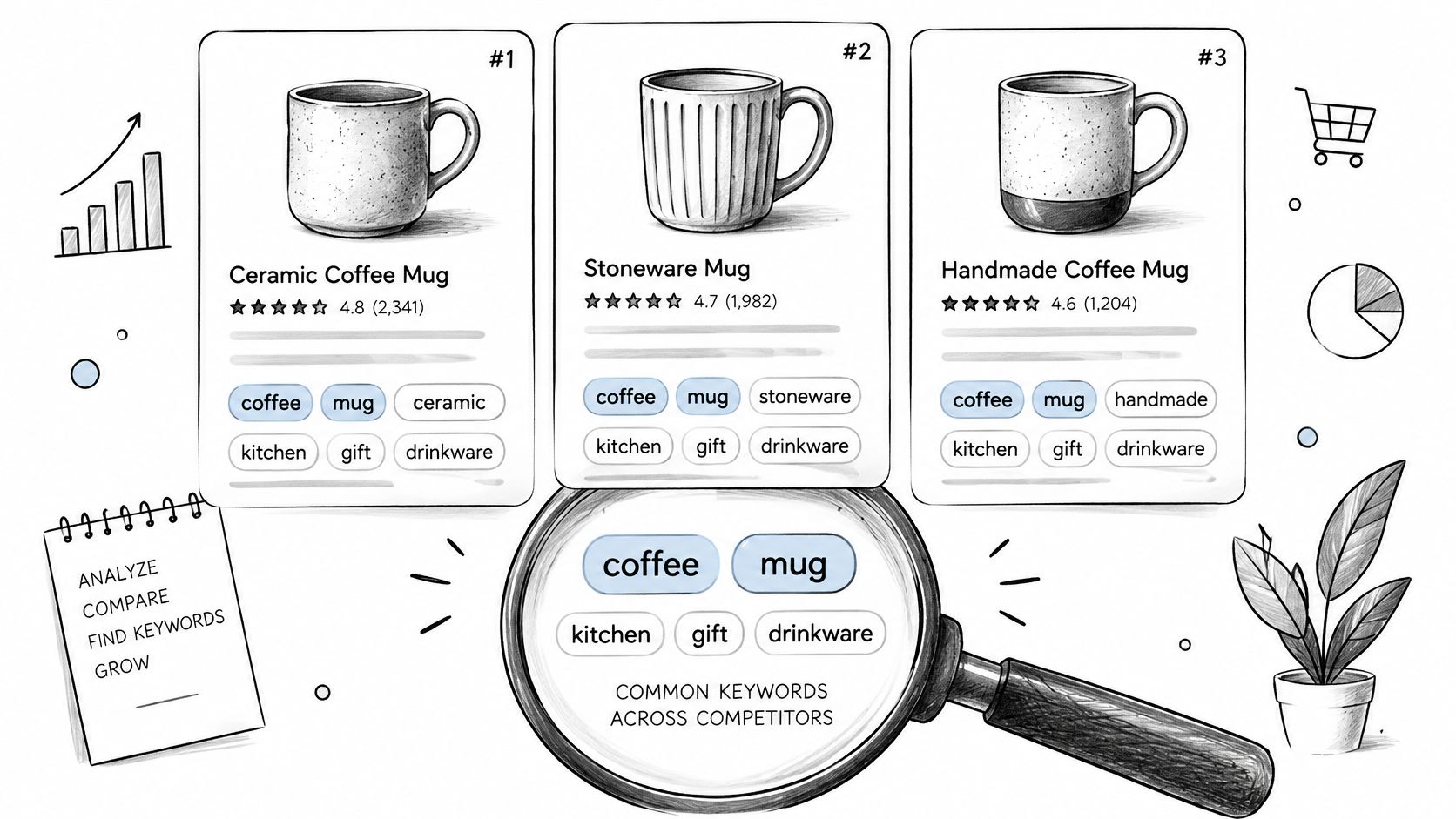
A jewelry seller searching dainty gold necklace might notice repeated wording such as minimalist, layering necklace, and gift for her. Those patterns offer a shortlist of phrases to investigate, not permission to copy another seller's title.
Competitor analysis reveals seller language, not the exact searches that produced their sales. A prominent listing may perform well because of its photographs, price, reviews, or established appeal. You can't isolate the contribution of a keyword just by looking at its position.
Record patterns without copying claims
Review relevant organic listings and separate visible facts from guesses. Titles and product details are available to inspect; a complete tag set may require a third-party tool, whose output should be treated cautiously.
Save exact wording: Note recurring product names, materials, styles, and recipient phrases.
Separate product differences: Don't borrow solid gold for gold-plated jewelry or handwoven for a different construction.
Find a useful gap: Look for a genuine feature competitors don't describe clearly, such as an adjustable length or a particular print format.
Etsy's tag guidance recommends using all 13 tags and choosing natural, multi-word phrases rather than splitting a concept into isolated words. That makes phrase selection more useful than collecting disconnected adjectives.
Use these Etsy title and tag examples to turn relevant phrases into readable listing language.
For a macrame wall hanging, repeated size and color modifiers may help you describe the right product variation. An uncommon phrase is only an opportunity if buyers use it and your item fits it. Low competitor usage alone doesn't establish demand.
3. Related Searches and Customers Also Searched Review
Related searches help you find nearby buyer needs you didn't think to test. Where Etsy displays related searches or suggested queries, inspect them after searching your main product term. Labels and availability can vary, so use what's visible rather than expecting a particular feature on every results page.
These suggestions can reveal a recipient, feature, or use that changes the buying decision. Don't assume you know exactly how Etsy generated them or how frequently each phrase is searched.
A ceramic mug seller might investigate a suggestion such as ceramic mug for coffee lovers. The useful question isn't whether that phrase sounds appealing. It's whether the mug's design, packaging, and presentation make it a convincing gift for that buyer.
Follow relevant branches, not every branch
A printable planner seller could begin with weekly planner, then investigate weekly planner undated if it appears. That modifier matters because buyers looking for an undated planner may reject a dated version even when the design is attractive.
Capture adjacent intent: Save suggestions that add a meaningful feature, recipient, or purpose.
Compare neighboring searches: Look for relevant wording that appears across related product searches.
Reject category drift: Skip suggestions that lead to products, formats, or materials you don't sell.
A related phrase is a lead to investigate, not evidence that your listing belongs in that search.
The Etsy-versus-Google distinction matters here. Related suggestions found on Etsy are on-platform clues. Google's related searches can still supply ideas, but they may reflect tutorials, definitions, or shopping needs outside Etsy.
The trade-off is speed versus certainty. You can discover useful directions quickly, but repeated suggestions don't establish stronger demand by themselves. Confirm the phrase against actual Etsy results and your product before using it.
4. Long-Tail Phrase Modeling for Buyer Intent
Build a phrase from the product outward: product + material + feature + recipient or use. You're not trying to include every possible detail. You're trying to describe a buying need clearly enough that the right shopper recognizes your product.
For handmade earrings, that might mean moving from earrings to sterling silver hoop earrings. For pottery, ceramic plant pot with drainage identifies a feature that can determine whether the item suits the buyer.
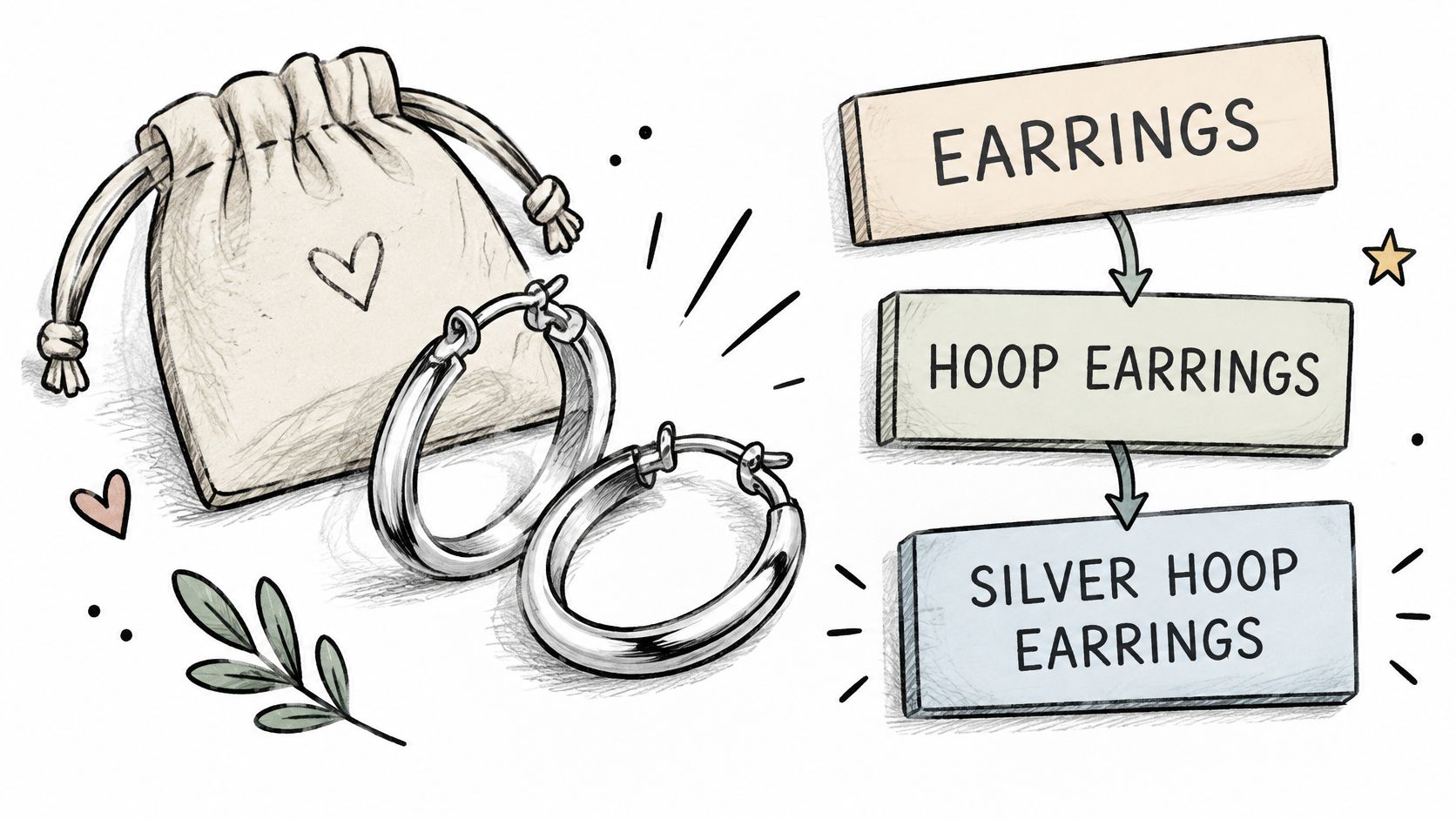
Treat modeled phrases as hypotheses
Phrase modeling doesn't show what buyers type. It produces candidates you should check through Etsy autocomplete, related suggestions, and results-page review. A phrase can describe your product perfectly and still be uncommon search language.
Also, long-tail doesn't just mean long. An analysis summarized by SEOrocket defined long-tail terms by monthly demand and found that 91.8% of the analyzed keywords accounted for only 3.3% of total search volume. Don't confuse specificity with abundant traffic.
Start with the product: Use the noun a buyer would recognize.
Add a meaningful modifier: Choose a material, function, style, or recipient that changes the purchase decision.
Remove awkward extras: Don't turn the title into a string of every possible audience and occasion.
These Etsy long-tail keyword examples can help you build natural combinations.
A narrower phrase may offer a better fit, but it isn't automatically easier to rank for or more likely to convert. Check the competing products. Then use the phrase naturally in your title and description, with suitable shorter variations in tags where necessary.
5. Google Trends for Seasonal Demand Timing
Google Trends helps you decide when to prepare, not which Etsy phrase has the most searches. It shows relative Google search interest over time. Its scores aren't monthly search counts, and they don't measure searches inside Etsy.
Use it when timing matters: ornaments, wedding stationery, seasonal decor, graduation gifts, or products tied to outdoor activities. Set the relevant country and keep the settings consistent when comparing phrases.
A Christmas ornament seller could compare personalized Christmas ornament with a broader ornament phrase. Look for a recurring rise across a multi-year view rather than planning around an isolated spike. Don't assume a peak starts in a particular month until you inspect the chart.
Plan around the rise, not just the peak
For wedding stationery, compare relevant phrases and check when interest begins building. Your useful preparation window starts before shoppers are busiest, because photography, samples, personalization instructions, and dispatch estimates need to be ready.
Compare close alternatives: A broad phrase may show a clearer seasonal pattern than a very specific product query.
Check consistency: Recurring seasonal interest is more useful for planning than a sudden, unexplained surge.
Prepare before demand builds: Leave room for production and delivery, not just listing edits.
Timing rule: Use Google Trends to schedule your work, then use Etsy signals to choose your wording.
The main trade-off is coverage versus relevance. Google can show a broad seasonal pattern even when an Etsy phrase is too specific to produce a useful chart. But that broader interest may include people seeking instructions, inspiration, or products from other retailers.
A blank or sparse chart doesn't prove there's no Etsy audience. Keep the phrase under consideration when Etsy suggestions, customer questions, and relevant results support it.
6. Keyword Volume Estimation with Google Keyword Planner
Botanical prints show the core problem. Botanical wall art, fern print, and botanical gallery wall set can look very different in Keyword Planner, yet those numbers reflect Google searches, not Etsy buyer searches. Planner also labels competition for Google ads. It says nothing about how hard an Etsy listing will be to rank.
Use it to compare wording, not to validate demand. Keep country and language settings identical across your shortlist, and compare phrases with similar intent. A broad decorating query will almost always dwarf a specific product phrase, which tells you about vocabulary size rather than purchase likelihood.
Third-party volume estimates often differ from Google's own data, so treat every figure as a relative signal instead of an exact count.
Flag weak interest: Very low estimates deserve investigation, not automatic rejection.
Check buyer intent: A phrase that attracts people looking for free downloads is a poor match for a paid physical print, even with higher volume.
Return to Etsy: Inspect suggestions and competing listings before you commit to a phrase, because close variants can receive grouped estimates that hide real differences in meaning.
Start with a list of potential Etsy keyword ideas for comparison, then keep only phrases that describe the product accurately and look sensible in Etsy search. I recommend keeping separate candidates when wording implies a different product or use, even when their estimates look alike.
Best use: Comparing broad interest across a shortlist. Main limitation: Google volume cannot validate Etsy demand, and Google advertising competition cannot measure Etsy ranking difficulty.
7. Customer Language Mining from Reviews and Messages
Your customers may describe a candle as a calming scent for bedtime, while your listing emphasizes its wax blend. Both descriptions can matter, but the customer's wording reveals the reason they wanted it.
Reviews, messages, and product questions are especially useful for discovering recipients, practical concerns, and expectations. They show real customer language, but not necessarily the words customers entered into search. That distinction keeps useful feedback from becoming an unsupported keyword assumption.
Separate needs from praise
Copy recurring phrases into a working document, removing names and private details. Group them by what the buyer wanted: a gift, a particular fit, a display setting, a material, or an everyday use.
Keep meaningful needs: Gift for my sister is more useful than absolutely lovely.
Investigate repeated questions: Buyers asking about drainage, printable sizes, or adjustable lengths may need clearer product information.
Verify every claim: Don't describe silver earrings as tarnish-free just because someone asked whether they are.
A jewelry maker receiving questions about tarnishing should explain the actual material and care requirements. The question reveals a concern; it doesn't establish that the product has the requested property.
Customer wording can also expose a mismatch between a phrase and the whole listing. Etsy's explanation of search describes contextual ranking and consideration of listing elements beyond keywords, including photos and reviews.
If customers buy your candle as a bedtime gift, test that language in Etsy autocomplete and review the matching results. Then make sure the first image, scent description, and packaging support that use without promising sleep or health benefits you can't substantiate.
The trade-off: Customer language is highly relevant to your product, but a small or unusual set of comments may not represent broader search behavior.
8. Competition Assessment Through Results Page Review
A keyword is only useful if your listing can compete for the buyer it attracts. Search the exact candidate phrase on Etsy and inspect the visible organic results. Separate sponsored placements from the listings you're using to judge organic visibility.
Review product fit before shop size. A results page filled with close matches presents a different challenge from a page where many items only loosely satisfy the phrase.
For a new collar listing, established shops with substantial review histories may signal strong competition. But shop-wide sales and reviews don't tell you how well a particular listing converts for that exact phrase.
Look for gaps you can actually fill
Record what shoppers can compare: the first photo, material, price, personalization, shipping information, and clarity of the offer. Check titles for relevant wording, but don't assume a missing exact phrase makes a listing weak.
Assess matching: Does the result deliver the specific material, feature, or recipient implied by the query?
Assess presentation: Can buyers understand the size, finish, and included options without hunting?
Record the context: Save the phrase, date, market, device, filters, and observed position.
Shifter's comparison of search-volume tools explains how averaging and variant grouping can obscure differences between phrases. Reviewing the exact Etsy results helps you assess the competition you'll face rather than borrowing a difficulty assumption from Google.
A home decor seller might find an opportunity where the results are only loosely matched to a specific size or function. Weak descriptions alone aren't enough, and an older listing isn't automatically vulnerable.
Best use: Deciding whether a candidate deserves a controlled test. Main limitation: You're observing a changing search context, not measuring a universal difficulty score.
How the 8 Keyword Research Methods Compare for Etsy Sellers
Item | Cost | Data Source | Shows Search Volume? | Best For |
|---|---|---|---|---|
Etsy Search Autocomplete Mining | Free; no tools needed | Etsy search suggestions | No | Finding phrases buyers use on Etsy |
Competitor Listing Title and Tag Analysis | Free; manual review takes time | High-performing Etsy listings | No | Identifying competitor wording and product-specific modifiers |
Related Searches and Customers Also Searched Review | Free | Etsy and other marketplace suggestions | No | Discovering related buyer intent and specific phrases |
Long-Tail Phrase Modeling for Buyer Intent | Free; requires research and judgment | Product terms and buyer-intent modifiers | No | Building specific, relevant keyword phrases |
Google Trends for Seasonal Demand Timing | Free | Google search trend data | Relative interest over time, not exact volume | Planning seasonal listings and campaigns |
Keyword Volume Estimation with Google Keyword Planner | Free with a Google Ads account | Google Search data | Yes; estimated monthly ranges | Comparing broad search interest across candidate phrases |
Customer Language Mining from Reviews and Messages | Free if customer feedback is available | Customer reviews, questions, and messages | No | Finding natural buyer language and product-use phrases |
Competition Assessment Through Results Page Review | Free; manual review takes time | Current Etsy search results | No | Judging ranking difficulty and choosing realistic targets |
Pick Two Methods and Test Them This Week
You don't need every tool open to make a better keyword decision. Start with Etsy autocomplete and competitor review, then apply what you learn to a listing with a clear offer and strong photographs. That pairing gives you suggested on-platform wording and a practical view of the products competing for it.
Choose a phrase that describes the item without stretching its material, purpose, or audience. A highly specific keyword won't help if the buyer clicks through and discovers a different product, unclear sizing, or an unexpected digital format.
Keep the test small enough to understand
Save the original title, tags, and listing presentation before making changes. Record your candidate phrase and why you selected it, including whether it came from Etsy suggestions, customer language, or a Google tool.
Establish a baseline: Note the listing's visible position and available shop performance indicators.
Make a focused change: Improve relevant wording without simultaneously replacing the entire offer, photography, and pricing.
Observe buyer response: Watch visits and orders where available, not just a search-position snapshot.
Keep the context consistent: Use the same market and browsing setup for comparable ranking checks.
Don't expect a perfectly isolated experiment. Seasonal demand, competitors, and shoppers can change while you test. The purpose is to make a more defensible decision, not to prove that a particular title edit caused every subsequent sale.
Better keyword research produces a clearer next action, not merely a longer keyword list.
Use Google Trends when you need timing guidance and Keyword Planner when broad comparisons would help. Use customer language when you need to understand why people buy. Return to Etsy before deciding that a phrase deserves your listing's attention.
If you're considering external ranking help, settle the phrase first. A ranking objective needs an exact search phrase and an agreed market; it shouldn't be a vague promise of more exposure across your shop.
Choose a listing and test your shortlist this week. If you want focused ranking help, our Upglider campaigns let you choose the target keyword and include a search phrase of three or more words. Every campaign carries a top-15 guarantee within 9 to 21 days in the agreed USA or UK market only, or your money back, with ranking maintenance during the paid period. Prepare your public listing URL and proposed phrase for our pre-payment assessment; no Etsy account access is required. The guarantee concerns ranking for the approved case, not sales.