You've been asked to send a progress report, and the draft is already filling with completed tasks: meetings held, pages updated, messages sent. But the reader needs to know something more useful: Are the agreed goals being met, and what should happen next? A good progress report answers those questions with clear evidence, not a longer activity log.
That matters in classrooms, project teams, client work, and even Etsy ranking campaigns. The details change for each audience, but the job stays the same: make progress understandable enough to guide a decision.
What Makes a Progress Report Good
A manager opens a report and sees a list of busy weeks: research completed, interviews scheduled, draft revised. The activity may be real, but the report doesn't say whether the project is closer to its goal. The writer is left wondering what to do with the information.
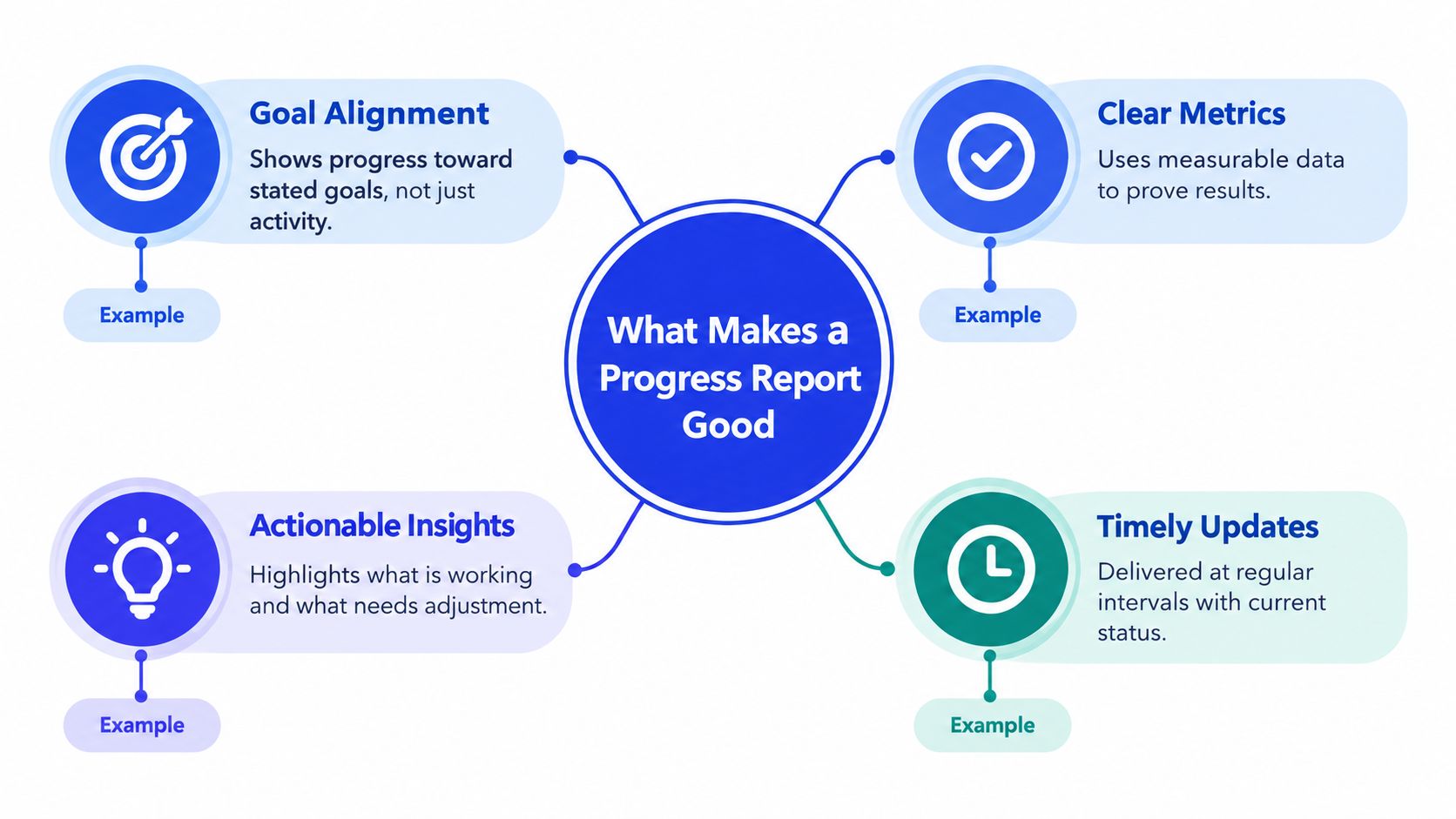
A good progress report is a decision tool, not a diary. It answers three questions: Where are we now? Where should we be? What should we do next? A report that answers only the first question records a status. One that answers all three helps the reader act.
Think of a progress report like a classroom conversation about learning. A teacher checks what a student understands, interprets the evidence, and adjusts instruction or asks the student to try a different approach. The report is useful because it supports that response, not because it exists as a document.
That connection has been studied in education. A 2024 meta-analysis of formative assessment in K–12 classrooms synthesized 118 primary studies and 258 effect sizes from classrooms worldwide. It found an overall effect size of 0.25 Hedges' g, meaning students receiving assessment-and-feedback practices performed modestly better than comparison groups.
From activity to a useful decision
Suppose a project goal is to publish a new product page. “The team held a planning meeting and drafted copy” tells the reader what happened. “The page is drafted, but product images are still missing, so publication is at risk until photography is complete” shows current status, the gap, and a next step.
The difference is not more formal wording. It's the link between evidence and action. If the report shows a gap, it should identify a response. If progress is on track, it should make clear what must continue. If the evidence is uncertain, it should say so rather than pretend the outcome is settled.
Practical rule: Include each detail because it helps the reader judge progress, understand a risk, or choose what to do next.
The best reports are also timely. A clear update that arrives after a decision is due may be accurate, but it can't help the reader make that decision. Regular reporting gives people a chance to adjust while there's still time to change the outcome.
The Core Anatomy of a Progress Report
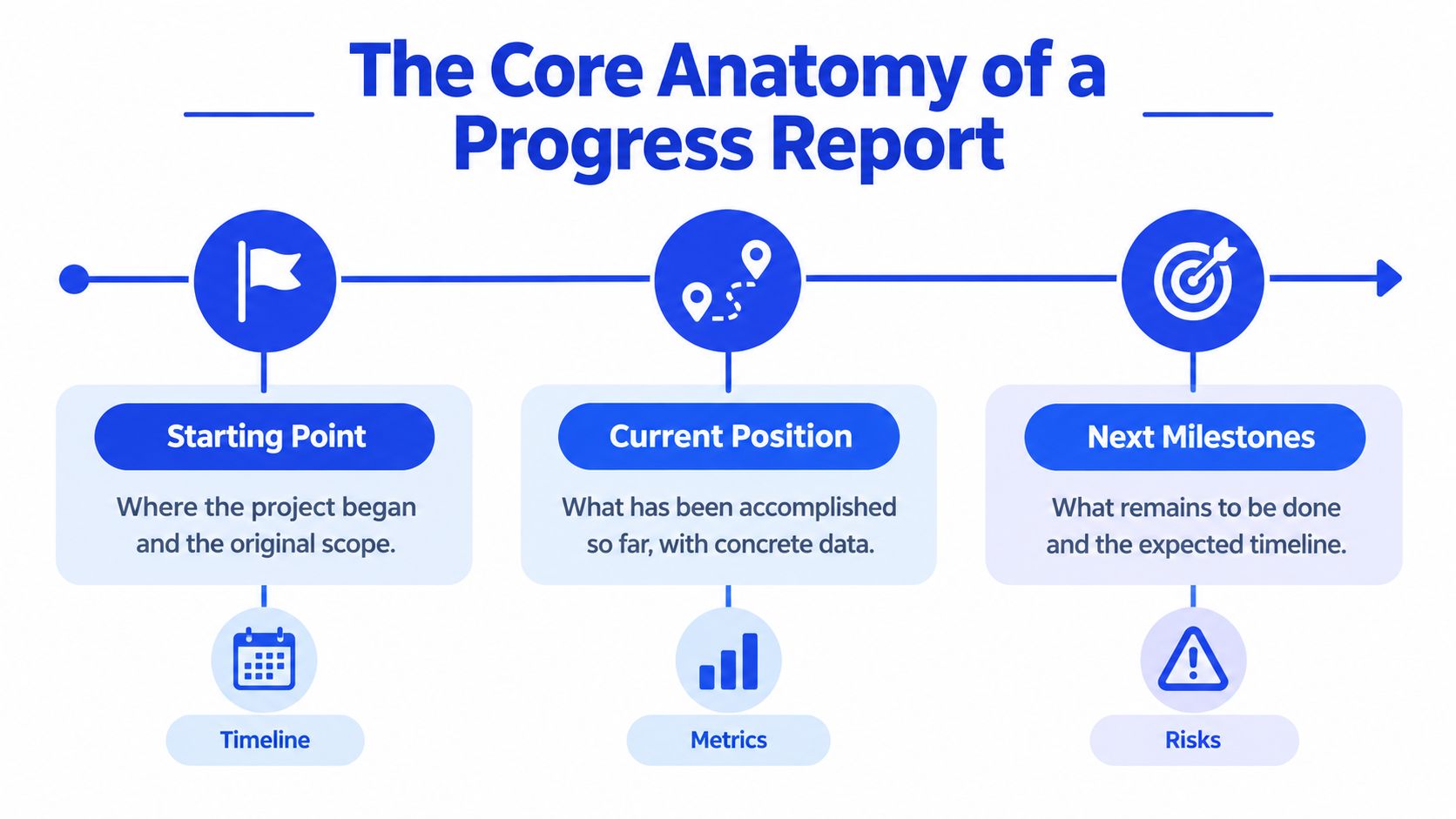
A progress report works like a map. It needs a starting point, a destination, a clear sense of the journey so far, and directions for the next stretch. Without those markers, readers can see activity but can't tell whether it represents progress.
Give the reader a starting point and destination
Start with the baseline, or where things stood before the work began. If a team is improving a support process, the baseline might describe the existing workflow and its known problems. If you leave that out, a reader can't distinguish change from business as usual.
Then name the target in plain language. “Improve the process” isn't specific enough to measure. “Reduce the number of unanswered customer questions by changing how requests are assigned” gives the team a direction, even if the exact measure still needs to be defined.
Next, state the reporting period. The reader needs to know which stretch of work the update covers. A report without dates can accidentally combine old evidence with current status.
Show evidence, then recommend a route
Describe what changed during that period and support it with evidence. A team might report that it tested the new assignment process, found that some requests still lacked a clear owner, and updated the handoff instructions. This is stronger than saying the team “made progress” because it identifies what was tested, what the result revealed, and what changed.
Close with the next action. If the handoff problem remains, the next step might be to assign an owner to each request type and check whether the revised instructions resolve the gap. A good recommendation names who will act, what they'll do, and what evidence will show whether it worked.
Research on goal-progress monitoring found a positive effect on goal attainment, with a meta-analytic effect size of 0.40, according to the summary of goal-progress monitoring research. That supports a practical point: tracking progress is most useful when it connects the current position to a goal and informs the next move.
A reader should be able to find these elements without searching through paragraphs:
Starting point: What was true before this work?
Target: What outcome are we working toward?
Time interval: Which period does this report cover?
Evidence of change: What shows movement, or a lack of it?
Next action: What should happen now?
Choosing the Right Metrics to Report
A report can contain plenty of numbers and still be misleading. The key is to choose measures that show progress toward the goal, then explain them so readers know what the numbers mean.
Begin by separating activity metrics from outcome metrics. Activity metrics show what the team did, such as how many calls it made or tasks it completed. Outcome metrics show what changed as a result, such as whether customers completed a purchase or whether a project milestone was reached. Activity matters, especially when diagnosing a problem, but it shouldn't be mistaken for the outcome.
Metric Type | Example | What It Tells You |
|---|---|---|
Activity metric | Product descriptions revised | What work the team completed |
Outcome metric | Orders attributed to a specific search query | Whether shopper behavior changed |
Activity metric | Ranking checks recorded | Whether monitoring took place |
Outcome metric | Visits and conversion rate for a query | Whether visibility attracted shoppers who acted |
Make each number interpretable
Pair the current value with a baseline, a target where one exists, and the reporting period. Then add a short explanation. “Traffic increased” leaves the reader asking: compared with what, over which period, and does the increase matter? A clearer version would name the starting point and current result, define the interval, and explain whether the change supports the stated goal. If no verified value is available, describe the direction qualitatively rather than making one up.
For an Etsy listing, ranking position alone doesn't tell the whole story. Etsy's Search Analytics exposes impressions, visits, orders, conversion rate, revenue, and average order value for individual queries. A useful report can pair position with those measures, while explaining that they may move independently.
Report quality, not just visibility
Imagine that a listing appears more prominently for a broad search phrase, but the report shows little evidence that those shoppers are buying. Calling that unqualified success would overstate what the ranking change means. A lower position for a more specific phrase may be more useful if it brings shoppers who are more likely to purchase.
For Etsy ranking campaigns, separate the observation of position from Etsy's own analytics about shopper behavior. The report should describe what each measure can establish, and avoid claiming that one caused the other unless the evidence supports that conclusion.
Tailoring the Report to Your Audience
The same project update can be accurate and still fail if it gives the reader the wrong level of detail. A busy executive wants the main conclusion and the decision needed. A client wants to see how work compares with agreed goals. A teammate needs clear assignments. A stakeholder may care most about risks and context.
Adapting the report doesn't mean changing the facts. It means choosing which facts to lead with, how much explanation to include, and what action to make visible. A useful guide to writing client update messages can help when the reader needs a concise, relationship-aware update.

One set of facts, different emphasis
Suppose a team has drafted a product page, but photography remains incomplete. The facts don't change, but the opening can change with the audience:
For a manager: “The page draft is ready, but publication depends on the product images. Please confirm who will complete photography.”
For a client: “The copy is drafted against the agreed scope. Photography is the outstanding item, and we'll confirm the publication plan once the images are ready.”
For a teammate: “Please add the product images and flag any missing files so the page can move to review.”
Each version leads with what the reader needs to understand or do. The manager sees a decision, the client gets a status against scope, and the teammate gets a task.
A report can also offer different layers of detail. Put the conclusion and immediate recommendation first, then provide the supporting evidence underneath. A reader who needs only the decision can find it quickly, while someone who needs more context can keep reading.
Put the most important message where the reader will see it first, not where you happen to finish explaining it.
When you tailor a report, keep the underlying evidence stable. Don't soften a risk for a client or inflate a result for a manager. State the issue plainly, explain its impact, and adjust the amount of background to suit the reader.
Two Sample Progress Report Layouts
Different readers need different report shapes. A decision-maker may need a compact summary, while a team needs enough context to act without guessing. These two layouts use the same basic ingredients, but arrange them differently.
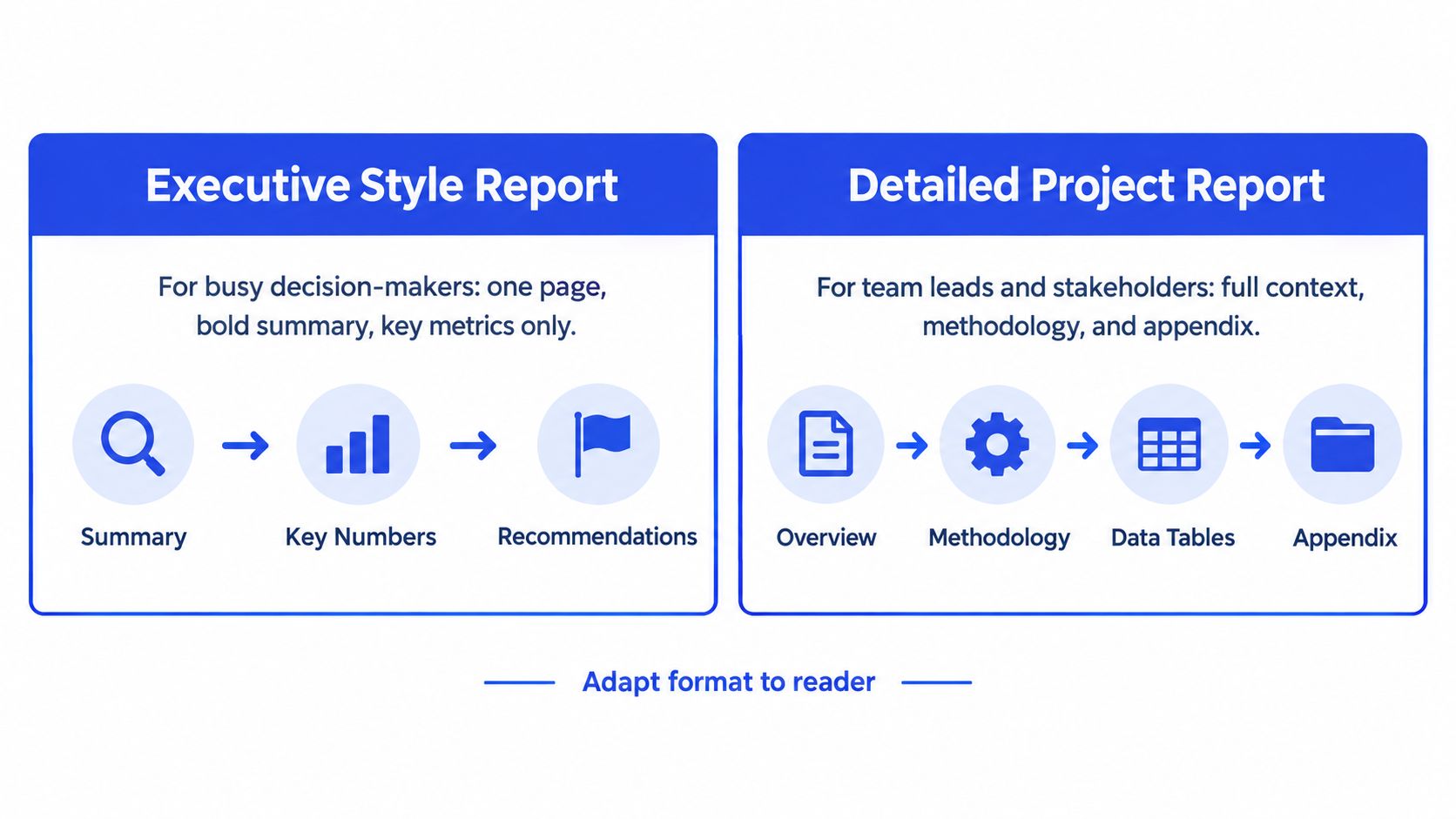
Layout for a busy decision-maker
Use this when the reader needs a quick understanding of status and a clear decision. Keep the explanation compact, but don't remove the evidence that supports the recommendation. A status report template can provide a starting structure.
Project: Product page launch
Reporting period: [Start date] to [End date]
Status: At risk
Summary: The page draft is complete. Product photography remains outstanding, so the launch date depends on receiving and approving the images.
Progress against goal: Draft prepared; imagery not yet approved.
Main risk: The team can't finish the page review without the images.
Decision needed: Confirm the person responsible for photography.
Recommendation: Assign an owner and agree on a handoff date, then review the page once the images arrive.
This layout puts status, evidence, risk, and recommendation near the top. It avoids a detailed account of every meeting because the reader needs to decide what happens next.
Layout for a team or client
Use a fuller format when readers need to understand the scope, evidence, and next steps.
Goal: Prepare the product page for review.
Starting point: The page required draft copy and product photography.
Work completed: Copy drafted and checked against the agreed content needs.
Evidence and current position: Copy is ready for review; product photography remains incomplete.
What changed during the period: The draft moved from outline to review-ready copy.
Risk or open question: The team can't assess the finished page until the images are available.
Next actions: The photography owner supplies the images. The reviewer checks the completed page and reports any remaining changes.
Decision or support needed: Confirm ownership of photography if it hasn't been assigned.
These are structures, not scripts. Replace the example details with evidence from the actual work, and leave out measures that don't help the reader understand progress or choose an action.
Reporting Progress When Rankings Fluctuate
A single ranking snapshot can look decisive, but it may not represent what every shopper sees or what will happen later. Etsy search results can vary with the search phrase and context, so a report should show how and when a position was observed rather than treating one result as universal.
Etsy describes search visibility as reflecting shop quality, listing quality, and customer-service quality. It identifies review rating, message response rate, and case rate over the previous three months as customer-service signals. Etsy also notes that search changes can take up to one day to appear, and that keyword relevance, filters, and other factors affect an individual shopper's results, as described in its search visibility guidance.
Record the conditions, not just the position
For each check, record the exact phrase, date, marketplace or location, device or search context, and any filters used. Say whether the result is a single observation or a range from repeated checks. This helps a seller compare like with like and understand what the report does, and doesn't, establish.
For example, an Etsy seller might report: “The listing appeared within the observed position range across checks on the dates recorded for this phrase and marketplace. The result is a snapshot of those checks, not a guarantee of placement for every shopper. Search Analytics will be reviewed separately for impressions, visits, and orders.” That statement is more careful than claiming the listing now holds a universal rank.
Distinguish movement from durable success
Also flag changes that might affect interpretation, such as new listing edits, seasonal demand, shipping costs, customer-service performance, or changes to the offer itself. A ranking change and a change in sales can happen together without proving that one caused the other. Reports earn trust when they identify the limits of the measurement instead of overclaiming.
Sellers who want a broader explanation of how to observe position can review this guide to rank tracking. The report itself should still state its measurement method and context so readers can interpret the result.
Common Mistakes and How to Fix Them
A quick review can catch the problems that make a report hard to use. Check the draft for these common misses:
Activity instead of progress: The report lists tasks but not results. Add evidence that compares the current position with the goal.
Bad news hidden: A risk appears late or in softened language. Put it near the summary and explain its effect.
Jargon without explanation: The reader must decode internal terms. Replace them with plain language or define them once.
Key message buried: The conclusion appears after a long activity log. Lead with status, the main gap, or the decision needed.
No baseline: The report says something changed but doesn't show where it started. Add the starting point so the change has meaning.
One number treated as universal: A snapshot is presented as a stable result for everyone. Record the measurement context and its limits.
Before sending, ask whether the report answers three questions: Where are we? Where should we be? What should happen next? Then check that its evidence supports the conclusion and that the recommendation makes sense for the reader's role.
Before sending your next report, choose one goal, state the starting point, and write the next action in plain language. If the report concerns an Etsy ranking campaign, include the search context alongside the position and shopper-behavior evidence, so the seller can make a decision from the whole picture rather than a single snapshot.