You searched your own product on Etsy tonight, and the listing you care about is still buried. You are about to pay to move it, which is the moment most sellers skip the only part that makes the spend honest. How to start a campaign is not picking a channel or a vague hope for more visibility. It is writing down one phrase, one baseline, and the rule for what counts as a result before any money moves. A higher position that never brings an order is not the win you paid for.
What One Campaign Covers and What It Leaves Out
A campaign is a focused push to move one Etsy listing up search results for one agreed phrase, and it fits when that listing matters more than the rest of the shop. If the whole shop needs fixing, a single-listing campaign will not do it.
Scope stays tight. You work on one listing, one search phrase of three or more words, and a target of a top-15 placement within 9 to 21 days of confirmed payment. That target is a measured goal, not a guaranteed placement. You choose one term, 30, 90, or 180 days. Each term is paid once, with no automatic renewal. The price is confirmed on the order page before you pay.
Term | Price | Position target | Renewal |
|---|---|---|---|
30 days | Confirmed on the order page | Target held for the term | None |
90 days | Confirmed on the order page | Target held for the term | None |
180 days | Confirmed on the order page | Target held for the term | None |
What the work does not include
Full-shop marketing, ads management, redesigns, and any edits to the listing itself sit outside the campaign. No Etsy password is needed. You share the public listing URL and the keywords only.
Upglider is an independent service that runs this kind of ranking campaign. It is not affiliated with or endorsed by Etsy. The campaign requirements page lists what the listing should already have before you ask for an assessment.
Who it fits
New shops that need first visibility on one live listing. Established sellers with one high-potential listing that has stalled. Seasonal sellers launching a product or a new release who need that item visible for a fixed window.
If you want one campaign to repair every listing in the shop, stop. That is a different job.
How to Choose the Listing and Search Phrase
A leather wallet listed as a gift should be tested against a phrase that describes that actual product, not a broad query that attracts mismatched shoppers. Set the listing, phrase, baseline, and decision rule before paying. A rank change is one signal; it does not establish that the campaign generated a sale.

Choose one live listing. Pick the item you want to measure, and confirm its photos, shipping, and returns are in place. The campaign will not set them up or edit the listing.
Choose a buyer's search phrase. It must have at least three words. A single word is refused, and a two-word phrase does not meet the minimum. Phrase length alone is not enough: it also has to describe the product.
Check the category and attributes. They should fit the phrase. If the listing is in the wrong category, shoppers and search filters may not treat it as a relevant result.
Review the title and all 13 tags. Etsy's seller handbook describes search visibility as reflecting shop quality, listing quality, and customer-service quality. Relevance, filters, shopper popularity, reviews, message-response performance, and case rate over the previous three months also factor in. Use all 13 tags for natural, multi-word phrases in your shop's language, aligned with the title. Etsy says search changes can take up to one day to appear, so allow time after an edit before recording the baseline.
Record the starting point before payment. Note the exact phrase's rank, along with impressions, visits, favorites, orders, and conversion rate. Keep the market, device, language, and logged-out state consistent when checking rank. Personalization and filters can change what appears.
Set the decision rule in one sentence. For example: “This listing reaches the top 15 for this phrase within 21 days, and the campaign runs for 90 days.” Track sales separately; a ranking goal does not prove that the campaign caused an order.
Which phrases pass
Search phrase | Word count | Verdict |
|---|---|---|
mug | 1 | Rejected: single word |
ceramic mug | 2 | Rejected: below the three-word minimum |
gift for her | 3 | Too vague: check fit before accepting |
handmade ceramic coffee mug | 4 | Accepted: specific and product-matched |
printable wedding seating chart | 4 | Accepted if the listing is a printable seating chart |
linen tablecloth for round table | 5 | Accepted: confirm competition in the assessment |
The right phrase describes the item a buyer will find after clicking. A longer phrase can still be too vague, and a popular query is a poor test if it promises a different product. Before choosing, use this guide to Etsy keyword research to assess demand and phrase fit. Then compare rank and sales against the baseline, rather than treating a higher position as proof of increased orders.
How to Request an Assessment and Pay
Companies often set the next budget from last year's split and a rule of thumb, rather than from a number they can defend. A McKinsey global survey of chief marketing officers and senior executives reports that pattern across companies. Treat the assessment as the point where you lock the measure of success before you choose the term.
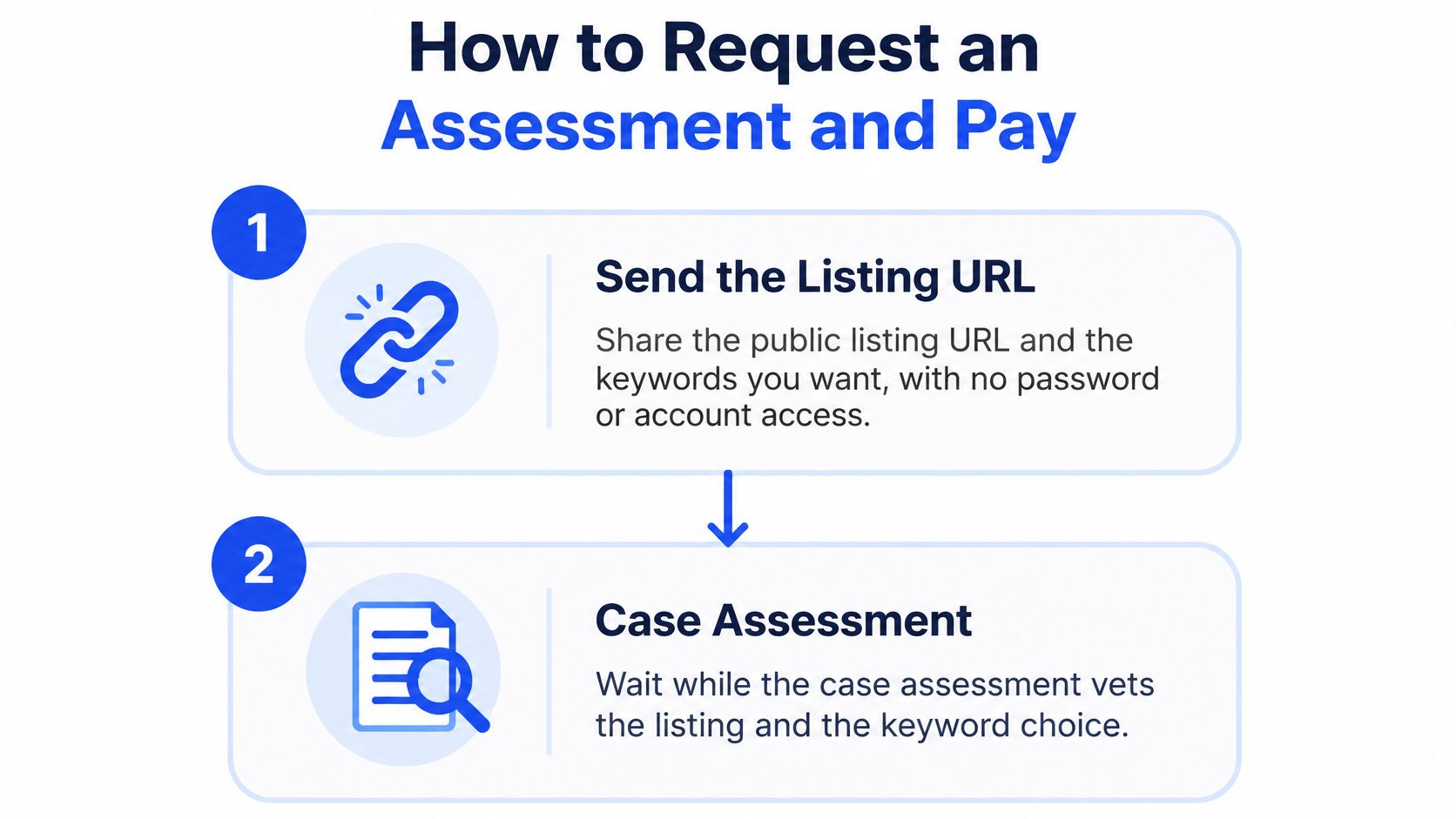
Send the public listing URL and the keywords you want. Do not send a password or any account access. The work uses the public listing only, so your login stays yours.
Wait for the case assessment. It vets the listing, the keyword choice, and the difficulty. You are checking whether this phrase is a fair test, not collecting a promise of placement.
Read the assessment and decide whether the phrase still fits. If it is too broad, ask for a change before you pay. A printables seller who submits the single word “printable” would be asked to choose a longer phrase, such as “printable wedding seating chart,” and no payment would be taken until that phrase is accepted. Single-word keywords are refused. Optional extra keywords can be added at a fixed add-on price if you want them after the main phrase is set.
Check the final terms and the tax treatment. Both are shown before payment, so you see the length, the target, and the cost together.
Choose a payment method. The options are instant bank transfer, bank transfer, or crypto.
Wait for payment to be confirmed. That confirmation starts the 9 to 21 day clock and opens the dashboard. Until then, nothing in the campaign has started.
What to Track on the Dashboard and How Often
A rank change can look like progress while orders remain unchanged. Use the dashboard to track the agreed search phrase alongside the listing's commercial results, and keep the conditions for each reading consistent. Rank is worth checking daily; review the shop and sales figures weekly. One snapshot is not a verdict.
Before judging results, set one primary measure, a numeric target, and the period you will use to assess it. For a ranking campaign, the primary measure is position for the exact agreed phrase. Keep orders and conversion rate beside it to see whether visibility is translating into purchases. Think with Google's media-effectiveness guidance supports setting a measurable target before assessing performance. A higher rank alone does not prove that the campaign generated sales.
Check rank daily using the same market, device, language, and logged-out state. Record the date, time, and search conditions so readings are comparable. Define conversion rate consistently as orders divided by attributable visits, and keep a change log that connects listing edits to later results.
Shop signals that sit beside one listing
Etsy's customer-service standards identify average review rating, message response rate, and case rate as shop-level signals measured over the previous three months. Use the seller handbook to check the current standards for response times rather than treating a particular reply deadline as a fixed requirement. Ranking work does not replace prompt customer service or a satisfactory experience after the sale.
Etsy search considers relevance across titles, tags, descriptions, categories, and attributes, alongside listing quality, shop quality, and engagement, including whether views lead to purchases. Search results are personalized, so a high position in one account is not a guarantee that every buyer sees the same position.
A top-15 reading that lasts a single afternoon is a data point, not a result.
Metric | How often | What it tells you | Warning sign |
|---|---|---|---|
Rank for exact phrase | Daily | Position for the agreed phrase | Top 15 for one day only |
Impressions | Weekly | How often the listing appears | Rising while orders stay flat |
Visits | Weekly | Shoppers who click through | Visits that never lead to a purchase |
Favorites | Weekly | Interest before buying | Favorites with no orders |
Orders | Weekly | Purchases during the campaign | No orders by the end of the review window |
Conversion rate (orders ÷ visits) | Weekly | Whether visitors buy | Falling as rank improves |
Review rating and reply time | Weekly | Shop-level service signals | Response time falling short of current Etsy guidance |
How Long Results Take and When a Refund Applies
Payment confirmation starts the campaign clock. On day 0, save the baseline and dashboard link. A first rank check is only a starting point, not a verdict.
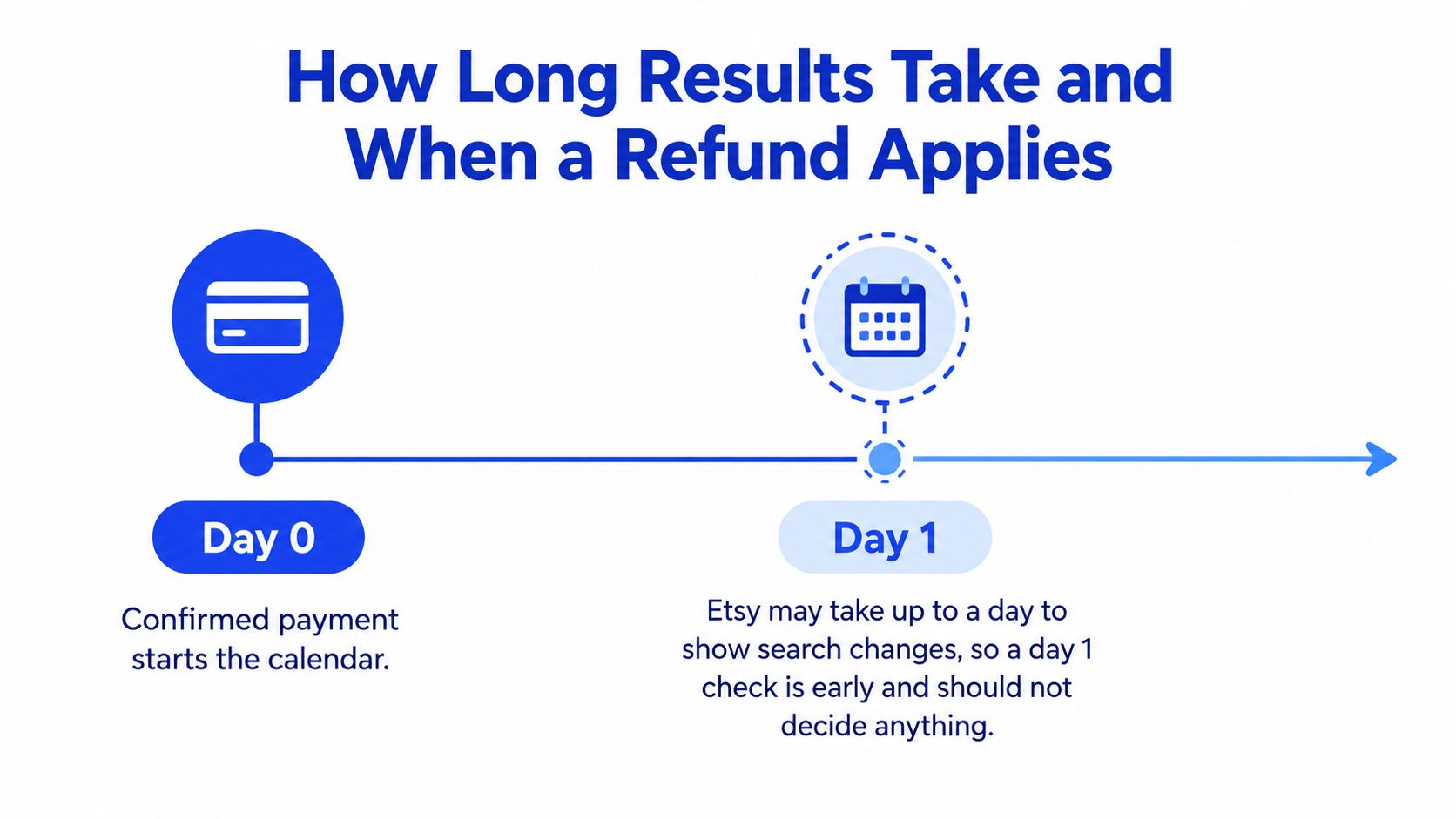
Etsy search changes can take up to one day to appear, so day 1 is too early to judge the campaign. The target window is days 9 to 21: a top-15 placement for the agreed phrase. Day 21 is the review point. Use the dashboard record across the checks in that window as evidence, rather than relying on a single search from your phone.
The terms on the order page determine whether a refund applies if the target is missed. Read those conditions before paying, including what evidence is required and how to request a refund. The campaign schedule shows how the target window fits within the paid term. The target is held for the full paid term, whether that term is 30, 90, or 180 days. The campaign ends when the term ends, and does not renew automatically.
What a short window can and cannot prove
Standard test planning often uses 95% confidence and 80% power, with sample size based on the baseline conversion rate and the smallest lift worth detecting, as the sample-size glossary explains. A low-traffic listing may show rank movement during days 9 to 21 without enough visits or orders to establish a conversion-rate lift. Rank improvement alone does not prove that the listing sells better.
If rank rises while sales stay flat, first check whether the phrase matches what buyers want. Then compare the listing's photos, price, and shipping with nearby competitors. Use those checks to decide whether another paid term makes sense, rather than treating a higher position as proof of a sale.
Stage | Timing | What happens | What you do |
|---|---|---|---|
Payment confirmed | Day 0 | Campaign clock starts | Save the baseline and dashboard link |
First changes visible | Day 1 | Etsy may take up to a day to show changes | Check rank, but do not judge yet |
Target window | Days 9 to 21 | Top 15 for the agreed phrase is the target | Read the trend across several checks |
Review point | Day 21 | Check whether the target was met and review the order-page refund conditions | Use dashboard records from the target window |
Term continues | Day 22 to end of term | The target is held for the paid term | Track conversion weekly |
Campaign ends | Day 30, 90 or 180 | No automatic renewal | Decide whether a new campaign is worth it |
Decide Whether to Start Your Campaign Now
Three answers decide whether you start now.
Is the listing live, with photos, shipping, and returns set? Is the target phrase three or more words, written in the shop's language? Can you read the dashboard weekly and record a baseline before launch? If all three are yes, choose 30, 90, or 180 days and request the assessment. If any answer is no, fix that first. Paying early only hides the gap.
What you must not fake
Etsy's seller policy prohibits creating duplicate shops and taking actions such as manipulating clicks, carts, or sales to influence search or evade Etsy rules. Artificial engagement creates policy risk even when the goal is a better position. This campaign uses no simulated clicks, carts, or purchases. Progress is measured only through transparent position checks and real buyer behavior.
Before you pay, look again at the mistakes already spelled out above. A single-word phrase. A verdict from one rank check. A rank gain counted as a sale. A full-shop fix expected from one listing. None of those survive a clean test.
Rank is a position. An order is a sale. Write both down, or you will mix them up the first week the listing moves.
If the three answers are yes, submit the public listing URL and the keywords for the case assessment, then read the terms before you pay.
Open the order page, confirm the term and the price shown there, and send the listing URL with a phrase of at least three words. Do not pay until the assessment says that phrase still fits the product you sell.