You opened your shop on a Sunday. By Wednesday you'd refreshed the stats page enough times to memorize the number next to views, and it's still sitting in single digits, most of them probably you. The products are good. The photos took an afternoon. Nobody has bought anything.
Nothing is broken. A first sale on Etsy passes through a sequence of gates, and each gate fails for a different reason: the listing can't be found, the thumbnail doesn't earn the tap, or the page doesn't close the sale. Build one product properly, price it against fees, then measure which gate is shut. That order beats every keyword trick I know.
What Your First Sale Costs in Fees
Say you sell a $30 item and charge $5 for shipping. The buyer pays $35. Etsy's charges come out of that $35, not out of the profit you were hoping for, so the arithmetic has to happen before you publish.
Start with the $0.20 USD listing fee. Etsy charges it when an item is listed, whether or not the item sells, and a listing generally expires after four months, so each relist costs another $0.20. A listing that sits unsold for a season automatically bills you again. When an order comes through Etsy.com, the transaction fee is 6.5% of the displayed item price plus any amount charged for shipping and gift wrapping, which is $2.28 on your $35. Both rules sit on Etsy's fee schedule and both apply to a shop with zero sales.
Offsite Ads is conditional. Etsy only charges it when the company attributes a sale to an offsite advertisement, so plenty of orders never carry the fee at all. When it does land, the rate is 15% for shops that made less than $10,000 on Etsy during the previous 365 days and 12% for shops at or above that threshold, capped at $100 per order.
Charge | Rule | Example Amount |
|---|---|---|
Listing fee | $0.20 per listing, charged whether or not it sells | $0.20 |
Transaction fee | 6.5% of item price plus shipping and gift wrap | $2.28 |
Offsite Ads, shops under $10,000 in past 365 days | 15%, capped at $100 per order, only if Etsy attributes the sale | $5.25 |
Offsite Ads, shops at or above $10,000 | 12%, capped at $100 per order, only if Etsy attributes the sale | $4.20 |
The pricing sequence that leaves a profit
Run it in this order every time, and the answer falls out at the end.
Add materials and labor for one unit. Be honest about the labor hours, including the ones you enjoy.
Add the postage you will pay to get the parcel to the customer.
Add the Etsy fees above at the rate that applies to your shop.
Set the price so item plus shipping still leaves a profit above that total.
On the worked example, the $30 item with $5 shipping leaves about $32.52 after the listing and transaction fees, before your own materials and postage. If materials and postage come to $18, you keep roughly $14.50 on the order, and an attributed offsite ad would shave another $5.25 off that. Payment processing is billed separately from the charges above, so check the current rate on Etsy's fee page before you publish rather than assuming the number you remember still holds.
One more cost that catches sellers who bundle: if a single listing offers several items or variations, how the listing fee works when one listing holds multiple items is worth five minutes before you set the price. Then pull up three to five listings that rank for the phrase you plan to use and compare prices. If yours sits far above them with no reviews behind it, price isn't the only thing that needs work.
How to Build One Listing That Search Can Find
Search runs in two stages, and most new sellers optimize for the wrong one. Etsy first matches a buyer's query against a listing's titles, tags, categories, attributes and descriptions. Only then does it rank those matching listings on signals such as relevance, engagement and shop quality, and the platform notes that exact keyword matches may carry stronger relevance, as Etsy's seller handbook explanation of how search matches listings sets out. Get the match right first. Ranking is a separate fight.
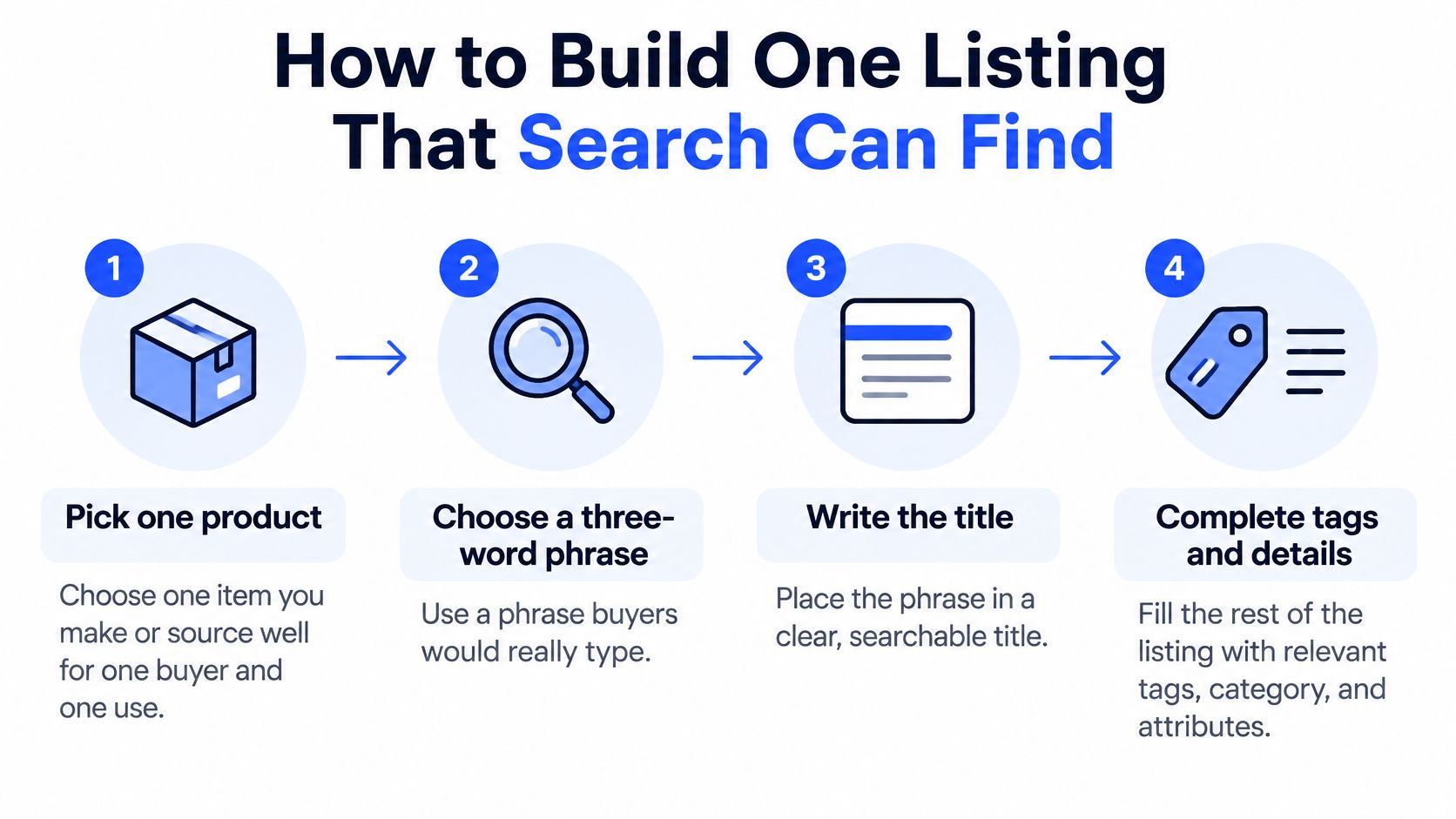
Here's the build order I'd follow for a first listing.
Pick one product you make or source well. One buyer, one use. If the shop has six candidates, choose the one with the clearest single purpose, because a listing that tries to be a gift, a tool and a decoration matches none of them well.
Choose a phrase of three or more words that a buyer would really type. "Personalized leather dog collar" carries intent. "Collar" carries nothing but competition. Narrow phrasing also hedges against a ranking system that keeps moving, since Etsy's seller handbook on trends and search describes search evolving toward personalization and greater weight on quality and the expected post-purchase experience. If you want a repeatable method for finding that phrase, start with Etsy keyword research done properly.
Put the phrase near the front of the title in plain words. "Personalized Leather Dog Collar, Custom Name Tag, Brass Buckle" reads like a product. Nine keywords separated by commas reads like spam. The common slip is burying the phrase behind a shop name nobody searches.
Fill all 13 tag slots with different phrases. Etsy gives you 13 tag fields and its own guidance recommends using every one, because an unused tag is a missed description. Tags should be distinct phrases covering what the item is, how it's used, its style, recipient, material or occasion, as Etsy's guidance on tags and attributes explains. The slip that kills new shops is repeating one keyword across ten slots.
Choose the most specific category and complete every attribute. Material, color and size are searchable fields, not decoration. Etsy matches against categories and attributes too, so filling them gives the listing extra routes into a query.
Write the description to answer the first questions. What it is, its dimensions, what's included, how long production takes. Those four items belong in the opening lines, before any story.
Read the title and description aloud. If the phrase fights the sentence, rewrite the sentence rather than shoving the phrase into an awkward spot. The slip here is copying tags from a bestseller, which describes their product and their buyer, not yours.
The self-check. Search your phrase on etsy.com while signed out and confirm the listing appears somewhere in the results, even far down page five. You're testing that the setup works, not that you rank yet. If it doesn't show at all, the phrase isn't supported by the title, tags and category. Then enter the price from the fee step and confirm it still covers everything before you publish.
Photos and Details That Turn Views Into Orders
Before you touch anything else, shrink your first photo to the size it appears on a phone. That thumbnail is what a shopper sees in search, side by side with twenty competitors, and it either earns the tap or it doesn't. Natural daylight by a window, a plain background, and the product filling most of the frame beat any amount of editing.
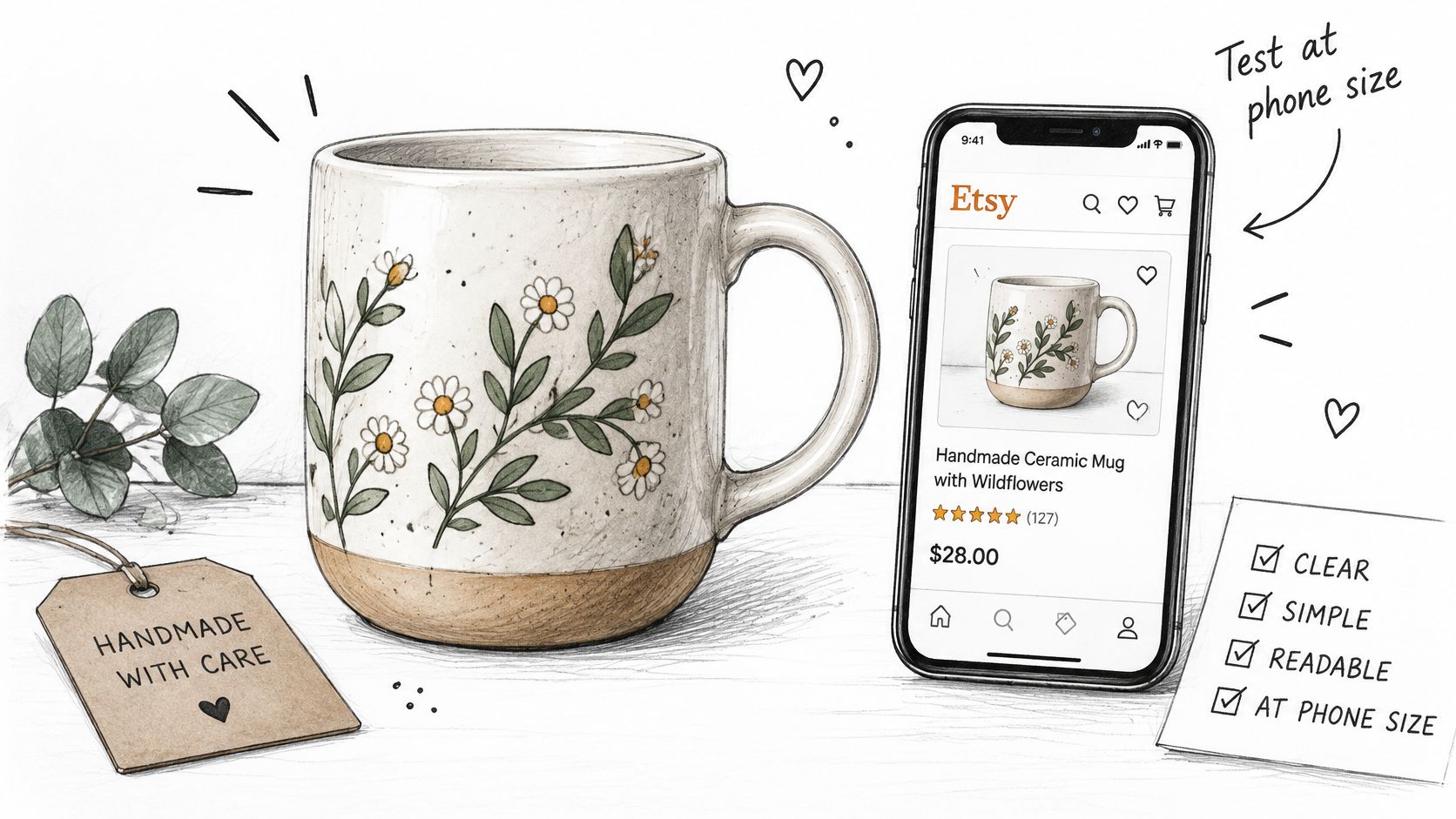
The five shots every new listing needs
The whole product, plain background, filling most of the frame.
A scale shot, with a hand or a familiar object beside it, so nobody has to guess at size.
A close-up of texture or detail, the part a buyer would touch in a shop.
The product in use, on a person or in a room, doing the job it's sold for.
What's included, laid out, so there's no surprise when the parcel opens.
Five to ten photos is the working range. Fewer than five looks unfinished next to the shops around you, and images past the tenth rarely get seen.
The details shoppers check before they buy
Processing time, stated as days, not "ships fast".
Shipping cost and estimated delivery, visible before checkout rather than buried in a policy page.
Returns, spelled out in one short sentence.
Shop policies and an About section with a real name and a short, specific story. Default templates read like an abandoned shop.
Personalization or size options, shown in the listing so buyers don't have to message you first.
Shoppers can't read the reviews you don't have yet. Your photos and policies have to do that job until they can.
Run Your Launch-Day Checklist, Then Decide on Paid Help
The listing is built. Run this list once, in full, before you send a single person to it.
At least five photos, with a first photo that reads clearly at thumbnail size
Your three-word phrase near the front of the title
All 13 tags filled with distinct phrases
The most specific category and every attribute complete
A price that covers fees, materials and postage
Processing time and shipping stated in the listing itself
Shop policies and About section finished
The link shared with your first three audiences
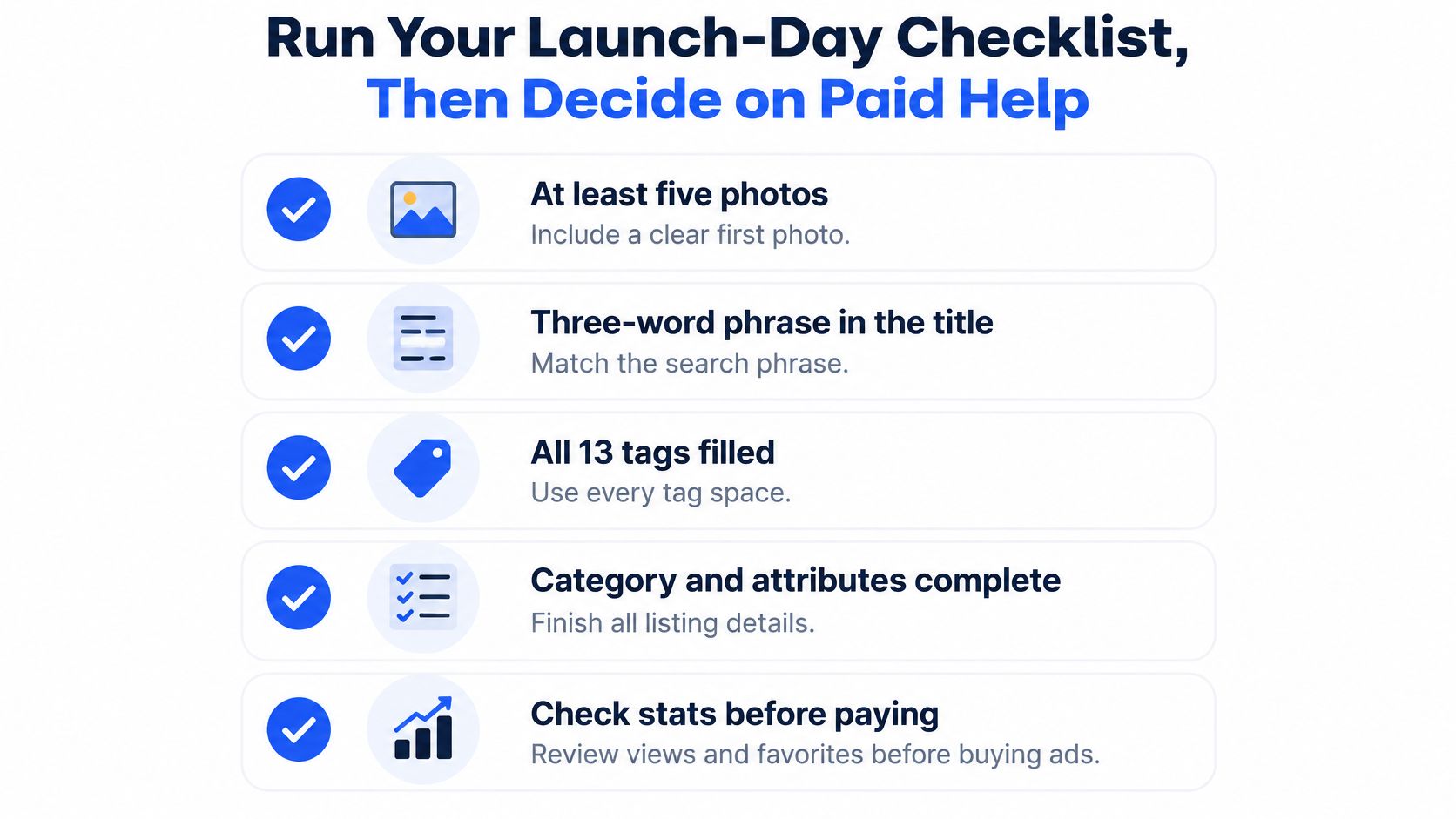
Then leave it alone and read shop stats once a week for four weeks. The rule is mechanical: low views sends you back to the title, tags and category work. Low clicks sends you to the first photo. Low orders sends you to the trust details, shipping and price. Change one thing per week so you can tell what moved.
If the listing is complete and still shows almost no impressions after four weeks, a paid ranking campaign earns a look. Upglider's Etsy listing ranking campaigns start from $129 USD, paid once, with no automatic renewal, and work to place the listing in the top 15 for the agreed phrase within 21 days. If we can't reach that position by day 21 the money-back guarantee applies, and we confirm the phrase and the ranking check with you before payment so nothing is ambiguous later. The service ranks listings in the USA and UK search markets only.
Get Early Visitors Before Reviews Arrive
Demand isn't the missing piece. Etsy acquired 4.8 million new buyers during the third quarter of 2025, according to Etsy's third-quarter 2025 results. The work is steering a handful of them to a shop with no track record.
Start with tactics that cost time instead of money. Tell friends, family and past customers, and give them something easy to pass on rather than a bare link. Post where the product fits, a breed group for a dog collar, a plant swap for a ceramic pot, and skip the groups where you'd only be advertising. A short launch discount for the first week works if the discounted price still clears the fees you worked out earlier. After each delivery, ask the buyer for an honest review in a plain message, no incentives attached.
Run the free tactics for two to four weeks with a complete listing before paying for visibility. If the page can't convert a visitor, more visitors only waste money.
Where views come from, and which channels are worth your evenings, is covered in how to get more views on Etsy.
Route | Cost | Time Needed | Best Fit |
|---|---|---|---|
Friends, family and past customers | Free, costs your time | A few hours | Listing is complete and ready to share |
Relevant communities and social groups | Free, costs your time | Ongoing, with consistent posting | Product clearly suits the group's interests |
First-week launch discount | Lower price on each order | Set once | Discounted price still covers fees |
Targeted ranking campaign | From $129 USD, paid once (confirm current terms) | Top 15 target within 21 days; campaigns run 30, 90 or 180 days | Listing is complete and clicks are already good |
The paid route is narrow by design: one listing, one search phrase of three or more words, moved toward the top 15 results. You send a public listing link and the phrase. We never sign in to your shop, never ask for a password, and never edit your title, tags or photos, so the listing stays yours. You can verify the position yourself at any time by searching the phrase on etsy.com while signed out, in a private window with no account logged in. None of it is worth buying until the listing is complete and clicks are healthy.
Find Which Stage Blocks Your First Sale
A quiet shop is normal. Many Etsy shops make no sales in their first weeks, so zero sales in week two says nothing about your product.
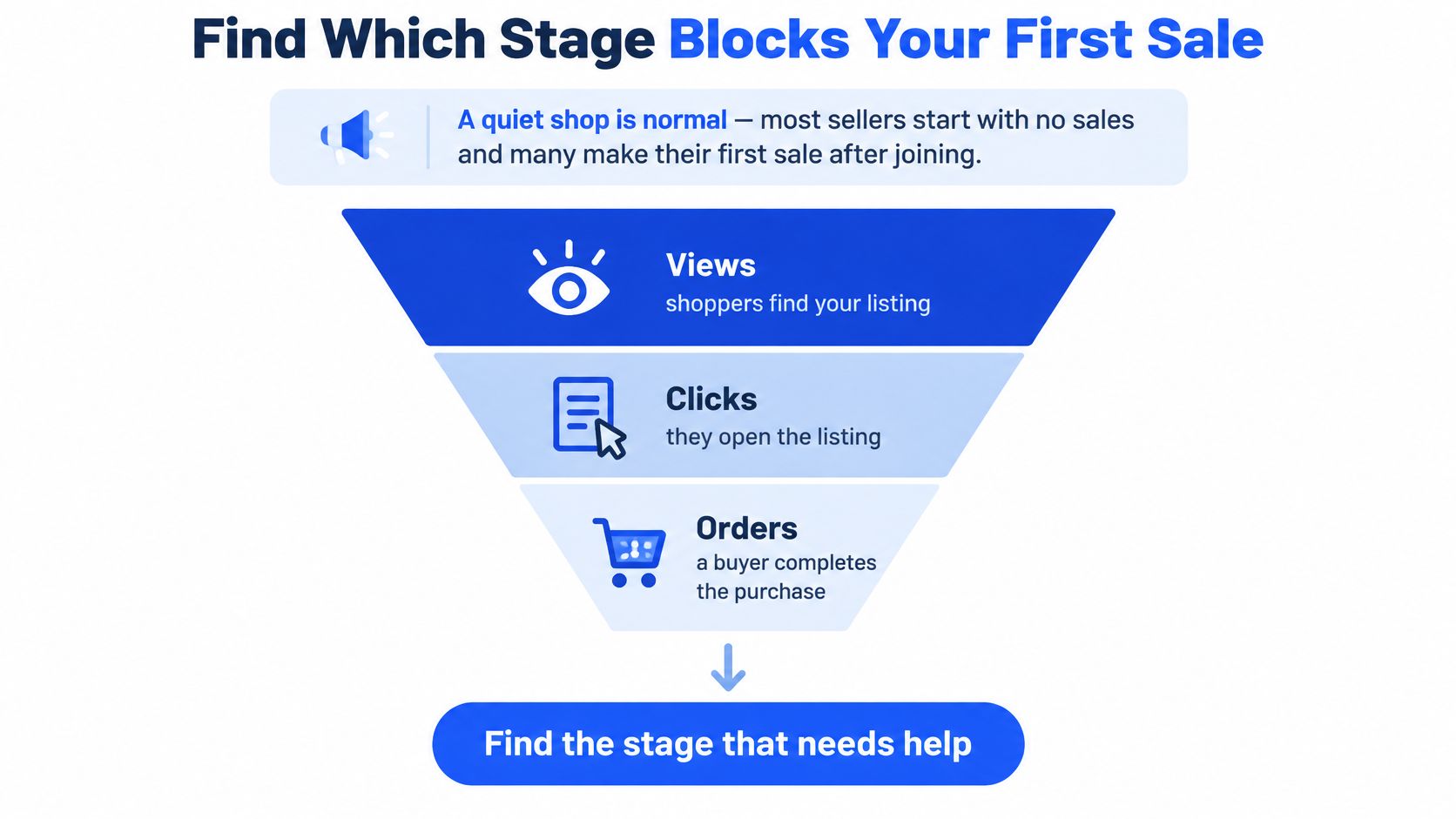
Read your stats in the right order
Eligibility comes before everything. Etsy's guidance treats exposure as a product of the listing, the shop and customer service together, and lists basic requirements such as having at least one listing image, as Etsy's search visibility help page explains. A listing with no photo cannot appear at all, so check that first.
Stage | What You See | Likely Cause | First Check |
|---|---|---|---|
Eligibility | Listing never appears in search | No listing image or listing not active | Listing is active with at least one photo |
Visibility | Few or no impressions or views | Listing does not match the phrase buyers type | Title, tags and category contain a 3+ word phrase |
Click | Impressions but few visits | Weak first photo or unclear title | First photo and title read clearly at thumbnail size |
Purchase | Visits or favorites but no orders | Trust gaps, unclear shipping or price | Shipping times, policies and price are visible |
Diagnose one complete listing, not the whole shop. A ring listing with zero views after two weeks sits in the visibility row, so reshoots will not move it. If it has forty views, two favorites and no orders, the click row is the constraint and the first photo or title is the likely drag. Sixty views with steady favorites and no checkout points to the purchase row, where shipping estimates, policies or price usually do the stalling.
Fix one stage, wait a week, then look again. Changing photos, tags, price and shipping in the same weekend leaves you with a new listing and no idea which change mattered.
Upglider's campaign fits only after that diagnosis points to visibility: one live listing link, one approved phrase of three or more words, USA/UK search only, from $129 USD paid once, with no Etsy password and no edits to the listing.