You've published several Etsy listings, checked them repeatedly, and still can't tell what to improve first. One product has decent photos, another has a clever title, and a third might be your strongest offer, but spreading attention across the whole shop makes every decision harder to measure.
The practical starting point is narrower: choose one listing, target one specific multi-word search phrase, and make that page easy for the right buyer to find, understand, and trust. Etsy reported 5.6 million active sellers and 86.5 million active buyers in Q4 2025, so visibility matters in a marketplace where many shops compete for attention, even while demand remains substantial (Etsy marketplace figures).
These selling on Etsy tips follow that focused path. Start with search intent, then improve relevance, photography, pricing, service, trust, promotion, and measurement. The aim isn't to chase every tactic at once. It's to create one listing you can evaluate clearly before applying the lessons elsewhere.
1. Optimize Your Listing Title With High-Intent Keywords
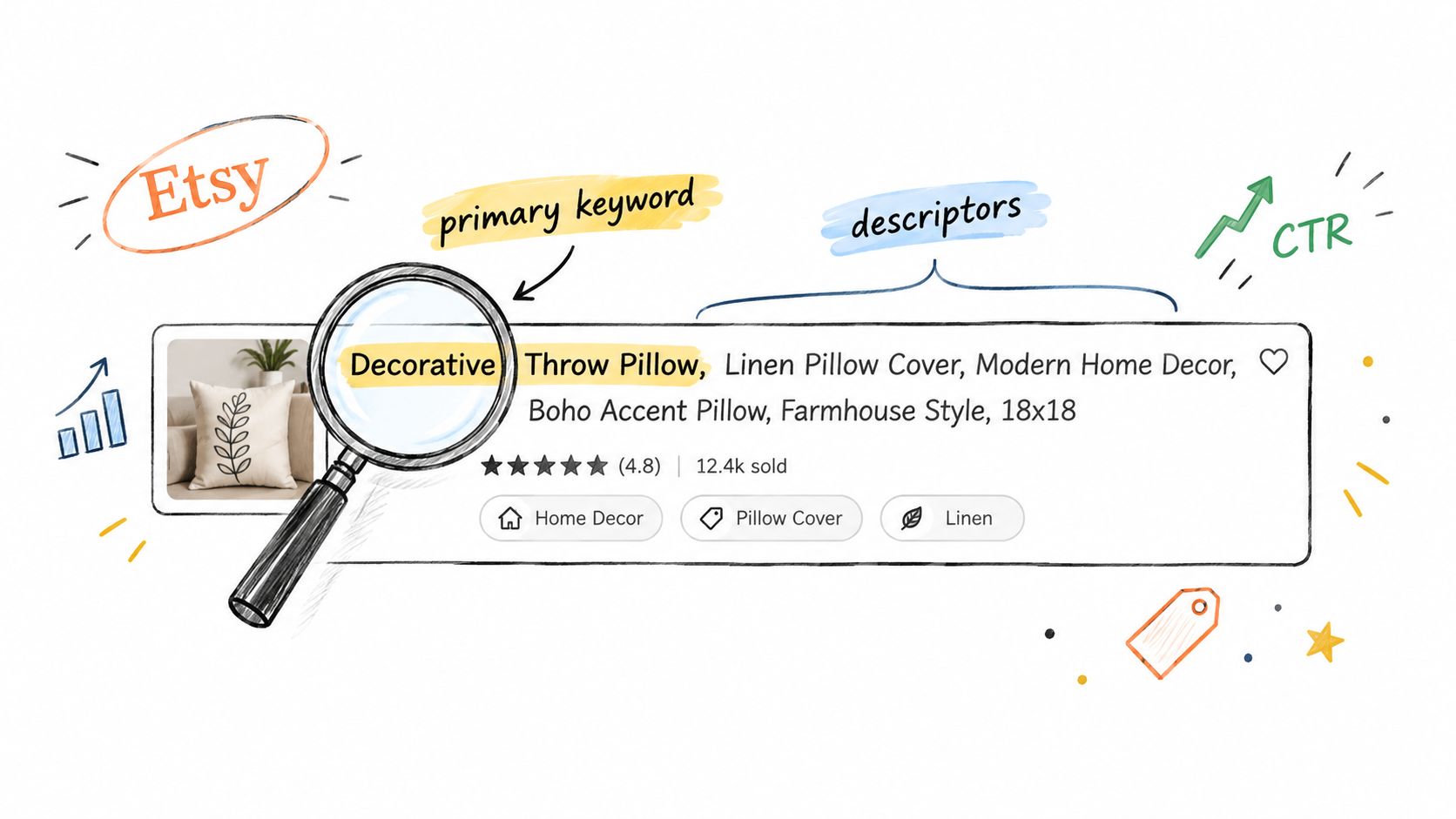
A buyer scanning search results should understand the product before opening the listing. A brand name such as “Luna Collection” may support shop identity, but “Personalized Birthstone Necklace” states what the item is and gives Etsy clearer context.
Put the strongest product phrase first, then add modifiers that affect the buying decision, such as material, recipient, occasion, color, or customization. For a handmade rose gold necklace, “Personalized Birthstone Necklace” could lead, followed by accurate details about the finish, recipient, or personalization. Leave out terms the product does not satisfy. Etsy says search considers relevance in titles and tags, while also evaluating listing quality and customer experience (Etsy search ranking guidance).
Practical rule: Write the title for a buyer scanning results, then confirm that Etsy can interpret the same wording.
Balance discovery with readability
Repeated phrases and stacked synonyms make a title harder to scan. Use natural word order, state the clearest product description near the beginning, and use the remaining space for meaningful qualifiers. A readable title may give up a little keyword coverage, but it can make the product easier to understand and click.
The title also needs support from the rest of the page. Match it with relevant tags, an accurate category, clear images, and a description that confirms exactly what the buyer receives. After making the change, avoid revising several major elements at once. A consistent observation period makes it easier to connect changes with views, clicks, or orders.
Next action: Write three titles for your chosen listing. Select the version that states the product, buyer intent, and strongest differentiator without reading like a keyword list.
2. Target Low-Competition, High-Intent Search Phrases
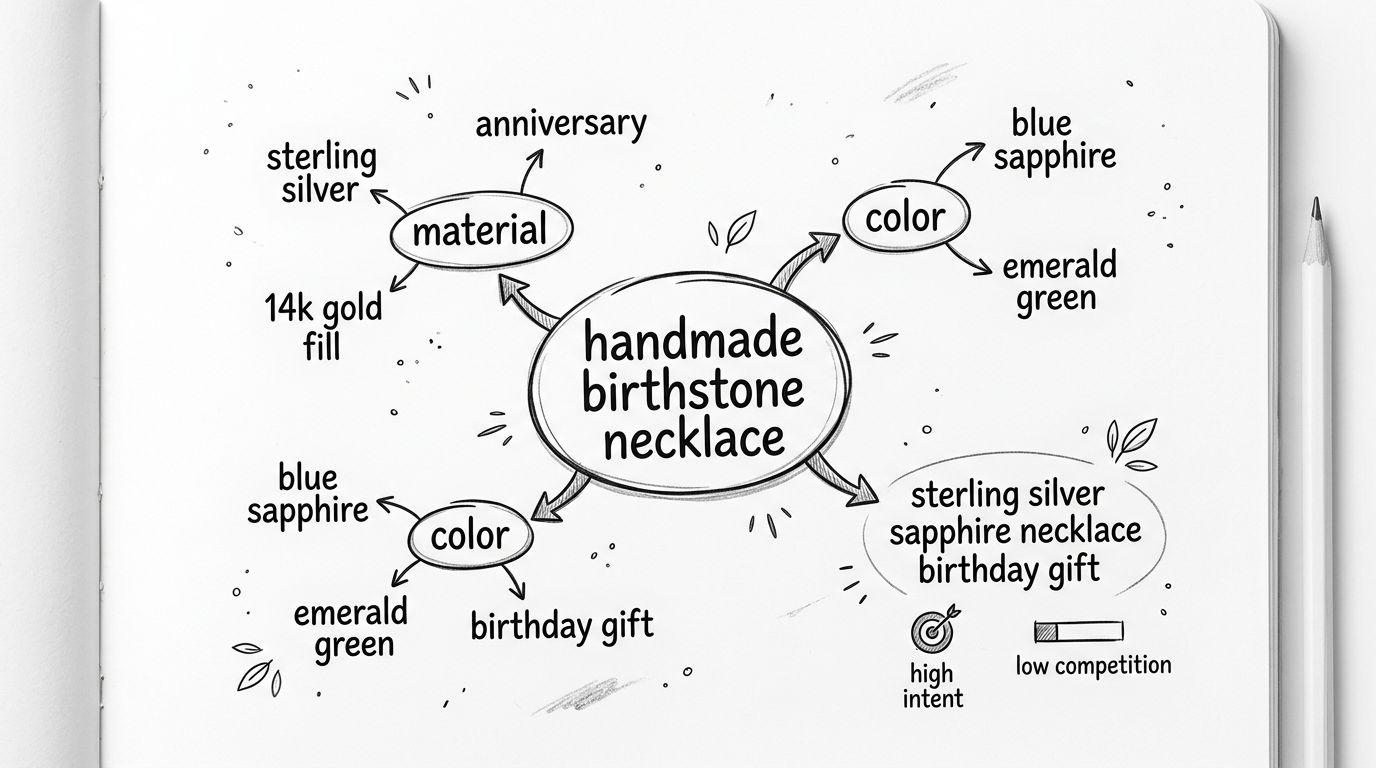
Broad terms such as “necklace,” “printable,” or “wall art” identify a category, but they reveal little about the shopper's purpose. Add product detail and buying context, such as “minimal birthstone necklace,” “editable wedding seating chart,” or “gallery print for neutral living room.”
Long-tail phrases often receive less search activity than broad categories, yet they make the buyer's need clearer. A shopper searching for a personalized birthstone necklace has already specified product details and may be closer to selecting an item than someone searching only for “jewelry.” For a new or time-constrained seller, that trade-off makes one specific phrase more practical than competing across every related category.
Use Etsy's own Search Analytics to compare shopper queries with your tags, average search position, and conversion from Etsy search (Etsy Search Analytics guidance). Choose wording your product can support. “Silver necklace” misrepresents a gold-plated piece, while a location modifier is unsuitable unless the listing genuinely serves that location.
Time seasonal phrases carefully
Seasonality affects when a phrase deserves attention. Etsy's 2026 Seller Trend Report highlights gifting intent, seasonal searches, and preparing inventory before key occasions. Its spring and summer 2026 trend coverage reported wall art decor searches up 110% and gallery prints up 80% (Etsy's 2026 trend insights). These figures describe movement in specific categories, not a guaranteed result for every seller.
Check three conditions before choosing a seasonal target:
Buyer intent: Does the phrase describe a purchase, or only general interest?
Competition: Can the product offer a clear distinction in the results?
Timing: Can you produce, publish, and promote it while the demand remains relevant?
Next action: Choose one phrase of three or more words that describes the exact product and buying situation. Use it as the primary target across this listing instead of switching between broad categories.
3. Use Tags and Categories Strategically to Support Your Keyword Target
Once you choose one target phrase, build the listing's tags around the same buyer need. Tags should add useful context rather than repeat one wording. Include related terms a shopper might use for the recipient, occasion, material, style, or intended use. For a birthstone necklace, accurate variations could cover personalization, jewelry gifting, and the intended recipient.
Categories and attributes provide another relevance signal. Select the narrowest accurate category, then complete available fields for material, color, occasion, and style. These choices place the item in a more specific part of Etsy's marketplace and give shoppers clearer information before they open the listing.
Tags support search relevance, but they do not repair weak listing quality or a poor customer experience. Etsy's search system also considers titles and tags, listing quality, customer and marketplace experience, recency, shop location, and shop diversity (Etsy's search system overview). Treat tags as one part of the listing setup, separate from later promotion that may bring outside traffic.
Build a keyword cluster, not a keyword pile
Assign each tag a clear job:
Product phrase: State exactly what the item is.
Audience phrase: Identify the likely recipient or buyer.
Occasion phrase: Name a genuine gifting or event context.
Attribute phrase: Describe material, color, style, or format.
Use-case phrase: Show where or how the buyer will use it.
Remove tags for products you do not sell, brands you are not connected to, or trends unrelated to the item. Those terms may attract mismatched visits, create confusion, and weaken buyer trust. Accuracy matters more than filling every space with loosely related wording.
Next action: Place each tag beside the product details and defend it in one sentence. Delete any tag you cannot support, then add a specific variation that reinforces the chosen search phrase.
4. Write Product Descriptions That Answer Buyer Questions
A strong description removes uncertainty before checkout. State what the buyer receives, what the item is made from, its size, customization steps, and care requirements. For digital products, explain file types, download access, and printing expectations. For physical items, clarify packaging, processing time, and everything included in the package.
Put the decision-making details near the top because mobile shoppers often skim. Open with a concise description of the product, then organize the rest into specifications, personalization instructions, delivery details, and care. Use bullets where they make comparisons easier, but keep wording natural and specific.
A description should support the search phrase selected for the listing, then shift quickly to buyer needs. If visitors arrive but do not understand the offer, improving keywords alone will not fix the listing. Review search traffic and conversion together, then investigate whether the product matches the query, the offer is clear, and unanswered questions are blocking purchase.
Replace vague benefits with usable detail
“Perfect gift” gives the buyer little to assess. “Personalized necklace with the selected birthstone, packaged for gifting” communicates a concrete feature and use case, provided the statement is accurate. Explain who the item suits, what the buyer can customize, and what they should expect after ordering. Avoid claims about quality, results, or suitability that the product cannot support.
Keep search terms out of the description unless they fit the sentence. Keyword repetition makes the copy harder to read and distracts from purchase decisions. Use related wording only when it clarifies the item, its materials, its format, or its intended use.
Next action: Ask someone unfamiliar with the product to read the opening section. Record every question they ask, then answer those questions directly in the listing.
5. Invest in High-Quality, Keyword-Relevant Photography
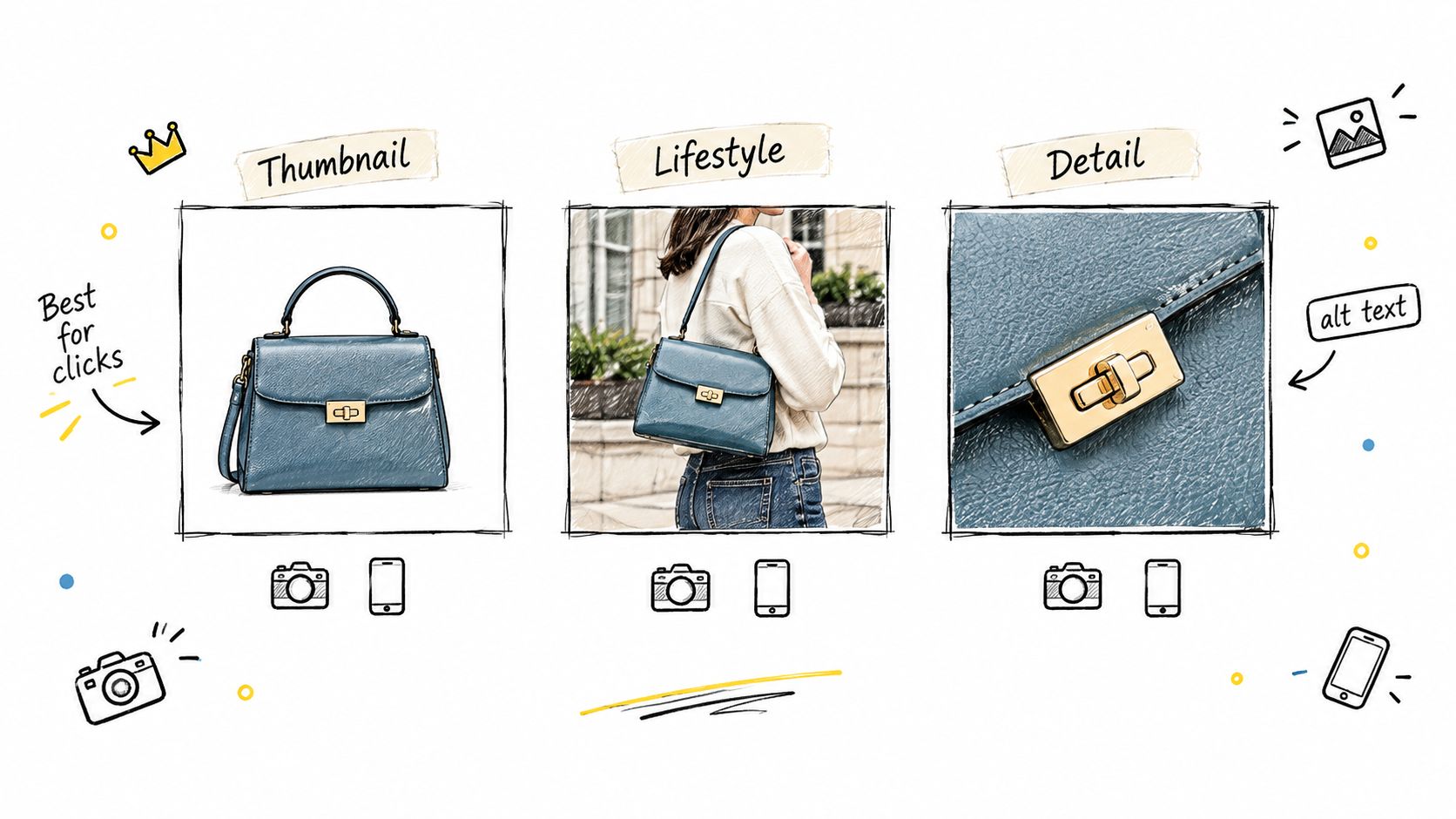
A strong search phrase can bring shoppers to a listing, but the thumbnail still has to earn the click. Make the product recognizable at a small size, show its shape clearly, and remove backgrounds or props that compete with it. Use the remaining images to answer questions about scale, texture, packaging, personalization, and use.
For a handmade mug, show a clean product view, its scale in a hand, a glaze close-up, and the mug on a real table. For jewelry, include a worn photo, a clasp or detail view, and packaging. For a printable, use a realistic mockup and state clearly that the purchase contains a digital file.
Photography supports listing quality in two stages. The first image helps shoppers judge whether the item matches their search. The full image set then helps them decide whether the product fits their needs. Etsy's ranking guidance for sellers also connects search engagement with shoppers clicking and purchasing, alongside signals such as conversion, reviews, response rate, and recent shop performance.
Make the image set answer objections
Keep lighting and framing consistent, while giving each image a different job. Accurate alt text should describe what appears in the image, not repeat hidden search phrases.
Next action: Open the primary image at thumbnail size. If you cannot identify the product and its main use quickly, reshoot it before promoting the listing.
6. Build a Cohesive Shop Aesthetic That Reflects Your Brand
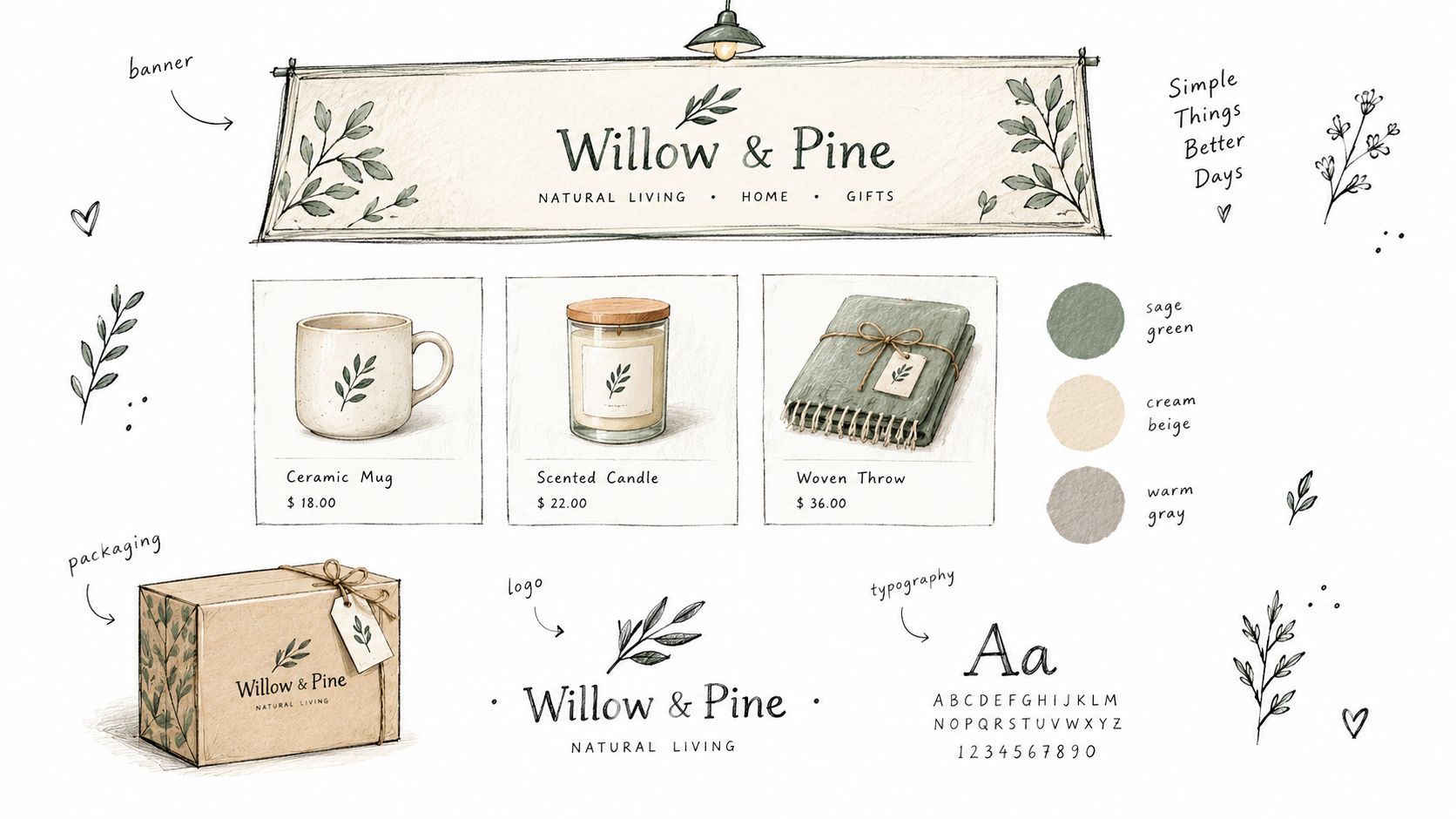
A buyer may enter through one listing and then inspect your shop before purchasing. Consistent photography, colors, typography, banner design, and writing style make that visit feel deliberate. The result doesn't need to look expensive. It needs to look controlled.
Choose a repeatable visual system. A ceramic shop might use warm natural light and pale backgrounds. A printable shop might use clean mockups with the same type treatment. A jewelry shop can keep close-ups, worn photos, and packaging images visually related without making every listing look identical.
Your shop policies and customer messages should match the tone of the storefront. A playful brand that sends abrupt, unclear service messages creates doubt. A calm, detailed shop should carry that same quality into personalization instructions and delivery updates.
For a practical expansion of shop promotion ideas, see this guide to Etsy shop marketing.
Keep variety inside a clear promise
A cohesive shop doesn't require every product to be the same. It requires the buyer to understand who the shop serves and why its products belong together. If your catalog is broad, organize it with sections and use photography to connect the ranges.
Next action: Review your banner, icon, first few listing images, and About section together. Remove visual elements that compete with the product or make the shop feel like several unrelated businesses.
7. Price for Profit Without Losing Buyer Confidence
Set a price from your costs, not from the lowest competing listing. Include materials, labor, packaging, Etsy fees, shipping obligations, and the margin required to keep producing and supporting each order. Compare similar products to understand the market, then decide what your product can support.
A higher price needs visible justification. Show material quality, craftsmanship, personalization, packaging, or service details in the photos and description. When those signals are missing, the price feels arbitrary. Clear presentation lets buyers connect the price with what they receive.
Shipping and customization change the buyer's total cost. State what the price includes, identify extra charges, and explain delivery terms before checkout. Unclear personalization limits or unexpected shipping conditions can create hesitation even when the product fits the buyer's needs.
Protect the floor before planning discounts
Etsy charges a $0.20 listing fee when you create or renew a listing. Listings expire after four months, and automatic renewal charges the same fee again at that point, according to Etsy's fee policy. Add these platform costs to your pricing calculation before planning promotions.
A discount can attract attention, but it should come from a price that already covers responsible fulfillment. Protecting that floor separates listing quality from promotion. Better photos, clearer value, and stronger trust signals improve the offer itself, while a discount only changes the buyer's short-term incentive.
Next action: Calculate the minimum price that covers making, packaging, support, platform fees, and responsible replacement. Do not discount below that floor to imitate a competitor.
8. Deliver Fast, Clear Customer Service That Earns Reviews
A buyer's experience starts before payment. Clear processing times, personalization instructions, shop policies, and shipping information reduce uncertainty and prevent avoidable messages. After purchase, confirm details that could cause an error, especially names, dates, sizes, colors, and file formats.
Fast replies help, but accuracy matters more than sending a rushed answer. If an order is delayed, contact the buyer with a specific update and a realistic next step. Don't promise a delivery date you can't control. Your service promise should reflect your actual production capacity during busy periods.
Reviews follow the experience, but sellers can't fully control what a buyer writes. The controllable inputs are the product, communication, packaging, and accuracy of the listing. Treat recurring questions as evidence that the page needs clarification.
Buyers don't need constant messages. They need the promised experience to match what they purchased.
Turn support messages into listing improvements
Keep a simple note of repeated questions. If several buyers ask whether a necklace includes a chain, add that information to the title support text, images, and description. If digital buyers misunderstand printing instructions, show the file formats and intended use before checkout.
Next action: Write three short message templates for personalization confirmation, order progress, and delay communication. Edit each one so it sounds like your shop, not an automated script.
9. Create a First-Sale Plan for One Focused Listing
A new listing can remain unseen while you optimize everything around it. Select one promising product and one specific search phrase. Align the title, tags, description, images, price, and service promise around that offer, then bring qualified visitors through one relevant external channel. This focused test shows whether the complete listing earns clicks and purchases, instead of scattering effort across every platform.
Listing quality and external ranking support are separate decisions. Upglider describes an independent service for one Etsy listing and one agreed search phrase of three or more words, with campaign options of 30, 90, or 180 days and a stated top-15 objective within 9 to 21 days from confirmed payment (Upglider's Etsy service). The service states that sellers do not provide Etsy account access or passwords. They submit a public listing URL and keywords, while dashboard updates show campaign progress.
Understand the trade-off before paying
External ranking support cannot correct weak product-market fit, unclear photography, unprofitable pricing, or fulfillment problems. Upglider is independent and is not affiliated with Etsy. Its stated money-back guarantee applies when the listing does not reach the top 15 for the agreed phrase within 21 days. Before paying, review the case assessment, measurement method, final terms, payment method, and tax treatment.
Use this practical guide to selling on Etsy to decide whether focused external support belongs in your launch plan.
Next action: Record the listing's current Etsy search position, visits, favorites, orders, and conversion rate before promotion. Change one major variable at a time, then compare results over the same review period.
10. Maintain Fresh Inventory and Renew Listings Strategically
Freshness may give a listing brief added visibility, but renewal cannot replace relevance. Etsy considers recency alongside titles, tags, listing quality, customer experience, and other ranking factors.
Use a renewal when it supports a real change, such as a launch, seasonal collection, new photography, or a meaningful product update. Renewing a weak listing without improving the offer can produce a short visibility window with few clicks or purchases. Seasonal sellers should prepare stock and production before the relevant search period instead of depending on a last-minute refresh.
Renewal also affects operating costs. Listings expire after four months, and creating or renewing a listing costs $0.20 under Etsy's fee policy. Automatic renewal can therefore create recurring charges as listings reach expiration. Record each renewal as a catalog expense, particularly when managing many listings.
Use freshness as a test
Publish or renew with a specific hypothesis. You might test a seasonal search phrase, an improved thumbnail, or a revised offer. Record the date, phrase, image, and product changes. This gives you a clearer comparison between genuine listing improvement and a temporary recency effect.
A fresh listing still needs a convincing offer, accurate information, and reliable fulfillment. Treat visibility as one measurement, not proof that the update worked.
Next action: Review your inventory calendar and select one meaningful update for the focused listing. Renew only when the product, timing, or presentation justifies the expense.
11. Understand Etsy's Search Algorithm Beyond Keywords
A listing can target the right phrase and still receive little attention. Etsy evaluates more than keyword matching, including listing quality, customer experience, recency, shop location, and shop diversity. Its ranking guidance also identifies engagement, conversion, reviews, response rate, and recent shop performance as relevant signals. Read the Etsy SEO guide alongside Etsy's ranking guidance to separate search setup from broader shop performance.
Use one listing and one target phrase as your working test. If its position is low, inspect the whole buying path. An unclear phrase can limit relevance. A weak thumbnail can reduce clicks, while an unconvincing price, incomplete personalization instructions, or slow service can reduce buyer confidence. Changing tags will not correct those problems.
Separate ranking support from sales performance
Record visibility and commercial outcomes in different fields. A listing may appear for a phrase without generating an order, while an order from social media or another source does not prove strong Etsy search visibility. Etsy Search Analytics offers query data, average position, and conversion from Etsy search, giving you a way to compare discovery with buyer action (Etsy Search Analytics).
Next action: For the focused listing, record the target phrase, position, clicks, favorites, orders, and buyer questions. Review the record after a substantial change, then improve the weakest stage before changing the keyword.
12. Focus Your Optimization Efforts on One Strategic Listing at a Time
A shop with many listings can create the illusion of progress while leaving no page fully improved. Focusing on one high-potential product gives you a cleaner test. You can align the phrase, title, tags, images, description, price, delivery promise, and promotion, then observe what buyers do.
This approach has a real cost. Other listings may remain unchanged while you work, and a diverse shop may not fit neatly into a single-product strategy. It still helps new sellers avoid changing everything at once. Once you understand which questions buyers ask and which presentation choices earn attention, you can apply those lessons to the next product.
Don't define success only as a ranking position. A higher position can create an opportunity, but sales still depend on the product, offer, buyer intent, trust, and fulfillment capacity. If the chosen phrase is too broad or the listing is poorly matched to it, concentrating effort won't solve the underlying issue.
Document the handoff to the next listing
Keep before-and-after screenshots, title versions, image changes, price decisions, service notes, and Search Analytics observations. When you move to another listing, carry forward the learning, not just the same keywords.
Next action: Choose the next listing only after you can explain what changed on the first one and what evidence supports your next test. Protect the focused process, even as your catalog grows.
12-Point Etsy Selling Tips Comparison
Item | Implementation Complexity 🔄 | Resource Requirements ⚡ | Expected Outcomes 📊 | Ideal Use Cases 💡 | Key Advantages ⭐ |
|---|---|---|---|---|---|
Optimize Your Listing Title with High-Intent Keywords | Low, straightforward edits 🔄 | Minimal, time for research ⚡ | Improved ranking and CTR 📊 | Any listing needing visibility 💡 | Direct SEO impact; immediate, free gains ⭐ |
Target Low-Competition, High-Intent Search Phrases | Medium, requires keyword research 🔄 | Low–Medium, tools/time to find phrases ⚡ | Faster top-15 ranking; higher conversion rate 📊 | Niche products; new sellers seeking traction 💡 | Easier to rank; attracts ready-to-buy traffic ⭐ |
Use Tags and Categories Strategically to Support Your Keyword Target | Low, simple to implement 🔄 | Low, use available tag slots ⚡ | Broader keyword coverage; better relevance signals 📊 | Listings that need supplemental keywords 💡 | Additional no-cost relevance; supports multiple phrases ⭐ |
Write Compelling Product Descriptions That Address Buyer Questions | Medium, structured writing 🔄 | Low–Medium, time to craft and test ⚡ | Higher conversion; fewer pre-sale questions/returns 📊 | Custom or detail-heavy products 💡 | Builds trust; supports secondary keywords ⭐ |
Invest in High-Quality, Keyword-Relevant Photography | Medium–High, staging and editing 🔄 | Medium–High, equipment or photographer fees ⚡ | Higher CTR and conversion; lower bounce 📊 | Visual/handmade products; premium positioning 💡 | Improves perceived value; alt-text SEO benefits ⭐ |
Build a Cohesive Shop Aesthetic That Reflects Your Brand | Medium–High, branding work 🔄 | Medium, design, photography, packaging ⚡ | Increased conversion and repeat customers 📊 | Brand-first shops; competitive marketplaces 💡 | Differentiation; stronger customer loyalty ⭐ |
Price for Profit Without Losing Buyer Confidence | Medium, costing and positioning 🔄 | Low–Medium, financial analysis ⚡ | Sustainable margins; clearer value perception 📊 | Sellers aiming for profitability and scale 💡 | Protects margins; supports deliberate promotions ⭐ |
Deliver Fast, Clear Customer Service That Earns Reviews | Medium, ongoing process 🔄 | Medium, time for communication ⚡ | More positive reviews; lower disputes/returns 📊 | Personalized/custom orders; high-touch shops 💡 | Builds trust and repeat business; improves shop metrics ⭐ |
Create a First-Sale Plan for One Focused Listing (e.g., Upglider) | Medium, campaign setup and prep 🔄 | Paid service or ad spend; moderate time ⚡ | Measured ranking boosts; focused traffic test 📊 | New shops needing initial traction or seasonal pushes 💡 | Concentrated, trackable campaign; provider guarantees may apply ⭐ |
Maintain Fresh Inventory and Renew Listings Strategically | Low, periodic action 🔄 | Low, time to renew and time listings ⚡ | Temporary ranking boost; timely visibility gains 📊 | Seasonal items; limited-edition or small inventories 💡 | Free way to refresh visibility; timing lever ⭐ |
Understand Etsy's Search Algorithm and Ranking Factors Beyond Keywords | High, ongoing learning and analysis 🔄 | Medium–High, analytics and operational changes ⚡ | Holistic, durable ranking and shop performance gains 📊 | Growing shops seeking sustainable results 💡 | Enables targeted improvements across listings and shop metrics ⭐ |
Focus Your Optimization Efforts on One Strategic Listing at a Time | Low–Medium, concentrated workflow 🔄 | Medium, focused edits and promotion time ⚡ | Faster measurable ranking and sales for that SKU 📊 | New sellers testing strategies; limited resources 💡 | Clear measurement, faster wins, repeatable process ⭐ |
Turn Visibility Into a Repeatable Etsy Growth System
The most useful selling on Etsy tips form a sequence, not a pile of disconnected tasks. Start by choosing one listing with a clear offer and enough fulfillment capacity. Then select one specific phrase that describes what the product is and why someone would buy it. Build the title, tags, category, attributes, and description around that phrase without forcing language that doesn't fit.
Next, make the page convincing. The first photo should identify the product quickly, while the rest should answer questions about size, scale, materials, customization, use, and packaging. Check the price against your costs and the value communicated by the page. A listing can earn visibility and still fail to convert if the buyer feels uncertain about quality, total cost, delivery, or what arrives.
Service completes the promise. Set processing expectations accurately, confirm personalization details, answer questions clearly, and communicate when circumstances change. Etsy's Account Security Checklist directs sellers to use official Etsy Support channels through the Help Center, including live chat, call, or email, if something seems wrong. Don't share credentials with an external provider. Use official support routes for account issues (Etsy's account security checklist).
Promotion should come after the listing can handle attention. You can use a relevant social channel, an existing audience, or an independent focused ranking service such as Upglider, but keep the distinction clear. External promotion may support visibility for a chosen listing and phrase, while photos, pricing, product fit, reviews, and fulfillment determine whether visitors become customers. Review the provider's terms and measurement method before paying, and remember that Upglider isn't affiliated with Etsy.
Measure the right things separately. Record the target query, search position, visits, favorites, orders, Etsy search conversion, buyer questions, and fulfillment issues. Don't treat a ranking change as proof of business growth, and don't treat a quiet sales period as proof that every part of the listing failed. Look for the specific point where the buyer journey weakens.
Finally, document what you learned and apply it to one next listing. Keep the useful title structure, the strongest image approach, the clearest personalization language, and the pricing logic. Change only what needs changing. That's how one optimized listing becomes a repeatable shop system instead of another unfinished batch of Etsy experiments.
Choose your strongest Etsy listing today, write down its current search phrase and performance, and make one evidence-based improvement before promoting it. If you're considering external ranking support, review Upglider's focused Etsy campaigns, confirm the phrase, measurement method, scope, and terms, then decide whether the service fits your listing and launch window.