You've paid for a 90-day Etsy campaign, your listing has been quiet for a week, and nobody has said a word. You check your shop, look for a message, and wonder whether the work has started. The silence leaves you with questions that a short update could have answered.
A seller shouldn't have to ask whether a paid campaign is active. A useful message names the listing, confirms the agreed search phrase, describes the latest verified status, and explains what happens next. It doesn't need to sound impressive. It needs to give the seller something clear enough to understand without another email.
Good progress report comments separate activity from results. Starting work isn't the same as reaching a ranking target, and reaching that target isn't a promise of sales. A calm update can acknowledge progress without making either claim.
The eight comments below cover the campaign from kickoff to wrap-up, including early movement, maintenance, a deadline check, and a refund outcome. They use Upglider's focused Etsy campaign structure, rather than a full-shop marketing service. Each template needs the actual listing name, exact phrase, confirmed dates, and recorded result before sending. Keep the message short, leave detailed notes on the dashboard, and tell the seller when they'll hear from you again.
1. Campaign Kickoff Update
A seller pays for a campaign and waits to see whether work has begun. Send the kickoff message as soon as payment is confirmed. For a handmade ceramic mug, name the listing and agreed search phrase, then state the campaign period and where the seller can follow updates.
Ready-to-send comment
Your campaign for “[listing name]” is active, targeting “[agreed phrase].” The goal is a top-15 placement within 9 to 21 days of confirmed payment. Your 90-day campaign runs until [date]. You can follow progress through the dashboard. The campaign objectives and reporting arrangements describe what to expect.
Use the duration the seller purchased, not the example duration. Check the campaign record before adding the end date. If the paid period differs, adjust the message rather than sending an inaccurate timeline.
At kickoff, the target is a goal, not a confirmed result. “We're aiming for” describes the work underway. Say a placement has been secured only after checking the result. A clear update sets expectations without suggesting that visibility has already improved.

Tell the seller where the actual campaign notes will appear. The guide to what a progress report contains explains the purpose of a progress report; use the dashboard for campaign-specific updates.
Keep payment methods, optional services, and a full explanation of external promotion in the agreement. The kickoff note has a narrower job: confirm what is active, the target, and when the paid period ends.
2. Keyword and Listing Confirmed
“Printable floral wedding invitation” and “floral wedding invitation printable” are different phrases. A seller with several similar listings may also assume a campaign covers an entire collection. Confirm the exact listing and agreed phrases before sending progress reports, so both sides share the same scope.
Ready-to-send comment
We've confirmed your campaign scope. Listing: [listing URL]. Target phrase: “[agreed phrase].” Additional agreed keywords: [phrases or “none”]. You don't need to share your Etsy password or make account changes. Please tell us if this summary doesn't match your agreement.
Copy the target phrase exactly as written in the agreement, including its spelling and word order. Include only additional phrases the seller approved, and use the public Etsy listing address rather than the shop homepage. The seller can then flag any mismatch before reporting begins.
Send this note with the kickoff confirmation when the scope is already settled. If the seller needs to check which listing or phrases are included, send it separately and wait for confirmation. Either way, avoid repeating the campaign timeline here.
Keep the message compact, ideally under five lines. Precise wording may feel less conversational than a welcome email, but it gives both parties a clear reference. If the agreed target changes, update the scope and make that change clear in later reports.
3. Early Movement Check-In
A seller has checked an art-print listing several times and sees no clear improvement. Your campaign record may show early movement, though the target remains out of reach. Report what the checks show and keep the update grounded in the evidence.
Ready-to-send comment
Day 5 update: “[listing name]” has moved upward for “[agreed phrase]” in our recorded checks. It hasn't reached the top 15, and results can vary between checks. The latest notes are on your dashboard. The target window is still open.
Use “moving upward” only when the records support it. If the position is unchanged, state that. If results are mixed, describe the movement as mixed instead of highlighting the strongest check.

When checks show inconsistent results, use a more cautious update: “We've recorded some movement, but the latest checks don't yet show a consistent direction.” It may sound less encouraging, but it gives the seller a fair account of what the record supports.
Practical rule: Tie every movement claim to a dated check in the campaign record.
Include the day count so the seller can place the update on the campaign calendar. Treat it as context, not a countdown to an outcome you cannot confirm.
Avoid phrases such as “guaranteed progress,” “about to break through,” or “sales should follow soon.” They promise more than the checks can establish. Close by naming the next scheduled check, so the seller knows when to expect another update, even if the position stays the same.
4. Top 15 Reached Milestone
When a jewellery seller's necklace reaches the agreed top-15 target, send an update tied to the recorded result. State the position for the contracted phrase and the date, using the measurement method disclosed before payment. General praise about the shop does not tell the seller whether this campaign milestone was met.
Ready-to-send comment
Good news: “[listing name]” reached position [verified position] for “[agreed phrase]” on [date], placing it within the top 15. This result uses the measurement method disclosed before payment. For the remaining campaign period, we'll continue monitoring the placement and report any changes.
Include the exact position when it is available. “First-page success” can blur how the target was assessed, so use the recorded position instead.

Celebrate the result without enlarging the promise
The comment reports the ranking result. Statements about orders, category dominance, or permanence go beyond what the campaign measured. A brief congratulatory opening is enough, followed by the date, verified position, and plan for continued monitoring.
Keep the supporting observation in the dashboard so the seller can review the basis for the update. If a later check shows a different position, report that change plainly. The milestone remains a dated result; it does not establish that the position stayed the same afterward.
This wording recognizes a meaningful campaign achievement while keeping its limits clear: the target was reached, and monitoring continues during the paid period.
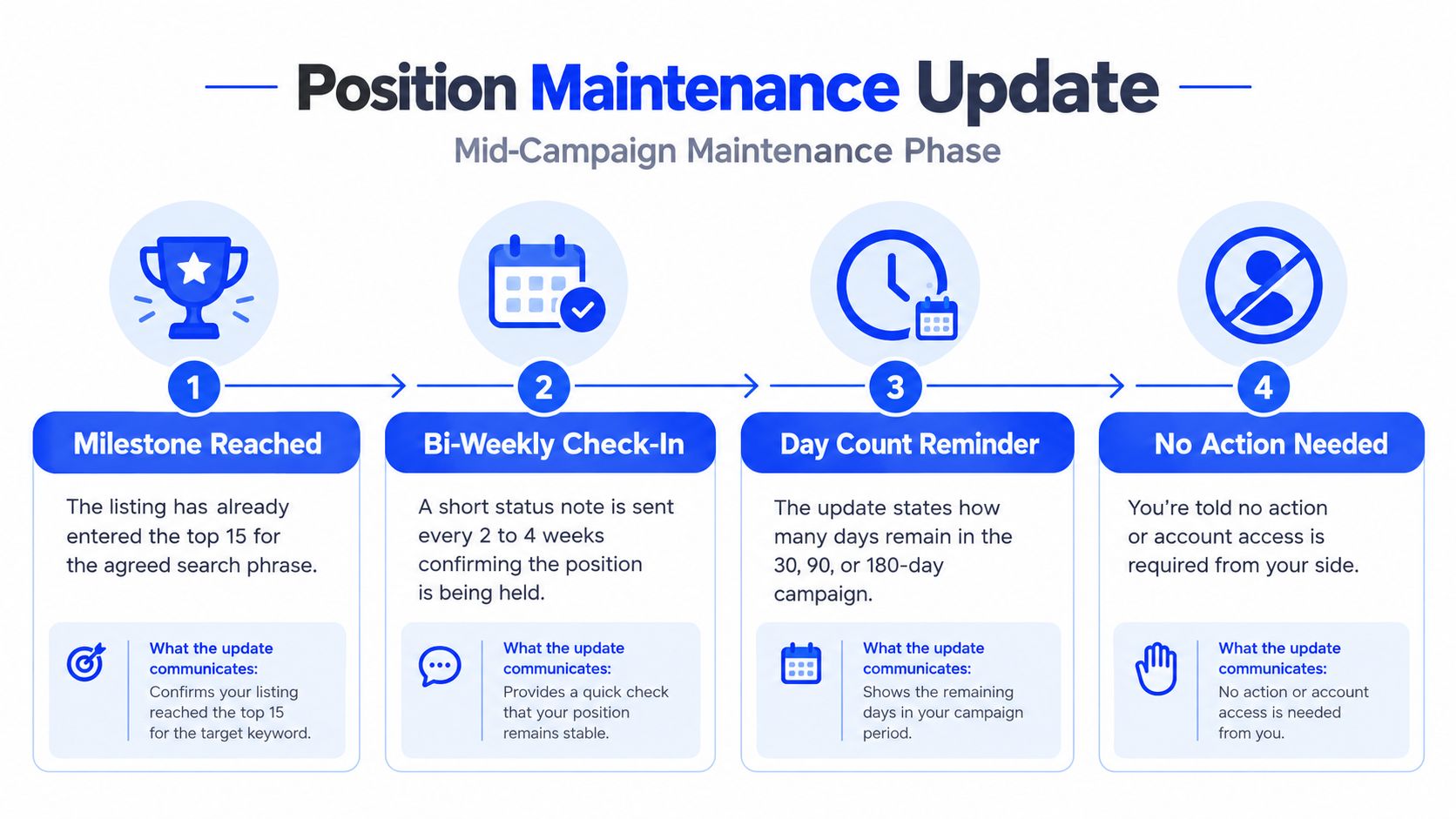
5. Position Maintenance Update
A seasonal home-decoration seller may be focused on stock and order fulfilment rather than checking the dashboard. A maintenance update keeps them informed between milestones, especially when the campaign is still active and the latest position needs context.
Monthly check: “[listing name]” is within the top 15 for “[agreed phrase]” in our latest recorded check. Your campaign ends on [date], with [remaining days] days left. No action is needed from you. The current position and supporting notes are available on your dashboard.
Match the wording to the evidence
Use “remains within” only when the reporting record supports that claim. If the listing dipped between updates, state that it is currently back within the target range and leave the intervening checks accessible. Only say the listing held its position throughout the period when checks cover the full period. Otherwise, report the latest check and note the dip.
Choose an update interval that suits the booked campaign period and the seller's reporting expectations. For Upglider's 30, 90, or 180-day campaigns, that interval is a communication choice, not a promise that the position will stay fixed between messages.
A simple routine helps sellers understand both the current status and when they can expect the next update:
Set a schedule: Agree on a recurring interval, such as every two to four weeks.
Show the end date: Connect the maintenance period to the seller's selling window.
Keep details accessible: Put individual checks in the dashboard rather than crowding the message.
Request action when needed: Give the seller a clear task only when the campaign requires one.
If nothing material has changed, say so briefly. A maintenance note can be useful without presenting every check as a new success. The seller gets a clear status, while the record preserves the detail behind it.
6. Campaign Still in Progress (Day 15 to 21 Update)
A deadline check needs more direct wording than an early update. If the seller's candle listing hasn't reached the target, acknowledge that fact before describing ongoing work. Don't make them read a reassuring paragraph to discover the actual position.
Ready-to-send comment
Day 16 update: “[listing name]” is currently at position [verified position] for “[agreed phrase].” It hasn't reached the top 15 yet. The deadline is [date], 21 days after confirmed payment; if the target isn't met by then, the money-back guarantee applies under Upglider's campaign schedule. We'll send the outcome notice after the deadline check.
Attach the refund terms the seller received before payment using the actual agreed document or address. Don't substitute a newly written summary for those terms, and don't invent a refund timetable to make the message feel complete.
The next-step sentence should describe a real action: another scheduled measurement, continued campaign work, or the final outcome review. “We're doing everything possible” tells the seller little and can sound defensive.
A missed target so far isn't a completed outcome. State the current result, the remaining deadline, and the agreed consequence separately.
Don't ask the seller to accept an extension in place of the guarantee unless they've explicitly agreed to a separate arrangement. Keep the original deadline visible.
This note may prompt questions, and that's preferable to leaving the seller uncertain. A direct answer preserves the distinction between work still underway and a target already achieved, without treating normal fluctuation as an excuse.
7. Money-Back Guarantee Outcome Notice
When the deadline passes without the agreed result, the seller needs a resolution. They don't need a long explanation of why the campaign was difficult or a pitch for another attempt. For a maker promoting a new knitted accessory, the immediate concern is what happens to the payment.
Ready-to-send comment
Your campaign for “[listing name]” didn't reach the top 15 for “[agreed phrase]” within 21 days. Under Upglider's money-back guarantee, you're eligible for a refund. Next steps: [confirmed refund process and timing from your agreed terms]. Thank you for trusting us with your listing.
Replace the refund placeholder before sending. State who takes the next action, whether the seller needs to provide anything, and the timing exactly as written in the agreement.
Eligibility, initiation, and receipt aren't the same status. If the refund has only been approved, don't say it has been sent. If it has been initiated, describe that action without claiming the seller has already received the funds.
Outcome: Confirm that the agreed ranking target wasn't met by the deadline.
Process: Explain the actual refund steps in plain language.
Timing: Use the agreed terms, not an informal estimate.
Contact: Give the seller a clear way to ask about the refund.
Avoid blaming Etsy, the seller's product, or the keyword assessment. If there's a useful explanation, provide it separately and only when supported by the campaign record.
A courteous closing is appropriate, but it shouldn't bury the refund information. Don't make another purchase sound necessary to obtain the agreed resolution. The notice should leave the seller knowing what happens next, who is responsible, and how they can follow up.
8. Campaign Completion and Season Wrap-Up
A seller who scheduled promotion for a holiday launch needs a clear end date and a final record. State when paid maintenance stopped, then report the last position recorded. This helps prevent confusion about whether the service is still active.
Ready-to-send comment
Your campaign for “[listing name]” ended on [end date], after running from [start date] to [end date]. The final recorded position for “[agreed phrase]” was [verified position], checked on [check date]. There's no automatic renewal, and your final report is on the dashboard. You can decide whether another campaign fits a future launch.
Use a period summary only when the campaign record supports it. If the listing reached the target and later moved outside it, report the final position and point to the dated campaign history. Avoid saying it “held the target throughout” unless the record shows that.
Closing principle: State the end date of paid work and the date of the final recorded check as two separate facts.
For a seasonal printable, a useful next step may be reviewing the target phrase before a future launch. For an established homeware listing, the seller may decide whether another campaign fits their plans. Offer these as options, without implying that rebooking is required.
Leave a usable record
Keep the agreed listing, target phrase, campaign dates, milestone history, and final observation together on the dashboard. This gives the seller a clear record of what was measured before completion and helps distinguish it from any check made afterward.
Avoid predicting how long the final position will last once paid maintenance has ended. State when maintenance stopped and report the result as recorded. A clear wrap-up gives the seller the facts needed to make their next decision.
8 Good Progress Report Comment Examples Compared
Campaign Update | Timing / Ideal Use | Main Content / Expected Outcome | 🔄 Complexity / Resources | ⭐ Key Advantage |
|---|---|---|---|---|
Campaign Kickoff Update | Same day payment is confirmed; new campaigns | Confirms listing, target phrase, top-15 goal, campaign length, and expected 9–21-day window | ⚡ Low; send a brief note with campaign details | Sets expectations and gives the campaign a clear goal |
Keyword and Listing Confirmed | Before or just after campaign start; scope confirmation | Records the agreed phrase, listing URL, and any add-on keywords | ⚡ Low; verify scope and send a short note | Prevents confusion about what is being targeted |
Early Movement Check-In | Days 3–10, before reaching the top 15 | Describes whether progress is rising, steady, or settling; notes ranking fluctuations | 🔄 Low; check trend and share a brief update | Builds trust and helps sellers understand early movement |
Top 15 Reached Milestone | When the listing enters the top 15 | Reports position and date; explains the shift to position maintenance | 🔄 Moderate; confirm the measured position | 📊 Provides a clear, measurable campaign milestone |
Position Maintenance Update | Every 2–4 weeks during the maintenance phase, especially for 90- or 180-day campaigns | Reports current position, days remaining, and whether seller action is needed | 🔄 Low; check status on a regular schedule | ⚡ Reassures sellers with concise, ongoing status updates |
Campaign Still in Progress (Day 15 to 21 Update) | Days 14–21 if the target has not yet been reached | States current position, deadline, next steps, and guarantee terms | 🔄 Moderate; verify status, deadline, and refund terms | 💡 Reduces surprises by making expectations clear |
Money-Back Guarantee Outcome Notice | After day 21 if the top-15 target was not met | Confirms the outcome, refund eligibility, process, and timing | 🔄 Moderate; confirm agreed terms and refund details | ⭐ Demonstrates accountability and clarifies the resolution |
Campaign Completion and Season Wrap-Up | At the end of any 30-, 90-, or 180-day campaign | Summarizes dates and final position; confirms no automatic renewal | 🔄 Moderate; prepare a final results summary | 📊 Provides a results record and supports future planning |
Turn Each Update Into a Routine You Can Repeat
Schedule the messages against the campaign record rather than waiting for the seller to ask. On day one, send the kickoff once payment is confirmed and make sure the listing-and-keyword confirmation matches the agreement. Keep the campaign start, target deadline, and end date in the same record so every later message uses consistent dates.
During the opening period, send an early check-in at the promised time, even if there's no clear movement. If the target is reached, send the milestone notice and move to the agreed maintenance schedule. If it hasn't been reached as the deadline approaches, send the direct status update rather than repeating the optimistic kickoff wording.
Use dates for reminders and results for decisions
Calendar-driven messages: Schedule kickoff, routine maintenance, the deadline check, and completion around the confirmed dates.
Result-driven messages: Send the milestone notice only after verification, and the guarantee outcome only after reviewing the deadline result.
Seller follow-up: Give questions about scope, measurement, or refunds a clear response instead of leaving them for the next scheduled report.
Dashboard record: Save the evidence and detailed notes behind each short message.
Don't schedule all eight templates as automatic sends. A campaign that reaches its target doesn't need the unsuccessful-outcome notice, and a refunded campaign shouldn't receive a routine success wrap-up. Reminders can be automatic; the wording still needs a human check against the actual record.
Research-based effective-feedback guidance from the NSW Department of Education describes a useful structure: identify what went well, explain the issue, and show what to do next. That research concerns learning, not Etsy campaign performance, but the communication structure is useful here. Name the observed status, explain the relevant gap, and state the next action.
Keep the update smaller than the report
The message should help the seller understand the dashboard, not reproduce it. Remove background details that don't change the status or the seller's next step. Keep necessary qualifications, especially when a result is mixed, a deadline remains open, or a refund hasn't yet been completed.
Short and factual doesn't mean cold. A greeting and a courteous close are enough when the middle of the message answers the seller's real questions. Good progress report comments make it easy to see what happened and what happens next.
Save these templates in your campaign workflow now. Before each send, fill in the listing name, exact agreed phrase, confirmed dates, and verified status, then remove anything you can't support. Keep every update short and factual, and set the next reporting reminder before closing the record.